

Best starting point: Carrier. Best for a Ruud-supported installation: Ruud. Best for a Daikin-supported central ducted system: Daikin. This 2026 guide compares the best AC brands for new construction homes in Florida, with the design checks that matter more than the name on the outdoor unit.
- Carrier leads this shortlist of best AC brands for new construction homes, provided the proposed system fits your home’s design.
- Ruud and Daikin deserve consideration when their complete central ducted system proposals meet your comfort needs.
- A.R. Williams Air Conditioning helps homeowners compare central AC options without choosing by brand name alone.
- Require room-by-room sizing, a humidity-control plan, and documented startup checks before accepting an installation.
A new house gives you an opportunity to get the cooling system right before walls close and landscaping limits equipment placement. A.R. Williams Air Conditioning provides AC installation for new construction homes and holds dealer relationships with all three brands on this shortlist.
Why this matters
A new AC system can cool the thermostat's hallway while leaving a sunny bedroom uncomfortable. The cause can be the duct layout, equipment sizing, or missing return-air paths rather than the equipment brand.
For a Florida home completed in 2026, choose the system and the installation plan together. You should know how the design handles afternoon sun, closed bedroom doors, and moisture during mild but humid weather.
A.R. Williams Air Conditioning is best for homeowners who want a new-construction AC proposal explained before choosing equipment. The company is a Carrier Authorized Dealer, certified Ruud Pro Partner, and Daikin Comfort Pro. Those relationships support a useful shortlist, but they do not establish that one brand lasts longer or removes more moisture than another.
What makes the best AC brand for a new home?
Use these criteria before comparing logos or accepting a builder's equipment allowance:
- Correct capacity: A room-by-room cooling calculation should account for windows, insulation, orientation, and the home's construction.
- Humidity control: Ask how the exact equipment and controls remove moisture when the cooling demand is low.
- Duct design: Supply ducts and return paths must move the airflow the selected equipment needs.
- Complete equipment match: Compare the outdoor unit, indoor equipment, and thermostat as a system.
- Service access: Filters, drains, coils, and electrical components need accessible maintenance space.
- Documented handoff: Require startup results, operating instructions, and the applicable warranty paperwork.
A strong proposal explains each item in plain language. If a contractor answers a sizing question with only square footage or a brand reputation claim, ask for the design behind the recommendation.
AC brands at a glance
These are proposal-based recommendations, not laboratory performance rankings. The best choice changes when the exact equipment, controls, or installation scope changes.
| Brand | Best for | Standout reason to consider it | Key limitation |
|---|---|---|---|
| Carrier | Your first complete-system proposal | An authorized dealer relationship through the installing contractor | The brand name alone does not establish humidity performance |
| Ruud | A Ruud-supported installation with clear maintenance planning | A certified Pro Partner relationship through the installing contractor | Coastal exposure still requires equipment-specific review |
| Daikin | A central ducted proposal with clearly explained controls | A Comfort Pro relationship through the installing contractor | Control compatibility and operation need confirmation for the exact system |
The use cases identify where to start your conversation. They are not claims that Carrier cannot serve a coastal home or that only Daikin offers suitable controls.
1. Carrier: best starting point for a complete-system proposal
Carrier is the first brand to request when you want a concrete baseline for comparing new-construction proposals. That recommendation rests on the available authorized dealer relationship, not an unsupported claim that every Carrier system outperforms competing equipment.
Ask for the complete equipment combination and the reason it fits your floor plan. A useful Carrier proposal should also explain how the system handles a smaller nighttime cooling demand without leaving bedrooms feeling damp.
Carrier pros:
- A.R. Williams Air Conditioning is a Carrier Authorized Dealer.
- A complete proposal gives you a specific equipment combination to compare against alternatives.
- New construction lets you coordinate the proposed equipment with ductwork before installation constraints become fixed.
Carrier cons:
- Choosing Carrier by name does not confirm the proposed compressor operation or humidity controls.
- An authorized dealer relationship does not replace load calculations or measured startup checks.
Best for: Homeowners who want a clear first proposal, then an explanation of whether another equipment combination fits better.
Verdict: Buy when the Carrier proposal documents sizing, airflow, humidity control, and installation scope. Hold the decision if the proposal gives you only a brand and equipment capacity.
2. Ruud: best for a supported installation and maintenance plan
Ruud belongs on this shortlist because the installing company has a certified Ruud Pro Partner relationship. For a homeowner, that creates a direct question: how will the proposed Ruud system be installed, checked, and maintained at this particular house?
Near the coast, discuss salt exposure before deciding where the outdoor unit belongs. Salt air can corrode outdoor coils, and a new installation still needs an equipment-specific maintenance plan. Do not assume the badge on the cabinet makes the system immune.
Ruud pros:
- A certified Ruud Pro Partner relationship is established for the installing company.
- New construction allows maintenance access and outdoor placement to be planned together.
- A written Ruud proposal gives you an alternative to compare against the same home design requirements.
Ruud cons:
- Coastal suitability cannot be established from the brand name alone.
- Protection claims, maintenance requirements, and warranty exclusions need confirmation in the exact equipment documents.
Best for: Homeowners who want a Ruud-supported installation with outdoor placement and ongoing maintenance explained before construction finishes.
Verdict: Buy when the Ruud proposal addresses your site's exposure and includes a workable service-access plan. Skip any recommendation that treats coastal maintenance as unnecessary.
3. Daikin: best for a central ducted proposal with clear controls
Daikin is another central ducted option to discuss through the company's Daikin Comfort Pro relationship. Keep the comparison focused on the complete system rather than an individual outdoor unit.
Ask the contractor to demonstrate how you will change temperature settings, select fan operation, and use any humidity functions included in the proposed equipment. Confirm thermostat compatibility before your builder or home-automation installer purchases a separate control.
Daikin pros:
- A Daikin Comfort Pro relationship is established for the installing company.
- A complete central ducted proposal provides another equipment match to evaluate.
- Planning controls before installation helps avoid conflicting thermostat and equipment selections.
Daikin cons:
- Features cannot be assumed across every Daikin equipment combination.
- Adding a preferred thermostat without checking compatibility can leave intended functions unavailable.
Best for: Homeowners who want the operation of a proposed central ducted system explained before committing to its equipment and thermostat.
Verdict: Buy when the Daikin proposal identifies the complete equipment match and explains the controls. Hold if the thermostat choice or humidity-control method remains unresolved.
How the shortlist is ranked
This 2026 shortlist starts with three brands supported by explicitly established dealer relationships. Carrier is the default conversation starter; Ruud and Daikin provide alternative proposal paths.
The ranking does not claim measured differences in failure rates, service life, noise, or efficiency. Compare those characteristics only when you have documentation for the exact equipment under consideration. A complete, well-supported proposal should beat an incomplete proposal carrying your favorite logo.
What your builder should settle before equipment is ordered
The best time to resolve airflow and access problems is while the house is still being designed. Put these subjects on the construction meeting agenda rather than leaving them for the final walkthrough.
Load calculation
Ask for a room-by-room calculation, commonly called Manual J. It estimates how much heat and moisture the home must remove under design conditions.
Capacity is not a quality score. One ton of cooling equals 12,000 BTU per hour, so a 3-ton system represents 36,000 BTU per hour of nominal cooling capacity. That conversion does not tell you what size your house needs.
Large west-facing windows, ceiling height, shading, and insulation affect the calculation. A neighboring house with similar square footage is not a substitute for your plans.
Duct design
Ask how air reaches each room and returns to the equipment when bedroom doors are closed. An open-plan living area and a closed upstairs bedroom do not have the same airflow conditions.
Return-air restrictions can limit the performance of otherwise suitable equipment. Review duct routes and return locations before framing or ceiling details make changes difficult.
Humidity plan
Ask what happens during humid weather when the house needs little temperature reduction. Equipment capacity, operating controls, ventilation, and air leakage all affect indoor moisture.
Variable-speed operation means equipment can adjust its output rather than operate at one fixed level. It is a capability to evaluate, not a guarantee of good humidity control. The complete design still matters.
Startup records
Ask what the contractor will measure and document before handing over the system. The checks should follow the equipment manufacturer's installation instructions and address airflow, refrigerant setup, drainage, and control operation.
Inspection approval and operating verification answer different questions. Keep both records with your home documents.
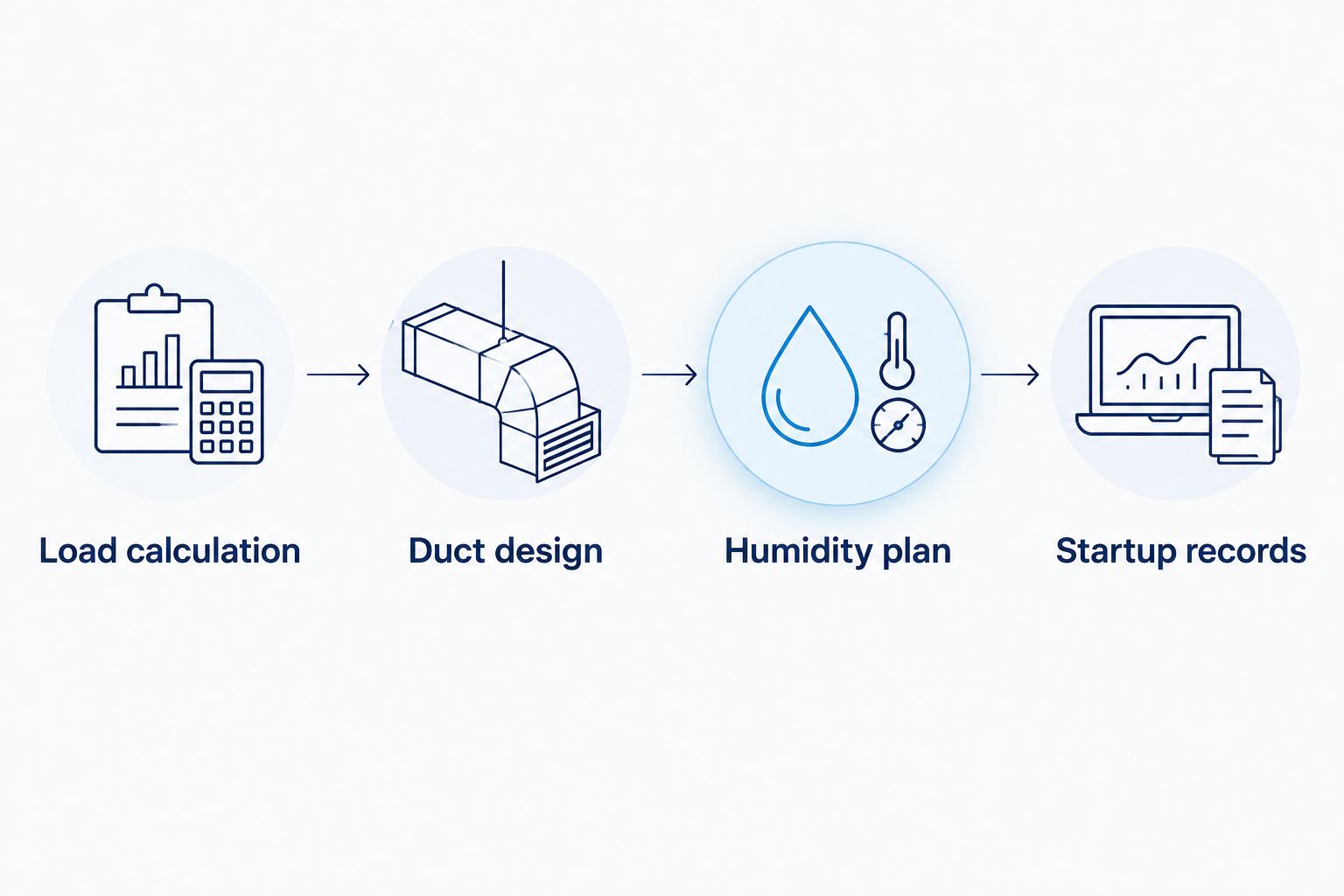
For a 2026 build, request this documentation as part of the agreed installation scope. That makes expectations clear before equipment arrives, rather than turning the final walkthrough into a discussion about missing information.
Florida details that belong in the proposal
Outdoor placement: A narrow side yard needs enough clearance for airflow and future service. Landscaping, fences, and screening must respect the manufacturer's clearance requirements.
Coastal exposure: A waterfront location deserves a specific discussion about salt exposure and maintenance. Ask what the proposed equipment documentation actually says, rather than accepting a general corrosion-resistance promise.
Seasonal occupancy: If your house will sit empty for part of the year, discuss humidity settings and drain maintenance before leaving. A temperature setting alone does not tell you whether indoor moisture stays controlled.
Construction dust: Ask how the HVAC equipment and duct openings will be protected during dusty work. The final handoff should include checking the filter and inspecting accessible components for construction debris.
Permits and inspections: Confirm the responsible permitting authority and who schedules inspections. Do not assume a process used on another project in Palm Beach, Martin, or St. Lucie County applies unchanged to your property.
Which AC brand should you choose?
Start with a complete Carrier proposal in 2026, then compare Ruud or Daikin when the alternative addresses a specific design need. Do not change brands merely because a second proposal uses more impressive language.
Choose the proposal that explains the equipment selection, accounts for your floor plan, and includes verification at startup. If none does, ask for a revised scope before deciding.
A.R. Williams Air Conditioning explains findings and options, quotes transparent flat-rate pricing before work starts, and focuses on long-term fixes. For new-construction AC, the useful next step is a conversation about your plans and the proposed installation scope.
Talk through your new home’s AC
Discuss your floor plan, comfort priorities, and proposed installation scope.
FAQ
What’s the best AC brand for a new construction home in Florida?
Carrier is the starting recommendation in this shortlist, with Ruud and Daikin as alternatives. Choose the exact equipment combination only after reviewing sizing, duct design, humidity control, and installation scope.
Is a bigger AC better for a new house?
No. An oversized AC can cool the house quickly without providing enough moisture removal. Require a room-by-room load calculation instead of selecting extra capacity as insurance.
Is Carrier better than Ruud or Daikin for humidity?
A brand name alone does not establish better humidity control. Compare the exact equipment combination, operating controls, airflow design, and moisture-removal plan.
Should I choose variable-speed AC for a new Florida home?
Evaluate variable-speed AC when adjustable output supports your home’s comfort and humidity needs. Ask how the proposed equipment and thermostat work together, rather than assuming the feature solves every moisture problem.
Can I use any smart thermostat with my new AC?
No. Thermostat compatibility depends on the equipment and the functions you want to use. Have the HVAC contractor confirm the control selection before purchasing a separate thermostat.
Does a new AC need special consideration near salt water?
Yes. Salt exposure can corrode outdoor coils, so placement and maintenance deserve attention. Review the exact equipment’s care instructions and applicable warranty terms before choosing.
What documents should I get before accepting a new AC installation?
Request the equipment identification, startup records, operating instructions, warranty paperwork, and applicable inspection records. Keep the load calculation and duct design information with those documents.
One last thing
Before the final walkthrough, ask for the AC to operate with bedroom doors closed. Then have the contractor explain the return-air path from each room.
An open-door demonstration can hide a problem you will notice every night. Checking the actual way you live is more useful than admiring a newly installed outdoor unit.
Related guides
