

Best overall: a dedicated variable-speed central ducted system. Best for a predictable daily routine: two-stage central AC. Best when indoor equipment space is limited: a packaged central system, if the site supports it. For a Florida guest house or detached casita, start with the building's cooling needs and humidity control, not a brand name or the size of the main home's AC.
- The best AC for a guest house in Florida starts with a separate cooling-load calculation, not square footage alone.
- Variable-speed central ducted AC is the default recommendation when suitable capacity and duct space are available.
- Two-stage central AC suits regularly occupied guest houses; packaged central AC addresses limited indoor equipment space.
- A.R. Williams Air Conditioning helps homeowners compare central AC options with clear explanations before installation.
Why this matters
A detached guest house has its own roof exposure, windows, insulation, and occupancy pattern. Treating it as an extra bedroom on the main home's system skips those differences. A small building with afternoon sun and a shower can have very different cooling and moisture needs from a shaded sleeping suite.
For a 2026 installation, the first useful document is a cooling-load calculation. This estimates how much heat the building gains and how much moisture the equipment must remove. The guide to choosing the right AC size for your home explains why floor area alone does not settle the question.
Choose the design before the equipment. You can ask for the reasoning in writing without committing to an installation.
What makes the best AC for a Florida guest house?
Judge each proposal against these criteria before comparing equipment names:
- Correct capacity: The calculation should reflect the casita itself, including glass, insulation, roof exposure, and occupants. Extra capacity is not a substitute for design.
- Moisture control: Ask how the system handles humid weather when the building needs relatively little cooling.
- Duct fit: Supply ducts deliver cooled air. Return ducts bring air back to the equipment. Both need space and a workable route.
- Independent control: Guests should have a thermostat that controls their building, rather than relying on the main home's temperature.
- Service access: Filters, drains, coils, and electrical components need access after the installation is finished.
- Site suitability: Outdoor clearance, coastal exposure, drainage, electrical supply, and local permitting requirements belong in the proposal.
These criteria matter more than choosing the highest efficiency rating in isolation. An efficient system still needs suitable airflow and controls to perform properly.
Central AC options at a glance
The first two options describe how cooling output changes. The third describes where the equipment sits. A packaged system can also have staged or variable output, so these categories can overlap.
| Option | Best for | Standout feature | Key limitation |
|---|---|---|---|
| Dedicated variable-speed central ducted AC | Changing occupancy and cooling demand | Adjusts cooling output across a range | Requires compatible controls and suitable minimum output |
| Dedicated two-stage central AC | Regular occupancy and a predictable routine | Uses lower and higher cooling stages | Less output flexibility than variable-speed equipment |
| Packaged central AC | Limited indoor equipment space | Houses major cooling components outdoors | Requires suitable outdoor space and duct connections |
This is a design guide for 2026, not a ranking of individual models. The right equipment depends on the capacity range that fits the building and the installation conditions.
1. Variable-speed central AC: best for changing occupancy
A dedicated variable-speed central ducted system adjusts cooling output instead of operating only at full output. It uses an indoor air handler connected to ducts and an outdoor unit. The guest house has its own thermostat and does not depend on the main home's cooling schedule.
That flexibility is useful when a casita alternates between quiet weekdays and occupied weekends. When properly sized and configured, the equipment can run at reduced output during lighter cooling demand. Longer operation can support moisture removal, but the controls and indoor airflow still matter.
Variable-speed central AC pros:
- Adjusts output as the guest house's cooling demand changes.
- Provides independent temperature control for the detached building.
- Can support longer cooling cycles at reduced output when conditions allow.
- Distributes air to separate rooms through a designed duct system.
Variable-speed central AC cons:
- The smallest available output still needs to suit the building's load.
- Requires compatible equipment, controls, and careful setup.
- Needs room for the air handler, ducts, and maintenance access.
Best for: Guest houses with changing occupancy, separate sleeping rooms, and enough space for a proper duct layout.
Ask the contractor to explain the system's minimum cooling output, not just its maximum capacity. A unit that can turn down substantially still has a lower operating limit. If that limit is too high for a very small, well-insulated casita, the variable-speed label does not solve the sizing problem.
Verdict: Buy when the load calculation, minimum output, and duct design fit.
2. Two-stage central AC: best for a regular guest-house routine
Two-stage central AC operates at a lower cooling stage or a higher cooling stage. It offers more output flexibility than a single-stage system, which runs at one cooling output when operating. It does not offer the same range of adjustment as variable-speed equipment.
This is a sensible comparison for a guest house used consistently by family or long-stay visitors. The lower stage handles lighter demand, while the higher stage handles greater demand. Humidity performance depends on equipment selection, run time, and airflow settings rather than the stage count alone.
Two-stage central AC pros:
- Offers reduced-output operation during lighter cooling demand.
- Gives the guest house independent temperature control.
- Supports ducted distribution to bedrooms and living areas.
Two-stage central AC cons:
- Has less flexibility during very light loads than a suitable variable-speed system.
- Still needs an indoor equipment location and complete duct design.
- Does not guarantee humidity control simply because it has two stages.
Best for: Regularly occupied guest houses where the calculated load matches the equipment's operating stages.
For your 2026 comparison, ask the contractor what happens during mild, humid weather. The answer should address the selected equipment and control settings, not simply promise that a larger system will cool faster. Fast temperature reduction and adequate moisture removal are different goals.
Verdict: Buy when both cooling stages suit the building's needs.
3. Packaged central AC: best for limited indoor equipment space
A packaged central system places major cooling components together outdoors and connects to the building through ducts. It avoids the separate indoor air-handler arrangement used by conventional split central systems. You still need space for supply and return duct connections.
This layout deserves consideration when an indoor mechanical closet would be difficult to accommodate. The outdoor location must support required equipment clearances, service access, and proper installation. Moving equipment outside changes the space problem; it does not remove it.
Packaged central AC pros:
- Keeps major cooling components outside the guest house.
- Provides central ducted cooling to multiple rooms.
- Offers an alternative equipment layout when indoor space is constrained.
Packaged central AC cons:
- Needs suitable outdoor space and weather-tight duct connections.
- Places equipment outdoors where coastal exposure deserves attention.
- Requires careful placement near sleeping areas and outdoor seating.
Best for: Guest houses with limited indoor equipment space and a suitable outdoor installation location.
Ask to see the proposed footprint and duct route before approving the layout. Near the coast, salt air can accelerate corrosion of exposed metal components. The proposal should explain maintenance access and equipment care without treating a protective feature as a substitute for maintenance.
Verdict: Hold until the outdoor location and duct connections are verified.
The design checks that protect your comfort
Calculate the load, then select capacity
Cooling capacity is commonly expressed in tons. 1 ton of cooling equals 12,000 BTU per hour, a measure of heat removal, not equipment weight. Those units describe capacity; they do not tell you how many tons your guest house needs.
A Manual J calculation, the residential method used to estimate heating and cooling loads, considers more than floor area. Ask whether the assessment includes window direction, ceiling height, insulation, and outdoor air entering the building. A kitchenette or frequently used shower also belongs in the discussion.
Give air a path back
A supply vent in a bedroom does not complete the airflow design. When the bedroom door closes, air still needs a return path to the equipment. Without one, room pressure and airflow can change.
Ask the contractor to show supply locations and return paths on the same drawing. This is especially useful in an older guest house where existing ceiling cavities or small returns constrain the layout.
Plan drainage and service access
Your AC removes water from indoor air, and that water needs a dependable drain route. Ask where it discharges and what overflow protection the installation requires. Equipment above finished living space deserves particular care.
Filter replacement should also be practical. A filter behind stored furniture or an awkward access panel makes routine care harder than it needs to be.
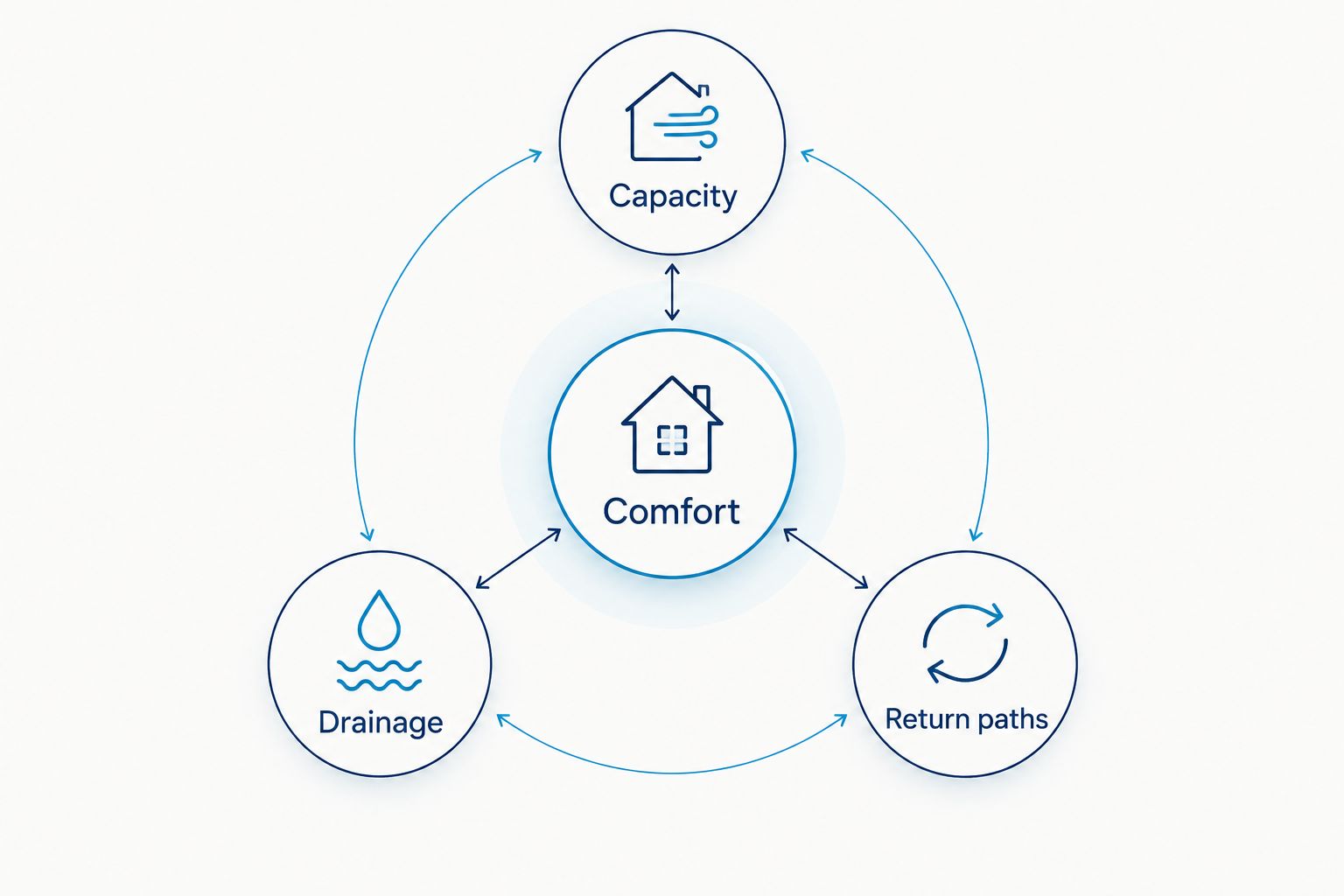
A clear proposal connects these checks to the selected equipment. You should be able to understand why the system fits without learning HVAC terminology.
Humidity matters even when nobody is staying
An empty casita still exchanges heat and moisture with its surroundings. Switching cooling off for a long vacancy removes an important means of moisture control. A thermostat setting alone also does not prove that indoor humidity is acceptable.
For your 2026 operating plan, use a humidity reading alongside temperature. The U.S. Environmental Protection Agency recommends indoor relative humidity below 60 percent, ideally 30 to 50 percent, to help control mold. Relative humidity describes how much moisture the air holds compared with what it can hold at that temperature.
Ask for an occupied and an unoccupied control plan. If humidity stays high despite suitable AC operation, have the cause checked before adding equipment. Air leaks, moisture sources, duct problems, and system settings all deserve attention.
A dehumidifier removes moisture, but it is not a replacement for AC. It also adds heat indoors. Consider it only after the cooling and moisture-control needs are assessed.
What to expect from an installation proposal
A.R. Williams Air Conditioning is best for homeowners who want guest-house central AC options explained before choosing an installation. Technicians explain their findings and lay out the options, with transparent flat-rate pricing quoted before work starts.
For AC installation for guest houses and detached casitas, ask the proposal to identify:
- The equipment capacity and the calculation behind it.
- The air-handler location or packaged-equipment footprint.
- Supply ducts, return paths, and thermostat placement.
- Electrical work, condensate drainage, and service access.
- Permit responsibilities and the inspection process.
Permit and inspection requirements depend on the authority responsible for your property. For a 2026 project in Palm Beach, Broward, or the Treasure Coast, confirm those requirements for the actual address rather than assuming the main home's previous installation sets the rules.
Talk through your guest-house AC options
Ask about system sizing, duct layout, and humidity control before choosing equipment.
How the options rank
Variable-speed central ducted AC ranks first for output flexibility when suitable equipment fits the load. Two-stage central AC earns its place for predictable occupancy. Packaged central AC addresses a different constraint: limited indoor equipment space.
The ranking follows capacity fit, moisture control, duct feasibility, independent control, and service access. It does not claim that one equipment type outperforms every alternative in every building.
Which AC should you choose?
Start with dedicated variable-speed central ducted AC, then verify that it fits your guest house. If its minimum output or physical requirements do not fit, compare a correctly sized two-stage design. Consider packaged central AC when equipment location is the main obstacle.
A.R. Williams Air Conditioning can explain the central AC options for your building. Request an assessment that covers the entire installation, not just the outdoor unit, and choose the proposal whose reasoning you understand.
FAQ
What’s the best AC for a guest house in Florida?
A dedicated variable-speed central ducted system is the starting recommendation when its capacity range and duct requirements fit the building. A cooling-load calculation must confirm the choice; a small guest house does not automatically need the smallest commonly offered central unit.
Can I connect a detached casita to my main home’s AC?
Do not assume the main home’s AC can serve a detached casita. A contractor must assess capacity, duct routing, airflow, and applicable requirements; a dedicated system provides independent control without relying on the main home’s thermostat.
Is two-stage AC better than variable-speed AC for a guest house?
Two-stage AC is not automatically better than variable-speed AC. Compare how each proposed system’s operating range matches the building, especially during light cooling demand and humid weather.
How many tons of AC does a small guest house need?
The required tonnage comes from a cooling-load calculation, not a floor-area shortcut. Windows, insulation, ceiling height, sun exposure, and moisture loads all affect the result.
Should I turn off the AC when the guest house is empty?
Do not make complete shutdown your default vacancy plan in a humid climate. Ask for temperature and humidity settings suited to the building, and check humidity rather than relying on temperature alone.
Can a packaged AC system cool separate bedrooms?
A packaged central AC system can cool separate bedrooms through properly designed ducts. Each room needs suitable supply airflow and a return-air path, including when bedroom doors are closed.
Does a guest house need a dehumidifier as well as AC?
A guest house needs an assessment of persistent humidity before you decide on a dehumidifier. Check AC sizing, airflow, controls, and moisture entry first; supplemental dehumidification addresses moisture that suitable cooling operation does not handle.
One last thing
Have the airflow checked with bedroom doors closed. Guests sleep with doors shut, so a layout that works only with every door open is not a finished comfort solution. Put that check on your installation walkthrough list.
Related guides
- Can an oversized AC unit raise indoor humidity?
- Best AC systems for high-humidity climates
- AC maintenance for snowbirds and seasonal residents
