

Choosing the best AC systems for beachfront rental properties in Florida means weighing salt air corrosion, brutal humidity, and long stretches with nobody home to notice a slow leak or a failing capacitor. Best overall: Ruud, for salt air corrosion resistance. Best for humidity control between guest turnovers: Carrier. Best for lowering operating costs on an absentee-owned property: Daikin. Best for high-cycle reliability in a rental that never really shuts off: Trane. Best for a straightforward replacement in an older beachfront building: Rheem.
- Ruud wins for beachfront rentals in 2026 because of its coastal corrosion protection on outdoor units.
- Carrier’s variable-speed compressors hold humidity steady between guest turnovers, which matters more at the coast than raw BTU output.
- Daikin trims operating costs for owners who aren’t checking utility bills weekly, a real factor for absentee-owned units.
- Any AC system installed in a Florida coastal home in 2026 must meet the 14.3 SEER2 federal minimum for the Southeast region.
- Skip anything still running on R-22 refrigerant, which stopped being manufactured in the U.S. in 2020.
Why this matters for beachfront rental owners
A beachfront rental in Palm Beach or Martin County works its AC system harder than a full-time family home does. Guests crank the thermostat down the second they walk in from the heat, then leave it running while they're at the pool. Add salt spray corroding the outdoor coil and long vacant stretches where nobody notices a slow refrigerant leak, and you have a recipe for early failure.
The wrong system choice here doesn't just mean a higher utility bill. It means a system that dies mid-season, guest complaints, and a scramble to find someone who can look at it the same day. Corrosion resistance for coastal ac systems isn't a nice-to-have on a property fifty feet from the water. It's the first filter you should apply before you even look at efficiency numbers.
What makes the best AC system for a beachfront rental
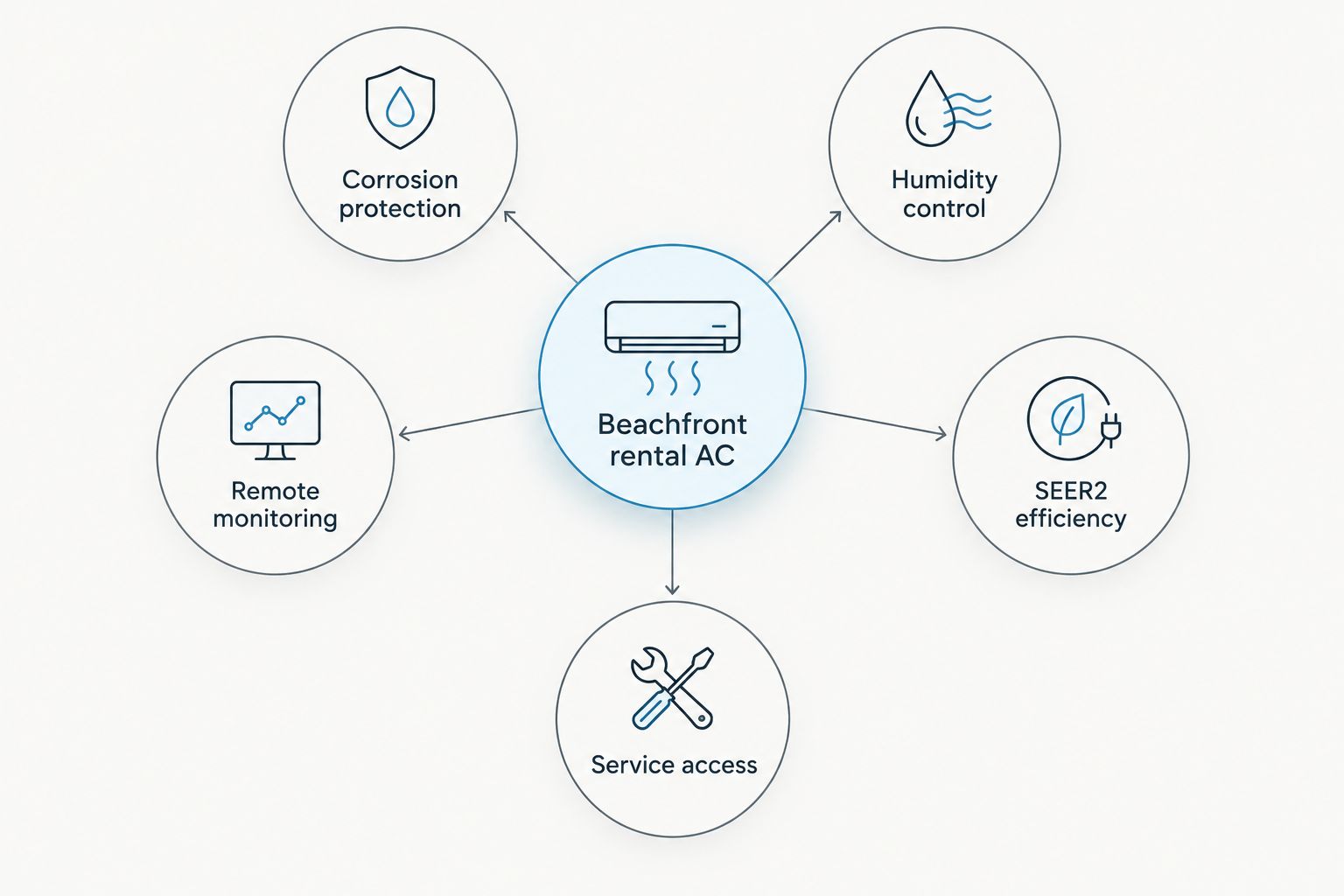
Before looking at the ranking, know what actually separates a system built for this job from one that just happens to be for sale nearby.
- Coil and cabinet corrosion protection. Salt air eats through unprotected coils and cabinet screws within a few cooling seasons on a direct-coastal property.
- Variable-speed or two-stage compressors. These hold humidity down between guest checkouts, instead of short-cycling and leaving the air damp.
- Remote monitoring compatibility. Owners who don't live on-site need a way to see a system is struggling before a tenant calls to complain.
- SEER2 efficiency rating. A coastal rental runs cooling nearly year-round, so efficiency differences show up fast on the utility bill.
- Manufacturer warranty terms that match rental-level runtime. A system cycling for paying guests wears differently than one in an owner-occupied home.
- Straightforward service access. Tight side yards and older beachfront construction make some systems easier to service than others.
At a glance
| System | Best for | Standout feature | Key limitation |
|---|---|---|---|
| Ruud | Salt air corrosion resistance | Corrosion-treated outdoor coil and cabinet components | Fewer high-end smart home integrations than some competitors |
| Carrier | Humidity control between turnovers | Variable-speed compressor holds steady indoor humidity | Higher-tier models need a trained technician to set up variable-speed staging correctly |
| Daikin | Lower operating costs for absentee owners | Strong SEER2 ratings across the product line | Higher-efficiency models cost more upfront than mid-tier alternatives |
| Trane | High-cycle reliability | Built to handle frequent on/off cycling from guest turnover | Parts and service can take longer to source in less common models |
| Rheem | Straightforward replacement in older buildings | Compatible sizing options for older ductwork | Base models lack the corrosion coating found on coastal-rated lines |
1. Ruud: best AC system for beachfront rentals for salt air corrosion resistance
Ruud builds coastal-rated equipment with corrosion protection on the outdoor unit's coil and cabinet, which matters most on a property where salt spray reaches the condenser daily. A.R. Williams installs Ruud systems as a certified Ruud Pro Partner, so parts and warranty support run through an established channel rather than a third party.
Ruud pros:
- Corrosion-treated coil and cabinet built for direct salt exposure
- Wide range of SEER2 ratings across tiers, so sizing to the property isn't a compromise
- Warranty support backed by an authorized installer relationship
Ruud cons:
- Fewer built-in smart home ecosystem integrations than some premium competitors
- Top-tier models carry a higher upfront cost than base coastal lines
Best for: homeowners renting a property within a few hundred feet of the beach where corrosion, not just heat, is the main threat.
Verdict: Buy.
2. Carrier: best AC system for beachfront rentals for humidity control between guest turnovers
Carrier's variable-speed line runs longer, slower cooling cycles instead of blasting cold air and shutting off. That matters in a rental because it pulls more moisture out of the air between checkouts, when the AC often sits idle for hours with the doors and windows recently opened. A.R. Williams is a Carrier Authorized Dealer, which means factory-backed training on the variable-speed staging that makes these systems worth the extra setup.
Carrier pros:
- Variable-speed compressor holds humidity steadier than single-stage alternatives
- Quieter operation, useful when a condenser sits near a lanai or pool deck guests use
- Strong SEER2 ratings on mid and upper tiers
Carrier cons:
- Requires correct commissioning to get the humidity control benefit; a rushed install undercuts the whole point
- Premium models cost more than a basic single-stage system
Best for: rentals where damp, musty air between bookings is the recurring complaint, not just heat.
Verdict: Buy.
3. Daikin: best AC system for beachfront rentals for lowering operating costs
Daikin's efficiency ratings run high across the lineup, which matters to an owner who isn't checking the utility bill weekly and just wants the number to stay reasonable. As a Daikin Comfort Pro, A.R. Williams sizes these systems to the property rather than defaulting to whatever unit happens to be in stock.
Coastal attics trap heat fast under a Florida sun, and undersized soffit vents for attic ventilation force any AC system, no matter how efficient on paper, to run longer cycles than the SEER2 rating suggests it should. Pairing a high-efficiency system with adequate attic airflow is what actually gets the operating cost down, not the equipment alone.
Daikin pros:
- High SEER2 ratings reduce the impact of near-constant summer runtime
- Broad range of sizing options for different rental floor plans
- Backed by manufacturer support through a Daikin Comfort Pro relationship
Daikin cons:
- Higher-efficiency models carry a higher equipment cost than mid-tier alternatives
- Efficiency gains shrink if attic insulation and ventilation aren't addressed alongside the system
Best for: absentee owners who want the lowest realistic operating cost and are willing to also check attic ventilation and insulation.
Verdict: Buy.
4. Trane: best AC system for beachfront rentals for high-cycle reliability
Trane systems are built to handle frequent starts and stops without the compressor wearing out early, which fits a rental property where the thermostat gets reset by a new guest every few days. That kind of cycling stresses a compressor differently than steady, predictable use in an owner-occupied home.
Trane pros:
- Compressors rated for frequent on/off cycling common in short-term rentals
- Solid build quality on cabinets exposed to coastal weather
- Good middle ground between upfront cost and expected lifespan
Trane cons:
- Parts availability for less common models can take longer than for Ruud, Carrier, or Daikin through an authorized channel
- Coastal-specific corrosion coatings aren't standard on every model in the lineup
Best for: a rental with frequent, short guest stays where the thermostat rarely sits untouched.
Verdict: Hold if your current system still has years of life left; Buy if you're replacing anyway.
5. Rheem: best AC system for beachfront rentals for straightforward replacement in older buildings
Rheem offers sizing flexibility that works well in older beachfront construction where ductwork wasn't designed around a modern system. For a rental in a building from the 1980s or earlier, that compatibility can matter more than chasing the highest SEER2 number on the market.
Rheem pros:
- Sizing options that adapt to older or non-standard ductwork
- Reasonable range of tiers for different rental budgets and needs
- Established manufacturer warranty structure
Rheem cons:
- Base models don't include the coastal corrosion coating found on Ruud's coastal-rated line
- Owners near the water should specifically ask for corrosion-protected options rather than assuming standard equipment includes it
Best for: older beachfront buildings where duct compatibility is the bigger constraint than corrosion resistance alone.
Verdict: Buy, with the corrosion-protected option specified.
How we ranked these systems
Each system got measured against the six criteria above: corrosion protection, humidity handling, remote monitoring compatibility, SEER2 efficiency, warranty terms suited to rental-level runtime, and how easy the equipment is to service in tight coastal properties. No system swept every category, which is the point. A property fifty feet from the water and a property a mile inland in the same zip code have different priorities, even under the same roof style.
Which AC system should you choose for a beachfront rental?
If you only remember one thing: corrosion resistance comes before efficiency numbers on a direct-coastal property. A high SEER2 rating on a coil that corrodes in eighteen months isn't efficient, it's a repeat expense.
For most beachfront rental owners in 2026, Ruud is the default pick because the corrosion protection is built into the coastal-rated line rather than sold as an add-on. If humidity between guest turnovers is the bigger complaint than heat itself, Carrier's variable-speed line earns the switch. If you're managing the property from out of state and want the lowest realistic operating cost, Daikin makes that case as long as attic ventilation gets addressed alongside it.
Get your rental’s AC sized correctly
Flat-rate pricing before any work starts, quoted for your property.
FAQ
What’s the best AC system for a beachfront rental property in Florida?
Ruud is the strongest overall pick in 2026 because its coastal-rated line includes corrosion protection on the outdoor coil and cabinet. Carrier and Daikin are strong alternatives depending on whether humidity control or operating cost matters more to you.
Do beachfront rentals need a different AC system than inland homes?
Yes. Salt air corrodes unprotected coils and cabinet hardware much faster than inland exposure does, so corrosion-rated coatings matter more here than in a home a few miles from the water.
How often should AC systems be serviced in a beachfront rental?
Coastal rentals benefit from more frequent coil and drain line checks than inland homes because of salt buildup and near-constant runtime from guest turnover. A regular maintenance plan catches corrosion and drainage issues before they become a no-cool call.
Is a variable-speed AC system worth it for a rental property?
For humidity control between guest stays, yes. Variable-speed compressors run longer, slower cycles that pull more moisture out of the air than single-stage systems that just blast cold air and shut off.
What SEER2 rating should a Florida coastal rental AC system have?
Any new system installed in Florida in 2026 must meet the federal minimum of 14.3 SEER2 for the Southeast region. Rentals that run cooling nearly year-round often see a faster payback from choosing a higher tier above that minimum.
Can an old R-22 AC system still be used in a beachfront rental?
Technically yes if it’s still running, but R-22 production stopped in the United States in 2020, so refrigerant for a leak repair is scarce and expensive. Most homes built before 2010 with an original R-22 system are better off planning a replacement than repairing around it.
Do rental property owners need remote monitoring on their AC system?
It helps significantly for owners who don’t live on-site. Remote monitoring flags a struggling system or a humidity spike before a guest calls to complain, rather than after.
One last thing
The detail most beachfront rental owners miss isn't the AC system at all, it's the drain line and the attic above it. A clogged condensate line in a coastal property with high humidity backs up faster than inland, and a guest who doesn't know to check it just lets water pool until it stains a ceiling. Whatever system you choose, ask that drain line access gets built into the maintenance routine, not treated as an afterthought.
Related guides
- AC maintenance plans built for rental property owners
- AC installation for waterfront and canal-front homes
