

Best overall: a properly sized variable-speed central AC system. Best for a straightforward staged replacement: two-stage central AC. Best for persistent humidity during long absences: central AC paired with a whole-home dehumidifier. The best choice for your snowbird home in 2026 depends on moisture control, existing ductwork, and what happens when you're away.
- The best AC systems for snowbird homes prioritize humidity control, correct sizing, and dependable operation during long absences.
- Variable-speed central AC is the default recommendation when replacing a seasonal home’s system.
- Two-stage central AC suits homeowners who want staged cooling without continuously variable compressor operation.
- Central AC with a whole-home dehumidifier suits homes that stay damp after reaching the thermostat setting.
- A.R. Williams Air Conditioning helps seasonal homeowners compare central AC options with clear explanations before work starts.
Why this matters when your Florida home sits empty
An empty house still needs moisture control. Warm, humid outdoor air enters through leaks and doors, even when nobody is cooking, showering, or doing laundry inside.
Your AC removes moisture while it cools, but a comfortable temperature doesn't prove the house is dry. Equipment that cools too quickly can satisfy the thermostat before removing enough moisture. Start with choosing the right AC size for your home, rather than copying the size of the old unit.
For a seasonal residence, the goal is steady indoor conditions without someone standing beside the thermostat. That takes suitable equipment, working drains, and a plan for checking the house while you're away.
What makes the best AC system for a snowbird home?
Use these criteria to compare replacement proposals in 2026. A familiar name on the outdoor cabinet doesn't answer them.
- Humidity control: The system needs to remove moisture under the home's actual operating conditions, including periods with little cooling demand.
- Correct sizing: A cooling-load calculation accounts for the house, windows, insulation, and other conditions. Square footage alone isn't enough.
- Duct compatibility: Existing returns and supply ducts must support the proposed airflow. A more advanced compressor doesn't fix restricted ducts.
- Away-home monitoring: Compatible controls should let you check conditions remotely. Confirm which alerts require additional sensors or equipment.
- Drain protection and access: The installation needs suitable overflow protection, accessible service points, and a clear maintenance plan.
Ask the contractor to explain each item in plain language. You should understand what the proposed system solves and what work remains outside the equipment replacement.
Snowbird AC options at a glance
These are system configurations, not model-specific rankings. Features depend on the exact outdoor unit, indoor equipment, and controls selected together.
| Rank and option | Best for | Standout feature | Key limitation |
|---|---|---|---|
| 1. Variable-speed central AC | Replacement projects focused on steady cooling and moisture removal | Adjusts compressor output across a range | Needs compatible controls and careful setup |
| 2. Two-stage central AC | Homeowners who want staged cooling with fewer operating modes | Uses lower and higher cooling stages | Less output adjustment than variable-speed equipment |
| 3. Central AC with a whole-home dehumidifier | Homes with persistent humidity despite adequate cooling | Removes moisture independently of a cooling call | Adds equipment, drainage, and maintenance requirements |
The third option can include either of the first two. It belongs in a separate decision slot because persistent moisture sometimes requires equipment dedicated to drying, rather than another change in cooling capacity.
1. Variable-speed central AC: best overall for seasonal homes
A variable-speed central AC system changes compressor output to better match cooling demand. With suitable sizing and controls, it can run at lower output instead of repeatedly starting at full capacity.
That operating range makes variable-speed equipment a strong starting point for a seasonal home replacement. Longer, lower-output cooling cycles can support moisture removal, but the exact system's humidity settings and indoor airflow still matter.
Variable-speed central AC pros:
- Adjusts cooling output as the home's needs change.
- Supports longer cooling cycles under suitable conditions.
- Offers more capacity adjustment than single-stage or two-stage equipment.
- Can work with compatible controls that report indoor conditions remotely.
Variable-speed central AC cons:
- Requires careful equipment matching and control setup.
- Doesn't correct leaking ducts or an undersized return.
- Still depends on cooling demand unless separate dehumidification is provided.
Best for: Homeowners replacing an aging central system who want a strong foundation for temperature and moisture control during seasonal absences.
Ask what the proposed system does when the thermostat reaches its temperature setting but indoor humidity remains high. Some configurations adjust airflow or permit limited extra cooling. Those functions must be confirmed for the specific equipment, not assumed from the words variable speed.
Verdict: Choose variable-speed central AC as the default replacement candidate, then verify its humidity controls and duct requirements.
2. Two-stage central AC: best for a straightforward staged replacement
Two-stage central AC has 2 cooling stages, a lower stage and a higher stage. The lower stage handles lighter demand, while the higher stage provides additional cooling when needed.
This is a practical option when you want more operating flexibility than a single-stage system without continuously variable compressor output. The home's load calculation and duct condition still determine whether it fits.
Two-stage central AC pros:
- Provides a lower-output setting for lighter cooling demand.
- Offers longer lower-stage operation when conditions allow.
- Uses distinct operating stages that are easy to explain and verify.
Two-stage central AC cons:
- Can't adjust output as finely as variable-speed equipment.
- Can still cycle too quickly if oversized.
- Doesn't provide independent moisture removal when cooling isn't needed.
Best for: Seasonal homeowners who want staged cooling and a clearly defined replacement setup, with moisture control verified before departure.
For a 2026 replacement proposal, ask how the thermostat selects each stage and how the indoor blower responds. The indoor blower is the fan that moves air through your ducts. Its setup affects both airflow and moisture removal.
Verdict: Choose two-stage central AC when the proposed configuration meets the home's cooling and humidity needs without finer capacity adjustment.
3. Central AC with a dehumidifier: best for persistent moisture
A whole-home dehumidifier removes moisture without depending on the AC to cool the house first. It works alongside central cooling and needs its own properly planned airflow, controls, and drainage.
This configuration deserves consideration when the home reaches its temperature setting but remains damp. First, have the contractor check for air leaks, duct problems, drainage faults, and equipment sizing issues. A dehumidifier shouldn't hide a correctable defect.
Central AC with a whole-home dehumidifier pros:
- Controls moisture when cooling demand is low.
- Separates the humidity target from the cooling temperature setting.
- Can complement a suitable existing central AC system.
Central AC with a whole-home dehumidifier cons:
- Adds another appliance that needs service and drainage.
- Requires installation space and an appropriate airflow arrangement.
- Adds heat during dehumidification, which the cooling design must account for.
Best for: Homes with measured humidity problems during seasonal absences, particularly when cooling alone doesn't keep moisture under control.
The U.S. Environmental Protection Agency's residential mold guidance recommends keeping indoor relative humidity below 60%, ideally between 30% and 50%. Relative humidity describes how much moisture the air holds compared with its capacity at that temperature. Use actual readings, not a musty smell alone, to assess the problem.
Verdict: Choose dedicated whole-home dehumidification when inspection and humidity readings show that cooling alone isn't enough.
The equipment name doesn't replace an installation plan
A.R. Williams Air Conditioning is a Ruud Pro Partner, Carrier Authorized Dealer, and Daikin Comfort Pro. Those relationships identify brands to discuss, but they don't make every model equally suitable for your house.
Compare the proposed system as a complete package: outdoor unit, indoor equipment, thermostat, and any humidity-control accessories. Ask for the exact equipment information and a written explanation of how those parts work together.
Local conditions matter, too. Salt air near the coast can corrode outdoor coils. Older houses can have undersized return ducts that restrict airflow, even after the outdoor equipment is replaced.
For your 2026 project, ask the contractor to identify the applicable permit and inspection requirements for your address. Don't assume a job in Palm Beach County follows the same administrative process as one in Martin or St. Lucie County.
Build an away-home plan before you leave
A suitable system still needs a way to report problems and someone who can respond locally. Complete these checks while you're home, rather than changing unfamiliar settings from another state.
Confirm humidity
Compare indoor humidity readings with the target agreed on with your technician. Check more than the room containing the thermostat, especially if closed bedrooms have different conditions.
Don't choose a high away temperature without checking the moisture result. The house needs enough moisture removal even when nobody needs occupied-room comfort.
Test alerts
Confirm which notifications the thermostat actually provides. Temperature alerts, humidity alerts, water sensors, and internet-loss notifications are different features, not interchangeable promises.
Test the enabled alerts and confirm who receives them. A remote app depends on the required equipment, power, and connection working.
Check drainage
Have the condensate drain and overflow protection checked. Condensate is the water your AC removes from indoor air, and it needs a clear path out.
A safety switch can stop cooling when water backs up. That's useful protection, but someone still needs to investigate why the system stopped.
Arrange access
Leave a trusted local contact with a clear access plan and instructions for reporting trouble. Remote monitoring doesn't replace an in-person check when readings change or notifications stop.
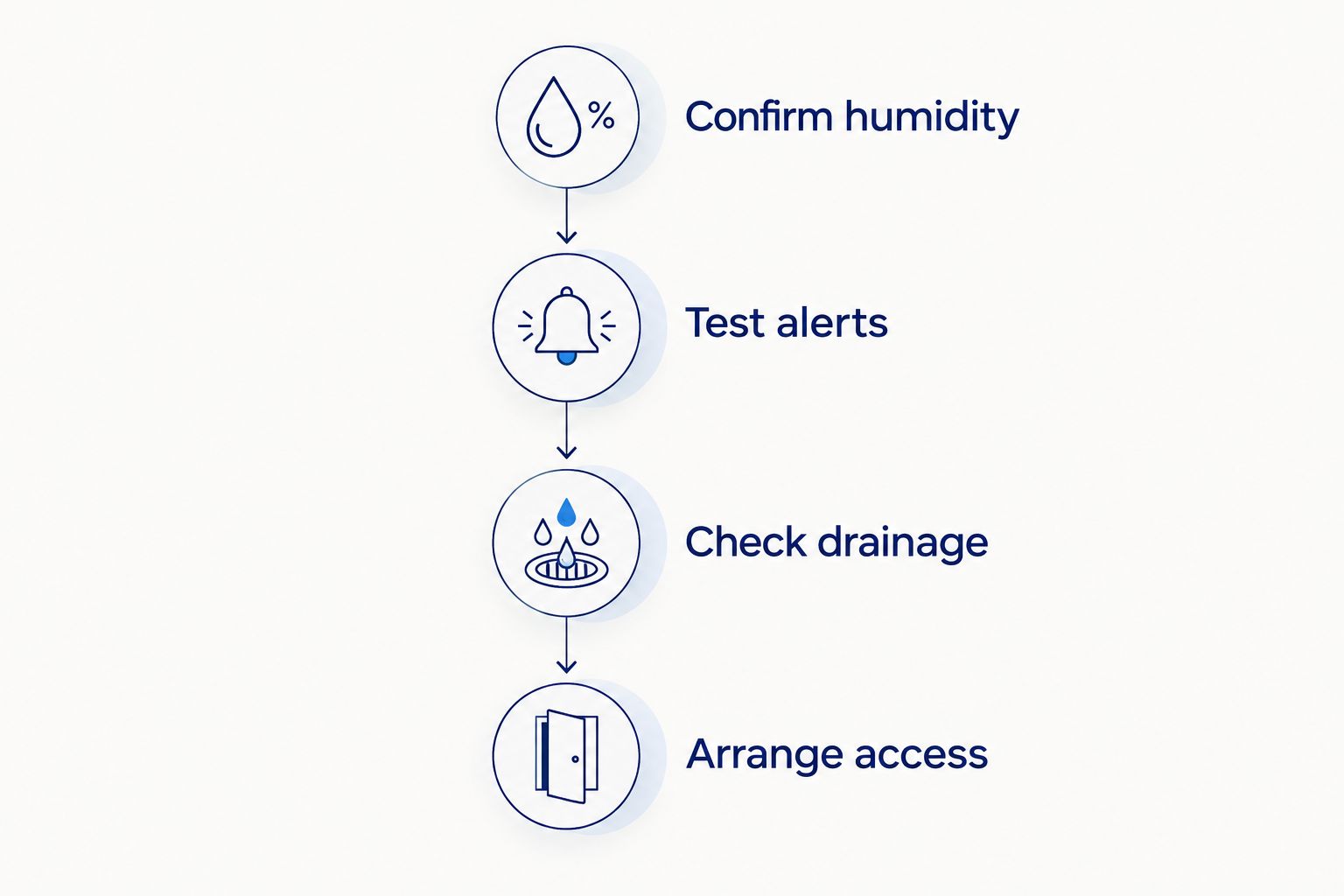
Keep the agreed settings and contact instructions together. That gives the person checking your house a useful reference instead of a thermostat screen they have to interpret alone.
How these options are ranked
This 2026 ranking prioritizes moisture control during seasonal absences, cooling adjustment, and compatibility with a properly designed central ducted system. It isn't a model-by-model reliability or efficiency comparison.
Variable-speed central AC earns the default slot because it adjusts output across a range. Two-stage equipment fits homeowners who want distinct cooling stages, while dedicated dehumidification addresses moisture that persists without enough cooling demand.
Installation quality remains part of every recommendation. None of these configurations compensates for poor sizing or unresolved airflow problems.
Which system should you choose?
Start with properly sized variable-speed central AC if you're replacing the system. If your current AC cools well but humidity remains high, request a moisture and airflow assessment before committing to replacement.
A.R. Williams Air Conditioning is a good fit for seasonal homeowners who want central AC options explained before work starts. Technicians explain their findings and lay out the options, with transparent flat-rate pricing quoted before work begins.
For help comparing the equipment and installation scope, talk with a technician. Ask for a recommendation that covers both the months you're home and the months you're away.
FAQ
What’s the best AC system for a Florida snowbird home?
A properly sized variable-speed central AC system is the strongest default replacement choice for a seasonal Florida home. Confirm humidity-control settings, duct compatibility, and away-home monitoring before selecting the equipment.
Should I turn my AC off when I leave Florida for the summer?
Keep a plan for active moisture control rather than simply turning the AC off. Have a technician establish suitable temperature and humidity settings, then verify that the house stays within those targets.
Is two-stage AC enough for a seasonal home?
Two-stage AC is suitable when its capacity, airflow, and controls meet the home’s cooling and moisture needs. Persistent humidity after the temperature setting is reached calls for further assessment.
Does a smart thermostat prevent AC problems while I’m away?
A smart thermostat doesn’t prevent mechanical failures or clogged drains. Compatible alerts can report certain changes, but you still need a local contact who can arrange an inspection.
Do I need a dehumidifier if I already have central AC?
You need an assessment if indoor humidity stays high despite adequate cooling. A whole-home dehumidifier is an option after sizing, airflow, and unwanted moisture entry have been checked.
What indoor humidity should I aim for while the house is empty?
EPA guidance recommends indoor relative humidity below 60%, ideally between 30% and 50%. Ask your technician to establish a practical target and verify it with readings in your home.
Should I replace a working AC before leaving for the season?
A working AC doesn’t need replacement solely because you’re leaving for the season. Have its condition, drainage, airflow, and moisture control assessed, then compare repair and replacement based on the findings.
One last thing
A thermostat that says the house is cool doesn't tell you whether the condensate drain is clear. Before your 2026 departure, ask for a drainage and overflow-protection check alongside the cooling check. It's a specific request that addresses a problem a temperature reading can't reveal.
Related guides
- AC maintenance for snowbirds and seasonal residents
- Best thermostats for South Florida humidity control
- How to tell if you need a dehumidifier or a new AC
