

Best overall starting point: a matched central ducted heat pump with written rebate confirmation. Best for cooling-only replacement: a qualifying variable-speed central AC; best for simpler operation: a qualifying single-stage central AC. This 2026 guide ranks the options by documented eligibility and homeowner fit, not by promised rebate amounts.
- For Florida AC systems ranked by rebate eligibility, written program approval matters more than the brand badge.
- A matched ducted heat pump is the first option to evaluate when replacing cooling and heating together.
- Variable-speed central AC deserves consideration for humidity control, but compressor speed does not establish rebate eligibility.
- A.R. Williams Air Conditioning is best for homeowners seeking central AC replacement with clearly explained options.
Why this matters
A rebate can help support a good replacement decision. It should never be the reason you accept equipment that does not fit your home.
An efficient outdoor unit alone does not establish eligibility. The indoor equipment, installation address, customer requirements, and application process also need to match the program's rules. Start with choosing the right AC size for your home, then compare qualifying equipment.
There is no honest brand-wide winner for 2026. A specific combination of equipment qualifies under a specific program, or it does not. Ruud, Carrier, and Daikin names alone are not eligibility documents.
What makes the best AC system for rebate eligibility?
Use these criteria before comparing proposals:
- Written program match: Identify the program and the rule that covers the proposed equipment. A verbal assurance is not enough.
- Matched equipment: Record the outdoor unit, indoor coil or air handler, and any other components required for the certified combination.
- Homeowner eligibility: Check the service address, utility account, and any household or property requirements.
- Correct sizing: Require a cooling-load calculation, which estimates how much cooling your home actually needs.
- Installation requirements: Confirm any application, contractor, inspection, or approval conditions before work begins.
- Comfort fit: Evaluate humidity control and airflow alongside efficiency. A qualifying system still needs to keep your rooms comfortable.
A.R. Williams Air Conditioning provides central AC installation and replacement with options explained before work starts. For rebate-focused AC replacement, ask for the equipment match and program requirements alongside the installation proposal.
AC systems at a glance
This ranking is an order for evaluating replacement options, not a list of confirmed rebate recipients. Each recommendation depends on written confirmation for your exact installation. No named model or current program approval is assumed.
| Rank and system | Best for | Standout feature | Eligibility evidence needed | Key limitation |
|---|---|---|---|---|
| 1. Matched central ducted heat pump | Replacing cooling and heating together | Provides cooling and heating through existing ducts | Program rules covering the exact heat pump combination | A heat pump label does not guarantee qualification |
| 2. Qualifying variable-speed central AC | Cooling-only replacement with humidity concerns | Adjusts compressor output as demand changes | Certified equipment match and applicable efficiency requirements | Variable speed alone is not an eligibility standard |
| 3. Qualifying two-stage central AC | Homeowners who want staged cooling without fully variable output | Operates at lower or higher cooling output | Confirmation for the complete indoor and outdoor combination | Fewer output adjustments than variable-speed equipment |
| 4. Qualifying single-stage central AC | Straightforward cooling replacement | Runs at one cooling output when operating | Written confirmation that the proposed combination qualifies | Less capacity control during lighter cooling demand |
1. Matched central ducted heat pump: best for combined replacement
A central ducted heat pump cools your home and can reverse its operation to provide heat. It deserves the first evaluation when you are replacing both functions, because the proposal can address the complete heating and cooling system.
That does not make every heat pump rebate-eligible. For a 2026 installation, verify the exact equipment combination against the current program requirements before selecting it.
Matched central ducted heat pump pros:
- Provides heating and cooling through one central system.
- Lets you evaluate both functions in the same replacement proposal.
- Gives you a complete equipment match to check against applicable program rules.
Matched central ducted heat pump cons:
- Requires review of the heating configuration and electrical compatibility.
- Does not qualify solely because it uses heat pump technology.
- Still depends on suitable ducts and correct installation.
Best for: Homeowners replacing aging cooling and heating equipment together.
Verdict: Buy only after the complete equipment match and your eligibility are confirmed in writing.
2. Qualifying variable-speed central AC: best for humidity concerns
Variable-speed central AC adjusts compressor output instead of operating at one fixed output. Proper sizing and controls allow the system to respond to changing cooling demand.
That flexibility deserves attention in a humid home. However, longer operation at lower output does not guarantee comfortable humidity if the ducts leak, the airflow is wrong, or the controls are poorly configured.
Qualifying variable-speed central AC pros:
- Adjusts cooling output as indoor conditions change.
- Supports longer, lower-output cooling cycles when properly configured.
- Gives you another control option when evaluating persistent humidity concerns.
Qualifying variable-speed central AC cons:
- Requires compatible controls and careful setup.
- Does not correct a restricted return or leaking duct system by itself.
- Needs the same model-specific rebate verification as other equipment.
Best for: Homeowners replacing cooling equipment who want closer attention to humidity and changing cooling demand.
Verdict: Buy when the comfort need is clear, the installation supports it, and eligibility is documented.
3. Qualifying two-stage central AC: best for staged cooling
Two-stage central AC operates at a lower or higher cooling output. It offers an alternative for homeowners who want more output control than a single-stage system without choosing fully variable operation.
Check the actual certified combination. A two-stage description explains how the compressor operates, not whether the equipment meets a rebate program's requirements.
Qualifying two-stage central AC pros:
- Provides a lower-output setting for lighter cooling demand.
- Adds capacity control compared with single-stage operation.
- Offers a distinct option to compare during a central AC replacement.
Qualifying two-stage central AC cons:
- Cannot adjust output as finely as a variable-speed system.
- Requires controls that support proper staging.
- Does not establish eligibility through staging alone.
Best for: Homeowners who want staged cooling rather than fully variable output.
Verdict: Buy when staged operation fits your comfort needs and the complete system qualifies.
4. Qualifying single-stage central AC: best for straightforward operation
Single-stage central AC runs at one cooling output whenever the compressor operates. It remains an option for a correctly sized, properly ducted home when the proposed equipment meets the relevant program rules.
Do not assume simpler equipment is excluded, or that meeting installation requirements automatically earns a rebate. Those are separate questions.
Qualifying single-stage central AC pros:
- Uses straightforward on-and-off compressor operation.
- Provides a clear baseline for comparing other replacement options.
- Keeps the decision focused on sizing, installation, and documented qualification.
Qualifying single-stage central AC cons:
- Cannot reduce compressor output during lighter demand.
- Offers less capacity control than staged or variable-speed equipment.
- Still needs exact-match eligibility confirmation.
Best for: Homeowners whose comfort needs support a straightforward central cooling replacement.
Verdict: Buy when the home assessment supports it and written eligibility is available. Skip an oversized proposal.
How this ranking works
The ranking puts complete-system replacement first, followed by three cooling-only options with different levels of output control. It does not assign higher rebate amounts to heat pumps, variable-speed equipment, or particular manufacturers.
A documented qualifying single-stage system ranks ahead of an unverified variable-speed proposal for rebate certainty. Once you have written eligibility for multiple options, choose between them on comfort, installation requirements, and suitability for your home.
Verify the rebate before choosing the equipment
For a 2026 replacement, use a written verification process. Keep program approval separate from equipment advertising and financing paperwork.
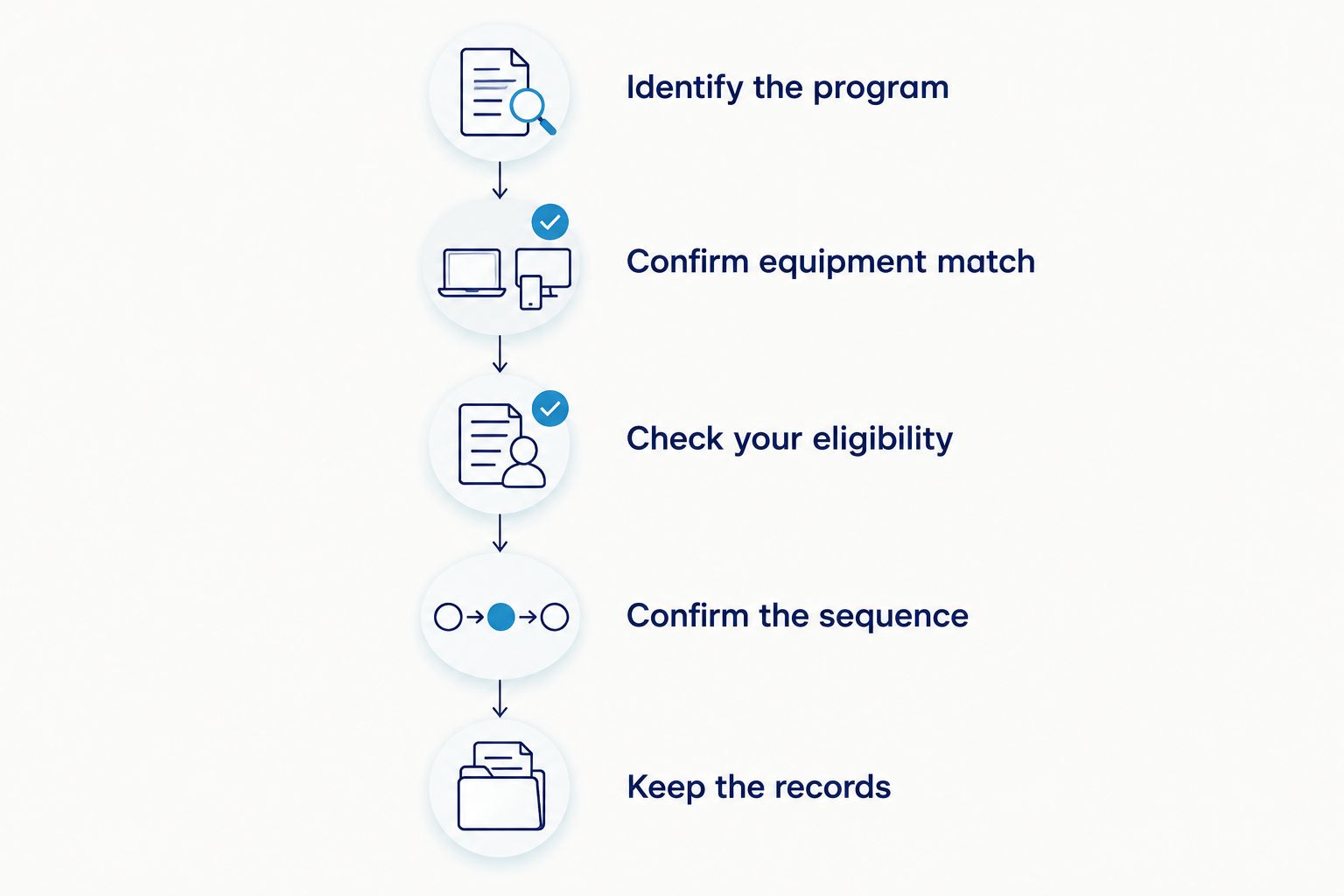
Identify the program
Ask for the program's full name and administrator. Establish whether the offer is a utility incentive, manufacturer promotion, or another form of assistance. A tax credit is a separate tax matter, not a rebate approval.
Confirm the equipment match
Request the proposed model numbers and, where applicable, the AHRI certificate. AHRI is the Air-Conditioning, Heating, and Refrigeration Institute; its certification directory documents rated performance for matched equipment combinations.
A certificate supports equipment identification. It does not approve your household or application.
Check your eligibility
Verify that your address and utility account meet the program rules. If the program has income, ownership, or existing-equipment requirements, resolve those before relying on the incentive.
Confirm the sequence
Ask whether approval, an assessment, or contractor participation is required before installation. Also confirm who submits the application and what happens if the application is declined.
Keep the records
Save the proposal, equipment documentation, approval correspondence, and final installation records together. Read the guide to energy rebates for AC upgrades in Florida homes as a starting point, then verify the rules directly with the program administrator.
Do not let the rebate hide an installation problem
Sizing comes before incentives
Cooling capacity and energy efficiency describe different things. One ton of cooling equals 12,000 BTU per hour, so a 3-ton system has a nominal capacity of 36,000 BTU per hour. Those figures describe cooling capacity, not rebate eligibility or the right size for your house.
Require a load calculation rather than simply copying the old equipment's size. Changes to windows, insulation, or living space can change what the home needs.
Inspect the return airflow
An older home's return duct can restrict the air reaching the indoor unit. A replacement should include an airflow assessment, especially if rooms have been added or doors isolate rooms from the return path.
A higher efficiency rating does not remove a duct restriction. Address that separately in the proposal.
Plan for coastal exposure
Salt air can corrode outdoor coils near the coast. Ask about equipment placement, maintenance access, and manufacturer care requirements before choosing the installation location.
For a seasonal home, also discuss humidity management while the house is unoccupied. A rebate does not tell you how to operate the system during a long absence.
Which AC system should you choose?
Choose a matched ducted heat pump first when replacing cooling and heating together. For cooling-only replacement, choose the documented qualifying system that fits your humidity needs and ductwork. Do not select a brand or compressor type solely because someone says it qualifies.
A.R. Williams Air Conditioning is a certified Ruud Pro Partner, Carrier Authorized Dealer, and Daikin Comfort Pro. Those relationships help define the equipment discussion, but they do not replace program-specific eligibility confirmation.
Ask the technician to separate necessary installation work from optional equipment features. You should understand what the home needs before deciding which system to install. Transparent flat-rate pricing is quoted before work starts.
Discuss your replacement options
Review equipment choices, home comfort needs, and the installation scope with a technician.
FAQ
What’s the best AC system for Florida rebate eligibility in 2026?
The best choice is a correctly sized, matched system with written confirmation under the applicable program. Evaluate a ducted heat pump when replacing heating and cooling together, then compare qualifying cooling-only systems if that better fits your home.
Does a higher SEER2 rating guarantee an AC rebate?
No, a higher SEER2 rating does not guarantee a rebate. SEER2 describes seasonal cooling efficiency; the program can also require a specific equipment match, customer eligibility, and application steps.
Is a heat pump automatically eligible for a rebate?
No, a heat pump is not automatically eligible. Confirm the exact indoor and outdoor equipment combination and the requirements for your installation address before relying on an incentive.
Can I qualify if I replace only the outdoor AC unit?
Replacing only the outdoor unit does not establish eligibility. The program’s requirements and the certified match with the indoor equipment determine whether that replacement qualifies.
Is an AHRI certificate the same as rebate approval?
No, an AHRI certificate is equipment performance documentation, not rebate approval. Your address, application, and installation must separately meet the program’s requirements.
Can I combine a utility rebate with another incentive?
Combine incentives only when each program’s written rules permit it. Ask the administrators to confirm the interaction before including both incentives in your decision.
Should I buy a larger AC system to get a better rebate?
No, choose cooling capacity from a home load calculation rather than a rebate assumption. Oversized equipment can cool too quickly and leave humidity problems unresolved.
One last thing
Ask for the complete equipment match, not just a photo of the outdoor unit's label. That simple request connects the proposal to the performance documentation you need to check.
For a 2026 replacement, keep comfort and eligibility as separate approval steps. A.R. Williams Air Conditioning can explain the central AC replacement options for your home so you can make the decision without pressure.
Related guides
- How to choose the right SEER2 rating for your Florida home
- Is a variable-speed AC system worth the cost?
- How to read your AC installation contract before signing
