

Best overall: a central AC matched to your home's calculated cooling load. Best for a lower calculated load: a 2-ton system. Best for a higher calculated load: a 5-ton system, but only when the sizing calculation and ductwork support it. This guide ranks capacity classes, not individual models, so you can compare recommendations without assuming bigger means better.
- The best central air conditioner capacity for a Florida home matches its calculated cooling load, not square footage alone.
- A 2-ton central AC provides 24,000 BTU/h of nominal cooling capacity; a 5-ton system provides 60,000 BTU/h.
- A.R. Williams Air Conditioning is best for homeowners who want central AC options explained before work starts.
- Check humidity performance and duct airflow before approving a larger replacement system.
Why capacity matters in Florida
An undersized AC struggles to meet the home's cooling demand. An oversized AC can cool the air quickly and shut off before removing enough moisture, so a lower thermostat reading doesn't necessarily mean better comfort.
You don't have to choose tonnage yourself. Start with a professional load calculation, then compare equipment that fits the result. Our guide to choosing the right AC size for your home explains the information behind that decision.
For a 2026 replacement, don't assume the existing unit is correctly sized. New windows, insulation changes, and enclosed additions can change the load since the original installation.
What makes the best central AC capacity
A useful capacity recommendation connects the equipment to the house. These criteria matter more than a familiar brand name or a larger number on the quote:
- Calculated cooling load: The system must handle heat entering through the roof, walls, windows, and outdoor air.
- Moisture removal: Cooling selection must address indoor humidity as well as temperature.
- Delivered capacity: The selected indoor and outdoor equipment must provide suitable cooling under the design conditions used for your home.
- Duct airflow: Supply ducts and return openings must support the selected equipment without excessive resistance.
- Part-load operation: Ask how the system operates when the house needs less than its maximum cooling output.
A.R. Williams Air Conditioning provides central AC installation and replacement with technicians who explain the findings and options. Ask for the sizing basis before deciding which equipment to install.
Central AC capacities at a glance for 2026
The order below runs from lower to higher nominal capacity. It is not a quality ranking: a properly selected 2-ton system is a better choice than an oversized 5-ton system for the same house.
One refrigeration ton equals 12,000 British thermal units per hour, written as BTU/h. Tonnage describes cooling capacity, not the equipment's weight or electrical consumption.
| Capacity class | Nominal cooling capacity | Best for | Standout feature | Key limitation |
|---|---|---|---|---|
| 2 tons | 24,000 BTU/h | Lower-load homes supported by calculation | Lowest capacity in this comparison | Insufficient when the verified load exceeds its delivered output |
| 2.5 tons | 30,000 BTU/h | Loads between the 2-ton and 3-ton classes | Intermediate sizing step | Not automatically correct because it splits the difference |
| 3 tons | 36,000 BTU/h | Homes with a verified midrange cooling load | Middle capacity class in this comparison | Doesn't guarantee balanced room temperatures |
| 4 tons | 48,000 BTU/h | Higher-load homes with suitable ducts | Greater nominal cooling output | Requires airflow capacity that older ducts might not provide |
| 5 tons | 60,000 BTU/h | Highest verified single-system loads in this comparison | Highest nominal capacity listed | Oversizing creates temperature and humidity trade-offs |
These are reference classes, not a complete equipment catalog. The selected system's published performance matters more than the rounded tonnage label.
1. A 2-ton central AC: best for a verified lower cooling load
A 2-ton central AC has a nominal capacity of 24,000 BTU/h. It belongs on your shortlist when the load calculation and equipment selection support that output, not simply because someone describes your house as small.
An insulated home with shaded windows can have a different cooling requirement from a similarly sized home with strong afternoon sun. Floor area alone doesn't settle the choice.
2-ton central AC pros:
- Fits lower cooling requirements when properly selected.
- Avoids unnecessary capacity when the house doesn't need more.
- Supports a right-sized approach to temperature and moisture control.
2-ton central AC cons:
- Won't satisfy a load above its actual delivered capacity.
- Doesn't correct leaky ducts or uneven room airflow.
Best for: A home whose documented load fits the selected 2-ton equipment.
Verdict: Buy only when the load calculation supports this capacity.
2. A 2.5-ton central AC: best for an intermediate cooling load
A 2.5-ton central AC provides 30,000 BTU/h of nominal cooling capacity. It creates an intermediate choice between the 24,000 BTU/h and 36,000 BTU/h classes.
That intermediate position is useful only when it fits the house. Choosing the middle of two proposals isn't a substitute for comparing their sizing assumptions.
2.5-ton central AC pros:
- Provides an intermediate nominal capacity.
- Avoids jumping directly to 3 tons when that output isn't justified.
- Gives the installer another class to evaluate against the calculated load.
2.5-ton central AC cons:
- Is not automatically suitable for an uncertain or borderline calculation.
- Still requires verification of equipment performance and airflow.
Best for: A verified load that the selected 2-ton equipment cannot meet, but that doesn't justify the selected 3-ton equipment.
Verdict: Buy when equipment performance confirms the intermediate fit.
3. A 3-ton central AC: best for a verified midrange load
A 3-ton central AC has a nominal capacity of 36,000 BTU/h. It sits in the middle of this comparison, but that doesn't make it a default recommendation for Florida homes.
If an existing 3-ton system leaves bedrooms warm, investigate air distribution before replacing it with a larger unit. A cool hallway and warm bedroom can reflect a duct problem rather than insufficient whole-house capacity.
3-ton central AC pros:
- Fits a documented load within its delivered performance.
- Provides more nominal output than the lower classes listed.
- Supports comparison of compressor-control options within the required capacity class.
3-ton central AC cons:
- Can be oversized for an efficient, lower-load home.
- Cannot guarantee even cooling through poorly balanced ducts.
Best for: A home with a verified midrange load and a suitable air-distribution system.
Verdict: Buy on the calculation, not because 3 tons sounds typical.
4. A 4-ton central AC: best for higher loads with suitable ducts
A 4-ton central AC provides 48,000 BTU/h of nominal capacity. Consider this class when the home's calculated demand and the selected equipment's performance justify that output.
Pay particular attention to older houses with undersized return openings. Before increasing capacity, have a technician check whether your ductwork can handle a bigger AC. A larger outdoor unit cannot make a restrictive return opening larger.
4-ton central AC pros:
- Provides greater output for a verified higher cooling load.
- Fits a whole-house design when the distribution system supports it.
- Gives higher-load homes a class below the 5-ton option.
4-ton central AC cons:
- Can require duct or return-air changes.
- Creates oversizing risk when selected to compensate for an undiagnosed cooling problem.
Best for: A higher-load home with documented airflow suitability.
Verdict: Hold until both load and duct capacity are confirmed.
5. A 5-ton central AC: best for the highest verified loads listed
A 5-ton central AC has a nominal capacity of 60,000 BTU/h. It is the largest capacity in this guide, not the strongest recommendation for every home.
A large house also needs an air-distribution design that serves its rooms properly. Increasing the capacity of one system doesn't automatically solve separate upstairs and downstairs comfort needs.
5-ton central AC pros:
- Offers the highest nominal output in this comparison.
- Fits high cooling loads when verified through equipment selection.
- Supports a single-system design where the house and ducts justify it.
5-ton central AC cons:
- Can satisfy the thermostat too quickly when oversized.
- Requires a distribution system designed for its airflow needs.
Best for: A high-load home whose calculation and duct design support the selected equipment.
Verdict: Buy only with documented sizing and airflow support.
How these capacity classes are ranked
This 2026 guide ranks nominal cooling output from low to high. Each recommendation depends on calculated load, moisture removal, equipment performance, and duct suitability. Capacity alone cannot establish which manufacturer or model is best for your house.
Compressor control is a separate comparison. A single-stage system runs at one cooling output when operating; a two-stage system has two operating levels; a variable-capacity system adjusts output across a range. None removes the need for correct sizing.
What to check before approving a 2026 replacement
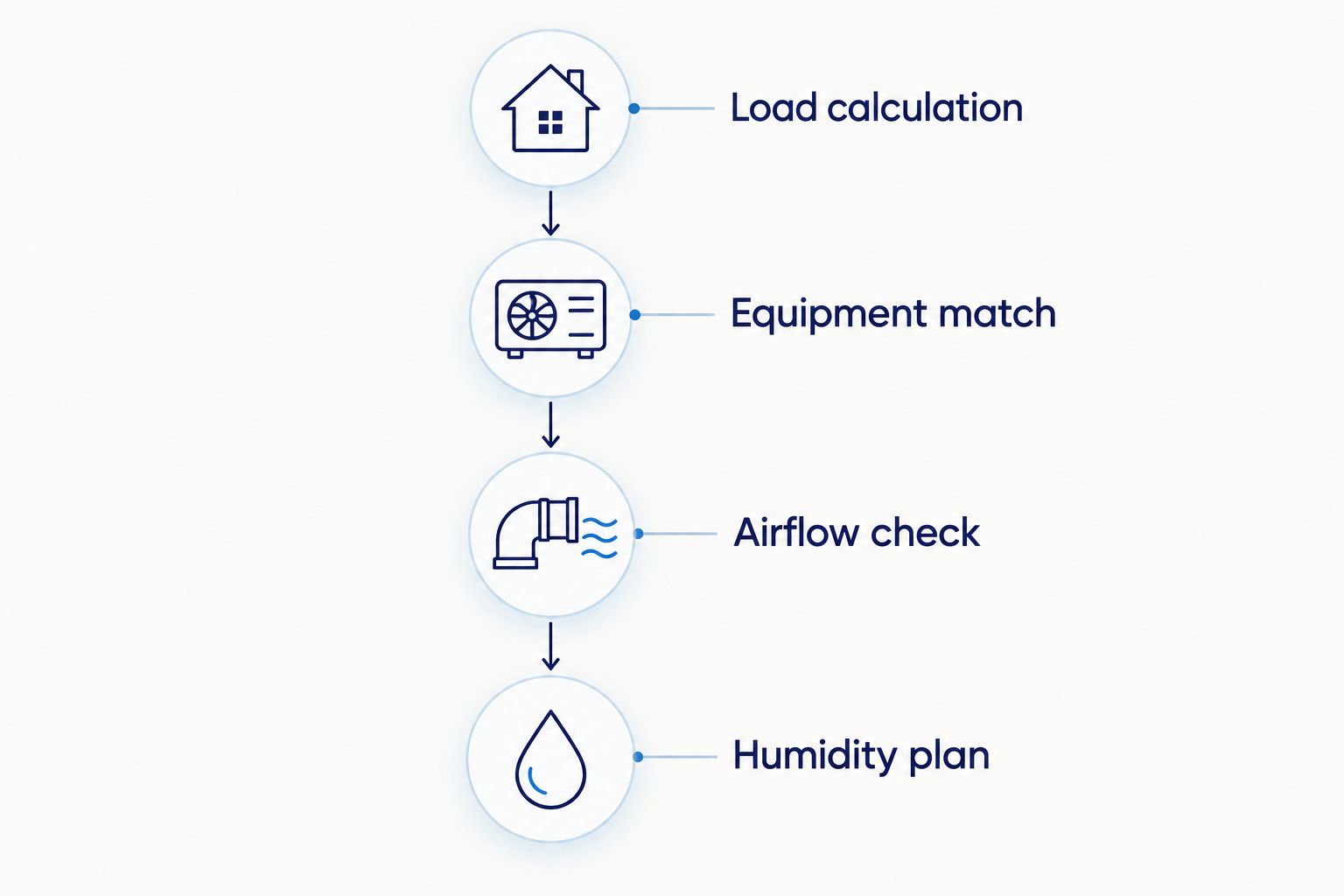
Ask the contractor to explain the proposed system in this order. You should understand why the capacity fits before discussing optional features.
Load calculation
Ask for a room-by-room load calculation using ACCA Manual J or another accepted residential sizing method. The inputs should reflect your actual windows, insulation, orientation, and conditioned rooms.
Equipment match
Ask how the proposed indoor and outdoor equipment meets that load. The nominal tonnage label isn't the same as verified cooling performance under the conditions used for selection.
Airflow check
Ask whether existing supplies and returns support the proposed system. Air resistance in the ducts, called static pressure, helps a technician assess whether the blower can move air as intended.
Humidity plan
Ask how the selected system will remove moisture during milder weather, when the house needs less cooling. Don't accept a larger capacity as the explanation for better humidity control.
Local conditions that deserve a closer look
Near the coast, salt air can corrode outdoor coils. Poor cooling from a deteriorated system doesn't prove the original capacity was too small, so the equipment's condition belongs in the diagnosis.
An enclosed lanai or sunroom also changes the discussion. Large glass areas and sun exposure affect cooling demand, and connecting an addition to existing ducts requires more than adding a vent.
Seasonal homes need a moisture-control plan while unoccupied. For a 2026 replacement in a snowbird home, explain how the house is used and ask how thermostat settings and system operation will address humidity during absences.
Which central AC capacity should you choose?
Choose the capacity supported by the load calculation and the selected equipment's actual performance. If two contractors recommend different tonnages, compare their inputs and airflow findings rather than choosing the larger proposal for reassurance.
A.R. Williams Air Conditioning explains central AC replacement options and provides transparent flat-rate pricing before work starts. Talk with a technician about your current comfort problems, especially rooms that stay warm or feel damp. Those details help define what the replacement needs to solve.
FAQ
What’s the best central air conditioner capacity for a Florida home?
The best capacity matches the home’s calculated cooling load and the selected equipment’s delivered performance. Square footage alone doesn’t account for windows, insulation, air leakage, or humidity needs.
Is a 5-ton AC better than a 3-ton AC?
A 5-ton AC has more nominal cooling capacity, but it isn’t automatically better. An oversized system can cool the thermostat area quickly without providing satisfactory moisture removal.
How many BTU per hour are in one ton of air conditioning?
One refrigeration ton equals 12,000 BTU/h. A 3-ton system therefore has a nominal cooling capacity of 36,000 BTU/h, although delivered performance depends on the selected equipment and operating conditions.
Can I choose AC tonnage from square footage?
Square footage alone is not enough to choose AC tonnage. A proper calculation also considers the building materials, windows, orientation, and outdoor-air load.
Should I replace my AC with the same tonnage?
The same tonnage is appropriate only when a current calculation supports it. Renovations, insulation improvements, window changes, or an originally incorrect selection can change the recommendation.
Will a bigger AC fix warm upstairs bedrooms?
A bigger AC does not automatically fix warm upstairs bedrooms. A technician should check room loads, supply airflow, return paths, and duct condition before recommending more whole-house capacity.
Does variable-speed operation mean AC sizing doesn’t matter?
Correct sizing still matters with variable-capacity equipment. The selected system must meet the peak cooling requirement and operate appropriately when demand is lower.
One last thing
Your old AC's nameplate tells you its nominal capacity, not what your house needs today. Bring a photo of that label to the estimate, along with notes about warm rooms and humidity. Treat it as background information, not the sizing instruction.
Related guides
- Can an oversized AC unit raise indoor humidity?
- Return-air vent sizing for South Florida HVAC systems
- How to get a second opinion on an AC replacement quote
