

Best overall for an enclosed pool house: a dedicated variable-speed central ducted system, if its minimum capacity fits the space. Best for a larger cabana with separate rooms: a two-stage central system. Best for an attached pool room: an engineered extension of the home's ducted system, but only after capacity and airflow checks. This 2026 guide compares those layouts so you can choose permanent cooling without buying more equipment than the building needs.
- The best AC system for pool house use matches the building’s cooling load, not just its floor area.
- Choose dedicated variable-speed central cooling when the equipment can operate low enough for the enclosed space.
- Consider two-stage central cooling for larger, divided cabanas; verify capacity before choosing equipment.
- A.R. Williams Air Conditioning helps homeowners compare central ducted AC options with clear explanations and upfront quotes.
Why this matters
A pool house has a different comfort problem from a bedroom. Sun through glass, wet towels, and doors opening onto the deck all affect the load. A room can feel cool and still feel damp.
Compact equipment is useful only when it fits the building's actual needs. Before comparing cabinets or efficiency ratings, start with a guide to choosing the right AC size. A small footprint does not automatically mean a small cooling requirement, and a small cooling requirement can rule out otherwise attractive central equipment.
An open-sided cabana is a different project altogether. The permanent AC options below apply to enclosed, weather-sealed spaces, not outdoor seating areas where conditioned air escapes continuously.
What makes the best pool house AC system?
For a 2026 installation, these are the criteria that should decide the shortlist:
- Capacity fit: The system must handle peak heat without being too large during quieter, less demanding periods.
- Moisture control: Equipment selection and controls must account for humidity, not just the thermostat temperature.
- Duct and return space: Supply ducts deliver cooled air. Return ducts bring room air back to the equipment. Both need a workable route.
- Physical fit: The indoor cabinet, outdoor unit, drain, and service access must fit without blocking walkways or maintenance.
- Building use: Occasional gatherings, daily exercise, and overnight guests create different operating needs.
- Coastal exposure: Outdoor placement should account for salt air, pool splash, and access for cleaning and repairs.
No equipment brand fixes a poor layout. A.R. Williams Air Conditioning is a certified Ruud Pro Partner, Carrier Authorized Dealer, and Daikin Comfort Pro, but the right pool house AC system still starts with sizing and installation design.
Pool house AC options at a glance
These are system configurations, not model recommendations. Exact equipment selection follows the building assessment.
| Option | Best for | Standout feature | Key limitation |
|---|---|---|---|
| Dedicated variable-speed central ducted system | Enclosed pool houses with changing cooling demand | Adjusts output across its operating range | Minimum output can still exceed a small room's needs |
| Two-stage central ducted system | Larger cabanas with separate occupied rooms | Offers lower and higher cooling stages | Less output flexibility than variable-speed equipment |
| Engineered extension or zoning of the home's central system | Attached pool rooms with a practical duct connection | Uses an existing central system where the design supports it | Requires verified capacity, duct sizing, and control compatibility |
1. Dedicated variable-speed central AC: best for changing demand
A dedicated variable-speed central system has its own indoor air handler, outdoor unit, and ductwork. Variable-speed equipment adjusts cooling output within its designed operating range instead of delivering full output every time it runs.
That flexibility suits an enclosed pool house where demand changes between a quiet morning and an afternoon gathering. Independent controls also let you manage the pool house without changing the main home's temperature.
The qualification matters: the equipment's lowest cooling output must suit the space. Even variable-speed central AC can be too large for a very small, well-insulated cabana. Ask for the minimum operating capacity, not just the maximum rating.
Variable-speed central AC pros:
- Independent temperature control for a detached building.
- Adjustable output as indoor and outdoor conditions change.
- Ducted distribution to the occupied parts of the space.
- Indoor equipment can sit outside the main seating area when the layout allows it.
Variable-speed central AC cons:
- Requires room for an air handler, ducts, and service access.
- Does not guarantee humidity control without correct sizing and settings.
- Its minimum capacity can eliminate it from consideration for a small building.
Best for: An enclosed pool house with enough cooling demand and space for a dedicated ducted installation.
Verdict: Buy when the load calculation and minimum equipment output agree. Do not approve a larger system simply because its cabinet fits.
2. Two-stage central AC: best for larger, divided cabanas
Two-stage central AC operates at a lower cooling stage or a higher cooling stage. Ductwork distributes that cooling to separate rooms, such as a lounge and changing area.
This configuration belongs on the shortlist when a larger cabana needs permanent central cooling but does not require the same output range as variable-speed equipment. The lower stage still needs to match the building's lighter-load conditions.
Room layout matters as much as the outdoor unit. A closed changing-room door should not cut off the path that lets air return to the system. Otherwise, one room can feel stuffy while the thermostat reports a comfortable temperature elsewhere.
Two-stage central AC pros:
- Provides distinct lower and higher cooling stages.
- Supports ducted air distribution across separate rooms.
- Keeps a detached cabana independent from the main house.
Two-stage central AC cons:
- Adjusts output in stages rather than across a wider variable range.
- Can still be oversized at its lower stage.
- Needs a planned return-air path for rooms used with doors closed.
Best for: A larger, enclosed cabana with multiple occupied rooms and a cooling load that matches the equipment's stages.
Verdict: Buy when both stages fit the building's expected demand. Hold the decision if the proposal lists only total capacity and says nothing about airflow between rooms.
3. Existing central AC extension: best for an attached pool room
An attached pool room can sometimes receive cooling from the home's existing central system. That requires a designed duct extension, and zoning is an option only when the equipment and duct system support it.
Zoning uses controlled duct dampers to direct air to different areas. It does not create extra cooling capacity. Adding a thermostat also does not prove that the existing blower can move enough air through the new layout.
This option makes sense only after an assessment of the home and the added room together. A long duct run to a detached building is not equivalent to adding a nearby room inside the same building envelope.
Existing-system extension pros:
- Uses existing central equipment when verified spare capacity exists.
- Can integrate an attached pool room into the home's ducted layout.
- Avoids a separate outdoor unit when the design supports that choice.
Existing-system extension cons:
- Can reduce comfort elsewhere if the original system lacks capacity.
- Needs duct, return-air, and control checks before approval.
- Ties pool-room operation to equipment that also serves the house.
Best for: An attached, enclosed pool room with a practical duct route and documented system capacity.
Verdict: Hold until the contractor verifies capacity and airflow. Skip an extension proposal based only on the statement that the existing AC is large enough.
How these options are ranked
This 2026 shortlist ranks configurations by capacity fit, independent control, moisture management, and installation practicality. It is not a ranking of manufacturer reliability or individual model performance.
Dedicated variable-speed central cooling takes the default position because adjustable output and independent control suit changing use. Two-stage central cooling earns its own slot for larger, divided spaces. An existing-system extension ranks separately because its suitability depends on the main home's equipment.
What to check before choosing equipment
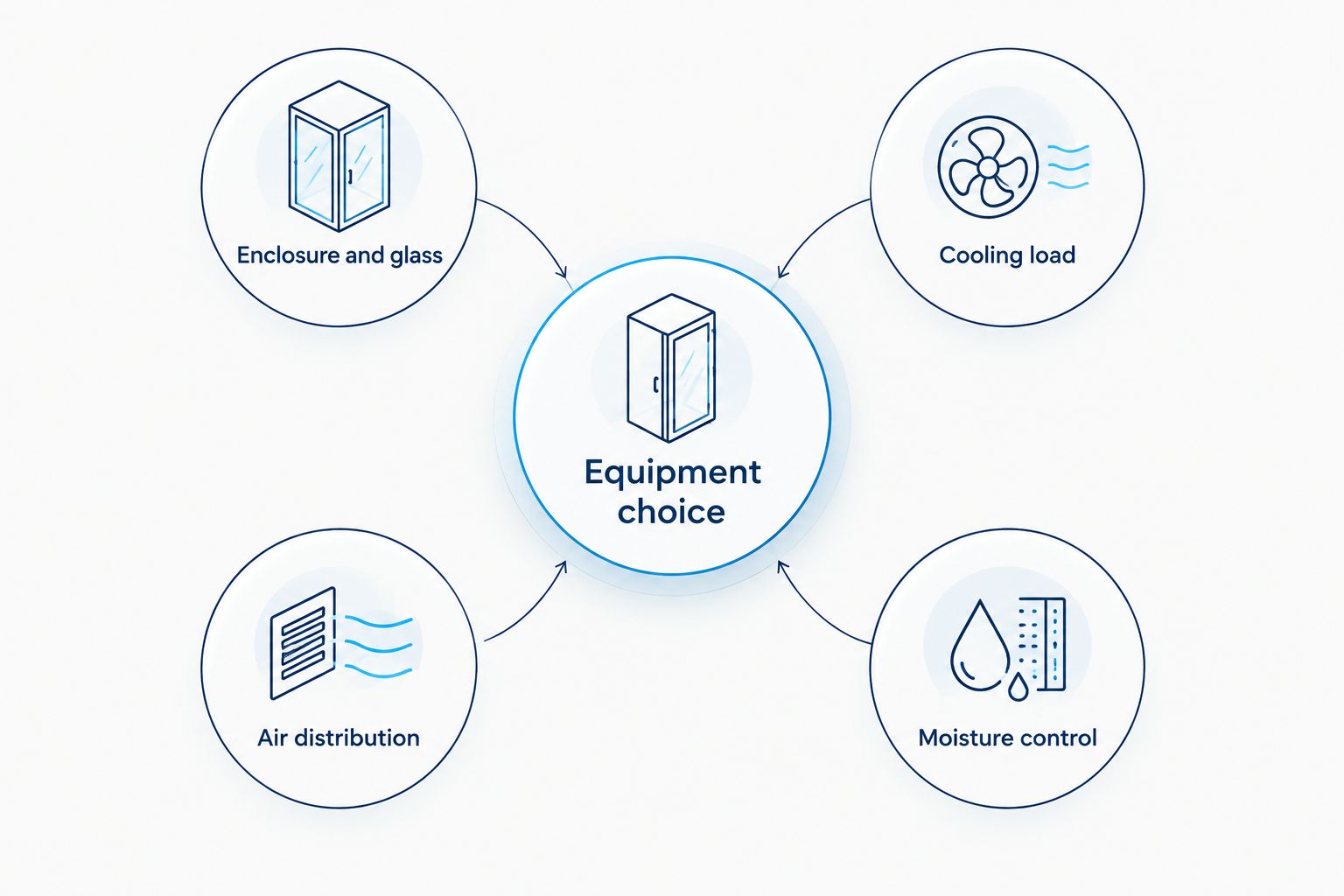
Enclosure and glass
Confirm that doors close properly and the roof and walls form a weather-sealed enclosure. Large glass doors facing afternoon sun can add substantial heat, even when the floor area is modest.
Include window direction, shading, and insulation in the assessment. Buying extra AC capacity instead of addressing an obvious opening leaves the underlying problem in place.
Cooling load
A cooling-load calculation estimates how much heat the system must remove. One cooling ton equals 12,000 BTU per hour, but that conversion does not tell you how many tons your pool house needs.
Square footage is a starting measurement, not an equipment specification. Even square-footage sizing benchmarks cannot account for your cabana's glass exposure, roof insulation, air leakage, or intended use. Ask the contractor to explain the building-specific calculation before recommending capacity.
Air distribution
Identify where cooled air enters and how it returns to the air handler. A supply register beside the thermostat can satisfy the controls before air reaches the far end of the room.
The duct plan should also consider furniture and closed doors. Those details belong in the design conversation before ceiling finishes hide the ductwork.
Moisture control
Ask how the system will manage humidity when cooling demand is low. A separate dehumidifier deserves consideration when moisture remains a problem despite suitable AC sizing and operation.
The EPA recommends keeping indoor relative humidity below 60%, ideally between 30% and 50%. Treat humidity as something to measure, not something to judge only by how cold the room feels.
Plan for poolside conditions, not just summer heat
Salt air can corrode outdoor coils near the coast. Pool splash and stored treatment chemicals create additional placement concerns. Keep the proposed equipment location separate from chemical storage, and have the installer follow the manufacturer's clearance requirements.
Do not hide the outdoor unit inside a tight decorative enclosure. Screens and landscaping need enough separation for airflow and future service. A neat-looking installation still needs room to breathe.
Condensate drainage deserves equal attention. AC removes water from indoor air, and that water needs a suitable drain route. Ask where the drain terminates and what protection is included against an overflow inside finished space.
For a seasonal home, discuss operation during extended absences. Leaving a pool house unattended does not remove its moisture load. In 2026, your control plan should explain temperature settings, humidity monitoring, and who checks the space while you are away.
What a clear installation proposal includes
You should be able to understand the recommendation without learning HVAC terminology. Ask for the following details in writing:
- The load calculation and selected equipment capacity.
- Indoor and outdoor equipment locations with service access.
- Supply ducts, return-air paths, and thermostat placement.
- Electrical work, drainage, and applicable permit responsibilities.
- The humidity-control approach and startup checks.
A.R. Williams Air Conditioning technicians explain what they find and lay out the options. Transparent flat-rate pricing is quoted before work starts, so you can evaluate the proposed work without pressure.
That explanation should include limitations. If central equipment is too large for the space, or the building needs enclosure work first, those findings belong in the conversation before an installation decision.
Which pool house AC system should you choose?
Start with dedicated variable-speed central ducted cooling for an enclosed pool house, then confirm that its minimum output fits. For a larger cabana with separate rooms, compare a properly sized two-stage central system. For an attached room, investigate the existing system before adding separate equipment.
A.R. Williams Air Conditioning is a fit for homeowners who want pool house AC options explained before they approve the work. Request an estimate and ask for a building assessment, not a recommendation based on floor area alone.
FAQ
What’s the best AC system for a small enclosed pool house?
A dedicated variable-speed central ducted system is a strong starting point only when its minimum output fits the cooling load. Very small spaces can fall below the suitable operating range of central equipment, so confirm sizing before choosing a model.
Can I air-condition an open cabana?
The permanent central AC options in this guide are intended for enclosed, weather-sealed spaces. An open cabana lets cooled air escape continuously, so enclosure needs to be addressed before selecting this equipment.
Can my home’s existing AC cool the pool house too?
An existing central system can serve an attached pool room only when capacity, ductwork, and return airflow support the added space. Adding a duct or thermostat without those checks can reduce comfort in the main home.
Does a bigger AC remove more humidity from a pool house?
A bigger AC does not automatically provide better humidity control. Oversized equipment can satisfy the temperature setting before it removes enough moisture, so capacity and operation need to match the building.
Do I need a dehumidifier as well as air conditioning?
A separate dehumidifier deserves consideration when measured humidity stays high despite appropriate AC sizing and operation. First check air leakage, operating settings, and moisture sources rather than assuming the AC needs more capacity.
Where should the outdoor AC unit go near a pool?
Place the outdoor unit where it has manufacturer-required clearances, service access, and separation from pool splash and chemical storage. Coastal exposure and the route for electrical and refrigerant connections also affect the location.
Should I turn off pool house AC when nobody is using it?
Do not base the operating plan on occupancy alone, because an unused enclosed pool house can still accumulate moisture. Agree on temperature and humidity settings that suit the building and arrange checks during extended absences.
One last thing
Before your 2026 installation visit, photograph the pool house with its doors in their usual positions. Note whether guests normally leave the pool-facing door open. That habit changes the cooling conditions, and no equipment selection can compensate reliably for an enclosure that stays open.
Related guides
- Best AC systems for high-humidity climates
- Can an oversized AC unit raise indoor humidity?
- AC maintenance for coastal homes with salt air exposure
