

Best overall: properly sized variable-speed central AC. Best for an existing theater with uneven cooling: central AC with corrected ductwork. Best for separate movie-night schedules: zoned central AC. For a Florida home theater in 2026, the right choice depends on heat from people and equipment, airflow with the door closed, and how much sound reaches your seats.
- The best cooling system for a Florida home theater combines quiet central AC, adequate airflow, and humidity control.
- Choose variable-speed central AC when replacing equipment, provided sizing and ductwork support the room.
- Correct duct problems before adding cooling capacity to an otherwise comfortable home.
- A.R. Williams Air Conditioning explains central AC repair and replacement options before work starts.
Why this matters
A theater can feel comfortable before a movie and become warm once everyone sits down. People release heat, electronics add heat, and a closed door changes how air moves through the room. A hallway thermostat doesn't necessarily reflect those conditions.
You don't automatically need another AC system. Start with how to cool a home theater efficiently, then ask a technician to separate an airflow problem from a capacity problem. That distinction prevents replacing equipment that isn't causing the discomfort.
What makes the best home theater cooling system?
Use these criteria to compare a 2026 proposal, rather than choosing by equipment size alone:
- Room-specific capacity: The design accounts for windows, insulation, occupants, and operating electronics.
- Quiet airflow: Ducts and grilles deliver the required air without distracting hiss or rumble.
- Closed-door performance: Supply air has a suitable path back to the system when the theater door closes.
- Humidity control: The room feels dry without requiring an unnecessarily low thermostat setting.
- Appropriate controls: The system responds to theater use without making the rest of the house uncomfortable.
- Service access: Filters, drains, and equipment remain accessible after cabinetry and acoustic treatments go in.
Home theater cooling options at a glance
These are system configurations, not interchangeable products. Some solve different problems and work together, such as variable-speed central AC with properly designed zoning.
| Cooling configuration | Best for | Standout feature | Key limitation |
|---|---|---|---|
| Variable-speed central AC | Whole-home replacement that includes a theater | Adjusts cooling output to changing demand | Cannot correct inadequate ducts by itself |
| Existing central AC with duct corrections | An isolated warm room in an otherwise comfortable house | Addresses delivery and return-air restrictions | Existing equipment must have sufficient capacity |
| Zoned central AC | Theater use on a different schedule | Gives a defined area separate temperature control | Requires compatible equipment and airflow design |
| Dedicated ducted central system | A separate, heavily used theater | Separates theater cooling from the main house | Needs equipment space and another system to maintain |
| Central AC with whole-home dehumidification | A room that is cool but persistently clammy | Handles moisture when temperature is already satisfied | Dehumidification does not replace cooling capacity |
1. Variable-speed central AC: best for whole-home replacement
Variable-speed central AC adjusts its cooling output instead of operating only at full capacity. In a properly designed system, that flexibility helps match changing conditions as the theater fills up or equipment switches off.
This is the default replacement configuration to evaluate, not a reason to discard working equipment. Indoor sound still depends on blower settings, duct dimensions, and grille placement. A quiet outdoor unit doesn't guarantee a quiet theater.
Variable-speed central AC pros:
- Adjusts output as cooling demand changes.
- Can support longer, lower-output operation that helps manage moisture.
- Serves the theater through central ductwork without equipment mounted inside the viewing room.
Variable-speed central AC cons:
- Restricted ducts can still cause noise and uneven temperatures.
- Performance depends on compatible controls and correct setup.
Best for: Homeowners already replacing central AC who want the theater included in the design.
Verdict: Buy when replacement is justified and the proposal includes room airflow, humidity settings, and sound considerations.
2. Existing central AC with duct corrections: best for one warm room
If the rest of your home stays comfortable, investigate the theater's ducts before selecting new equipment. A restricted branch duct, leaking connection, or inadequate return-air path can leave the room warm even when the AC itself works properly.
A technician should evaluate airflow with the theater door closed. In older homes, a return arrangement that worked for an open living area can struggle after that space becomes an enclosed media room.
Central AC with duct corrections pros:
- Addresses a room-level problem directly.
- Keeps serviceable central equipment in use.
- Can reduce grille noise when excessive restriction causes the sound.
Central AC with duct corrections cons:
- Cannot compensate for an undersized or failing system.
- Duct access can require work around ceilings or finished surfaces.
Best for: A theater that is warmer than nearby rooms while the rest of the house cools normally.
Verdict: Hold on equipment replacement until a technician checks supply airflow and the closed-door return path.
3. Zoned central AC: best for a separate viewing schedule
Zoning uses controls and motorized duct dampers to direct cooling to defined areas. It can suit a theater used in the evening when other parts of the house need less cooling.
Zoning is more than adding another thermostat. The equipment must operate safely when only a smaller area requests cooling, and the duct design must keep airflow within the system's requirements.
Zoned central AC pros:
- Gives the theater's area a separate temperature setting.
- Responds to different occupancy schedules.
- Allows the main equipment to serve multiple areas through planned controls.
Zoned central AC cons:
- A small theater alone might not support the equipment's minimum airflow.
- Poor damper design can cause noise and pressure problems.
Best for: A theater within a suitable zone that needs cooling on a different schedule from the main living area.
Verdict: Buy only after the contractor confirms equipment compatibility and minimum airflow for each operating condition.
4. Dedicated ducted central system: best for a separate theater
A dedicated ducted system cools the theater independently of the main house. It deserves consideration when a substantial, enclosed theater has a distinctly different heat load or the existing system cannot reasonably serve it.
The design needs space for the indoor equipment, outdoor equipment, ducts, and drainage. Placement matters because vibration and equipment sound can travel into the listening area.
Dedicated ducted central system pros:
- Provides independent temperature control.
- Keeps theater cooling demand separate from the main system.
- Allows duct placement specifically for the viewing room.
Dedicated ducted central system cons:
- Requires another system to maintain.
- Installation depends on equipment space, electrical capacity, and feasible duct routes.
Best for: A separate, frequently used theater whose documented cooling needs justify independent equipment.
Verdict: Buy for a demonstrated independent load, not simply because the room contains a projector.
5. Central AC with dehumidification: best for cool but clammy rooms
A whole-home dehumidifier removes moisture separately from the AC's temperature-driven cooling cycle. It addresses a different problem from insufficient cooling: a theater that reaches its thermostat setting but still feels damp.
First, check for air leaks, drainage problems, incorrect settings, and equipment sizing. Adding dehumidification without finding the moisture source can leave an underlying defect unresolved.
Central AC with dehumidification pros:
- Removes moisture when the thermostat doesn't require more cooling.
- Reduces the temptation to keep lowering the temperature.
- Separates humidity management from temperature control.
Central AC with dehumidification cons:
- Adds equipment, drainage requirements, and maintenance.
- Does not fix inadequate cooling capacity or restricted airflow.
Best for: A theater with measured humidity problems after the central AC and building conditions have been checked.
Verdict: Buy after diagnosis confirms a moisture-control need. Skip it as a substitute for an airflow repair.
Size the theater around actual use
For a 2026 installation, ask for a room-by-room cooling-load calculation, often called a Manual J calculation. This estimates how much cooling each room needs from its construction, exposure, and intended use. Floor area alone doesn't capture a theater's operating conditions.
For scale, an equipment load of 500 watts becomes about 1,706 BTU per hour of heat when that energy ends up inside the room. One ton of AC capacity equals 12,000 BTU per hour. These are unit conversions, not measurements of your theater or a recommendation to add a particular equipment size.
Give the technician your normal seating count and equipment list. Actual operating power is more useful than assuming every device continuously draws the maximum figure printed on its label.
A.R. Williams Air Conditioning provides central AC repair, installation, and maintenance. Ask the technician to explain whether the theater's problem comes from the equipment, the air distribution, or moisture before discussing replacement.
Check the room with the door closed
A theater's sound isolation changes its airflow needs. If you seal the doorway for better listening, supply air still needs a planned path back to the AC system. Don't assume a door gap is sufficient.
The assessment should connect four checks:
- Heat load: How much cooling the occupied room requires.
- Supply airflow: How much conditioned air reaches the room.
- Return path: How air leaves with the door closed.
- Sound control: How the air route affects listening comfort and privacy.
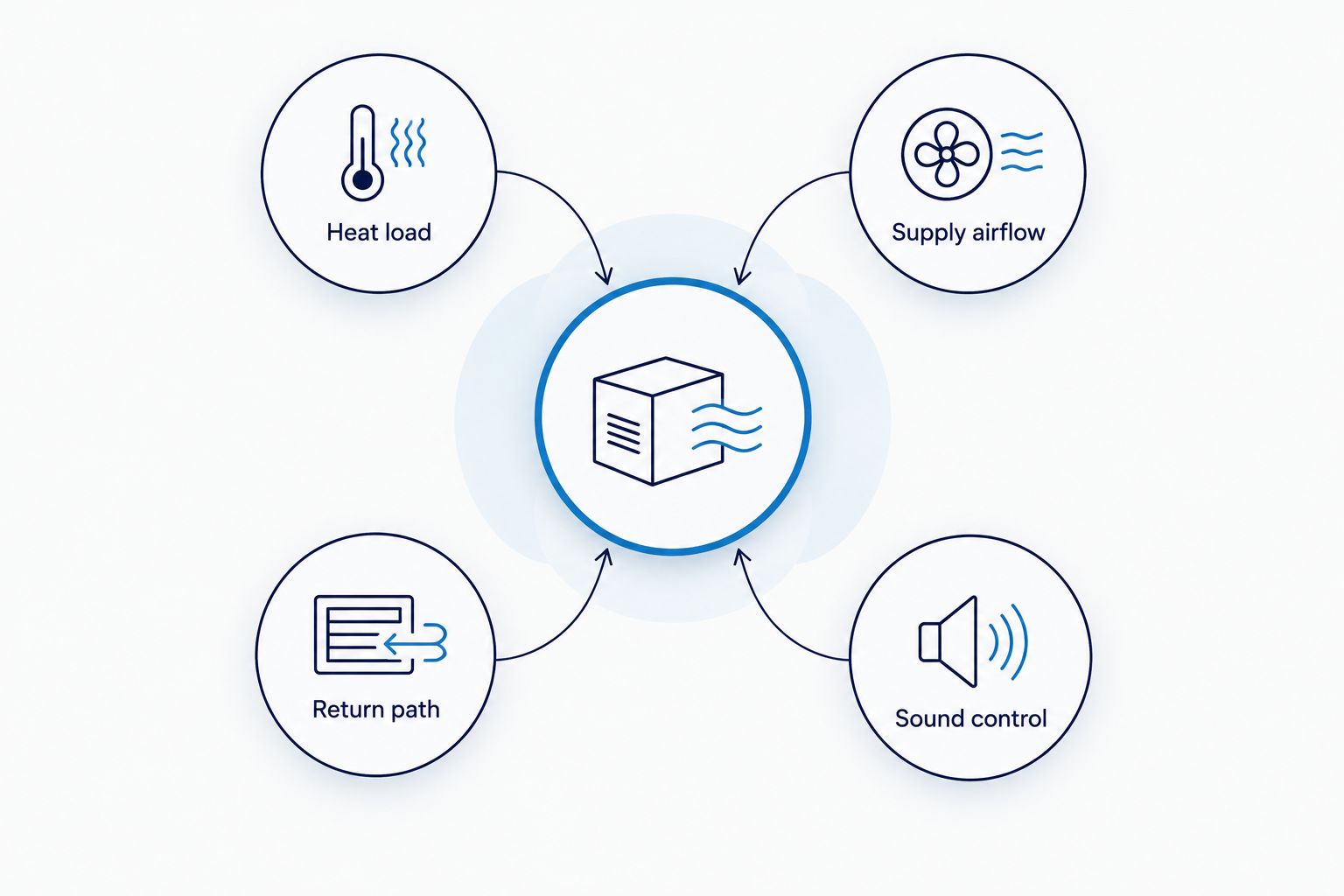
Ask the HVAC contractor and theater installer to coordinate return locations and acoustic treatment. An open transfer grille can carry dialogue into the hallway, while an improvised sound-blocking enclosure can restrict airflow. Neither trade should solve its problem by creating one for the other.
Account for Florida moisture and coastal exposure
Humidity deserves its own check. Ask the technician to measure it rather than judging only by the thermostat temperature. Oversized equipment can satisfy the temperature setting before it removes enough moisture.
Near the coast, salt air can corrode outdoor coils. Equipment location and maintenance access matter even though the theater sits indoors. Keep outdoor equipment considerations in the proposal instead of focusing exclusively on what you hear inside.
Seasonal homes need a plan for periods without occupants, too. Don't use a movie-night temperature preference as the only basis for the home's unattended humidity settings.
How the ranking works
These 2026 recommendations prioritize the problem each configuration solves: replacement, uneven airflow, separate schedules, independent cooling, or excess moisture. Quiet operation and closed-door performance matter across every option.
This is a configuration guide, not a tested ranking of individual models. Equipment selection follows the load calculation and duct assessment, rather than replacing them.
Which cooling system should you choose?
Choose properly sized variable-speed central AC as the default when replacement is already necessary. If the existing system works and only the theater feels warm, start with ductwork and return airflow instead.
A.R. Williams Air Conditioning suits homeowners who want central AC options explained and flat-rate pricing quoted before work starts. Request findings that distinguish a necessary repair from an optional improvement, with the proposed work explained clearly.
FAQ
What’s the best cooling system for a home theater in Florida?
Properly sized variable-speed central AC is the default configuration to evaluate when replacing a home’s system. An existing theater with isolated discomfort should have its ductwork and return airflow checked before equipment replacement.
Why does my theater get hot when the door is closed?
Closing the door can restrict the room’s return-air path. People and electronics also add heat, so a technician should check airflow and cooling demand under normal viewing conditions.
Will a bigger AC make my media room more comfortable?
A bigger AC is not the right fix for restricted ducts or an inadequate return path. Oversized equipment can also cool too quickly to manage humidity effectively, so sizing needs a room-by-room calculation.
Is zoned AC better than a separate system for a theater?
Zoning fits a theater that the existing equipment and ductwork can serve safely as a defined area. A separate ducted system fits an independent cooling load that justifies its own equipment and maintenance.
How do I keep AC noise out of quiet movie scenes?
Have the contractor evaluate duct size, grille airflow, equipment placement, and vibration transmission. An equipment sound rating alone does not describe what you will hear at the seats.
Does a home theater need a dehumidifier?
A home theater needs separate dehumidification only when measured moisture conditions justify it. Check AC sizing, operation, drainage, and air leaks before adding equipment.
Can I hide the return vent behind acoustic panels?
Do not cover a return vent with acoustic panels unless the assembly is specifically designed to preserve the required airflow. Coordinate the acoustic treatment and return-air design before finishing the room.
One last thing
A thermostat reading doesn't prove the theater cools properly. For a 2026 theater renovation, ask for a final comfort check with the door closed and the usual equipment operating. That reflects the room you actually use, not an empty space with an open doorway.
Talk with a technician at A.R. Williams Air Conditioning about the symptoms you notice during a movie. Include whether the room gets warm, feels damp, or becomes noisy when the blower runs, so the discussion starts with the right problem.
Related guides
- How to choose the right AC size for your home
- How to reduce indoor humidity without overworking your AC
