

Best overall: a correctly sized variable-capacity central heat pump. Best for homeowners who want simpler capacity control: a two-stage central heat pump. Best for straightforward operation: a single-stage central heat pump. For South Florida winters, choose equipment that also handles your home's much longer cooling season well.
- The best heat pump for South Florida balances winter heating with summer cooling and humidity control.
- Variable-capacity central heat pumps offer the most flexibility when cooling demand changes.
- Two-stage and single-stage systems fit different needs, but neither fixes undersized returns or leaking ducts.
- A.R. Williams Air Conditioning helps homeowners compare heat pump options with clear explanations before work starts.
A cold morning doesn't mean you need the biggest heating system on the proposal. You need enough heating capacity for your house, dependable cooling, and controls that work with the equipment. Start with choosing the right AC size for your home before comparing equipment features.
Why this matters
A heat pump moves heat rather than creating it with electric resistance elements. In cooling mode, it carries heat outdoors. In heating mode, it reverses that process and brings heat inside.
South Florida's mild winters make that approach practical, but winter performance is only part of the decision. A system that heats well and leaves your home clammy during mild, humid weather is still a poor fit.
Choose a heat pump for year-round comfort, not for the coldest morning alone. Your 2026 replacement proposal should explain both heating and cooling performance, along with any airflow corrections the house needs.
What makes the best heat pump for South Florida?
These criteria matter more than a brand badge or a long feature list:
- Correct sizing: A room-by-room load calculation estimates the heating and cooling your house actually needs.
- Capacity control: The compressor's ability to adjust output affects how closely the system follows changing demand.
- Humidity performance: Cooling runtime, indoor airflow, and control settings determine how effectively the system removes moisture.
- Duct compatibility: Returns and supply ducts must carry the required airflow without excessive resistance or leakage.
- Coastal suitability: Salt exposure, equipment placement, and manufacturer-approved maintenance deserve attention near the water.
- Installation quality: The indoor unit, outdoor unit, thermostat, and backup heat must work together as a documented combination.
No compressor type compensates for a badly restricted return. Ask the contractor to explain the home's limitations before discussing upgrades.
Heat pump options at a glance
These are central ducted system types, not a ranking of individual manufacturers. Compare the actual equipment combinations proposed for your house in 2026.
| Option | Best for | Standout feature | Key limitation |
|---|---|---|---|
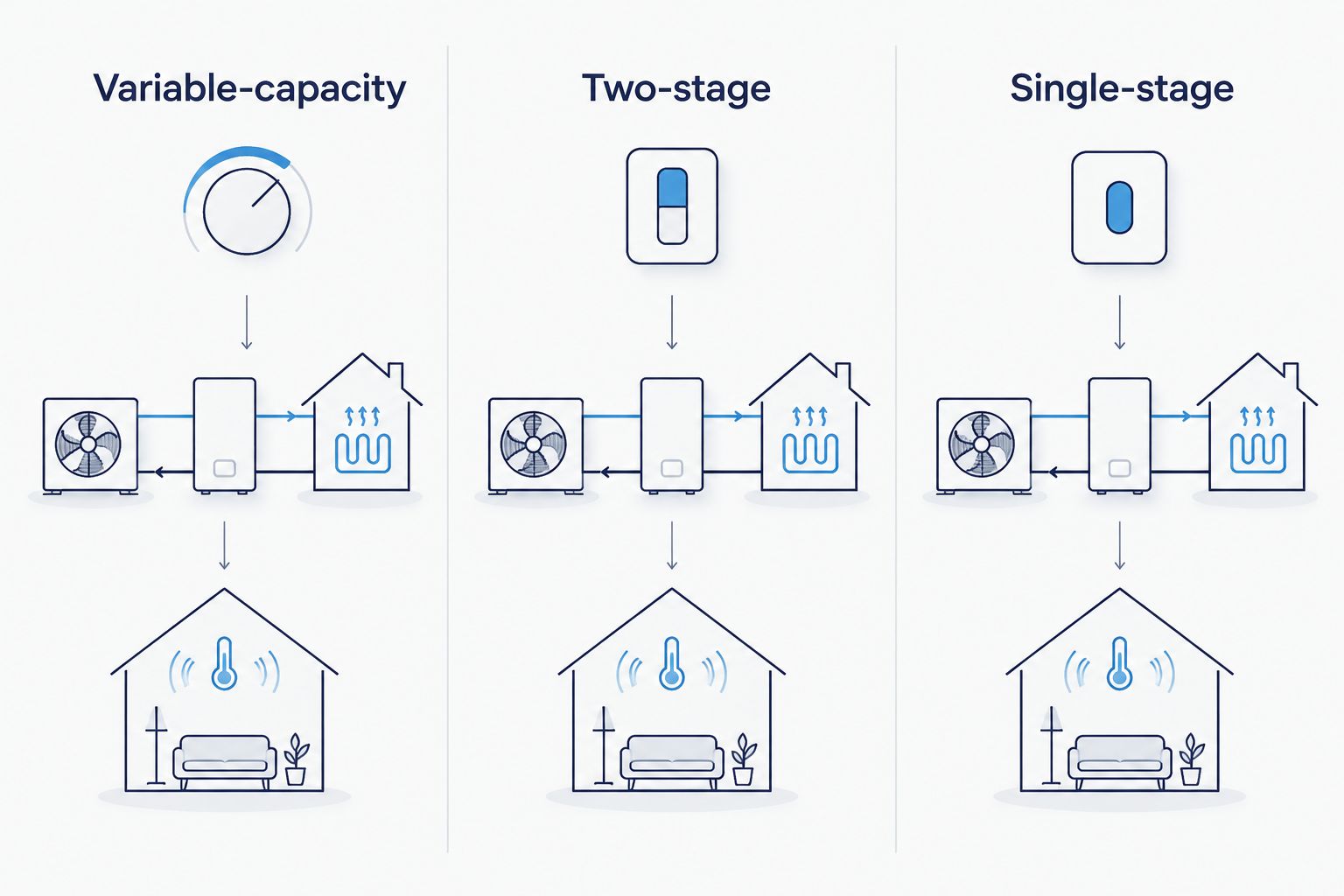
| Variable-capacity central heat pump | Changing cooling demand and closer temperature control | Adjusts compressor output across a range | Depends on compatible controls and careful setup |
| Two-stage central heat pump | Homeowners who want defined low and high settings | Uses two compressor capacity levels | Cannot adjust output as finely as variable-capacity equipment |
| Single-stage central heat pump | Straightforward operation in a home with suitable airflow | Runs at one compressor capacity when operating | Cannot reduce compressor output during lighter demand |
The table describes operating differences, not guaranteed results. Equipment sizing, duct condition, and installation settings determine how those differences translate into comfort.
1. Variable-capacity: best for changing cooling demand
A variable-capacity central heat pump adjusts compressor output across a range instead of operating only at full capacity. That gives the system more flexibility as outdoor conditions and indoor demand change.
For a homeowner who wants steadier temperatures, this is the strongest starting point. Its ability to operate at reduced output supports longer cooling cycles under suitable conditions, but humidity results still depend on airflow and control settings.
Variable-capacity pros:
- Adjusts output more closely to changing demand.
- Supports longer operation at reduced capacity.
- Offers finer temperature control when properly configured.
Variable-capacity cons:
- Requires compatible controls to deliver the intended operation.
- Adds diagnostic complexity compared with simpler equipment.
- Does not independently solve moisture entering through leaks or poor ventilation control.
Best for: Homeowners replacing a central system who prioritize close temperature control across changing weather.
During a 2026 estimate, ask whether the proposal includes a compatible thermostat and how the technician will configure cooling airflow. A variable-speed indoor blower alone does not establish that the outdoor compressor has variable capacity.
Verdict: Buy when the proposed equipment match, controls, and duct assessment support the upgrade.
2. Two-stage: best for defined low and high operation
A two-stage central heat pump operates at a lower compressor capacity or a higher one. It provides a middle option between single-stage operation and the finer adjustments of variable-capacity equipment.
Lower-stage cooling can extend runtime compared with full-output operation under similar conditions. Whether that improves comfort in your house depends on sizing, thermostat configuration, and indoor airflow.
Two-stage pros:
- Provides a lower operating stage for lighter demand.
- Adds capacity flexibility without continuous modulation.
- Gives homeowners a clear low-and-high operating arrangement.
Two-stage cons:
- Offers fewer capacity adjustments than variable-capacity equipment.
- Needs controls that correctly manage both stages.
- Still cycles off when demand falls below its lower-stage output.
Best for: Homeowners who want staged operation without choosing a continuously adjusting compressor.
Ask the installer to explain what activates the higher stage. The answer should describe the proposed equipment and thermostat, not a generic promise that the system will always run on low.
Verdict: Buy when two operating stages meet your comfort needs and the installation includes proper stage control.
3. Single-stage: best for straightforward operation
A single-stage central heat pump runs at one compressor capacity when it is on. The thermostat cycles the system on and off to maintain the selected temperature.
This design can provide dependable heating and cooling in a correctly sized installation. Its limitation is flexibility: it cannot reduce compressor output when the house needs only a little cooling.
Single-stage pros:
- Has a straightforward on-and-off operating pattern.
- Uses a simpler capacity-control arrangement.
- Provides both heating and cooling through the same central system.
Single-stage cons:
- Cannot reduce compressor output during mild weather.
- Has less flexibility for controlling temperature swings.
- Oversizing can produce short cooling cycles and poor moisture removal.
Best for: Homeowners who value straightforward operation and have a house with verified sizing and suitable ducts.
Do not reject a sound single-stage proposal solely because another system has more features. Compare the installation scope first, especially duct corrections and the indoor-outdoor equipment match.
Verdict: Buy when the load calculation and comfort assessment support it; skip an oversized proposal.
What to check before choosing equipment
Size the house, not the old nameplate
An existing system's capacity is a clue, not proof of what belongs in the house. Window replacements, insulation changes, additions, and duct problems all affect the assessment.
For reference, 1 ton of cooling equals 12,000 BTU/h. A 2-ton system provides a nominal 24,000 BTU/h, while a 3-ton system provides a nominal 36,000 BTU/h. Those are capacity conversions, not recommendations based on floor area.
Ask for the reasoning behind the selected size. A proposal that repeats the old capacity without evaluating the house leaves an important question unanswered.
Check the return and supply ducts
Older homes can have return openings that restrict airflow. Installing new equipment without addressing that restriction leaves the new system working against the same problem.
A technician should assess airflow and static pressure, which is the resistance the blower works against. Duct leakage also deserves attention, particularly where ducts pass through a hot attic.
Treat humidity as a separate question
A thermostat measures temperature, but comfortable air also depends on moisture. Ask how the proposed system handles mild days when the house needs little cooling.
The relationship between AC systems and high-humidity conditions matters throughout the year. Capacity control helps, but moisture sources and duct leakage still need their own assessment.
Avoid short cycling before blaming the heat pump
Short cycling means the system starts and stops repeatedly instead of completing normal operating cycles. Oversizing is one possible cause, but restricted airflow, control problems, and equipment faults also need investigation.
Correct sizing and verified airflow help prevent heat pump short cycling, so a replacement proposal should address those conditions rather than promise that a different brand will solve everything.
For your 2026 installation, ask the contractor to document startup checks. That includes the equipment match, airflow assessment, refrigerant charging procedure, and thermostat configuration according to the manufacturer's instructions.
A new system should come with an explanation of normal operation. Longer low-output cycles on suitable equipment are different from repeated starts and stops, and homeowners should know the distinction.
Coastal exposure and winter heating details
Salt air can corrode outdoor coils and metal components near the coast. Ask which protective features the proposed equipment actually has, along with the manufacturer's cleaning and maintenance instructions.
Do not assume a coating eliminates maintenance or that every coastal warranty has the same exclusions. Read the terms for the exact equipment before signing.
Winter operation deserves a separate conversation. Electric backup heat, when installed, uses resistance elements rather than the heat pump's normal heat-transfer process. Ask when the controls activate it and whether the home's electrical system supports the proposed arrangement.
Seasonal residents should also ask how to manage the house while away. Turning heating and cooling off for an extended absence does not address indoor moisture, so thermostat settings and ongoing system checks need a plan.
How these options were ranked
This ranking prioritizes capacity control and year-round comfort, followed by duct compatibility and installation requirements. It is not a manufacturer reliability ranking or a claim that one system type fits every house.
Variable-capacity equipment ranks first because it offers the widest adjustment range. Two-stage equipment occupies the middle position, while single-stage equipment fits homeowners whose assessment supports simpler operation.
A.R. Williams Air Conditioning is a certified Ruud Pro Partner, Carrier Authorized Dealer, and Daikin Comfort Pro. Those relationships identify dealer credentials, not a reason to skip comparing the exact equipment and installation scope.
Which heat pump should you choose?
Start with a variable-capacity central heat pump if close temperature control is your priority. Then compare it with a two-stage proposal that includes the same duct and installation work.
For a 2026 replacement, request a written scope that identifies the indoor unit, outdoor unit, controls, duct corrections, and backup heat arrangement. Ask who handles the applicable permit and inspection requirements. Those details make proposals easier to compare without pressure.
A.R. Williams Air Conditioning is a good fit for homeowners who want their central heat pump options explained before work starts. Technicians explain findings and lay out the options, with transparent flat-rate quotes before the work begins.
Talk through your heat pump options
Discuss your home’s heating, cooling, and airflow needs before choosing replacement equipment.
FAQ
What’s the best heat pump for South Florida winters?
A correctly sized variable-capacity central heat pump is the strongest starting point when close temperature control is your priority. Compare its cooling performance, controls, and duct requirements with the other options proposed for your house.
Is a two-stage heat pump better than a single-stage system?
A two-stage heat pump offers more capacity flexibility than a single-stage system. It can operate at a lower stage during lighter demand, but sizing and airflow still determine the result.
Will a heat pump keep my house warm during a cold spell?
A properly selected heat pump should meet the heating requirements established for your house’s design conditions. Ask the installer to explain heating capacity and when any electric backup heat will operate.
Does variable-speed equipment automatically fix indoor humidity?
No, variable-speed equipment does not automatically fix indoor humidity. Compressor capacity, blower settings, duct leakage, and moisture entering the house all affect the outcome.
Can I keep my existing air handler when replacing the outdoor unit?
Keep the existing air handler only if the proposed combination is approved and compatible. Refrigerant requirements, controls, coil condition, and documented equipment matching need verification.
Why does heat pump air feel less hot than furnace air?
Heat pump supply air can feel less hot because normal heat pump operation delivers heat differently from a combustion furnace. Judge performance by whether the house reaches and maintains the thermostat setting, and have unexpected changes checked.
Should I replace a working AC just to get heat pump heating?
Not automatically, because the condition and capabilities of your existing system matter. Compare its heating arrangement, repair history, and cooling performance before deciding whether replacement solves a real need.
One last thing
A variable-speed blower and a variable-capacity compressor are different components. Before choosing a heat pump, ask the technician to identify both on the proposal and explain what each does. That small clarification prevents a feature label from standing in for an actual equipment comparison.
Related guides
- Return air vent sizing for South Florida HVAC systems
- AC maintenance for coastal homes with salt air exposure
- How to read your AC installation contract before signing
