

Best overall for an existing rooftop package system: a properly sized packaged heat pump. Best cooling-only replacement: a packaged air conditioner. Best for a home with an indoor air handler: a compatible roof-mounted split-system condenser. For your 2026 replacement, the right choice starts with the equipment layout and roof condition, not a brand ranking.
- The best rooftop AC unit for flat roof home replacements depends on existing ductwork, roof support, and cooling needs.
- Choose a packaged heat pump when your approved rooftop layout needs both cooling and heating.
- Choose a packaged air conditioner when cooling-only equipment fits the home’s heating plan.
- A.R. Williams Air Conditioning provides AC installation consultations for homeowners who want clear replacement options.
Why the roof matters as much as the AC
A flat roof doesn't automatically need a rooftop air conditioner. Some homes use a single rooftop cabinet connected directly to ducts. Others have an outdoor condenser on the roof and a separate indoor air handler, the cabinet that moves air through your home.
Those layouts require different equipment. Replacing one with the other changes the installation scope, so identify what you have before comparing proposals.
Start with how to choose the right AC size for your home. A larger unit doesn't correct restricted ductwork or a leaking roof connection, and excess cooling capacity can leave the house cool but damp.
What makes the best rooftop AC for a flat-roof home?
Use these criteria to narrow your 2026 shortlist:
- System compatibility: The equipment must match the home's duct layout, electrical supply, and heating needs.
- Roof support: The structure and equipment support must suit the proposed unit and installation design.
- Water protection: Roof openings, flashing, and condensate drainage need a defined scope of work.
- Humidity control: Correct sizing and airflow matter alongside the equipment's cooling features.
- Wind attachment: The mounting design needs documentation appropriate to the property and local requirements.
- Service access: Technicians need safe access and the manufacturer's required working clearances.
Reject a proposal that names a unit but leaves its roof attachment or drainage unexplained. Those details belong in the installation plan, not in a conversation after equipment arrives.
Rooftop AC options at a glance
These are equipment configurations, not individual model recommendations. Each has a different job; none is the default for every flat-roof house.
| Option | Best for | Standout feature | Key limitation |
|---|---|---|---|
| Packaged heat pump | Replacing a rooftop package system that needs cooling and heating | Cooling and heat-pump heating in one outdoor cabinet | Requires compatible ducts, roof support, and heating controls |
| Packaged air conditioner | Replacing a cooling-only rooftop package system | Cooling equipment and indoor-air components share one cabinet | Does not provide heat-pump heating |
| Roof-mounted split-system condenser | Keeping an existing indoor air-handler layout | Leaves the indoor air-moving equipment separate from the outdoor unit | Requires a documented compatible indoor and outdoor combination |
1. Packaged heat pump: best for cooling and heating in one cabinet
A packaged heat pump contains the main cooling and air-moving components in one outdoor cabinet. It connects to your home's supply and return ducts and reverses its refrigeration cycle to provide heating.
Best for: A home with an existing rooftop package layout that needs both cooling and heating. This is the strongest starting point when the roof and ducts are suitable and the replacement doesn't require a major layout change.
Packaged heat pump pros:
- Provides cooling and heat-pump heating through the same duct system.
- Keeps the main air-handling components outside the living space.
- Can retain a suitable existing rooftop package arrangement.
Packaged heat pump cons:
- Roof access is necessary for servicing the main equipment.
- Duct connections through the roof require careful weatherproofing.
- Existing supports and openings still need evaluation, even for a similar-looking replacement.
Ask which operating features the proposed model actually includes. A heat-pump label alone doesn't establish variable-capacity operation, humidity controls, or corrosion protection.
Verdict: Buy a packaged heat pump when the documented roof, duct, and heating requirements support it.
2. Packaged air conditioner: best for a cooling-only package replacement
A packaged air conditioner puts the cooling components and blower in one outdoor cabinet. Unlike a heat pump, it doesn't reverse its refrigeration cycle to heat the home. Any heating provision needs separate confirmation in the equipment proposal.
Best for: A homeowner replacing an existing cooling-only rooftop package system whose heating needs are already addressed. Keep this option separate from a heat-pump comparison so you know what each proposal includes.
Packaged air conditioner pros:
- Keeps the cooling and air-moving components together.
- Fits the basic layout of a compatible existing package installation.
- Avoids adding a separate indoor air handler when the approved design doesn't need one.
Packaged air conditioner cons:
- Does not provide heat-pump heating.
- Exposes the cabinet and duct connections to rooftop weather.
- Still needs a verified support, drainage, and attachment plan.
Don't assume a similar cabinet footprint means a direct fit. Supply and return openings, electrical requirements, and service clearances can differ between models.
Verdict: Buy a packaged air conditioner when a cooling-only configuration meets the home's needs and the installation details are confirmed.
3. Roof-mounted split-system condenser: best for keeping an indoor air handler
A split central AC system separates the outdoor condenser from the indoor coil and air handler. The condenser can be roof-mounted when the structure, mounting design, and manufacturer instructions permit that location.
This is not a packaged rooftop unit. It belongs in the comparison because a flat-roof homeowner searching for rooftop AC may already have this arrangement.
Best for: A home with a suitable indoor air handler and refrigerant lines that connect to rooftop outdoor equipment.
Roof-mounted split-system condenser pros:
- Retains a separate indoor air-handler layout.
- Keeps the outdoor unit out of a narrow side yard.
- Avoids converting to rooftop supply and return duct openings when the existing design doesn't use them.
Roof-mounted split-system condenser cons:
- Requires a compatible indoor coil, air handler, and outdoor unit.
- Refrigerant-line routing and length must meet equipment instructions.
- Rooftop servicing still requires safe access.
A working indoor air handler isn't automatically compatible with a new condenser. Ask for the documented equipment combination rather than accepting a match based only on cooling capacity.
Verdict: Hold the purchase until the contractor confirms the indoor and outdoor equipment match and the rooftop mounting design.
How these options are ranked
The ranking favors an appropriate replacement layout, then heating needs, moisture control, and serviceability. It does not rank manufacturers by reliability or promise that one configuration performs best in every house.
For 2026 proposals, compare exact model numbers and installation scopes. A familiar badge doesn't answer whether a unit fits your ducts or whether the roof connection is sound.
Confirm the installation before choosing the cabinet
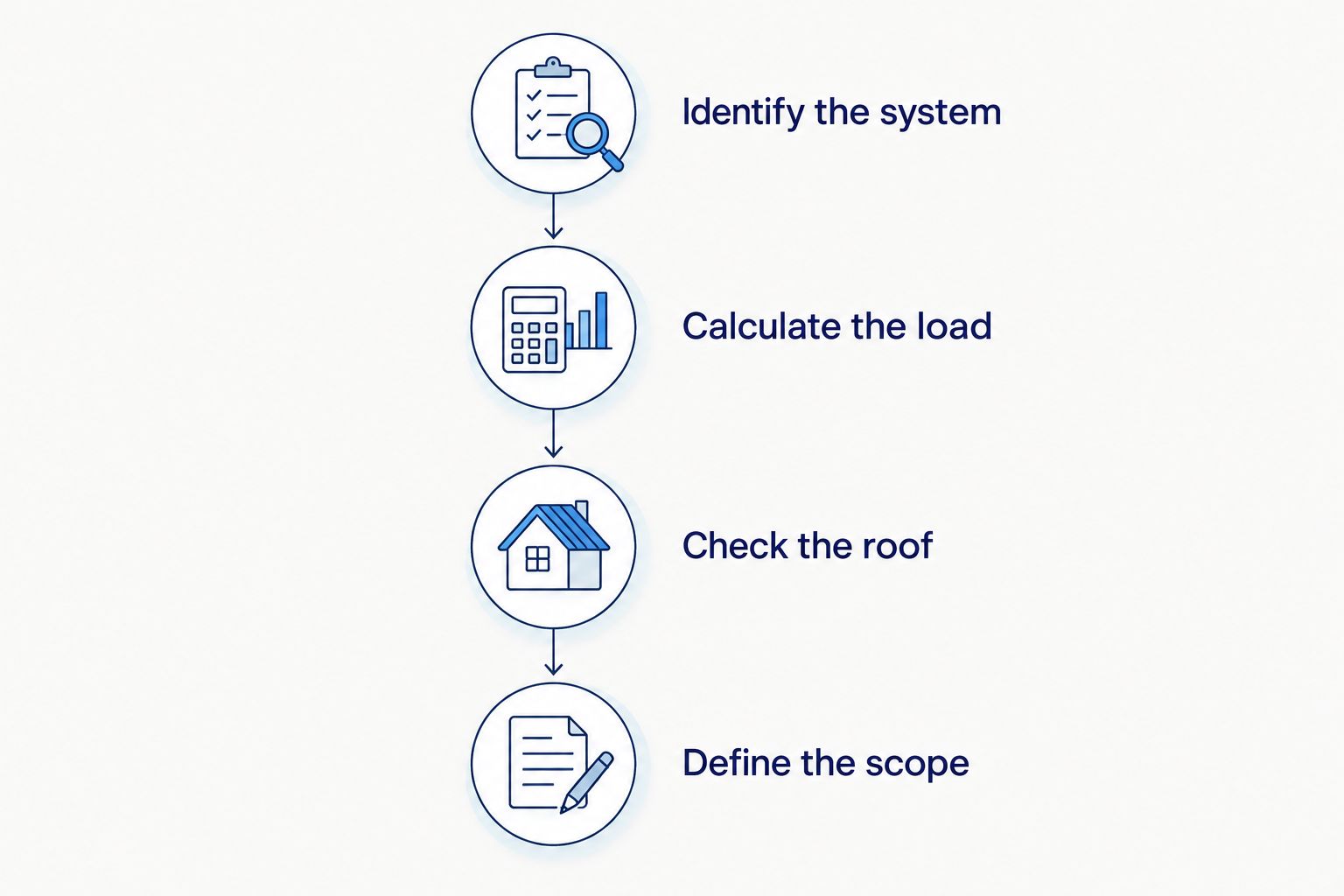
A rooftop replacement involves more than disconnecting the old equipment. Use this sequence to separate equipment selection from the work that makes it function properly.
Identify the system
Ask the contractor to identify whether you have a package unit or a split system. Photograph accessible equipment labels from a safe location; leave roof access and cabinet inspection to the professionals.
Calculate the load
Request a cooling-load calculation that considers the home's windows, insulation, roof assembly, and air leakage. Floor area alone doesn't describe how much heat enters the house.
Cooling capacity uses tons as a unit: 1 ton equals 12,000 BTU per hour. A 2-ton system provides nominal capacity of 24,000 BTU per hour, while a 3-ton system provides 36,000 BTU per hour. These are unit conversions, not sizing recommendations for your house.
Check the roof
Have the support condition, roof openings, and attachment design reviewed. A roof curb, the raised frame beneath some package units, also needs inspection rather than automatic reuse.
Define the scope
The written proposal should identify electrical work, duct transitions, drainage, roof flashing, and required permits. Ask who handles each part and how completion will be documented.
What coastal exposure changes
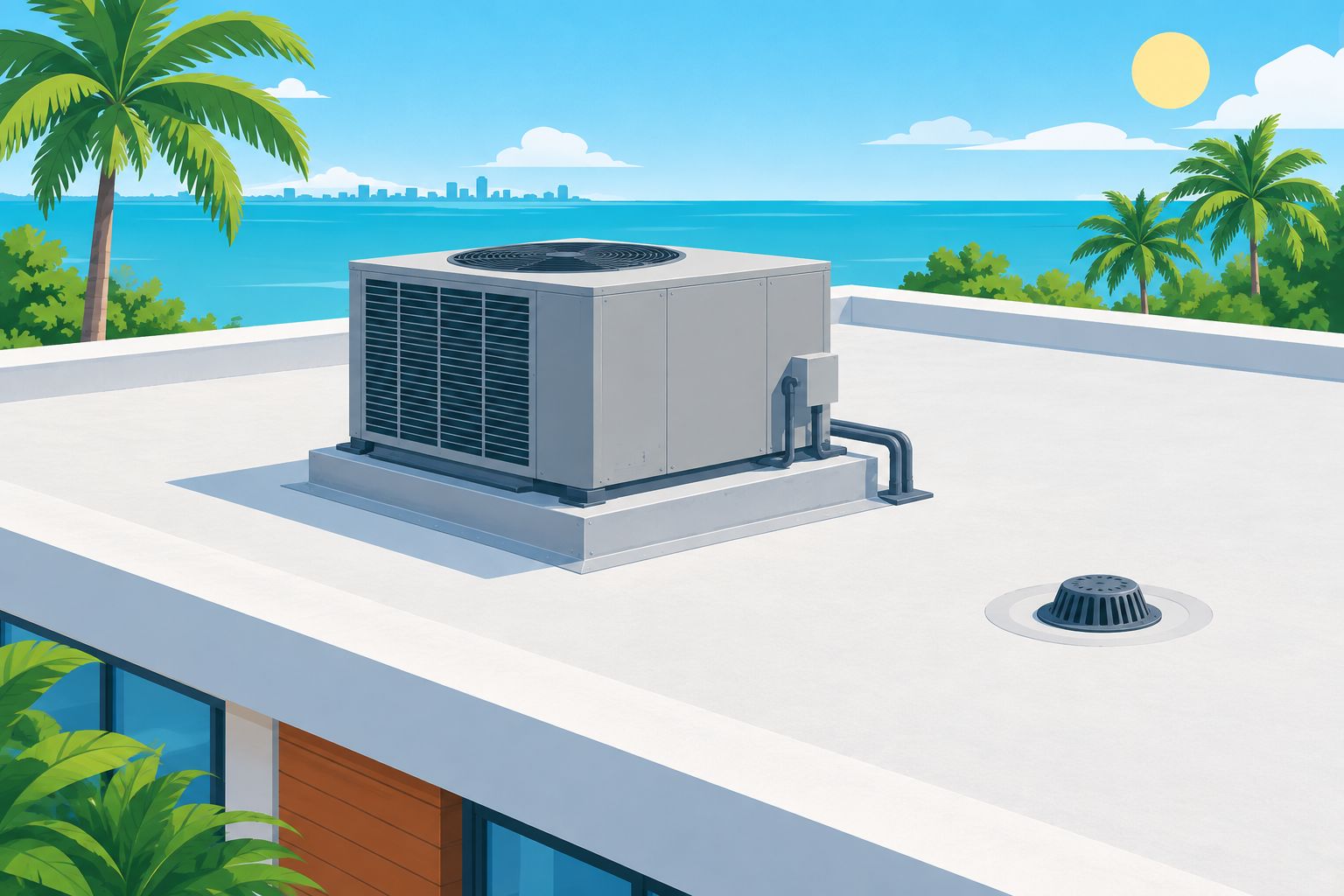
Salt air can corrode outdoor coils and metal components. Rooftop placement doesn't remove that exposure, so a coastal installation needs a maintenance plan that reflects the site's conditions.
Understanding how salt air affects AC helps explain why coil condition and approved corrosion protection belong in the equipment discussion. Ask what protection the exact model includes and which cleaning methods the manufacturer allows.
Don't treat an added coating as automatically compatible. Get written confirmation before applying products to coils, cabinets, or electrical components.
For a seasonal home, include access arrangements in the maintenance plan. A rooftop unit still needs inspection when the house sits empty, and an unnoticed drainage problem doesn't become harmless because nobody is home.
Roof drainage and AC drainage are separate jobs
A flat roof still needs a working drainage path. The equipment support must not obstruct roof drains or create a place where debris collects and water remains trapped.
The AC also produces condensate, the water removed from indoor air. Its drain arrangement needs to follow the equipment instructions and applicable requirements rather than simply discharge wherever installation is easiest.
Ask who is responsible for flashing, the material that seals roof penetrations, and whether a roofer needs to coordinate the work. This matters especially when AC replacement follows roof repairs or a new roof installation.
Humidity and noise deserve their own questions
A system that cools the house quickly can still leave it uncomfortable. Oversizing can shorten cooling cycles and reduce moisture removal, while restricted return airflow can interfere with operation.
In older homes, ask the contractor to inspect return-air capacity before recommending more cooling capacity. Replacing the cabinet doesn't repair an undersized return or disconnected duct.
For noise, ask where the equipment sits relative to bedrooms and how vibration transfers through its support. A sound rating alone doesn't describe what you'll hear inside the house. The mounting arrangement and surrounding structure also matter.
What a clear replacement proposal includes
A useful 2026 proposal lets you compare the whole job, not just the equipment name. Look for exact model numbers, the approved equipment combination where applicable, and a clear description of the rooftop work.
A.R. Williams Air Conditioning provides AC repair, installation, and maintenance for homeowners. Technicians explain their findings and lay out the options, with transparent flat-rate pricing quoted before work starts.
A.R. Williams Air Conditioning is a fit for AC replacement consultations when you want explained options before choosing equipment. For a rooftop project, ask which roof-related work is included and which work needs coordination with another trade.
You can talk with a technician about your current system and request an estimate. Have the equipment details and any recent roof-work information ready.
Which rooftop AC should you choose?
For an existing package installation that needs cooling and heating, start with a properly sized packaged heat pump. Choose a packaged air conditioner when cooling-only equipment meets the home's needs. Keep a split-system layout when a compatible indoor air handler and approved rooftop condenser installation make that the appropriate choice.
Your 2026 decision should follow the house assessment. Hold any proposal that leaves roof support, water protection, or equipment compatibility unanswered.
FAQ
What’s the best rooftop AC unit for a flat-roof home?
A properly sized packaged heat pump is a strong starting point for an existing rooftop package installation that needs cooling and heating. Homes with separate indoor air handlers need a split-system assessment instead.
Does having a flat roof mean I need a rooftop AC?
No, a flat roof does not require rooftop AC equipment. Equipment location depends on the home’s layout, available space, structural support, and installation requirements.
Can my old rooftop AC support be reused?
Reuse requires an inspection and confirmation that the support suits the replacement equipment. Condition, attachment details, dimensions, and applicable requirements all matter.
Will a bigger rooftop AC make my house less humid?
A bigger unit is not a reliable solution to high humidity. Excess capacity can shorten cooling cycles, so sizing, airflow, duct condition, and moisture sources need evaluation.
Can I replace only the outdoor rooftop condenser?
Replace only the outdoor condenser when the proposed unit is a documented compatible match for the indoor equipment. Cooling capacity alone does not establish compatibility.
Can rooftop AC replacement cause a roof leak?
Roof penetrations or disturbed flashing can leak if they are not properly addressed during the work. The proposal should identify who handles weatherproofing and how the roof connection will be checked.
How do I compare rooftop AC replacement estimates?
Compare exact equipment, installation scope, and roof-related responsibilities together. Ask each contractor to explain duct changes, electrical work, drainage, mounting, permits, and any exclusions.
One last thing
Keeping the AC in the same location doesn't prove the old installation details are suitable. The replacement can have different dimensions, airflow needs, or attachment requirements even when it looks similar from the yard.
Before you approve the work, ask for a plain-language explanation of what stays and what changes. A.R. Williams Air Conditioning can discuss your AC replacement options without asking you to choose a cabinet before you understand the job.
Related guides
- AC repair for Florida homes with flat roofs
- How to get permits for AC installation in Florida
- AC maintenance for coastal homes with salt-air exposure
