

Best overall: a smart water sensor with a remote probe, paired with a compatible AC overflow shutoff. Best for seasonal homes: a hub-connected sensor with remote alerts. The best smart leak sensor for an AC system detects water where it first collects, but a notification alone does not stop an overflowing drain pan.
- The best smart leak sensor for an AC system pairs useful water detection with a separate, compatible overflow shutoff.
- Choose a remote probe for cramped drain-pan access and a sensing cable for wider coverage.
- For seasonal homes, choose remote alerts and arrange for someone local to respond.
- A.R. Williams Air Conditioning provides AC service for homeowners who want the cause explained before work starts.
Why this matters
Your central AC removes moisture from indoor air. That water normally leaves through a condensate drain, the pipe that carries water away from the indoor equipment. A blocked drain, damaged pan, or other drainage problem can leave water where it doesn't belong.
A sensor helps you notice that water. It does not clear the blockage or repair the equipment. If you already see a puddle, start with how to stop your AC unit from leaking water rather than treating a new alarm as the repair.
For a Florida home that sits empty for part of the year, an audible alarm has an obvious limitation: nobody is there to hear it. Remote notifications help, but you still need a working connection and someone who can respond.
What makes the best smart leak sensor for an AC system?
For your 2026 shortlist, compare these features before choosing an app or brand:
- Detection location: The sensing contacts must reach the likely water path without interfering with drainage or equipment access.
- Notification method: Confirm whether the exact model provides a local alarm, phone notifications, or both.
- Connection requirements: Check whether it needs a hub, a particular wireless network, or another device.
- Power monitoring: Look for a clear way to check battery condition or power status.
- Environmental suitability: Read the operating-temperature and moisture limits, especially for attic installations.
- Shutoff compatibility: Treat automatic AC shutdown as a separate function unless the complete setup explicitly supports it.
Choose the detection layout first, then confirm the connection and response plan. A feature-rich sensor in the wrong location leaves the actual leak unmonitored.
Smart leak sensor options at a glance
These rankings compare sensor configurations, not interchangeable product models. A remote-probe sensor can also use a hub, so choose the physical layout and connection method separately.
| Rank and option | Best for | Standout feature to seek | Key limitation |
|---|---|---|---|
| Remote-probe smart sensor | Cramped access near an indoor drain pan | Separate sensing probe and electronics | Detects water only where the probe reaches |
| Sensing-cable smart sensor | A wider potential leak path | Water detection along a compatible sensing cable | Placement requires care around drainage and service access |
| Hub-connected smart sensor | Seasonal homes with an existing compatible hub | Remote alerts through a supported hub | Adds a hub and its connection requirements |
| Standalone Wi-Fi water sensor | An accessible equipment closet without a hub | Direct network connection on models designed for it | Network coverage and device placement must both work |
A properly installed overflow switch belongs alongside these options when appropriate. It is not ranked as a smart sensor because its main job is different: interrupting AC operation when water reaches its activation point.
1. Remote-probe smart sensor: best for cramped drain-pan access
A remote-probe sensor separates the water-sensing tip from the main device. That lets you position the probe near the likely collection point while keeping the electronics somewhere accessible, within the manufacturer's placement requirements.
This configuration is a practical starting point when the sensor body itself won't fit where detection is needed. For a 2026 purchase, check that the included probe actually senses water; a cable attached to a device is not necessarily a sensing cable.
Remote-probe smart sensor pros:
- The probe can reach a tighter location than the main housing.
- The main device can remain easier to inspect and maintain.
- Placement can focus on a specific likely collection point.
Remote-probe smart sensor cons:
- Water outside the probe's location can go undetected.
- A displaced probe no longer monitors the intended spot.
- A phone alert does not establish automatic AC shutoff.
Best for: Homeowners with limited access around the indoor drain pan or a clearly identified water collection point.
Ask a technician to identify that point before deciding where the probe belongs. Don't place it in a location that stays wet during normal operation unless the manufacturer's instructions specifically call for that installation.
Verdict: Choose a remote-probe configuration when precise placement matters more than covering a broad area.
2. Sensing-cable smart sensor: best for a wider potential leak path
A sensing-cable configuration detects water along the portion of cable designed for that purpose. It suits a layout where escaping water could travel across a broader area rather than collect neatly beneath a single point.
This is different from a remote probe with an ordinary connecting wire. Read the exact model's documentation to establish which part detects moisture and how it must be positioned.
Sensing-cable smart sensor pros:
- It can monitor more of an identified water path than a single sensing point.
- Its shape can suit an irregular equipment footprint.
- It gives you another placement option when the first collection point is uncertain.
Sensing-cable smart sensor cons:
- Incorrect routing can leave gaps in the intended coverage.
- The cable needs protection from displacement during maintenance.
- Normal condensation touching the cable can create unwanted alerts.
Best for: Homeowners whose indoor equipment has a broader potential leak area that a technician can identify and access.
Keep the cable clear of moving components and service panels. It should never block the drain or turn a routine equipment inspection into a difficult job.
Verdict: Choose a sensing cable when the water path needs coverage beyond a single probe location.
3. Hub-connected smart sensor: best for seasonal homes
A hub-connected water sensor sends its information through a compatible central device. The hub's supported features determine how you receive notifications and whether other actions are possible.
For your 2026 seasonal-home setup, assess the entire chain: sensor, hub, internet connection, phone notification, and local response. A notification is useful only if it reaches someone who can arrange a check.
Hub-connected smart sensor pros:
- It can fit an existing compatible monitoring setup.
- Supported systems can bring multiple sensor locations into one interface.
- Remote alerts help you monitor a home while you're away.
Hub-connected smart sensor cons:
- The sensor and hub must support each other explicitly.
- Remote reporting depends on the required devices and connections working.
- Smart-home integration alone does not prove AC shutoff compatibility.
Best for: Seasonal homeowners who already use a compatible hub and have a local person available to respond.
Before leaving the house unoccupied, test the alert with the intended recipient. Confirm that the notification identifies the AC sensor clearly rather than displaying an unclear device name.
Verdict: Choose a hub-connected configuration when it fits your existing system and a real response plan.
4. Standalone Wi-Fi water sensor: best for an accessible equipment closet
A standalone Wi-Fi sensor connects directly to a supported wireless network without a separate sensor hub. For models with sensing contacts on the housing, the whole device must sit where water will reach those contacts.
That makes placement especially important. A convenient shelf might provide a strong connection but leave the sensing contacts above the water path.
Standalone Wi-Fi water sensor pros:
- It avoids a separate hub when the model supports direct connection.
- An accessible housing simplifies inspection and battery replacement.
- It can provide a focused monitoring setup for one equipment location.
Standalone Wi-Fi water sensor cons:
- The correct sensing position must also have adequate network coverage.
- A larger housing can limit placement choices.
- Remote alerts still depend on the required connection working.
Best for: Homeowners with an accessible indoor equipment location and a confirmed compatible wireless network.
Test the sensor in its final position, not beside the router. Keep the equipment closet in its normal condition during the test, including closing the door.
Verdict: Choose standalone Wi-Fi when direct connection and accessible placement both work at the equipment.
Alerting and automatic shutoff solve different problems
A smart water sensor tells you that its sensing area is wet. An AC overflow switch responds to water reaching its activation point and, when correctly installed, interrupts the relevant equipment operation.
You want the distinction explained before approving an installation. A smart-home routine that changes a thermostat setting is not automatically equivalent to a dedicated overflow safety control.
A.R. Williams Air Conditioning provides AC maintenance and repair for homeowners who want the findings explained and the options laid out clearly. Ask the technician which protection is already installed, what it monitors, and whether a separate smart sensor would cover a useful additional location.
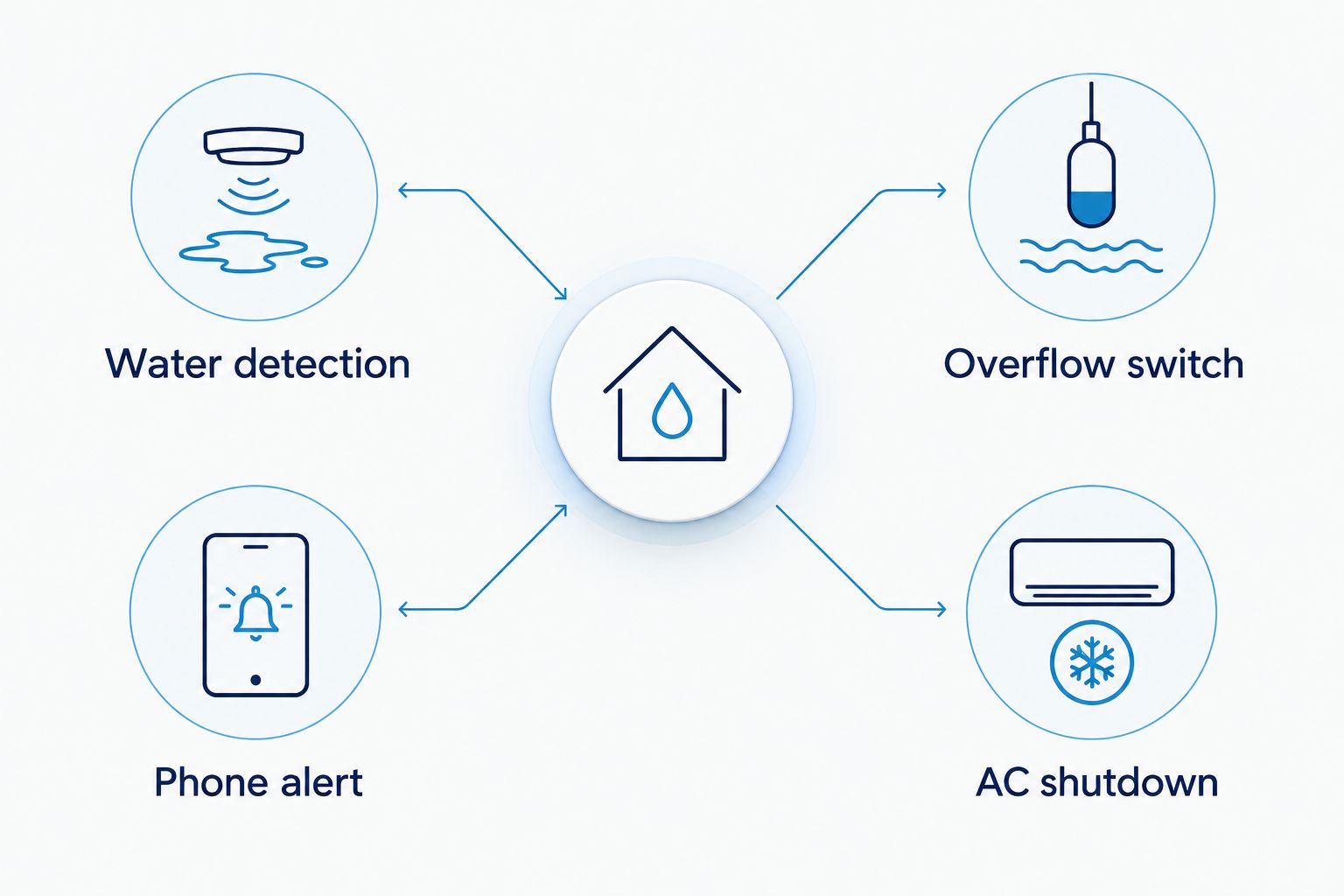
A technician should handle any connection to AC control wiring. Never bypass an existing safety switch to restore cooling after it has activated. The water source needs attention first.
Placement and testing before you rely on the sensor
Use this 2026 installation checklist with your technician. It checks the system you actually have rather than assuming every indoor unit drains the same way.
Identify the water path
Have the technician inspect the drain arrangement, pan condition, and existing overflow protection. Water beside an air handler does not prove a clogged drain; the source needs diagnosis.
For attic equipment, keep monitoring accessible without obstructing service access. Don't climb into an unsafe or difficult attic to position a sensor yourself.
Confirm the operating conditions
Check the manufacturer's limits for the actual installation location. A product intended for an indoor floor location is not automatically suitable for attic heat or placement inside equipment.
Humidity monitoring is a different feature from liquid-water detection. A humidity reading does not confirm that a drain pan is dry.
Test the complete response
Follow the manufacturer's water-detection test instructions. Confirm the notification arrives, the device name makes sense, and everyone responsible knows what to do.
Have the technician test the overflow control separately. Repeat the relevant checks after relocating a sensor or changing the network equipment it depends on.
How these configurations are ranked
This 2026 guide ranks configurations by sensing access, coverage, connection requirements, and homeowner response. Remote probes lead because they separate sensing placement from the main housing; wider leak paths, existing hubs, and accessible closets justify different choices.
The ranking does not replace an equipment inspection. The best configuration is the one that covers an identified risk without interfering with the AC's drainage or safety controls.
Which smart leak sensor should you choose?
Start with a remote-probe smart sensor and verified overflow protection unless your equipment layout points to another configuration. Choose a sensing cable for a wider water path, a hub-connected model for an established monitoring system, or standalone Wi-Fi for an accessible location with suitable coverage.
A.R. Williams Air Conditioning is a fit for homeowners who want AC leak protection explained alongside the underlying drainage condition. Technicians explain their findings and quote transparent flat-rate pricing before work starts.
You don't need to choose a sensor before requesting an inspection. Ask what protection is present and what additional monitoring would accomplish.
Get your system checked
Have the drainage condition and existing overflow protection explained before choosing added monitoring.
FAQ
What’s the best smart leak sensor for an AC system?
A remote-probe smart sensor is a useful default when the likely water collection point is difficult to reach. Pair monitoring with compatible overflow protection, and choose the exact model around the equipment layout and connection requirements.
Will a smart water sensor turn off my AC automatically?
A smart water sensor does not automatically turn off your AC unless the complete installation supports that function. Have a technician explain and test the actual shutdown method rather than assuming phone notifications include it.
Where should I put a leak sensor near my air handler?
Place the sensing element where unintended water is likely to collect, following the manufacturer’s instructions. A technician should identify that location without blocking drainage or equipment access.
Can a water sensor detect a refrigerant leak?
An ordinary water leak sensor does not detect refrigerant leaks. It detects liquid water at its sensing contacts, while refrigerant problems require a different diagnostic process.
Will my leak sensor work if the internet goes down?
Internet-dependent phone notifications require the necessary connection to work. Local alarms and other offline functions depend on the exact model, so check its documentation and test the supported behavior.
Is a sensing cable better than a single probe?
A sensing cable is better when you need to monitor a wider identified water path. A single probe is a better fit when water collects at a specific accessible point.
Does a smart leak sensor replace AC drain maintenance?
A smart leak sensor does not replace drain maintenance or repair. It reports water at its sensing location but does not remove a blockage or fix a damaged pan.
One last thing
A quiet sensor doesn't prove your AC is dry. Water must reach the sensing element before a water-contact device can report it, so ask your technician to show you the expected water path, not simply where the device fits.
Related guides
- Automatically shut off your AC when a leak sensor detects water
- AC maintenance for snowbirds and seasonal residents
- AC maintenance for high-humidity climates
