

Yes, an AC unit can be too big for a house: excess cooling capacity can make it reach the thermostat setting before it removes enough moisture. That leaves you with cool, clammy rooms and frequent starts and stops, especially with a single-stage system. Before replacing equipment in 2026, have a technician check the home's cooling load, airflow, and controls, because those symptoms do not prove oversizing by themselves.
- Can an AC unit be too big for a house? Yes. Excess capacity can hurt humidity control and comfort.
- A.R. Williams Air Conditioning recommends checking cooling load and airflow before choosing replacement capacity.
- Short cycling is a clue, not proof. Thermostat, drainage, and airflow problems can cause similar symptoms.
- Choose central AC through a home-specific load calculation, not square footage or the old unit’s size alone.
Can an AC unit be too big for a house?
Yes. An oversized central AC has more cooling capacity than the house needs under its design conditions. It can lower the air temperature quickly, satisfy the thermostat, and shut off before it has done enough moisture removal.
That distinction matters in a humid climate. Your system must remove heat and water vapor, not simply deliver cold air at the vents. The guide to choosing the right AC size for your home explains why a home-specific calculation is the starting point.
| Capacity compared with the home's needs | Typical comfort concern | What to verify |
|---|---|---|
| Too much capacity | Short runs and weak humidity control, particularly with single-stage equipment | Load calculation, equipment selection, and control settings |
| Properly matched capacity | Supports temperature and moisture control when installed correctly | Airflow, duct condition, and startup measurements |
| Too little capacity | Difficulty maintaining the desired temperature under design conditions | Actual cooling load and whether the equipment delivers its rated capacity |
These are diagnostic patterns, not a replacement verdict. A properly sized AC with a dirty coil or a restricted return can also perform poorly.
Why this matters in a humid home
You can feel uncomfortable even when the thermostat shows your preferred temperature. If the air remains damp, lowering the setting further can make rooms colder without resolving the underlying problem.
In coastal South Florida, outdoor moisture enters through air leaks and open doors. Older houses also deserve a close look at return-air capacity and duct condition. A larger outdoor unit does not correct those problems.
For a 2026 replacement, ask how the proposed system will control humidity as well as temperature. A recommendation that only promises stronger cooling leaves part of the comfort problem unanswered.
What oversized AC symptoms look like
Frequent starts and stops
Short cycling means the cooling equipment repeatedly starts and stops instead of completing a normal cooling run. An oversized single-stage system can do this because it delivers its full cooling output whenever the compressor operates.
But short cycling has other causes. A thermostat problem, a drain safety switch, restricted airflow, or an equipment fault can interrupt operation. A technician needs to determine whether the thermostat is ending the cooling call or a safety control is stopping the system.
Cool rooms that still feel damp
Your indoor cooling coil removes moisture when water vapor condenses on its cold surface. The water then drains away. Very short cooling runs can limit that process.
A damp feeling alone does not establish the cause. Outdoor air leakage, duct leakage, and fan settings also affect indoor humidity, so the diagnosis should include those conditions.
Uneven comfort between rooms
The room containing the thermostat can cool before bedrooms farther away receive enough conditioned air. When the thermostat ends the cooling call, those rooms remain uncomfortable.
That pattern also points to distribution problems. Closed doors, restricted returns, duct leaks, and poorly balanced airflow need attention before anyone recommends more capacity.
Strong airflow or noticeable air noise
A larger system can require more airflow than existing ducts can carry properly. Whistling grilles or loud return-air noise deserve an airflow assessment, not an assumption that powerful airflow means better cooling.
No single symptom confirms oversizing. The useful evidence is the combination of operating behavior, measured performance, and the home's calculated needs.
Why the right AC size varies between houses
Two homes with the same floor area do not necessarily need the same cooling capacity. These factors change the load or affect how well the equipment serves it:
- Windows and sun exposure: Large areas of sun-facing glass add heat differently from shaded windows.
- Insulation and roof conditions: The attic and building envelope influence how much heat enters the living space.
- Ceiling height and layout: Tall rooms and additions need more consideration than a floor-area shortcut provides.
- Air leakage and moisture: Humid outdoor air entering the home adds a moisture load as well as a cooling load.
- Duct location and condition: Leaking ducts in a hot attic reduce delivered cooling and can draw unwanted air into the system.
- Renovations: New windows, insulation, or an enclosed addition can change the load since the previous AC was selected.
For a 2026 equipment proposal, ask which current home conditions the calculation includes. Copying the old unit's capacity assumes that its original sizing was correct and that the house has not changed.
How a technician should confirm the size
A useful assessment separates the house's needs from the equipment's current condition. Otherwise, a repairable performance problem can become an unnecessary replacement recommendation.
- Review symptoms. Explain which rooms feel damp or warm, when the problem occurs, and whether it started after installation or a renovation.
- Check operation. The technician checks thermostat behavior, equipment condition, drainage controls, and relevant operating measurements.
- Measure airflow. The technician evaluates the blower and duct restrictions, including pressure that indicates how hard the fan must work to move air.
- Calculate load. A residential load calculation, commonly performed using ACCA Manual J, estimates the home's heat gain and moisture load.
- Select equipment. The proposed system's performance must match that load, with suitable airflow and compatible indoor and outdoor components.
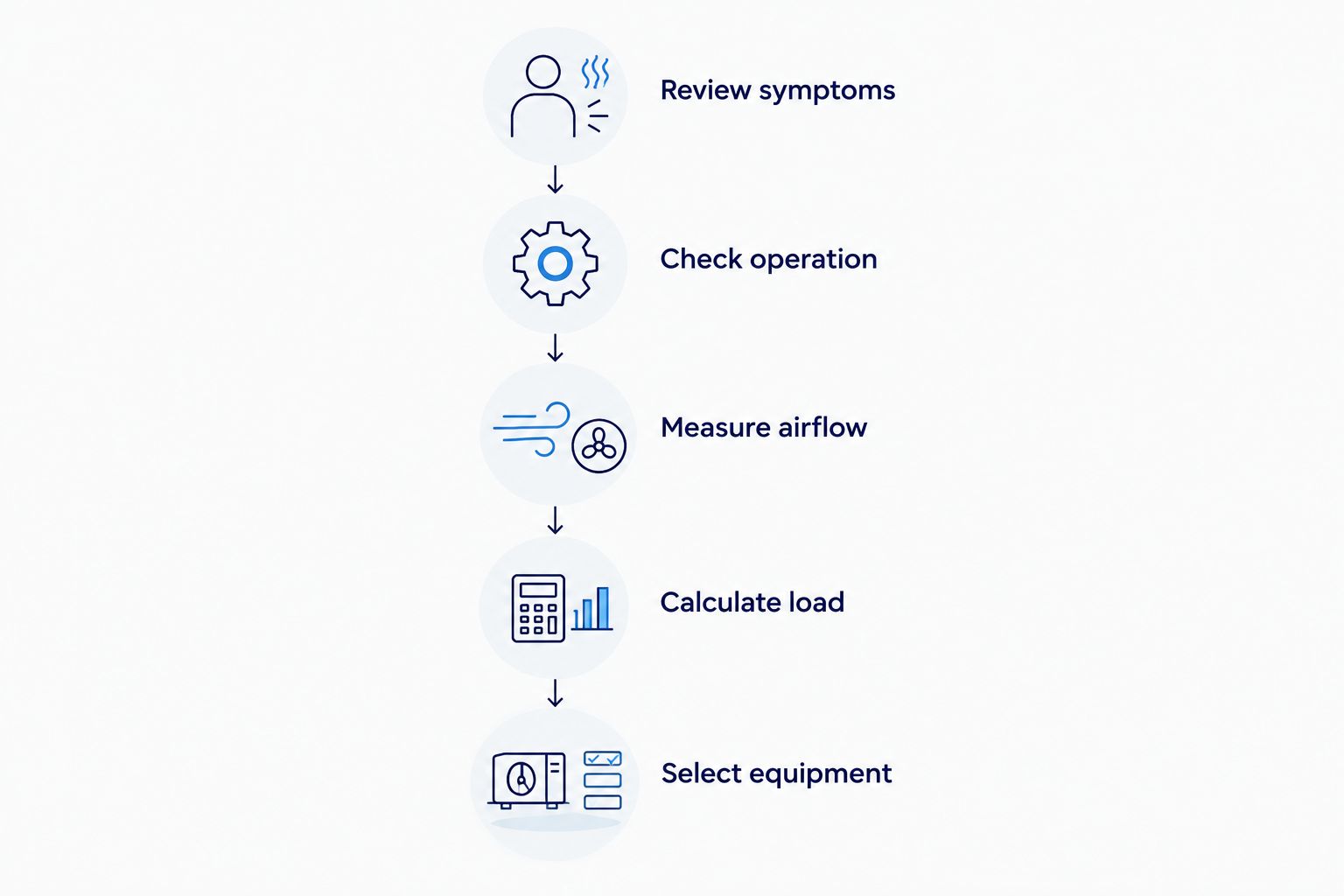
Ask for the load calculation and an explanation of the equipment selection. You do not need to interpret every technical field yourself. The contractor should explain why the proposed capacity fits your house and how the installation will address the comfort complaint.
What AC tonnage actually tells you
AC tonnage describes cooling capacity, not the equipment's weight. One ton equals 12,000 BTU per hour, a standard measure of heat removal. That makes 2 tons equal to 24,000 BTU per hour and 3 tons equal to 36,000 BTU per hour.
Those conversions do not tell you which size your house needs. A bigger capacity number is not a quality rating, and it does not establish better humidity control.
For a 2026 comparison, ask contractors to separate capacity from efficiency and compressor operation. Capacity describes how much cooling the equipment supplies; efficiency describes energy performance under specified test conditions. Neither replaces a load calculation.
Does variable-speed equipment solve oversizing?
A variable-speed compressor adjusts cooling output within its operating range. That flexibility can support longer runs at lower output, which helps match changing cooling needs and supports moisture removal.
The limitation matters: variable-speed equipment still has a minimum output. If that minimum is too high for the home's needs under mild conditions, the system still cycles off. It also cannot correct leaking ducts or poor installation by itself.
Variable-speed central AC is best for homeowners who need adjustable output and steady comfort, provided the equipment is correctly selected. It is not permission to choose extra capacity without supporting calculations.
A single-stage system operates at full cooling output when its compressor runs. Its simpler operation can suit a correctly calculated load, but it has less flexibility when the house needs only a small amount of cooling. Compare operating range and humidity control, not capacity alone.
| Central AC option | Best for | Main benefit | Limitation |
|---|---|---|---|
| Single-stage | Homes with a suitable calculated load and straightforward control needs | Simple full-output operation | Less ability to match lighter cooling loads |
| Variable-speed | Homeowners seeking steadier comfort as cooling demand changes | Adjusts output within its operating range | Still requires correct sizing, airflow, and setup |
Can you fix an oversized AC without replacing it?
Sometimes a correctable setup or airflow problem explains the symptoms. A technician can verify thermostat configuration, blower settings, duct performance, and whether the installed components are compatible.
Adjustments have limits. A technician should not reduce airflow below the manufacturer's requirements to make oversized equipment behave like a smaller system. That can create new operating problems.
If testing confirms excess capacity, discuss the findings before authorizing replacement. Ask what an adjustment will solve, what it will leave unresolved, and why replacement is recommended if that is the proposed next step.
Do not close supply vents to imitate a smaller AC. That restricts airflow without reducing the compressor's cooling capacity. If the ducts are part of the problem, review whether your ductwork can handle a bigger AC before changing equipment size.
Will a bigger AC cool my house faster?
A bigger AC can lower the temperature faster when the system and ducts support its output. Faster temperature reduction is not the same as better comfort, because moisture removal and room-to-room air distribution still matter.
If your current system cannot keep up, first establish whether it delivers its intended performance. Restricted airflow, dirty coils, or a refrigerant problem can make correctly sized equipment appear too small.
Should the replacement match my old AC's tonnage?
No. The old tonnage is useful background, not proof of the right replacement size. The previous system might have been selected incorrectly, and changes to windows, insulation, or living space can alter the home's load.
For a 2026 replacement, request sizing based on the house as it exists now. A contractor should explain a change in capacity rather than present it as an automatic upgrade.
Get a clear recommendation before deciding
A.R. Williams Air Conditioning is best for South Florida homeowners who want central AC sizing explained before choosing a replacement. Technicians explain their findings and lay out the options, with transparent flat-rate pricing quoted before work starts.
An assessment still needs to establish the cause. A.R. Williams Air Conditioning provides AC repair, installation, and maintenance, but a replacement should follow the evidence rather than a symptom checklist. Talk with a technician about your home's comfort problems before choosing more capacity.
FAQ
How do I know if my AC is too big for my house?
Frequent short runs combined with cool, damp rooms can indicate excess capacity, but they do not confirm it. A technician should check operation and airflow, then compare equipment performance with a home-specific load calculation.
Can an oversized AC cause high humidity?
Yes, an oversized AC can leave indoor humidity high when it satisfies the thermostat before removing enough moisture. Air leakage, duct problems, and fan settings also need evaluation.
Is a bigger AC better for Florida heat?
No, a bigger AC is not automatically better for Florida heat. The right system matches the home’s heat and moisture loads and works with its ductwork.
Can I fix an oversized AC by closing vents?
No, closing supply vents does not reduce the compressor’s cooling capacity. It restricts airflow and can create additional operating problems.
Does short cycling mean I need a smaller AC?
No, short cycling does not automatically mean you need a smaller AC. Thermostat faults, drainage safety controls, and airflow problems can produce similar behavior.
Will a new thermostat fix an oversized air conditioner?
A new thermostat cannot remove excess equipment capacity. Correcting a thermostat fault or configuration can help if controls are causing the symptoms, but sizing still requires a separate assessment.
Can new windows make my existing AC oversized?
New windows can reduce a home’s cooling load, which can change how the existing AC matches the house. A new load calculation establishes whether the change is significant enough to affect equipment selection.
One last thing
A long cooling run on a hot afternoon is not automatically a sign that your AC is too small. Equipment sized for the home's design conditions can run for extended periods when the outdoor load is high.
The better question is whether it maintains comfortable temperature and humidity with proper airflow. Judge the system by those results, not by how quickly it shuts off.
Related guides
- How to reduce indoor humidity without overworking your AC
- How to fix an AC that keeps turning on and off
- How to get a second opinion on an AC replacement quote
