

An old AC unit can contribute to allergy symptoms, asthma flare-ups, or irritation if it spreads contaminants or fails to control moisture, but age alone does not make it unhealthy. Those symptoms do not prove the AC is responsible, and replacing the equipment will not fix a separate roof leak or other indoor pollution source. The right first step is to identify the problem, not assume you need a new system.
- Can an old AC unit make you sick? Poor moisture control and airborne contaminants matter more than age.
- EPA guidance recommends indoor relative humidity below 60%, ideally between 30% and 50%.
- A.R. Williams Air Conditioning recommends diagnosing moisture and airflow problems before considering AC replacement.
- Persistent breathing symptoms need medical advice, not just an HVAC inspection.
Why this matters
A home can feel cool and still have a moisture problem. In a coastal Florida house, damp indoor air deserves attention even when the thermostat reaches its setting.
If an odor appears when cooling starts, use that observation to guide an inspection. The guide to getting rid of musty AC smells explains that symptom further, but an odor alone cannot identify mold or establish a health diagnosis.
Can an old AC unit make you sick?
An old AC can contribute to unhealthy indoor conditions, but its birthday is not the cause. Moisture, contamination, filtration, and airflow are the conditions that need checking.
A cooling system moves indoor air through a filter and across a cold coil. If moisture persists around dirty components or damaged insulation, microbial growth can develop. A poorly fitted filter also allows particles to bypass the filter material.
| Finding | What it can mean | What it does not prove |
|---|---|---|
| Musty odor during cooling | A damp component or nearby material needs inspection | That the odor is mold or explains your symptoms |
| Dust around returns | Filter fit, household dust, or duct leakage needs checking | That all ductwork needs cleaning |
| Sticky rooms despite cool temperatures | Moisture removal needs evaluation | That refrigerant is low |
| Coughing or sneezing indoors | Indoor exposures deserve consideration | That the AC caused an illness |
| Water around the air handler | Drainage, insulation, or another leak needs attention | That the entire system needs replacement |
For a 2026 inspection, ask for findings tied to specific components. "The unit is old" is not an explanation for a musty bedroom.
What symptoms deserve attention?
Dust and mold exposure can cause sneezing, a runny nose, irritated eyes, or coughing in susceptible people. Mold can also trigger symptoms in people with asthma. These effects vary by person, and similar symptoms have many other causes.
Notice whether symptoms occur in particular rooms, after cooling starts, or after you return to a previously closed house. Share that pattern with your healthcare professional and the technician, without treating it as proof.
Seek prompt medical help for significant breathing difficulty, chest pain, or severe or worsening symptoms. Do not wait for an AC appointment to address a medical concern.
An HVAC technician can investigate equipment and building conditions. A healthcare professional evaluates symptoms and treatment. Neither an equipment photo nor a musty smell can replace that medical assessment.
Why the risk varies between homes
Two older systems can have very different conditions. These factors explain why an inspection should cover more than the outdoor unit:
- Persistent moisture: Wet insulation, a leaking drain pan, or condensation on nearby materials can support growth.
- Filter fit: Gaps around a filter allow air and particles to pass around it rather than through it.
- Airflow restrictions: A dirty filter, obstructed return, or dirty coil can interfere with normal cooling operation.
- Duct condition: Leaky return ducts can pull unwanted air from an attic or other unconditioned space.
- Cooling cycles: Equipment that cools the house too quickly can stop before removing enough moisture.
- Other water sources: Roof leaks and plumbing leaks can create dampness that an AC replacement will not resolve.
South Florida adds practical inspection clues. Salt air can corrode outdoor coils near the coast, while a seasonally vacant house can develop unnoticed drainage or humidity problems. Neither condition proves a health hazard, but both deserve a place in the inspection history.
What should you check before the appointment?
You do not need to open equipment or handle chemicals to provide useful information. Keep your observations simple and leave internal inspection to a qualified technician.
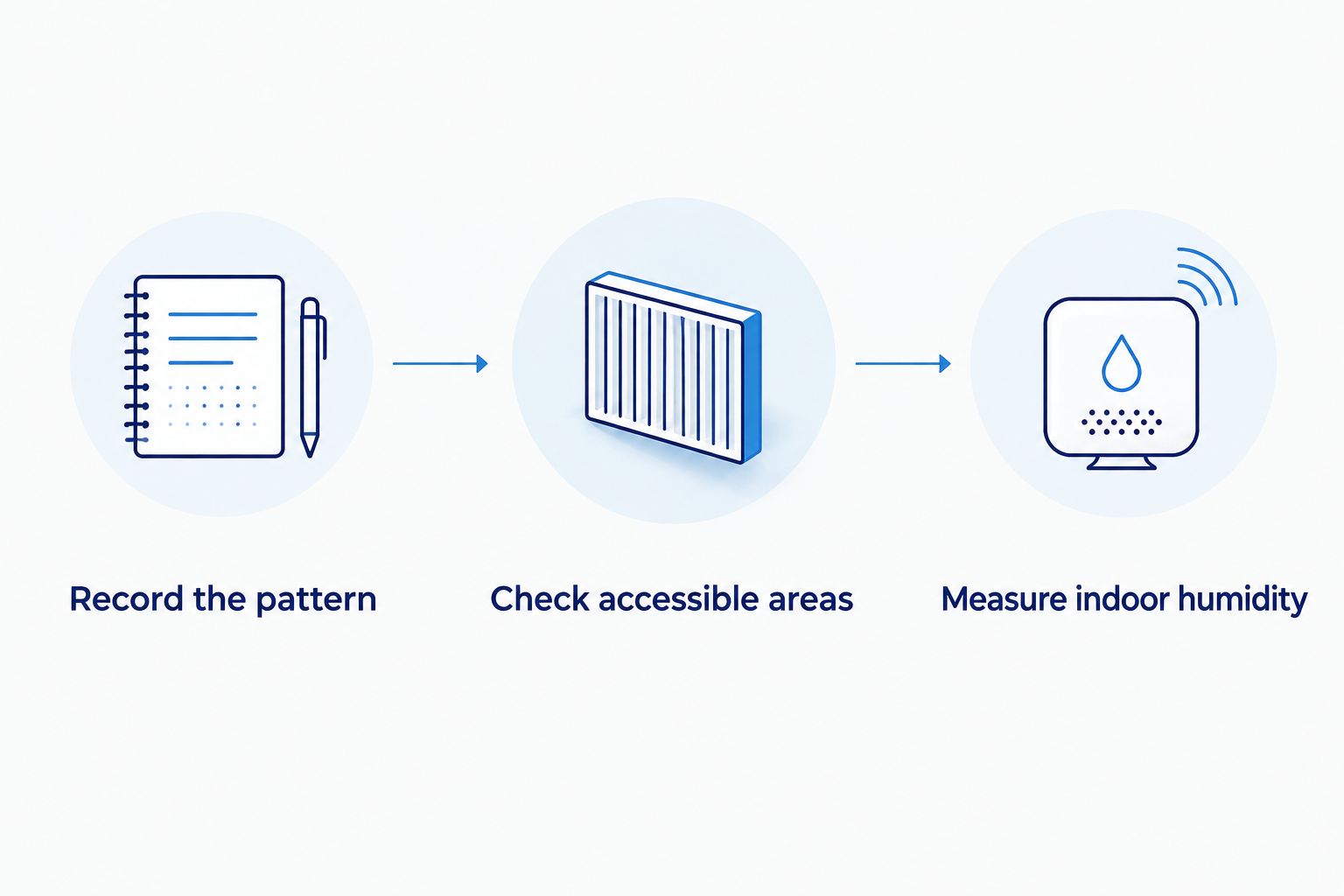
Record the pattern
Write down where the odor or discomfort occurs and whether cooling is running. Note recent roof work, plumbing leaks, water stains, or a long period when the house was unoccupied.
For a 2026 service visit, photos of visible water damage and a short symptom timeline are more useful than guessing which component failed. Keep medical details for your healthcare professional as well.
Check accessible areas
Look at an accessible filter without removing equipment panels. Record its size, whether it appears dirty, and whether it fits securely. Check that furniture is not blocking return grilles.
Do not enter an unsafe attic or reach into equipment. If you see water near electrical components, avoid the area and arrange professional service.
Measure indoor humidity
A household humidity meter gives you a useful starting point. Keep it away from supply vents, direct sunlight, and cooking steam, and note the reading alongside room temperature.
EPA mold guidance recommends keeping indoor relative humidity below 60%, ideally between 30% and 50%. One reading does not explain the cause, so record the conditions when rooms feel damp and share them with the technician.
What should a technician inspect?
Ask for the moisture source and airflow findings before discussing add-ons or replacement. A useful inspection connects each recommendation to something observed or measured.
The technician should examine the indoor coil, blower compartment, drain pan, and condensate drain. Condensate is the water removed from indoor air during cooling. That water needs a clear path out of the system.
The inspection should also cover filter fit, return airflow, and accessible duct connections. In an older house, a restricted return can remain a problem even after someone installs new cooling equipment.
Ask the technician to explain whether the system is removing moisture properly and whether damaged insulation or nearby building materials are involved. If visible contamination extends beyond the equipment, appropriate cleanup can require a separate professional.
For your 2026 records, request photos where accessible and a written explanation of the proposed work. A photo of discoloration documents an observation, not a laboratory identification or a medical conclusion.
Is repair or replacement the better choice?
Repair and replacement solve different problems. Choose the work that addresses the documented cause, rather than treating equipment age as the deciding factor.
| Approach | Best for | Main benefit | Limitation |
|---|---|---|---|
| Targeted repair and maintenance | A serviceable system with a specific drainage, airflow, or cleanliness problem | Addresses an identified fault without replacing sound equipment | Does not correct unrelated building leaks or extensive damage |
| AC replacement | Equipment with major deterioration or documented performance problems that support replacement | Replaces worn equipment and allows a sizing review | Does not automatically repair ducts or remove contaminated building materials |
| Building moisture correction | Roof, plumbing, or other water intrusion | Addresses moisture outside the AC system | Does not repair a separate cooling fault |
If replacement is proposed, ask what the new system will correct and what work remains outside that scope. A new outdoor unit does not fix a leaking return duct in the attic.
For a 2026 replacement estimate, ask how the contractor evaluated equipment size and moisture control. A larger system is not automatically a healthier choice.
Will a better filter or air purifier solve the problem?
A suitable filter can reduce airborne particles, but filter fit and system compatibility matter. A more restrictive filter can reduce airflow if the system cannot support it.
Ask which filter your equipment can use and how its fit will be checked. Do not choose a filter solely because its packaging promises stronger filtration.
Air-cleaning equipment also has limits. It does not repair a blocked drain, remove water-damaged insulation, or seal a leaking duct. UV equipment is not a substitute for cleaning and moisture correction, and its suitability depends on the application.
Correct the source before adding treatment equipment. Any recommendation should identify the contaminant or condition it addresses, plus the maintenance it requires.
Does an old AC spread viruses or cause Legionnaires' disease?
An AC unit's age does not create cold or flu viruses. Shared indoor air can carry respiratory particles, but that is a ventilation and exposure issue, not proof that an old cooling system caused an infection.
A typical residential central AC also differs from a building cooling tower. CDC guidance states that home and car air-conditioning units do not use water to cool the air and are not a risk for Legionella growth.
Residential equipment still produces condensate that needs proper drainage. Standing water deserves correction, but it should not be used to frighten you with an unrelated disease claim.
How can you prevent the problem from returning?
Prevention depends on the cause. A drainage repair needs verified drainage; an airflow repair needs confirmation that airflow improved.
EPA guidance advises drying water-damaged materials within 24 to 48 hours to help prevent mold growth. Hidden moisture or porous materials that cannot be dried properly need appropriate professional assessment.
For seasonal homes, arrange checks while the property is unoccupied rather than assuming a thermostat setting confirms everything is working. Cooling, drainage, and humidity control are separate things to verify.
After service, monitor the original symptom. If dampness returns, report the location and conditions instead of repeatedly lowering the thermostat. Colder air alone does not establish that the moisture problem is fixed.
What should you expect from your service visit?
A.R. Williams Air Conditioning is best for South Florida homeowners who want AC repair options explained before work starts. Technicians explain their findings and provide transparent flat-rate pricing quoted before the work begins.
A.R. Williams Air Conditioning provides residential AC repair, installation, and maintenance. The limit is clear: AC service addresses equipment conditions, not a medical diagnosis or every source of indoor pollution.
Ask what needs correction, what can be monitored, and how the result will be checked. You should understand the recommendation without having to become an HVAC expert.
FAQ
Can an old AC unit make you sick even if it still cools?
Yes, an old AC can contribute to irritation or allergy symptoms if moisture or contaminants are present, even when it still cools. Cooling performance alone does not confirm that drainage, filtration, or humidity control is working properly.
Does a musty AC smell mean there is mold?
No, a musty AC smell does not confirm mold. It signals that damp equipment, nearby materials, or another odor source needs inspection.
Can my AC cause a sore throat or cough?
Airborne irritants circulated through a home can contribute to a sore throat or cough, but those symptoms do not identify the AC as the cause. Persistent or worsening symptoms need medical advice.
What humidity level should I keep inside my house?
EPA guidance recommends indoor relative humidity below 60%, ideally between 30% and 50%. Persistent dampness still needs investigation, even if a single meter reading looks acceptable.
Should I replace my AC because someone in my house has asthma?
Asthma alone is not a reason to replace an AC system. Have moisture, filter fit, and equipment condition evaluated, and follow the person’s medical care plan.
Will duct cleaning fix symptoms from my AC?
Duct cleaning cannot guarantee symptom relief. The recommendation should follow an inspection, and any moisture source must also be corrected.
Can I spray bleach into my AC to remove the smell?
Do not spray bleach into your AC equipment. Household chemicals can damage components or create unwanted exposure, so use a qualified technician for appropriate cleaning.
One last thing
The most useful question is not "How old is it?" It is "Where is the moisture coming from, and how will you confirm it is fixed?"
Before booking a 2026 replacement, get that answer. If you need help with the equipment side, talk with a technician at A.R. Williams Air Conditioning and request an inspection focused on the conditions you have noticed.
Related guides
- How to tell if your AC needs repair or replacement
- How to reduce indoor humidity without overworking your AC
- Indoor air quality solutions for humid climates
