

A properly sized central ducted AC system can cool an entire home when the equipment, ductwork, and return-air paths are designed together. If some rooms stay warm, the answer is not automatically a larger unit: the system needs an evaluation of airflow, heat gain, and humidity control before you choose a repair or replacement.
- Central ducted AC can cool an entire home when sizing and airflow match each room’s needs.
- A larger AC unit does not fix restricted returns or leaking ducts.
- Whole-home cooling should address humidity as well as temperature.
- A.R. Williams Air Conditioning explains AC repair and replacement options before work starts.
Can central ducted AC cool an entire home?
Yes. Whole-home cooling depends on delivering the right amount of conditioned air to each room and giving that air a path back to the system. An outdoor unit's capacity alone does not establish whether bedrooms, living spaces, and upstairs rooms will stay comfortable.
A technician starts with the house rather than the existing equipment label. Your windows, insulation, ceiling heights, and room layout affect the cooling required. A guide to choosing the right AC size explains why square footage is only part of that assessment.
For a 2026 replacement, ask whether the proposed equipment selection reflects the home's current condition. New windows, an enclosed room, or changes to insulation can make an old sizing assumption unreliable.
The evaluation should follow a clear sequence:
- Calculate heat gain. Determine how much heat enters the house and each room under the design conditions used for your location.
- Inspect the ducts. Check their condition, insulation, connections, and ability to carry the required airflow.
- Check return paths. Confirm that air can travel back from occupied rooms, including bedrooms with closed doors.
- Select compatible equipment. Match the indoor and outdoor components to the calculated load and duct system.
- Verify operation. Check airflow, drainage, and equipment setup after installation or repair.
These steps separate an equipment problem from a distribution problem. Both can leave you uncomfortable, but they need different fixes.
Why whole-home cooling needs more than a thermostat setting
Your thermostat measures temperature where it is installed. It does not prove that every bedroom has enough airflow or that indoor moisture is under control.
That distinction matters in humid weather. A living room can reach the thermostat setting while a distant bedroom stays warm, or the house can feel cool and clammy at the same time.
Before a 2026 AC consultation, describe where comfort breaks down and when it happens. A room that gets hot in late afternoon gives the technician a different starting point from a room that becomes uncomfortable only after its door closes.
You do not need to diagnose the cause yourself. Your job is to describe the pattern; the technician's job is to test the explanation.
How air reaches every room
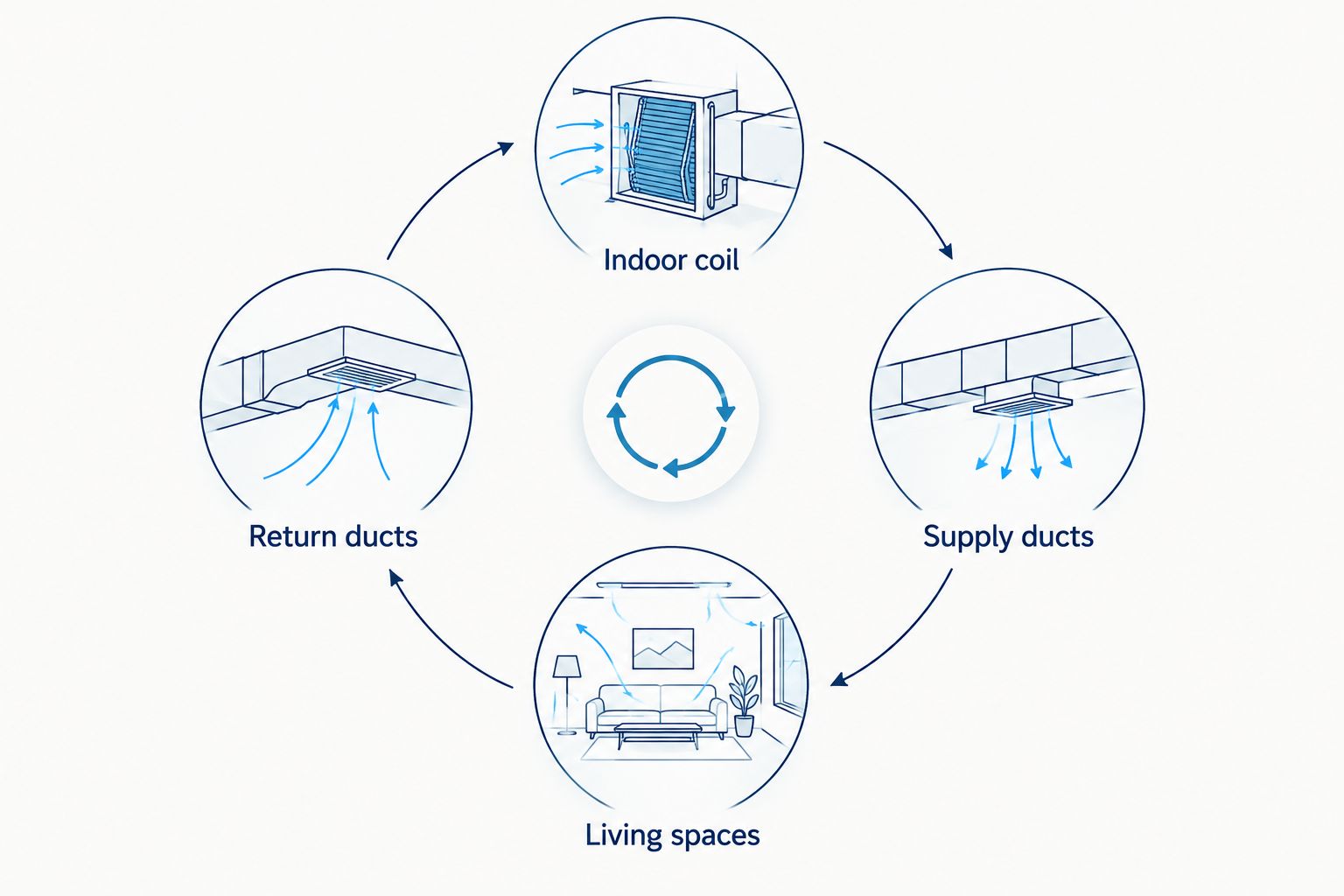
A central ducted system removes heat at the indoor coil and moves conditioned air through supply ducts. Return ducts bring indoor air back to the equipment so that the cycle can continue.
Supply air needs a return path. A bedroom with a supply vent but an inadequate path back to the return can develop comfort problems when the door is closed. Turning the thermostat down does not correct that restriction.
Older homes sometimes have return arrangements that no longer suit their room layout. Added walls, enclosed spaces, or a different air handler can change how the system behaves.
Ask the technician to evaluate return-air vent sizing rather than assume the existing opening is adequate. The assessment should include the duct behind the grille, not just the grille's visible size.
Keep furniture and stored items away from supply and return openings. Leave changes to duct sizes, blower settings, and return arrangements to a qualified technician.
What AC tonnage tells you, and what it does not
Cooling capacity is often described in tons. One ton of cooling equals 12,000 British thermal units per hour, written as BTU/h. This is a measure of heat removal, not the equipment's weight.
The following figures explain the units. They are not recommendations for a particular house.
| Capacity label | Heat-removal capacity | What the label does not establish |
|---|---|---|
| 1 ton | 12,000 BTU/h | Whether the equipment meets a particular room's cooling load |
| 2 tons | 24,000 BTU/h | Whether existing ducts can carry the required airflow |
| 3 tons | 36,000 BTU/h | Whether every bedroom will receive enough conditioned air |
A larger capacity number does not guarantee better comfort. Equipment that is too large for the load can satisfy the thermostat quickly without providing the moisture removal your home needs.
Equipment that is too small can struggle to meet the calculated demand. The right selection requires a load calculation and equipment performance information, not a capacity guess based on a neighbor's house.
For a 2026 installation, ask what calculation supports the proposed size. If the recommendation changes from the existing capacity, ask what finding explains the change.
Why whole-home cooling performance varies
Homes with similar floor areas can need different cooling designs. These factors help explain why:
- Sun exposure and windows. Large areas of sunlit glass add heat to the rooms they face. Afternoon discomfort near west-facing windows deserves a room-level assessment.
- Insulation and air leakage. Heat entering through the roof and humid outdoor air entering through gaps both affect the system's workload.
- Duct condition. Disconnected joints, damaged insulation, and leaks can reduce the cooling delivered to occupied rooms.
- Room layout and returns. Long duct runs and closed bedroom doors can expose airflow problems that are less obvious in an open living area.
- Indoor moisture. Cooking, bathing, and outdoor-air entry add moisture that the home's cooling and moisture-control approach must address.
- Equipment condition and setup. Dirty coils, incorrect airflow, and other operating faults can prevent equipment from performing as intended.
Near the coast, salt exposure also deserves attention during an outdoor-unit inspection. Corrosion can affect equipment condition, but proximity to the water alone is not a diagnosis.
For a seasonal home, describe how you operate the AC while the house is unoccupied. A home that sits empty still needs a plan for moisture control and maintenance.
Which central AC approach fits your house?
Start with the problem you need to solve. A repair, a replacement, and a zoning change address different conditions; none should be recommended solely because one room feels warm.
| Approach | Best for | Main benefit | Limitation |
|---|---|---|---|
| Repair the existing central system | A diagnosed fault in otherwise suitable equipment | Restores operation without assuming replacement is necessary | Does not resolve unrelated duct or design problems |
| Repair or modify ductwork | Confirmed leaks, restrictions, or poor room airflow | Addresses how cooling reaches the rooms | Cannot correct an independent equipment failure |
| Replace the central system | Equipment that needs replacement after evaluation | Allows equipment selection against the current cooling load | Existing duct defects still need attention |
| Add compatible central zoning | Homes with distinct areas and a verified zoning design | Provides separate temperature control for designated areas | Requires compatible controls and careful airflow design |
Choose the approach supported by the findings. A zoning system uses controls and motorized duct dampers to direct airflow, but it is not a substitute for adequate duct capacity.
A.R. Williams Air Conditioning provides AC repair, installation, and maintenance for homeowners. The relevant choice is the work your central AC system needs, with the reason explained before you authorize it.
What should a whole-home AC evaluation include?
A useful evaluation connects your symptoms to measurements and visible findings. A statement that the system is old does not explain why a bedroom stays warm.
For a 2026 project, ask the technician to address these points:
- Which rooms need attention, and under what conditions?
- Is the equipment operating correctly?
- Are the supply ducts and return paths adequate?
- Does the house need a new load calculation?
- How will the proposed work address humidity?
- How will the completed work be checked?
You should also know what the proposal includes. Duct modifications, drainage work, electrical work, and permit requirements should be addressed where applicable, rather than left as assumptions.
Requirements depend on the work and the local jurisdiction. Ask who handles required permits and inspections without assuming that every project follows the same process across Palm Beach, Martin, and St. Lucie counties.
Can a bigger central AC unit fix a hot bedroom?
A bigger central AC unit does not reliably fix a hot bedroom. A restricted duct, inadequate return path, or unusually high room heat gain can remain after the equipment is replaced.
Ask for a room-level airflow and load assessment. Increasing capacity without checking distribution can leave the bedroom uncomfortable while other parts of the house cool too quickly.
Can central AC keep upstairs bedrooms comfortable?
Central AC can keep upstairs bedrooms comfortable when the design accounts for their heat gain and airflow needs. Roof exposure, duct routing, and return paths all deserve attention in a two-story home.
If upstairs rooms lag behind the main floor, ask whether the cause is equipment operation, duct performance, or a control issue. Separate temperature control is useful only when the equipment and airflow design support it.
Does a comfortable temperature mean humidity is controlled?
A comfortable thermostat reading does not establish that indoor humidity is controlled. Temperature and moisture are related, but they are not the same measurement.
Ask for humidity to be checked if rooms feel clammy or surfaces show persistent moisture. The technician should investigate operation, drainage, and outdoor-air entry before recommending additional equipment.
What clear recommendations should sound like
You deserve an explanation that connects the finding to the proposed work. If a technician recommends replacement, ask what replacement solves and whether any existing duct problems will remain.
A.R. Williams Air Conditioning quotes flat-rate pricing before work starts and explains the available options. A.R. Williams Air Conditioning is a fit for homeowners who want central AC service with an explanation before work begins.
The company also focuses on long-term fixes rather than shortcuts. That does not mean every comfort problem requires new equipment; a sound recommendation identifies what needs correction and why.
For your 2026 service visit, prepare a short list of uncomfortable rooms and the conditions that make them worse. Ask the technician to walk through the findings, then request an estimate for the recommended work.
FAQ
Can one central AC system cool every room in my house?
One central AC system can cool every room when its capacity and duct design meet the home’s cooling needs. The evaluation must include room-level airflow and return paths, not just total floor area.
Why is my bedroom hot when the living room is cool?
A hot bedroom can have inadequate supply airflow, a restricted return path, or greater heat gain than nearby rooms. Ask for those conditions to be checked before assuming you need larger equipment.
Should I close vents in rooms I do not use?
Do not use closed supply vents as a substitute for a designed airflow solution. Closing vents changes airflow and can increase pressure in the duct system, so discuss persistent room differences with a technician.
Does central AC remove humidity?
Central AC removes moisture when water condenses on its cold indoor coil and drains away. Proper sizing, airflow, and operation affect that process, so a cool but clammy house needs an evaluation.
Do I need new ducts when I replace my AC?
AC replacement does not automatically require complete duct replacement. Existing ducts need an inspection for condition, leakage, insulation, and compatibility with the proposed equipment.
Can I choose an AC size based only on square footage?
Square footage alone is not enough to select an AC size. Windows, insulation, air leakage, ceiling heights, and room exposure also affect the cooling load.
What should I tell a technician about uneven cooling?
Tell the technician which rooms feel uncomfortable, when it happens, and whether the doors are open or closed. Also mention recent renovations and any clammy conditions or unusual operating patterns.
One last thing
Check whether the warm bedroom's door is usually closed when the problem appears. That observation does not diagnose the system, but it gives the technician a useful clue about the return-air path.
Bring the pattern to the appointment, not a predetermined equipment size. A clear diagnosis lets you choose the work that addresses the actual problem.
Related guides
- How to keep upstairs bedrooms cool
- Can an AC unit be too big for a house?
- How to get a second opinion on an AC replacement quote
