

A Florida AC system has no fixed expiration age: its useful life depends on its condition, installation, maintenance, and exposure to coastal air. Age helps you plan, but it does not tell you whether the next repair is worthwhile. The practical answer is to assess cooling performance, corrosion, and repair history before deciding to keep or replace the system.
- How long does an AC system last in Florida? Condition and repair history matter more than age alone.
- ENERGY STAR recommends considering replacement for air conditioners more than 10 years old, not automatically replacing them.
- Coastal corrosion, restricted airflow, and unresolved refrigerant leaks deserve attention before another repair.
- A.R. Williams Air Conditioning helps homeowners understand AC repair and replacement options before work starts.
An older unit that still cools reliably presents a different decision from one with recurring leaks and deteriorating coils. Start with the evidence, not a sales deadline. This guide to how to tell if your AC needs repair or replacement explains that distinction in more detail.
How long does an AC system last in Florida?
Use age as a planning signal, not a replacement order. ENERGY STAR's homeowner guidance, When is it time to replace?, identifies an air conditioner more than 10 years old as a reason to consider replacement. That is national guidance, not a measured Florida lifespan or a prediction for your equipment.
For your 2026 decision, pair that age threshold with an inspection. A technician should distinguish a repairable component failure from deterioration that affects the system as a whole. Neither a birthday nor a single failed part answers that question.
| Path | Best for | Main benefit | Limitation |
|---|---|---|---|
| Maintenance | A system that cools properly but needs routine care | Addresses dirt, drainage, and developing problems | Cannot reverse corrosion or restore worn components |
| Targeted repair | A confirmed, isolated failure in otherwise serviceable equipment | Corrects the diagnosed problem without replacing the whole system | Does not renew the remaining older components |
| System replacement | Equipment with extensive deterioration or recurring major failures | Allows a fresh assessment of equipment, sizing, and installation | Requires installation work and careful review of the home's airflow needs |
A repair recommendation should name the failed component and explain the condition of the equipment around it. A replacement recommendation should explain what a repair would leave unresolved. You deserve both explanations before choosing.
Why this matters for Florida homeowners
Florida cooling decisions involve humidity as well as temperature. An AC system removes moisture while it cools, so a house that reaches the thermostat setting but still feels clammy needs more than an age check.
The U.S. Environmental Protection Agency's published mold guidance recommends indoor relative humidity below 60%, ideally between 30% and 50%. Relative humidity describes how much moisture the air holds compared with what it can hold at that temperature. Those figures are general indoor-moisture guidance, not a promise that one thermostat setting will achieve them.
For a 2026 system assessment, tell the technician about both comfort and moisture. Mention damp-feeling rooms, musty odors, and changes in cooling performance. A larger replacement unit is not automatically the answer to those symptoms.
Why AC lifespan varies in Florida
Two systems installed at the same time can age differently. These factors help explain why:
- Salt exposure: Coastal salt air can corrode outdoor coils and metal components. Actual exposure and existing damage matter more than a broad coastal address.
- Cooling demand: Long cooling seasons put equipment to work for extended periods. Evaluate operating condition rather than assuming calendar age captures all that use.
- Airflow: Dirty filters, restricted returns, and duct problems interfere with heat transfer. Older homes with undersized returns deserve an airflow assessment.
- Maintenance: Coil condition, drainage, and electrical connections need attention. Maintenance addresses developing problems but does not guarantee a particular lifespan.
- Installation quality: Equipment sizing, refrigerant charge, and duct compatibility affect how the system operates. A replacement should correct installation problems rather than repeat them.
- Repair history: Repeated refrigerant loss or recurring failures require an explanation of the underlying cause. Restoring cooling temporarily is different from resolving the problem.
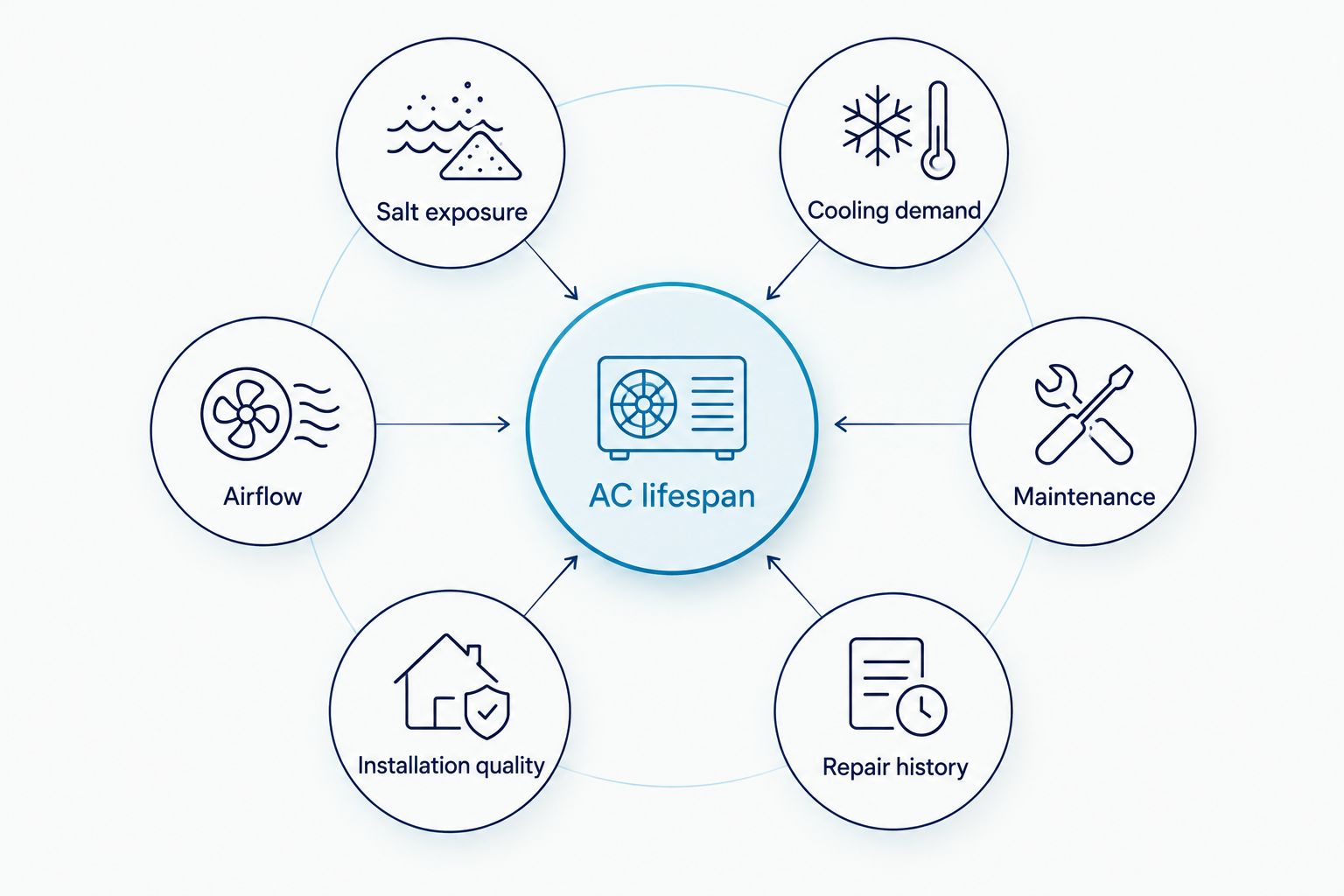
These factors overlap. A corroded outdoor coil and restricted return airflow create a different repair decision from a clean system with one failed electrical component. Ask the technician which conditions are present in your home, rather than accepting a general statement about Florida weather.
What should you check before replacing an older AC?
A useful assessment separates equipment age from equipment condition. Follow this sequence when you arrange an inspection or review a recommendation.
1. Confirm the installation history
Look for an installation invoice, permit record, or service paperwork. The equipment label can help identify the model and manufacturing date, but manufacturing date and installation date are not necessarily the same.
Check the outdoor unit and indoor air handler separately. They might have been replaced at different times. Your 2026 assessment should describe the complete system, not just the age of the outdoor cabinet.
2. Describe what changed
Tell the technician whether the house no longer reaches the set temperature, certain rooms feel warmer, or the system starts and stops repeatedly. Explain whether the problem developed gradually or appeared suddenly.
An electricity bill alone does not establish that the AC is worn out. Weather, thermostat settings, occupancy, and utility rates also affect the bill. Pair any billing concern with a description of actual system behavior.
3. Ask for a whole-system diagnosis
The assessment should address airflow, coil condition, drainage, and the operation of relevant electrical components. If refrigerant loss is suspected, ask how the leak will be confirmed and addressed.
Refrigerant is not a fuel that the system routinely uses up. Repeated additions without an explanation of the loss leave the underlying problem unresolved. Ask what the proposed work fixes and what it does not.
4. Review the remaining equipment
A failed component does not automatically mean the entire system has reached the end of its life. Equally, replacing that component does not make the rest of the equipment new.
Ask about the condition of both coils, the compressor, and the indoor blower. The compressor moves refrigerant through the system; the blower moves air through your home. Their condition helps put the proposed repair in context.
5. Compare written scopes
For a repair, request a clear description of the diagnosis and proposed work. For replacement, ask how the contractor will verify sizing and assess existing ducts, drainage, and electrical connections.
Keep the written diagnosis with your 2026 service records. That gives you a useful baseline if another problem occurs and makes a second opinion more productive.
Does an older AC always need replacement?
An older AC does not need replacement solely because it passes 10 years. ENERGY STAR's more-than-10-years guidance is a prompt to evaluate replacement, not a mandatory retirement age.
If the equipment cools consistently, controls moisture, and has no unresolved major defects, age alone does not establish a need for replacement. Continue appropriate maintenance and keep track of changes. Ask for documented findings rather than a prediction about when it will fail.
Replacement deserves closer consideration when an inspection finds extensive corrosion, recurring major failures, or problems that the proposed repair would leave in place. A technician should explain those findings in plain language. You should not have to interpret a list of part names on your own.
A.R. Williams Air Conditioning is a fit for homeowners who want AC repair and replacement options explained before work starts. Its technicians explain their findings and quote flat-rate pricing before work begins. An inspection still comes first; no company can determine remaining equipment life from age alone.
Will a new AC fix poor airflow or humidity?
A new AC does not automatically fix duct restrictions or excess indoor moisture. Replacing equipment without investigating those problems can leave the original comfort complaint unresolved.
In older houses, a return opening or return duct can restrict the air reaching the indoor unit. Leaky ducts also affect delivered cooling. Ask the contractor to evaluate the air distribution system before recommending different equipment capacity.
Oversized equipment can cool the house quickly and shut off before it removes enough moisture. A proper sizing assessment considers the home's cooling needs rather than simply copying the old unit's capacity. Our guide to choosing the right AC size for your home explains what that decision involves.
For a 2026 replacement project, describe recent changes to the house. New windows, insulation improvements, and room additions can change the cooling requirement. Existing equipment size is a starting point for investigation, not proof of the correct replacement size.
How does salt air affect an AC near the coast?
Salt exposure adds a reason to inspect the outdoor coil carefully. Corrosion can damage the thin metal fins and refrigerant-containing tubing, although visible discoloration alone does not establish that replacement is necessary.
Ask the technician to explain whether the finding is surface deterioration, damaged fins, or a confirmed leak. Those are different conditions. A useful recommendation connects the observed damage to performance or repairability.
Keep vegetation and stored objects away from the outdoor unit according to its manufacturer's clearance requirements. Leave coil cleaning methods and protective treatments to manufacturer guidance and a qualified technician. An unsuitable cleaner or treatment can damage the equipment it is intended to protect.
How should seasonal homeowners assess AC life?
An empty house still needs moisture management. Less occupancy does not mean the AC needs no attention, especially when nobody is present to notice a drainage problem or a gradual loss of cooling.
Before leaving for an extended period, arrange a system check and discuss appropriate temperature and humidity management for the home. Review filter condition and condensate drainage with the technician. Condensate is the water the AC removes from indoor air.
For an older system, keep service records accessible to whoever looks after the property. Note existing concerns rather than assuming a thermostat adjustment will address them. A planned inspection provides more useful information than waiting for someone to discover a warm, damp house.
What should a good service recommendation include?
A good recommendation identifies the fault, explains the condition of the remaining system, and states the limits of the proposed work. It also separates necessary repairs from optional improvements. Ask questions until the distinction is clear.
A.R. Williams Air Conditioning focuses on long-term fixes rather than shortcuts. That approach is relevant when an older system has a repeat complaint: the next step should address why the problem returns, not simply restore cooling without an explanation.
You do not need to choose replacement during the first conversation. Request a written scope and review it at a comfortable pace. If the reasoning is unclear, ask for clarification or seek another assessment.
FAQ
How long does an AC system last in Florida?
A Florida AC system has no fixed expiration age; its useful life depends on condition, installation, maintenance, and exposure. Evaluate cooling performance and repair history rather than treating age alone as a replacement deadline.
Should I replace my AC when it is 10 years old?
A 10-year-old AC does not automatically need replacement. ENERGY STAR recommends considering replacement for equipment more than 10 years old, but an inspection should establish whether repair or continued maintenance is appropriate.
Does salt air shorten the life of an outdoor AC unit?
Salt air can corrode outdoor coils and metal components. Ask a technician to distinguish surface deterioration from damage that affects performance or causes refrigerant loss.
Can regular maintenance guarantee a longer AC lifespan?
Regular maintenance cannot guarantee a specific AC lifespan. It addresses dirt, drainage, and developing problems, but cannot reverse corrosion or renew worn components.
Does a refrigerant leak mean I need a new AC?
A refrigerant leak does not automatically require a new AC. The decision depends on the leak location, repairability, and condition of the remaining equipment.
Why does my house feel humid even when the AC cools it?
Cooling and moisture removal are related, but reaching the thermostat setting does not prove humidity is controlled. Equipment sizing, airflow, operating patterns, and moisture entering the home deserve assessment.
Should the indoor and outdoor AC units be assessed together?
The indoor and outdoor AC units should be assessed together because they operate as a system. Their ages, condition, and compatibility matter when planning a repair or replacement.
One last thing
Replacing a component does not reset the age of the system. Keep the original installation history alongside later repair records so the next diagnosis reflects what is actually in your home.
If you want a clearer picture of your AC's condition, talk with a technician at A.R. Williams Air Conditioning. Ask what is healthy, what needs attention, and what each option leaves unresolved. That conversation gives you a sounder decision than an age cutoff alone.
Related guides
- How to extend the life of your AC system
- AC maintenance for coastal homes with salt air exposure
- How to reduce indoor humidity without overworking your AC
