

Duct replacement has no fixed completion time: the schedule depends on how much ductwork needs replacing, how crews can reach it, and whether the layout needs correcting. For a 2026 project, ask for separate estimates for installation time and the period your AC will be off, with any inspection or ceiling repairs listed separately.
- How long does duct replacement take? Get a home-specific schedule covering access, replacement scope, and final airflow checks.
- Separate the duct replacement schedule from the time your central AC will be unavailable.
- A.R. Williams Air Conditioning offers South Florida homeowners clear explanations before they approve HVAC work.
- Confirm whether permits, inspections, and ceiling repairs are included in the completion date.
Why the schedule matters
Your main concern probably isn't how long technicians spend in the attic. It's whether your home will have cooling when you need it. Those are different questions, and a useful estimate answers both.
Start by defining the work. This guide to ductwork replacement for older South Florida homes explains the broader project; the schedule should reflect the actual condition and layout of your ducts, not just your home's floor area.
A short installation window isn't automatically better. The job still needs sound connections, proper support, intact insulation, and checks that air reaches the rooms it serves.
How long does duct replacement take?
The useful answer is a written, home-specific schedule, not a completion promise made before anyone checks the ducts. An accessible damaged section and a full replacement behind finished ceilings involve different work.
For your 2026 estimate, ask the contractor to walk through this sequence:
- Inspect the existing system. Identify damaged ducts, access points, and rooms with airflow problems before setting the scope.
- Confirm the replacement layout. Decide which supply ducts, return ducts, and connecting sections will change. Supply ducts deliver conditioned air; return ducts carry air back to the equipment.
- Protect the work area. Establish a route for materials and removed ductwork. Identify any ceiling openings before demolition starts.
- Remove and replace the agreed sections. Install the new ducts with suitable connections, support, and insulation.
- Check system operation. Verify connections and airflow, address problems, and explain any remaining work before closing the project.
Ask where your cooling interruption falls within that sequence. Also ask which milestones depend on an inspector or another trade rather than the installation crew.
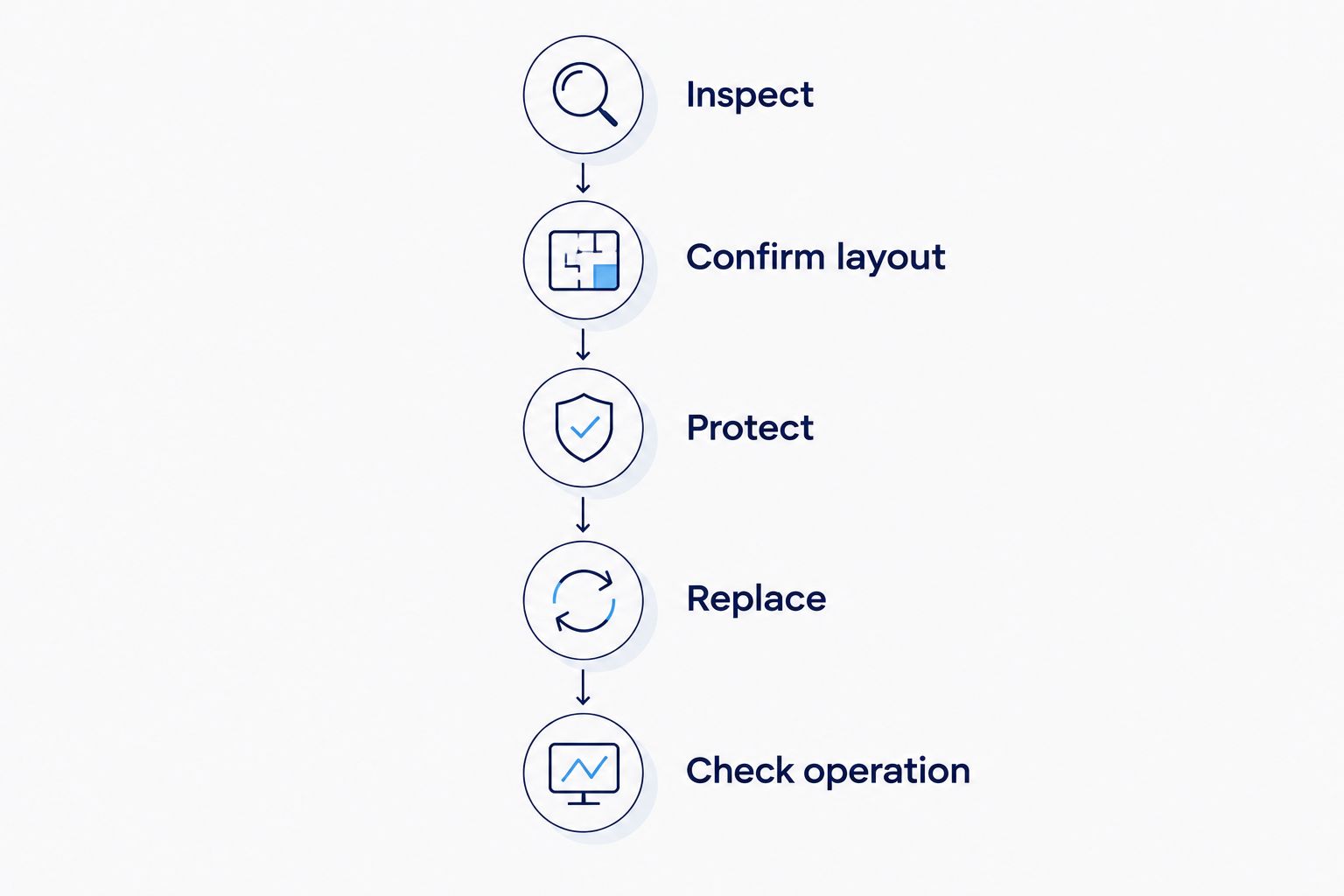
The schedule should distinguish work completion from project closeout. Reconnected ducts don't necessarily mean ceiling patches, painting, or a required inspection are finished.
Partial duct replacement: a narrower scope
Best for: an isolated damaged section when the remaining ductwork is sound and properly sized. Replacing a limited area involves fewer connections than replacing the entire distribution system, but access still determines how difficult the work is.
A damaged branch in an open attic is a different project from a similar section enclosed behind drywall. Ask the contractor to show you the damage and explain where the replacement starts and ends.
The advantage is a focused repair. The limitation is that it leaves the rest of the system in place, including any unrelated restrictions or deteriorated sections. A narrow scope makes sense only when the inspection supports it.
Full duct replacement: more connections to complete
Best for: widespread deterioration or a duct layout that needs correction throughout the home. A full replacement requires planning how air travels from the equipment to each room and returns to the system.
This work isn't simply a matter of copying every old duct. If the existing layout contributes to uneven cooling, replacing it exactly as it was preserves that problem.
The advantage is the opportunity to correct problems across the distribution system. The trade-off is a larger work area and more connections to install and check. Confirm whether the proposal includes return ducts and the main connecting boxes, often called plenums, rather than assuming everything is included.
| Scope | Best for | Main advantage | Limitation | Schedule question |
|---|---|---|---|---|
| Partial replacement | Isolated damage with sound remaining ducts | Focuses work on the affected area | Leaves other ducts unchanged | Can the section be reached without opening finished surfaces? |
| Full replacement | Widespread damage or layout problems | Allows system-wide corrections | Requires broader access and more connections | Does the schedule include returns, testing, and surface repairs? |
Why duct replacement time varies
These factors explain why a contractor needs to inspect your home before giving a dependable schedule:
- Access to the ducts. An accessible attic and a sealed ceiling cavity require different preparation. Tight spaces also limit how materials can be moved and installed.
- Extent of replacement. A single branch, the main supply section, and the complete supply-and-return system are different scopes.
- Layout corrections. Rerouting ducts or correcting restricted returns adds work beyond replacing damaged material in the same position.
- Finished surfaces. Opening and restoring drywall introduces work outside duct installation. Confirm who handles each part.
- Permits and inspections. Applicable requirements depend on the project and local building authority. Inspection scheduling is separate from the crew's installation work.
- Existing conditions. Unexpected damage or an obstructed route can change an agreed plan. Ask how the contractor documents and obtains approval for changes.
For a 2026 project, put these assumptions in writing. A schedule is more useful when you know what it includes and what would require a revision.
What should happen before installation starts?
Tell the technician which rooms stay warm, which doors you keep closed, and whether the problem changes during the day. A bedroom that becomes uncomfortable with its door shut can point to a different airflow issue than a damaged supply duct.
In older South Florida houses, limited return-air pathways deserve attention before replacement begins. Review return-air vent sizing if the proposal focuses only on ducts that deliver cool air. Return air is part of the same circulation path.
Ask the technician to distinguish damaged material from a sizing or layout problem. New ducts don't automatically fix a restricted return or a cooling problem elsewhere in the AC system.
Approve the intended result, not just a list of materials. Your proposal should identify the affected rooms, the sections being replaced, and how the contractor will check the result.
Will my AC be off during duct replacement?
Your AC needs to be off while connected duct sections are open or disconnected. Ask the contractor to identify that interruption separately from the total project schedule and explain whether the work can be divided into stages.
Don't assume that a crew leaving for the day means your cooling will be available overnight. Confirm the expected operating condition before work begins, especially if your household includes someone sensitive to heat.
For a 2026 installation, your household plan should follow the expected cooling interruption rather than the appointment window. Decide whether you need another comfortable place to spend time, and keep pets away from work areas and open access points.
A seasonal home needs the same planning. If you won't be present, arrange access and decide who can review a proposed change before the contractor proceeds.
Can I stay home while the ducts are replaced?
You can remain home when the work area can be separated safely and the cooling interruption is manageable for your household. Noise, attic access, dust protection, and the movement of old materials all affect how comfortable that arrangement will be.
Before installation, ask which rooms and hallways the crew needs to use. Move fragile items from those routes, clear access to the attic opening, and arrange a separate space for pets.
You don't need to enter the attic to prepare. Let the contractor inspect access conditions and explain any changes needed before work starts.
If you work from home, ask whether your workspace will remain accessible. Plan around noise and cooling rather than assuming you can continue your normal routine beside the work area.
Does duct replacement require an inspection?
Inspection requirements depend on the replacement scope and the local building authority. Ask the contractor to confirm the applicable requirements before you approve the work, including who handles permits and inspection appointments.
Palm Beach, Martin, and St. Lucie counties contain different local jurisdictions. Don't assume a neighbor's project establishes the requirements for your address.
If an inspection applies, ask whether it must happen before any work is concealed. Also confirm whether the promised finish date means installation is complete or the required inspection has passed.
That distinction belongs in the proposal. It prevents a misunderstanding about when the project is actually closed.
What a clear proposal should tell you
A useful 2026 proposal makes the boundaries of the job easy to understand. Look for the specific duct sections included, expected cooling interruption, surface-repair responsibilities, and the process for approving changes.
Ask how completion will be checked. The answer should go beyond whether the AC turns on: connections, duct support, insulation, and airflow all deserve attention.
A.R. Williams Air Conditioning is a fit for South Florida homeowners who want clear explanations before approving HVAC work. Its technicians explain their findings and options, with flat-rate pricing quoted before work starts.
A.R. Williams Air Conditioning provides residential AC repair, installation, and maintenance. Discuss the duct findings and the equipment's condition together so you understand whether the proposed work addresses the actual comfort problem.
There is a limit to what any replacement proposal can promise. Duct work doesn't establish that the existing cooling equipment is correctly sized or that an unrelated equipment fault has been resolved. Ask for those issues to be distinguished rather than bundled into a vague promise of better cooling.
FAQ
Can duct replacement be completed in a single visit?
A single-visit completion should be confirmed after the contractor checks the scope and access. Ask whether that commitment includes operational checks and whether inspections or surface repairs remain afterward.
Will replacing my ducts fix a hot bedroom?
Duct replacement addresses a hot bedroom when damaged or unsuitable ducts are responsible for the airflow problem. The technician should also check the return-air path and equipment operation before recommending replacement.
Do all my ducts need replacing if one is damaged?
A damaged duct does not automatically mean every duct needs replacement. Ask for an inspection of the remaining system and a clear explanation of why partial or full replacement fits its condition.
Will workers have to cut holes in my ceiling?
Ceiling openings are needed when the affected ducts cannot be reached through existing access. Ask the contractor to identify likely openings and state who will patch and paint them before you approve the work.
Does new ductwork mean I need a new AC too?
New ductwork does not automatically require a new AC. The existing equipment’s condition and suitability should be assessed separately from duct damage or layout problems.
How do I know the duct replacement is finished properly?
Ask for a final walkthrough covering the replaced sections, system operation, and airflow concerns identified before the job. Confirm that cleanup, any required inspection, and agreed surface repairs are complete or documented as remaining work.
One last thing
Ask what will be checked in the room that bothered you most. A replacement project should connect the original complaint to the final walkthrough, not end with a glance at the thermostat.
When you speak with A.R. Williams Air Conditioning about an HVAC concern, describe that room and when it becomes uncomfortable. Talk with a technician about the findings before deciding on the next step.
Related guides
- How to check whether your ductwork can handle a bigger AC
- Is duct sealing worth it for an older home?
- How to prepare your home for AC installation day
