

AC refrigerant should not run out during normal operation because it circulates inside a sealed system rather than getting used up. In 2026, as with older systems, a low refrigerant charge points to a leak, an incorrect initial charge, or refrigerant lost during service, not a routine need for a refill.
- How long does it take for AC refrigerant to run out? A sealed system should retain its charge.
- Low refrigerant requires diagnosis; warm air and frozen coils alone do not prove a leak.
- Adding refrigerant does not seal a leak or establish how long cooling will last.
- A.R. Williams Air Conditioning explains AC repair findings and options before work starts.
Why this matters
If someone says your AC needs refrigerant because it has been working hard, ask what caused the charge to drop. Heavy use does not consume refrigerant. You deserve an explanation before approving another recharge.
For a confirmed leak, refrigerant leak repair addresses the cause rather than only restoring the amount in the system. That distinction matters when you want reliable cooling instead of repeated service visits for the same unresolved problem.
How long does it take for AC refrigerant to run out?
There is no normal countdown: a properly sealed AC system does not use up its refrigerant. The refrigerant repeatedly absorbs heat indoors and releases it outdoors. Changing between liquid and vapor does not consume it.
Once a leak exists, there is no universal timeline for losing cooling. The opening, operating conditions, and amount already lost determine what happens next. A technician cannot reliably predict the remaining cooling time from the thermostat reading alone.
A system also does not need to become completely empty before performance suffers. An incorrect charge can reduce cooling while plenty of refrigerant remains inside. Waiting until the AC stops cooling completely does not make the diagnosis clearer.
Before treating low refrigerant as a maintenance item, separate these situations:
| Situation | What it means | Best next step | Limitation |
|---|---|---|---|
| Sealed system with the correct charge | Refrigerant stays in circulation | Best for routine maintenance: preserve normal operation | Maintenance cannot guarantee that a future leak will never develop |
| Confirmed refrigerant leak | Refrigerant is escaping | Best for correcting refrigerant loss: locate and repair the leak | Repair scope depends on the damaged component |
| Incorrect charge after installation or service | The system does not contain the specified amount | Best for correcting a charging error: verify and adjust the charge | A charging error does not rule out a separate leak |
| Poor cooling without a confirmed charge problem | Another fault remains possible | Best for avoiding unnecessary refrigerant work: check the whole system | Symptoms alone do not identify the cause |
Why refrigerant-loss timing varies
A leak does not come with a dependable expiration date. These factors explain why a system that gradually loses cooling and a system that suddenly stops cooling need different investigations:
- Opening size: A larger escape path can release refrigerant faster than a small leak under comparable conditions.
- Leak location: Coils, tubing connections, and service valves require different access and repair methods. Conditions at the leak also affect refrigerant flow.
- Operating pressure: Pressure changes as the system runs and stops. A leak's behavior can change with those conditions.
- Starting charge: A system already short of refrigerant has less margin before cooling suffers further.
- Changing damage: Corrosion or mechanical damage can worsen, so a previous slow loss does not establish a future timeline.
Near the coast, salt air can corrode outdoor equipment. That makes coil condition relevant, but a coastal address does not prove that your AC has a leak. The technician still needs evidence from your equipment.
The same caution applies after yard work or other work near exposed refrigerant tubing. Report any known contact or damage without assuming it explains every cooling problem.
What signs suggest low refrigerant?
Warm supply air, longer cooling cycles, and ice on refrigerant tubing can accompany a low charge. None is a reliable diagnosis on its own. Restricted airflow and other equipment faults can produce overlapping symptoms.
An oily mark near a refrigerant connection is another clue because oil travels with refrigerant. It is a reason to investigate, not proof that the connection is leaking. A clean-looking coil can still have a leak that is difficult to see.
In older homes, an undersized return opening or a dirty filter can restrict airflow through the indoor coil. Adding refrigerant will not correct that restriction. Ask whether airflow was checked before the technician concluded that the system was undercharged.
If the unit runs but your home stays warm, the guide to an AC that's running but not cooling explains the broader troubleshooting picture. Start with the symptom, not a presumed refrigerant diagnosis.
What a refrigerant check should include in 2026
A useful refrigerant diagnosis connects measurements to the manufacturer's instructions and the conditions at your home. It should explain why the system is undercharged, not simply report a pressure reading.
- Review symptoms. Tell the technician when cooling changed, whether ice appeared, and whether refrigerant was added previously. Share earlier invoices if you have them.
- Check airflow. The technician should assess restrictions and equipment conditions that affect airflow before interpreting charge measurements. A frozen coil needs to thaw before meaningful operating checks.
- Verify charge. Refrigerant pressures and line temperatures must be evaluated using the appropriate procedure for the equipment. A pressure reading by itself does not establish the correct charge.
- Locate loss. If the evidence points to a leak, ask what testing will locate it. Electronic detection, bubble testing, or other approved methods serve different diagnostic purposes.
- Confirm repair. After an approved repair, the technician should follow the required evacuation, charging, and verification procedures. Evacuation removes air and moisture before the system returns to operation.
The order matters. A low-looking pressure reading taken while airflow is restricted can send the diagnosis in the wrong direction.
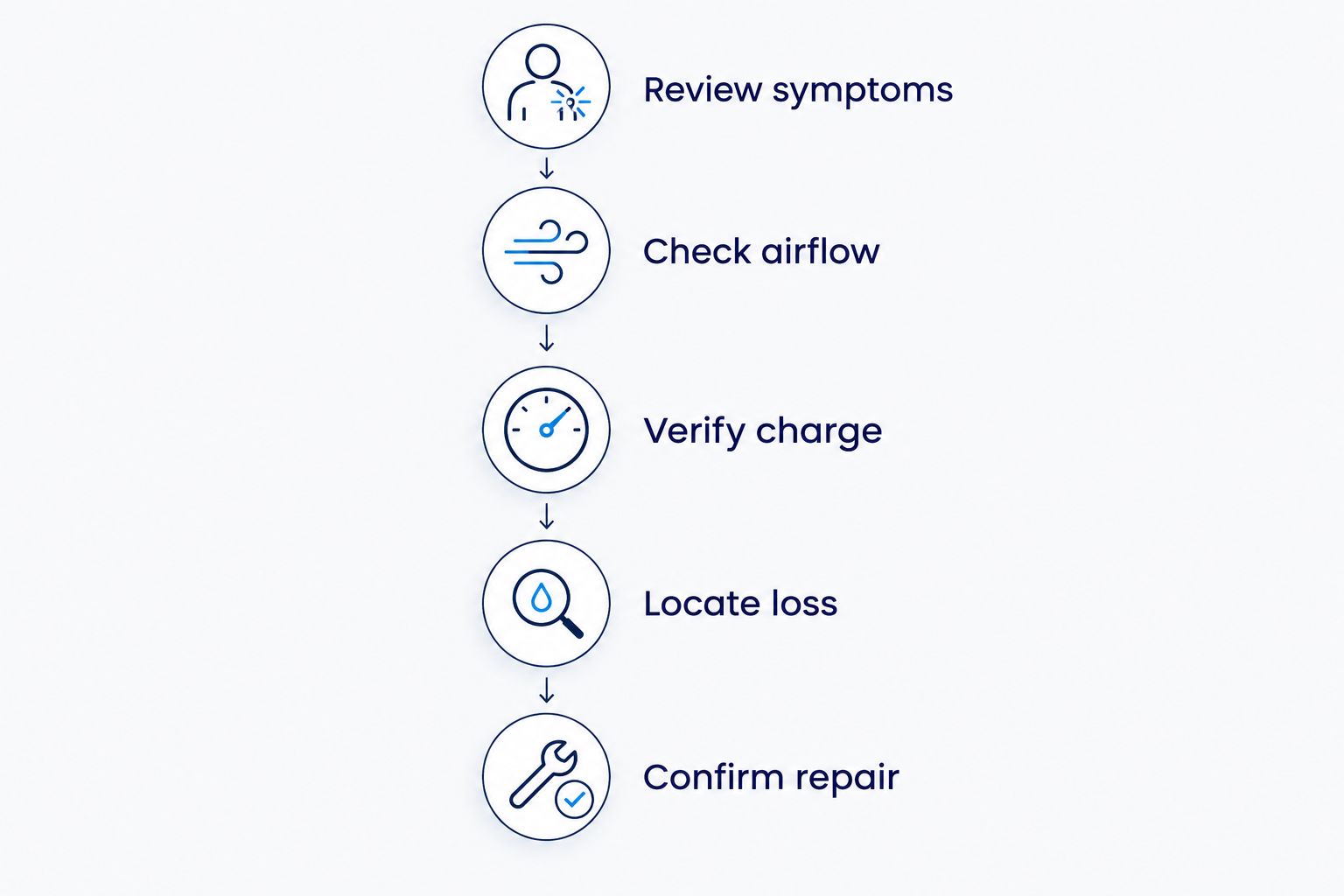
You do not need to interpret the instruments yourself. Ask the technician to connect each finding to a plain-language conclusion: what failed, what evidence supports that finding, and what the proposed work will correct.
Should you approve a recharge, leak repair, or replacement?
Choose the work that addresses the confirmed problem. Low refrigerant alone does not establish that the entire AC needs replacement. It also does not make adding refrigerant a complete repair.
For a 2026 repair decision, compare the condition of your existing central system with the scope of the proposed work. A single repairable connection and a deteriorated coil are different problems, even when both leave the system undercharged.
| Approach | Best for | Benefit | Drawback |
|---|---|---|---|
| Charge correction | A verified installation or service charging error | Restores the specified refrigerant amount | Does not repair a leak if one also exists |
| Leak repair and proper recharge | A confirmed, repairable leak | Addresses the escape path and restores the charge | Other deteriorated components remain part of the existing system |
| Component replacement | A leaking coil or other component that warrants replacement | Removes the damaged component | Requires evaluation of compatibility and the remaining equipment |
| System replacement | Equipment whose condition supports replacement over repair | Replaces the existing system rather than retaining its worn components | Is a larger project and needs its own sizing and installation assessment |
Ask for the diagnosis and scope in writing. The proposal should distinguish leak testing, the actual repair, and restoring the charge so you understand what you are authorizing.
A.R. Williams Air Conditioning is for homeowners who want AC repair findings explained before choosing a solution. Technicians explain what they found and lay out the options, with transparent flat-rate pricing quoted before work starts. That clarity does not remove the need for testing or make every damaged component repairable.
Does AC refrigerant need replacing every year?
AC refrigerant does not need annual replacement. Routine maintenance checks equipment condition; it should not treat refrigerant as something the system consumes each cooling season.
If your 2026 maintenance visit includes a recommendation to add refrigerant, ask what measurements support it and whether the reason for the shortage has been established. A previous recharge is useful history, but it is not evidence that another refill is normal.
For a seasonal home, leave service records where the person arranging maintenance can find them. A record of repeated additions helps the technician recognize an unresolved problem, even if you were away when cooling first changed.
How long will an AC recharge last if there is a leak?
An AC recharge has no dependable lifespan while a leak remains open. Adding refrigerant restores the amount temporarily; it does not establish how quickly refrigerant will escape afterward.
A period of improved cooling proves that performance changed, not that the leak disappeared. Ask whether the proposed visit includes locating the loss and what remains unresolved if you approve charging without repair.
What should you do while waiting for a diagnosis?
Keep your checks limited to accessible, routine observations. Confirm that the thermostat is set to cool, look at the filter, and note whether air is coming from the vents. Do not attach gauges, open refrigerant connections, or add refrigerant yourself.
If you see ice, stop cooling operation and arrange service. Do not chip ice from the coil or tubing, and do not lower the thermostat further to compensate. Tell the technician where the ice appeared because it can melt before the visit.
If the house is becoming uncomfortably hot, use a cooler indoor location while the problem is assessed. For older adults, children, or anyone sensitive to heat, comfort and safety matter more than repeatedly restarting equipment that is not cooling.
FAQ
Can my AC lose refrigerant without a leak?
Yes, an AC can be undercharged because the initial charge was incorrect or refrigerant was lost during service. Normal operation does not consume refrigerant, so a shortage still needs an explanation.
Does running the AC all day use more refrigerant?
Running the AC all day does not use up refrigerant. The same refrigerant circulates through a sealed system; heavy use can reveal a cooling problem without causing normal refrigerant consumption.
Does ice on the refrigerant line mean I need a refill?
Ice on a refrigerant line does not prove that you need a refill. Low refrigerant and restricted airflow can both contribute to freezing, so stop cooling operation and have the cause checked.
Can I check the refrigerant level myself?
You cannot confirm the refrigerant charge from the thermostat or by looking at the outdoor unit. A technician needs equipment measurements and the manufacturer’s charging procedure; homeowner checks should stay limited to accessible filters, settings, and visible symptoms.
Is the water dripping from my AC refrigerant?
Water draining from an AC is usually condensation removed from indoor air, not refrigerant. Water where it does not belong still needs attention because a drain problem or melting ice can damage your home.
Should I replace my AC if the coil has a refrigerant leak?
A leaking coil does not automatically require whole-system replacement. Compare the proposed coil repair or replacement with the condition of the remaining equipment, compatibility requirements, and any applicable warranty terms.
What should a refrigerant repair proposal explain in 2026?
A 2026 refrigerant repair proposal should explain the diagnosis, the approved repair scope, and how the charge will be restored and checked. Ask which findings are confirmed and whether any additional testing is needed before choosing the work.
One last thing
Ask where the missing refrigerant went. That question is more useful than asking how many refills your AC should need. A sealed system has no routine refill schedule, and a repair decision should start with the reason the charge is low.
If you want the findings explained before choosing the work, talk with a technician at A.R. Williams Air Conditioning. Schedule your service and share any history of refrigerant additions so the visit starts with the right information.
Related guides
- How to check your AC refrigerant levels before summer
- How to fix a frozen AC unit in Florida
- How to tell if your AC needs repair or replacement
