

Refrigerant leak repair cost depends on where the leak is, whether the damaged part can be repaired, and what it takes to restore the correct refrigerant charge. A recharge alone does not fix a leak, so your estimate should separate finding the problem from correcting it. Before approving work, ask for a written scope that includes the repair, refrigerant handling, and final testing.
- Refrigerant leak repair cost should cover leak detection, the repair, and restoring the correct refrigerant charge.
- A.R. Williams Air Conditioning explains AC repair options and quotes flat-rate pricing before work starts.
- Adding refrigerant without repairing a confirmed leak leaves the underlying problem unresolved.
- Compare targeted repair, coil replacement, and system replacement using documented findings, not cooling symptoms alone.
Weak cooling does not automatically mean you need a new AC. It also does not prove that your system needs refrigerant. A clear diagnosis gives you room to make a decision without guessing.
For a confirmed leak, refrigerant leak repair for South Florida AC systems should address the escape point before restoring the system's charge.
How much does a refrigerant leak repair cost?
A useful refrigerant leak repair estimate covers the whole repair, not just the refrigerant added. An accessible leaking connection and a corroded indoor coil involve different work. Comparing them as the same service hides the details you need to judge a quote.
Use this breakdown when reviewing a 2026 estimate:
| Part of the estimate | What it covers | What to ask |
|---|---|---|
| Diagnosis and leak detection | Checking operation and locating the escape point | Has the leak been located, or is testing still needed? |
| Repair or replacement part | Correcting the leaking connection, tubing, or component | Which part failed, and why is this repair appropriate? |
| Refrigerant handling | Recovering refrigerant where required and restoring the specified charge | Is the refrigerant included in the written scope? |
| Pressure and vacuum testing | Checking repair integrity and removing air and moisture when the circuit is opened | What tests will confirm the repair is ready for charging? |
| Operating checks | Verifying cooling and system operation after service | What results will be documented before the job is closed? |
An initial diagnostic visit and the finished repair are not necessarily the same scope. Ask what you are authorizing before testing begins, then request the complete repair quote once the technician identifies the problem.
Why the diagnosis matters before the estimate
Refrigerant moves heat through a sealed circuit. It is not fuel that a healthy AC consumes during normal operation. If a system loses refrigerant, the cause needs investigation rather than an assumption that refilling it is routine maintenance.
Low refrigerant can cause poor cooling or an iced coil, but restricted airflow can produce similar symptoms. A dirty filter, blocked return, or blower problem needs a different solution. Pressure readings also need context, including airflow and operating conditions.
That distinction matters in older local homes with undersized return-air openings. Adding refrigerant will not correct a return that cannot move enough air. Likewise, replacing a filter will not seal a leaking coil.
The guide to how long AC refrigerant takes to run out explains why repeated refills deserve a closer look.
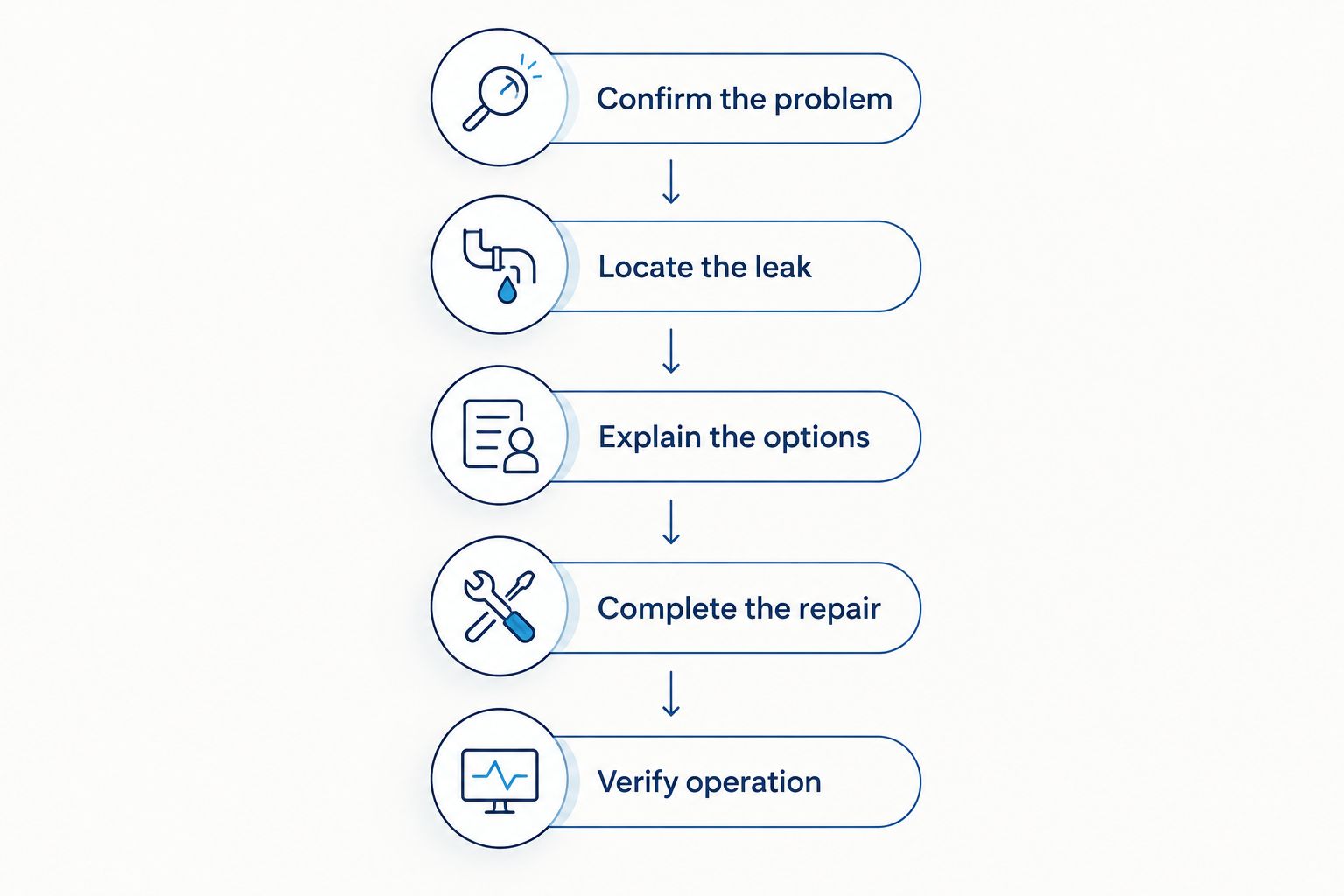
What a complete leak repair involves
A sound repair follows the evidence. The technician should explain what has been confirmed, what still needs testing, and whether the leaking section is suitable for repair.
- Confirm the problem. Check airflow, equipment operation, and refrigerant readings before deciding that low charge is the cause.
- Locate the leak. Use an appropriate detection method to identify the affected connection, tubing, or component. A suspected leak and a located leak are different findings.
- Explain the options. Describe whether the defect supports a targeted repair, component replacement, or a broader equipment discussion.
- Complete the repair. Handle refrigerant properly, correct the defect, and test the work. Opening the refrigerant circuit also requires attention to air and moisture removal.
- Verify operation. Restore the manufacturer-specified charge and check performance under suitable operating conditions.
For your 2026 service records, ask for the leak location, work performed, refrigerant type, and final findings in writing. Those details help if you later need warranty support or another technician reviews the system.
Which repair approach fits the finding?
The right recommendation depends on the damaged part and the condition around it. A small, isolated defect does not automatically justify replacing the entire system. Widespread corrosion also deserves more consideration than a promise to patch the next visible hole.
| Approach | Best for | Main benefit | Main limitation |
|---|---|---|---|
| Targeted connection or tubing repair | An isolated, accessible defect in otherwise sound material | Corrects the identified problem without replacing an unaffected assembly | Does not correct deterioration elsewhere |
| Coil replacement | A leaking coil that is unsuitable for a dependable localized repair | Replaces the affected heat-transfer assembly | Requires a compatible component and substantial refrigerant-circuit work |
| System replacement | Equipment with broader condition, compatibility, or performance problems | Allows the complete system to be evaluated together | Involves a larger installation scope than an isolated repair |
Targeted connection or tubing repair
A leaking service connection or accessible tubing defect can support a focused repair when the surrounding material is sound. Ask the technician to identify the exact location and explain how the repaired area will be tested.
The benefit is a defined correction to a defined problem. The limitation is equally important: repairing one location does not make unrelated corrosion disappear. Choose a targeted repair when the findings support a dependable fix, not simply because the visible defect looks small.
Coil replacement
Your indoor evaporator coil absorbs heat from the house. The outdoor condenser coil releases that heat outside. A leak in either assembly requires an assessment of the material, leak location, and component compatibility.
Replacing a deteriorated coil addresses the affected assembly, but it does not renew every other part of the AC. Ask how the remaining equipment is performing and whether the replacement coil matches the system's requirements.
System replacement
A refrigerant leak alone is not proof that the entire AC needs replacement. A broader discussion makes sense when the diagnosis also identifies substantial deterioration, repeated failures, or equipment-matching problems.
For a 2026 replacement proposal, request a separate written scope rather than a verbal comparison with an incomplete repair estimate. You should understand what each option fixes and what remains unchanged.
Why refrigerant leak repair cost varies
The details below explain why two homes with weak cooling can receive very different repair recommendations:
- Leak location. A visible connection is different from tubing behind finished surfaces or a leak deep inside a coil assembly.
- Condition of the material. Sound tubing with an isolated defect presents a different repair problem from widespread corrosion.
- Component involved. Repairing a connection and replacing a coil require different parts and procedures.
- Refrigerant type and required charge. The technician must identify the refrigerant specified for your equipment and determine the correct charge using the manufacturer's procedure.
- Access and equipment layout. An attic air handler or difficult-to-reach line section affects how the work must be performed.
- Verified warranty coverage. Coverage depends on the actual warranty terms. A covered component does not automatically mean every related service is covered.
Near the coast, salt exposure can corrode outdoor equipment. Ask whether the technician sees one repairable defect or broader material deterioration. Coastal location provides context, but inspection findings should determine the recommendation.
Can you just add refrigerant instead of repairing the leak?
Adding refrigerant does not seal an existing leak. Cooling can improve after a recharge while the escape point remains unchanged. That makes a refill different from a completed repair.
Ask why refrigerant is being added and whether the leak has been located. If additional testing is necessary, the technician should explain that distinction before you approve the next step.
Be cautious about a recurring refill presented as normal upkeep. The appropriate question is not how often your AC needs refrigerant, but why the sealed circuit is losing it.
Does a refrigerant leak mean you need a new AC?
A refrigerant leak does not automatically require a new AC. An isolated defect in sound equipment can support repair, while deteriorated components or other documented problems can support a replacement discussion.
Ask for the repair findings before comparing options. A recommendation is easier to evaluate when you can connect it to a specific failed part, the condition of the remaining equipment, and a clear explanation of expected limitations.
You do not need to approve a replacement simply because cooling has stopped. You need enough information to understand why the recommended scope fits the failure.
What should you check before approving a quote?
Use your 2026 written estimate to answer these questions before work starts:
- Has the technician located the leak, or is the proposal for further diagnosis?
- Does the quote identify the part being repaired or replaced?
- Does the scope include refrigerant handling and restoring the correct charge?
- How will the repair be checked for leaks?
- What operating checks will follow the repair?
- Has any claimed warranty coverage been verified?
If the quote says only "add refrigerant," ask for clarification. That description does not tell you whether the source of the loss will be corrected.
You can also ask what happens if testing reveals another affected area. Agreeing on how additional findings will be explained prevents an unclear initial scope from becoming an open-ended authorization.
What you can safely do while waiting for service
Record when cooling changed, whether airflow feels weaker, and whether you see ice on accessible equipment. Leave panels closed and avoid touching refrigerant connections. These observations help the technician without turning the visit into a homeowner repair project.
If you see ice, stop running the cooling system and arrange an inspection. Do not chip ice from a coil or tubing. Keep people and belongings clear of any water released as the ice melts.
Water near the air handler is not proof of a refrigerant leak. It can come from a drainage problem or melting ice, so describe what you see rather than assuming the cause.
For a seasonal home, give the technician any maintenance records and explain how long the property has been unoccupied. A quiet house with little day-to-day observation can make the timing of a cooling problem harder to establish.
Clear options without pressure
A.R. Williams Air Conditioning is best for South Florida homeowners who want AC repair findings explained and flat-rate pricing quoted before work starts. The service approach focuses on long-term fixes and respect for your home.
A.R. Williams Air Conditioning provides AC repair, installation, and maintenance. The appropriate leak repair still depends on inspection findings, so a diagnosis must come before a final recommendation.
For a 2026 repair decision, ask A.R. Williams Air Conditioning to walk through the identified problem and explain the options. Schedule your service when you are ready to have the system checked.
FAQ
Why can’t I get an accurate refrigerant leak repair quote from cooling symptoms alone?
Cooling symptoms do not identify the leaking part or establish that low refrigerant is the problem. A useful quote follows checks of airflow, equipment operation, and the refrigerant circuit.
Is a refrigerant recharge included in leak repair?
A refrigerant recharge is included only when the written repair scope says it is. Ask whether the estimate covers diagnosis, correcting the leak, refrigerant handling, and final testing.
Can an AC refrigerant leak be repaired permanently?
A properly selected repair can correct the identified leak, but its suitability depends on the location and material condition. Repairing one defect does not prevent an unrelated deteriorated area from leaking later.
Will my AC warranty cover a leaking coil?
Your AC warranty covers a leaking coil only if the failure meets the warranty’s terms. Have the contractor verify coverage and explain which related work is included or excluded.
Does ice on my AC mean it needs refrigerant?
Ice on your AC does not prove it needs refrigerant. Low charge and restricted airflow can both cause freezing, so the system needs diagnosis before refrigerant is added.
Is water under my air handler a refrigerant leak?
Water under your air handler is not proof of a refrigerant leak. A blocked drain or melting coil ice can release water, and each requires a different diagnosis.
Should I replace my AC after repeated refrigerant refills?
Repeated refrigerant refills justify locating the leak, not automatically replacing the AC. Compare a documented repair recommendation with replacement only after reviewing the equipment’s wider condition.
One last thing
Ask the technician to show you where the refrigerant escaped, using a photo when the location is difficult to access. Then ask how the completed repair was checked. Evidence of the problem and evidence of the fix are more useful than a promise that the air feels cold again.
Related guides
- How to tell if your AC needs repair or replacement
- How to get a second opinion on an AC replacement quote
- How to fix a frozen AC unit in Florida
