

The cost to relocate an outdoor AC unit depends on the refrigerant piping, electrical work, equipment support, and access required at the new location, so get a written, site-specific estimate before approving a move in 2026. Confirm whether that estimate includes permits, testing, and restoring any walls or landscaping disturbed by the work.
- The cost to relocate an outdoor AC unit depends on the complete installation scope, not just moving distance.
- Approve the new location before changing patios, fences, or landscaping around your central AC system.
- Compare relocation with replacement when the existing equipment already has significant problems.
- A.R. Williams Air Conditioning explains AC options and quotes flat-rate pricing before work starts.
How much does it cost to relocate an outdoor AC unit?
A reliable relocation quote covers disconnecting, moving, reconnecting, and testing the system. Measuring the distance between the old pad and the proposed location is only the starting point. The route between the indoor and outdoor equipment matters just as much.
Before choosing a spot, review AC unit placement options for narrow side yards. A location that frees up your patio still needs adequate airflow and room for a technician to reach the equipment.
For a 2026 relocation estimate, ask the contractor to identify these parts of the job:
| Part of the work | What the written scope should explain |
|---|---|
| Existing equipment assessment | Whether the unit is in suitable condition to relocate |
| Refrigerant piping | Whether the existing copper tubing can be reused or needs changes |
| Electrical connection | Whether wiring and the outdoor disconnect need to move |
| Equipment support | What pad, stand, and anchoring the new location requires |
| Approvals | Who handles applicable permits and inspections |
| Startup and testing | How the contractor checks connections and operating performance |
| Property restoration | Who handles abandoned supports, wall openings, and disturbed surfaces |
A quote that says only "move condenser" leaves important questions unanswered. The condenser is the outdoor part of your central AC system. Ask for the work behind that description before comparing proposals.
Why this matters before you change your yard
Moving an outdoor unit affects a connected cooling system. Copper refrigerant tubing and electrical wiring connect the equipment to the house, so relocation involves more than lifting the cabinet onto a different pad.
The new location also becomes part of your home's long-term service access. A narrow passage that looks acceptable while the yard is empty can become difficult to use after a fence, pool enclosure, or planting bed goes in.
Have the AC location checked before the surrounding construction is finalized. That gives your HVAC contractor and other trades a chance to resolve conflicts before concrete is poured or walls are closed.
Why the cost to relocate an outdoor AC unit varies
These factors determine the work your contractor needs to include. Ask how each applies to your home rather than assuming every relocation follows the same process.
- Piping route: The copper tubing route, bends, and height changes must fit the equipment manufacturer's installation requirements.
- Electrical changes: Moving the unit changes where its power connection and service disconnect need to be accessible.
- Support and anchoring: The new location needs a suitable base and attachment method for the site and applicable requirements.
- Access: Gates, fences, landscaping, and tight passages affect how the equipment can be moved and serviced.
- Equipment condition: Corroded tubing, damaged connections, or existing operating problems need attention before relocation makes sense.
- Approvals and restoration: Permit requirements, inspections, wall repairs, and work by other trades affect the total project scope.
Distance matters, but it doesn't describe all of these conditions. A nearby spot behind a finished wall can involve a more complicated route than a location farther along an accessible exterior wall.
A nearby move still needs a complete installation plan
A short relocation can preserve a useful outdoor space without changing the entire system. The benefit is keeping equipment that still works well while addressing a genuine placement problem.
The limitation is that a short move doesn't guarantee reusable connections. Your technician needs to inspect the tubing and wiring, check the proposed position, and determine how to reconnect the equipment without stressing those connections.
Ask whether the quote includes removing the old pad or support. Also clarify what will remain at the original location, including unused wiring routes or openings through the wall.
A longer move needs a piping and electrical review
Moving the unit to another side of the house changes the route between the outdoor equipment and the indoor coil. The indoor coil is the part of the system that absorbs heat from your home's air.
Manufacturers specify limits and installation details for refrigerant tubing. The contractor should check the proposed route against the instructions for your particular equipment rather than apply a general distance rule.
Longer piping also requires the technician to check the refrigerant charge according to the manufacturer's procedure. Refrigerant is the substance that carries heat through the system. Moving the unit without completing those checks leaves the installation unfinished.
Raising the unit changes the support requirements
If your goal is to lift the equipment out of a low area, the job needs more than a taller platform. Support stability, anchoring, service access, and the connections all need review.
A raised installation can address a site concern, but it doesn't make the equipment floodproof. Ask what site conditions the proposed support addresses and what protection it does not provide.
Near the coast, inspect exposed metal and connections before investing in a move. Salt air can corrode outdoor coils and other components. A different location does not reverse existing corrosion.
Should you relocate the unit or replace the system?
Relocation solves a placement problem; replacement addresses an equipment problem. Keep those decisions separate when comparing your 2026 options.
A system that cools properly and has sound components deserves a different discussion from one with refrigerant leaks or significant corrosion. Ask the technician to explain the existing condition before recommending either path.
| Option | Best for | Main benefit | Main limitation |
|---|---|---|---|
| Keep the current location | Homeowners whose proposed location offers no clear installation benefit | Avoids disturbing working connections | Leaves the original placement concern unresolved |
| Relocate the existing unit | Homeowners with serviceable equipment and a workable new location | Keeps existing equipment while changing its position | Does not correct wear or unrelated cooling problems |
| Coordinate relocation with replacement | Homeowners whose system already warrants replacement | Allows equipment selection and placement to be planned together | Requires a broader installation decision |
Don't approve replacement solely because you asked about relocation. Equally, don't assume that moving worn equipment is the right long-term choice. Request the findings that support the recommendation.
What should happen before and after the move?
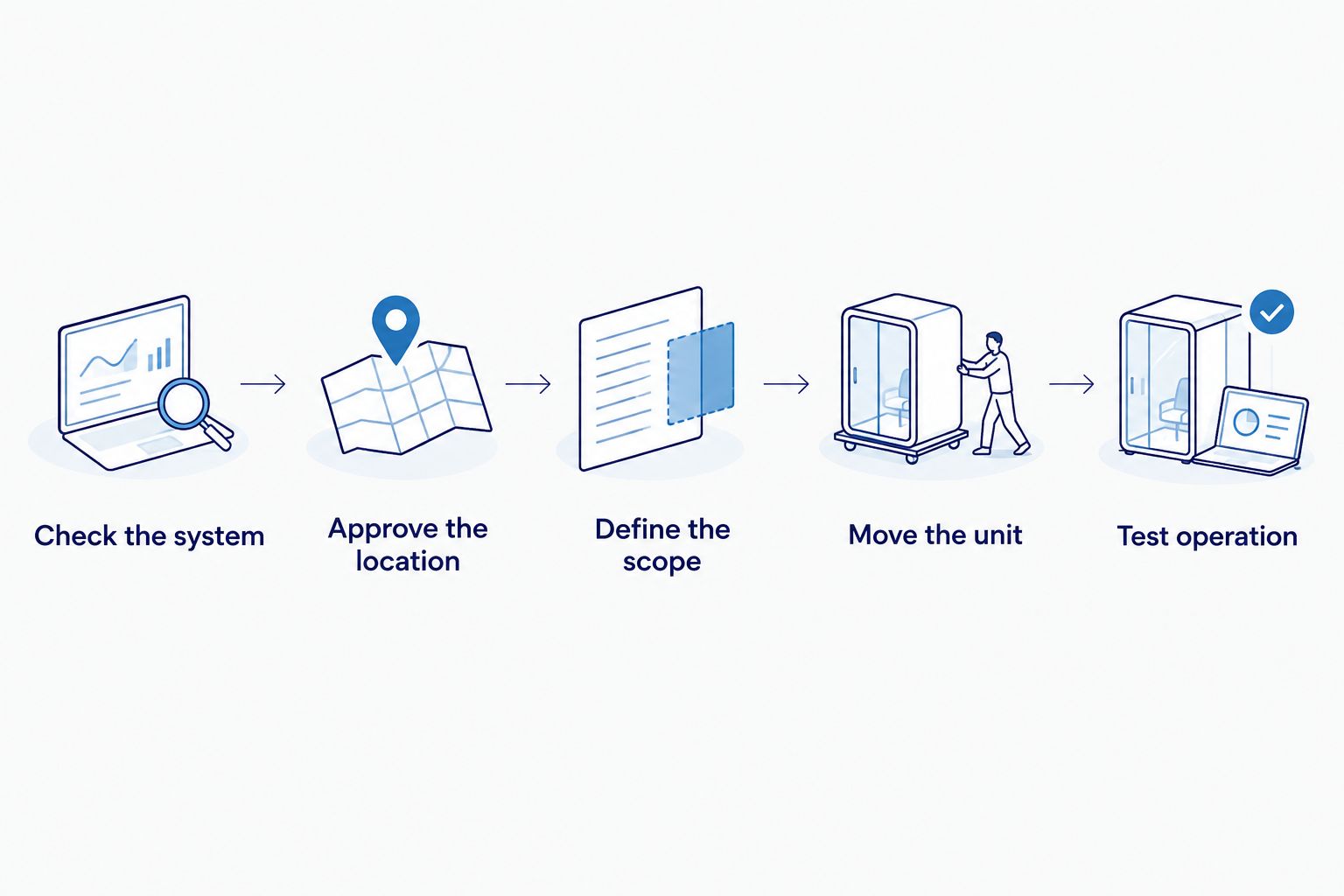
A clear sequence helps you understand what you are approving. The contractor should inspect the system before disconnecting it, not discover its operating condition only after the move.
- Check the system. Document existing cooling problems, visible damage, and equipment condition.
- Approve the location. Check manufacturer clearances, access, piping feasibility, and applicable site restrictions.
- Define the scope. Put piping, electrical work, supports, approvals, and restoration responsibilities in writing.
- Move the unit. Have qualified professionals handle the equipment, electrical connections, and refrigerant circuit.
- Test operation. Complete the required connection checks and startup procedure before calling the project finished.
You don't need to supervise the technical work. You do need to know who is responsible for each part, especially when an HVAC contractor, electrician, and remodeling contractor are involved.
Do you need a permit to move an outdoor AC unit?
Check with the local building department before work starts. The answer depends on the work involved and the jurisdiction responsible for your property, including whether the home is within a municipality or an unincorporated county area.
For a 2026 project, ask the contractor to confirm current requirements rather than rely on what applied to a previous installation. Use this guide to permits for AC installation in Florida to prepare your questions.
Permit approval and association approval are separate matters. If your neighborhood association restricts equipment placement or screening, resolve that before the contractor commits to the new location.
Can moving the outdoor unit make your AC quieter?
Relocation can change how much equipment noise reaches a bedroom or patio, but it does not repair a mechanical noise problem. Have rattling, grinding, or unusual vibration checked before treating distance as the solution.
Consider the neighboring property too. Moving the unit away from your bedroom window is not a good placement decision if it directs sound toward another home's frequently used space.
Don't enclose the unit tightly to hide it or reduce sound. Any screen or barrier needs to preserve the manufacturer's airflow and service clearances.
Can you move the unit without disconnecting it?
Don't slide or lift a connected unit yourself. Copper tubing and electrical connections are not handles, and moving the cabinet can damage them even when the distance looks small.
The contractor should decide how to handle the refrigerant circuit after inspecting the installation. Work that opens that circuit requires appropriate refrigerant-handling practices and qualified personnel.
Your useful preparation is simpler: clear the access route and identify the proposed location. Leave disconnecting and repositioning the equipment to the contractor.
What to ask before you approve the work
You should be able to explain what the project includes without translating technical shorthand. Ask the contractor to walk through the route and point out anything that another trade must complete.
- Is the existing equipment in suitable condition to move?
- Does the proposed location meet the equipment's installation instructions?
- Which piping, wiring, and supports will change?
- Who handles approvals and any required inspections?
- What testing is included after reconnection?
- What restoration or follow-up work is excluded?
A.R. Williams Air Conditioning is best for South Florida homeowners who want their AC options explained before work starts. Technicians explain their findings and lay out the options, with transparent flat-rate pricing quoted before work begins.
A.R. Williams Air Conditioning provides residential AC repair, installation, and maintenance. A relocation decision still needs an assessment of your equipment and property; a description of the desired move alone does not settle the installation details. Talk with a technician about the proposed location before finalizing your renovation plans.
FAQ
What determines the cost to relocate an outdoor AC unit?
The cost to relocate an outdoor AC unit depends on piping, electrical changes, equipment support, access, and applicable approvals. Ask for a written scope that also identifies testing and restoration responsibilities.
Is moving an outdoor AC unit a simple landscaping job?
No, an outdoor AC unit is connected to refrigerant piping and electrical wiring. Have an HVAC contractor assess the move before a landscaper or remodeling contractor changes the surrounding area.
Can I move my outdoor AC unit closer to a fence?
Only if the proposed location preserves the manufacturer’s required airflow and service clearances and meets applicable placement rules. Check the finished fence layout before approving the move.
Will relocating my outdoor unit fix poor cooling?
Relocation does not automatically fix poor cooling. A technician should diagnose the problem first and explain whether placement contributes to it.
Should I replace an old AC system instead of moving it?
Base that decision on the equipment’s condition and the work involved, not age alone. Ask for the findings behind both recommendations so you can compare relocation with a properly planned replacement.
Can I use my AC while the outdoor unit is being moved?
No, the system cannot cool your home while its outdoor unit is disconnected. Ask the contractor when cooling will be unavailable and when startup testing is expected to finish.
Does moving my AC unit affect its warranty?
Warranty treatment depends on the manufacturer’s terms and the installation work. Ask the contractor to check the applicable requirements before changing the equipment’s location or connections.
One last thing
Before signing a 2026 relocation proposal, mark the future fence line, planting beds, and gate swing on the site plan. An empty yard can hide access conflicts that become obvious only after the surrounding work is finished.
Approve the finished layout, not just the empty spot where the unit will sit. That is the placement decision you and future service technicians will live with.
Related guides
- How to read your AC installation contract before signing
- How to tell if your AC needs repair or replacement
- How to reduce outdoor AC unit noise for light sleepers
