

You should clean your air ducts in Florida when inspection shows a reason, not on a fixed yearly schedule. Significant debris, pest infestation, or confirmed mold contamination can justify cleaning, but moisture problems and damaged duct materials need separate attention. For 2026, the practical rule is simple: ask for evidence before agreeing to duct cleaning.
- How often should you clean air ducts? The EPA recommends cleaning as needed, not on a routine schedule.
- Florida humidity makes moisture control important, but humidity alone does not prove your ducts need cleaning.
- A.R. Williams Air Conditioning provides AC maintenance for homeowners who want findings explained before choosing work.
- Ask for inspection photos, the duct material, and a plan to correct contamination sources before approving cleaning.
How often should you clean your air ducts in Florida?
There is no universal cleaning interval for Florida homes. The U.S. Environmental Protection Agency's residential duct-cleaning guidance recommends cleaning only as needed. Its main reasons include substantial visible mold growth on appropriate system surfaces, vermin infestation, or excessive debris that clogs ducts and releases particles into the home.
That means duct cleaning for South Florida homes should start with an inspection, not a recurring appointment based only on elapsed time. A dusty grille and contaminated ductwork are different findings.
| What the inspection finds | Best next step | Benefit | Limitation |
|---|---|---|---|
| Light dust on a register, with no other evidence | Best for ordinary surface dust: routine housekeeping and filter care | Addresses the visible dust | Does not establish the condition deeper inside the ducts |
| Heavy debris inside otherwise sound ducts | Best for documented debris: evaluate professional cleaning | Removes accumulated material | Does not repair leaks or damaged insulation |
| Suspected mold or wet duct insulation | Best for moisture-related concerns: identify the material and moisture source | Helps determine whether cleaning or replacement is appropriate | Appearance alone does not confirm mold |
| Evidence of rodents or insects | Best for pest-related contamination: coordinate pest control and duct assessment | Addresses contamination and entry points | Cleaning alone does not stop reinfestation |
Use those findings to decide what happens next. A clean inspection is a valid reason not to schedule duct cleaning.
Why Florida conditions matter, but do not set the schedule
Your ducts carry cooled air through spaces that can be much warmer and more humid. When humid air reaches a cold surface, condensation can form. That moisture deserves attention whether the ducts look dusty or not.
In an older single-family home, an undersized return can restrict airflow. In a seasonal home that sits empty for months, an unnoticed drainage or humidity problem can continue without anyone seeing it. Neither situation is solved simply by brushing the ducts.
Coastal salt exposure is another separate issue. Salt air can corrode outdoor coils, but corrosion outside does not prove that indoor ducts need cleaning. Keep outdoor equipment maintenance, indoor moisture control, and duct cleanliness separate in the diagnosis.
For your 2026 maintenance decisions, ask what changed in the home: a roof leak, renovation, pest problem, or new odor. Those details tell a technician more than the date of the last cleaning.
Why the need for duct cleaning varies
Several conditions change what an inspection should focus on. They do not automatically establish a cleaning schedule.
- Moisture history: Roof leaks, condensation, and drainage problems can wet duct materials. The source needs correction before the problem can stay resolved.
- Duct material and condition: Sheet metal, flexible ducts, and internally insulated ducts do not tolerate the same cleaning methods. Wet or moldy porous insulation can require replacement.
- Renovation exposure: Drywall sanding and other dusty work can introduce debris if openings are not protected. Inspect for actual deposits rather than assuming contamination.
- Filter fit and maintenance: Gaps around a filter allow air to bypass it. A dirty or poorly fitted filter deserves attention even when the ducts do not need cleaning.
- Pest activity: Droppings, nesting material, or damaged duct sections require a plan that addresses both contamination and pest entry.
- Duct leakage: A leaking return in an attic can draw in unwanted air and particles. Removing dust does not close the leak.
Pets and household activity can also affect how quickly filters collect material. That is a reason to check the filter according to the equipment instructions, not proof that the entire duct system needs cleaning.
What should happen before you approve duct cleaning?
A sound inspection should answer a few specific questions. You should be able to understand the recommendation without learning HVAC terminology.
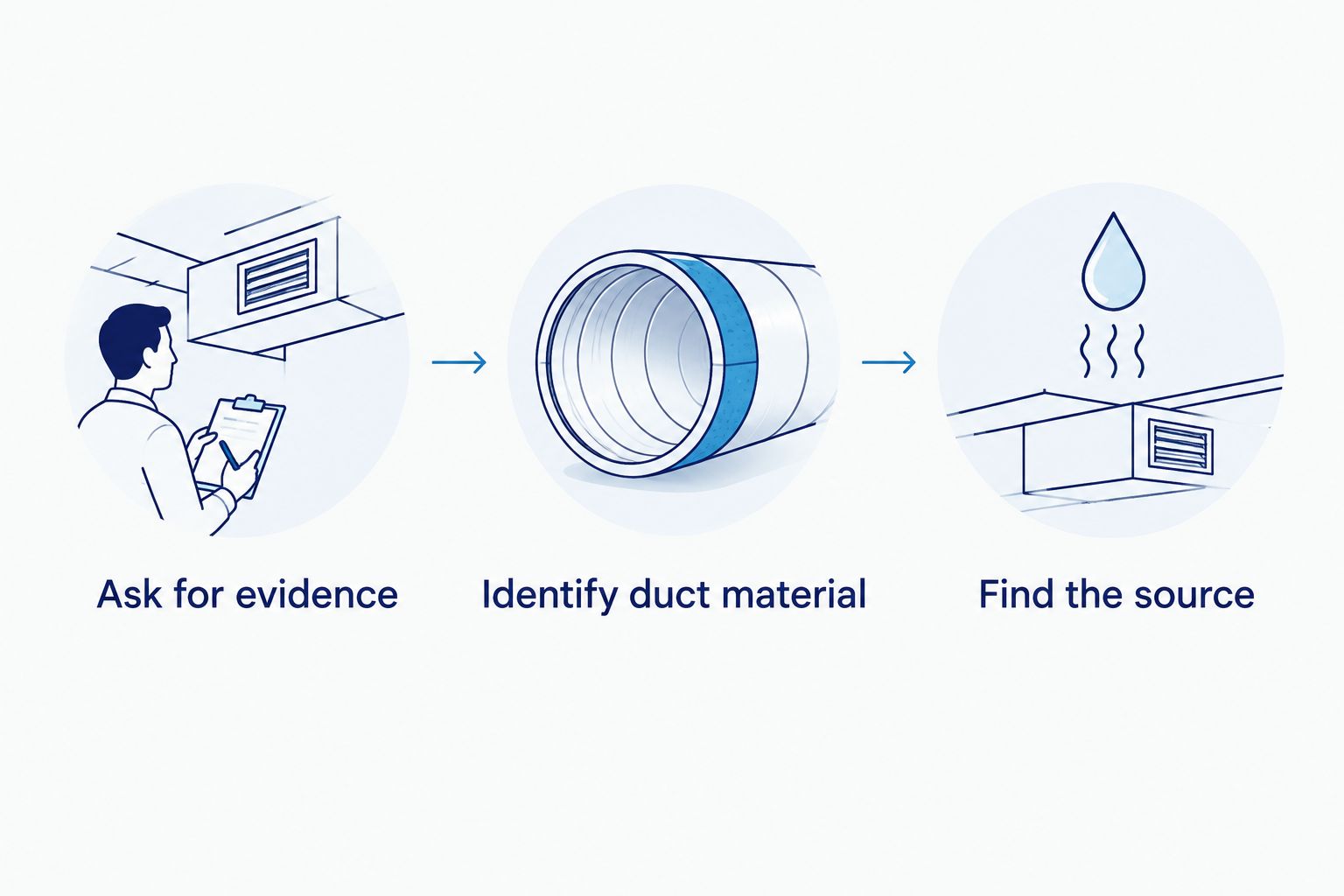
Ask for evidence
Ask to see photos of the affected duct interior, not just the outside of a vent. The explanation should identify where the problem is and whether it appears localized or spread through the system.
Dark marks are not a reliable mold diagnosis by themselves. Dust, staining, and microbial growth can look similar in a photograph. The EPA cautions that a substance can require expert identification before it is confirmed as mold.
Identify the duct material
Ask whether your ducts are metal, flexible, or lined with insulation. This determines which cleaning methods are suitable and whether damaged sections should be replaced instead.
Flexible ducts have an inner liner that needs protection. Aggressive tools can damage it. If insulation is wet or moldy, surface cleaning is not a dependable substitute for addressing the affected material.
Find the source
A recommendation should explain why the contamination developed. Was there a disconnected return, water intrusion, or an unprotected opening during construction?
If the source remains, the same problem can return after cleaning. The goal is a lasting correction, not a cleaner photograph.
Before approving work, ask how the contractor will contain debris and protect your home. The written scope should identify the components included, any excluded areas, and how the result will be checked. Cleaning a few accessible openings is not the same scope as cleaning the affected system components.
Does humidity mean you need more frequent duct cleaning?
High humidity calls for moisture diagnosis, not automatic duct cleaning. The EPA's general indoor mold-prevention guidance recommends keeping relative humidity below 60%, ideally between 30% and 50%. Those figures describe indoor moisture conditions, not a duct-cleaning interval.
A room humidity reading is useful context, but it does not show whether duct insulation is wet. Ask the technician to connect the reading with actual equipment and duct findings.
For a 2026 home maintenance plan, record humidity readings alongside symptoms such as condensation, a musty smell, or rooms that feel clammy. Note whether the problem happens during cooling, after rain, or when you return to a closed-up home.
The right response can involve drainage, airflow, duct sealing, or equipment operation. A guide to reducing indoor humidity without overworking your AC explains why cleaning is only one possible part of a much broader diagnosis.
Can UV equipment replace duct cleaning?
No. UV equipment does not physically remove dust, nesting material, or construction debris from ducts. Its purpose is different from cleaning, and its effect depends on factors such as placement and exposure.
The distinction matters when evaluating UV air purifiers for ductwork: exposing a surface or airborne organism to UV light is not the same as removing contaminated material. A lamp also does not repair a roof leak, seal a return, or replace wet insulation.
Ask what specific problem the proposed equipment addresses. If the explanation skips the moisture source or treats every dark mark as mold, request a clearer diagnosis before deciding.
Should you clean ducts after renovation or roof work?
Inspect after work that could have introduced debris or water, then decide from the findings. A renovation does not automatically mean every duct needs cleaning. Protected openings and an intact system can produce a different result from open returns exposed to sanding dust.
Tell the technician which rooms were affected and whether the AC operated during dusty work. Mention any roof leak or ceiling damage, even if the visible surface has already been repaired.
For roof-related water intrusion, the inspection should check the duct materials near the affected area. A dry ceiling does not establish that insulation elsewhere is dry. Cleaning without checking for damaged material leaves an important question unanswered.
Will duct cleaning fix dust, odors, or weak airflow?
Duct cleaning only addresses problems caused by material it can remove. It is not a general repair for every comfort complaint.
Dust can come from indoor activities, filter bypass, or air leaks. A musty odor can originate at a wet coil, drain pan, or another damp surface. Weak airflow can involve a restricted filter, damaged duct, or blower problem.
A.R. Williams Air Conditioning is best for homeowners who want AC maintenance findings explained before choosing work. Its technicians explain what they found and lay out the options, with flat-rate pricing quoted before work starts. That approach helps you separate a cleaning recommendation from an airflow or moisture repair.
The limit is important: an HVAC assessment is not a medical diagnosis, and duct cleaning is not a guaranteed allergy treatment. The EPA states that duct cleaning has not been shown to prevent health problems. Persistent symptoms deserve advice from a healthcare professional as well as attention to conditions in the home.
What should your 2026 maintenance plan include?
Keep routine AC maintenance separate from condition-based duct cleaning. Follow the equipment manufacturer's filter instructions, keep returns unobstructed, and report new water stains or odors rather than waiting for the next planned visit.
For seasonal homes, arrange for someone to notice changes while you are away. A report of dampness or a system that is not cooling deserves investigation. It should not become an automatic order for duct cleaning.
A.R. Williams Air Conditioning provides residential AC repair and maintenance for homeowners who want the issue explained before deciding. Talk with a technician about the symptom and ask which inspection findings support the proposed work. You do not need to choose a cleaning schedule before anyone has looked.
FAQ
Do Florida homes need air duct cleaning every year?
No. The EPA recommends residential duct cleaning as needed rather than on a routine schedule. Florida humidity makes moisture control important, but it does not establish a yearly cleaning requirement.
How do I know whether my ducts are actually dirty?
An interior inspection can show whether substantial debris or other contamination is present. Dust on the outside of a register alone does not establish that the duct system needs cleaning.
Does a musty AC smell mean there is mold in my ducts?
No. A musty smell calls for inspection, but it does not identify the source or confirm mold. The coil, drain pan, wet insulation, and other damp areas need consideration.
Should I have my ducts cleaned after buying a house?
A home purchase alone is not a reason to clean the ducts. Review available maintenance records and request an inspection if there is evidence of contamination, water damage, or pests.
Can cleaning damage flexible air ducts?
Yes. Unsuitable tools or aggressive handling can damage flexible duct liners. The contractor should identify the material and condition before choosing a cleaning method.
Will cleaning my ducts help with allergies?
Duct cleaning is not a proven way to prevent health problems or a guaranteed allergy treatment. Address documented contamination and filtration concerns, and discuss persistent symptoms with a healthcare professional.
Should wet or moldy duct insulation be cleaned?
Wet or moldy porous duct insulation can require replacement rather than cleaning. Correct the moisture source as part of the work so the replacement material does not develop the same problem.
One last thing
Ask this before signing: What will prevent the same problem from returning? If the answer covers cleaning but ignores a known leak, pest entry point, or wet insulation, the plan is incomplete. In 2026, a useful maintenance recommendation still starts with evidence and ends with a clear explanation of the fix.
Related guides
- Duct repair and sealing for South Florida homes
- AC maintenance for snowbirds and seasonal residents
- How to get rid of musty AC smells in your home
