
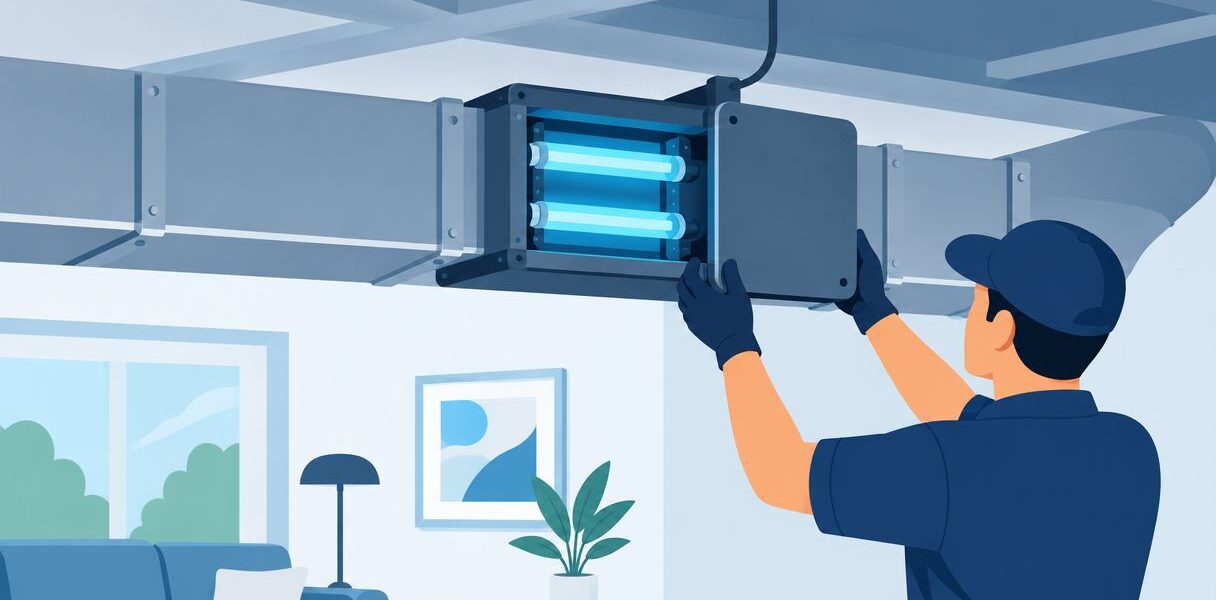
Instead of treating a recurring musty AC smell with sprays, connect a UV air purifier to AC ductwork through a professional installation that addresses the actual source. Your HVAC technician must choose an approved mounting location, connect the specified power supply, and verify that UV light cannot escape into occupied or service areas.
- Connect a UV air purifier to AC ductwork with professional mounting, electrical connections, and UV exposure safeguards.
- Coil-treatment UV targets illuminated surfaces; air-treatment UV requires documented performance at your system’s airflow.
- UV air purification does not replace filters, drain maintenance, or humidity control.
- A.R. Williams Air Conditioning explains AC findings and repair options before work starts.
Why this matters
A UV lamp inside your central AC system is not a general-purpose solution for dirty ducts or damp indoor air. Germicidal UV can inactivate microorganisms that receive enough exposure, but it does not collect dust or remove moisture. Choose the treatment goal before choosing the installation location.
In coastal Florida homes, the indoor cooling coil produces condensation during normal operation. A blocked drain, wet insulation, or leaking return duct needs its own correction. Adding a lamp leaves those problems in place.
Start with the differences covered in UV air purifiers for Florida HVAC systems. For a 2026 installation, use the exact purifier's current installation manual and your air handler's accessory requirements, not a mounting diagram for a similar-looking unit.
A.R. Williams Air Conditioning is best for homeowners who want AC findings explained before choosing a repair. Ask for a diagnosis before deciding whether an accessory belongs in the solution.
Before you start
This is a homeowner planning guide, not a wiring or duct-cutting tutorial. UV-C exposure can injure eyes and skin, and an air handler contains electrical hazards even when the thermostat is off.
Have these items ready before an installation appointment:
- Equipment information: Gather the air handler model, purifier model, and their installation manuals. The technician needs the actual supply-voltage requirements and approved mounting instructions.
- Safe access: Clear the route to the air handler and proposed mounting area. Leave cabinet removal, electrical testing, and work inside the equipment to the technician.
- Material compatibility: Confirm that nearby drain pans, wiring, insulation, and filter materials can tolerate the proposed UV exposure. A lamp that physically fits can still damage exposed materials or block coil access.
Do not order equipment solely because the listing says it fits central AC. Compatibility includes mounting, electrical capacity, exposure protection, and enough room to replace the lamp without disturbing refrigerant piping.
Choose the treatment goal
Two installation approaches serve different purposes. Neither should be sold as a substitute for correcting moisture problems.
| Approach | Best for | Benefit | Limitation |
|---|---|---|---|
| Coil-treatment UV | Targeting microbial growth on illuminated cooling-coil surfaces | Treats stationary surfaces where exposure can continue | Does not treat shadowed areas or establish whole-home airborne performance |
| Air-treatment UV | A defined airborne-treatment goal supported by testing | Exposes air passing through the treatment section | Performance depends on UV intensity, airflow, exposure time, and the target organism |
For a coil-related problem, require a coil-treatment plan. For an airborne-treatment goal, require performance evidence at your AC's operating airflow. A visible glow proves neither result.
Mounting location
A UV purifier usually mounts in an approved air-handler or duct location rather than connecting through a separate air hose. Its lamp extends into the treatment area, while its power components remain positioned according to the manufacturer's instructions.
- Ask the technician to identify the source of the complaint. Have the coil, drain pan, drainage, filter condition, and accessible ductwork assessed before discussing the accessory. Describe whether the odor occurs at startup, during cooling, or continuously.
- Match the location to the treatment goal. For coil treatment, the lamp needs an approved view of the intended surfaces. For air treatment, the installation must match the manufacturer's tested arrangement and airflow requirements.
- Confirm clearances and future access. Require space for lamp removal, coil service, and filter replacement. The technician should identify materials needing shielding and confirm that the housing supports the mounting assembly.
Expected result: You can point to the proposed location and explain what it treats. The technician can show the mounting instructions that support it.
Do not accept a universal lamp-to-coil distance. There is no single clearance that applies to every purifier, drain pan, or air-handler cabinet. The selected model determines the required geometry.
Flexible duct, lined duct, and sheet-metal plenums are not interchangeable mounting surfaces. Any proposed opening needs suitable support and an approved seal. The installation must preserve the duct's insulation and moisture barrier where applicable.
Power and exposure protection
Electrical compatibility is separate from physical fit. Some HVAC UV equipment uses a 24 V supply; other equipment uses a 120 V supply. These are examples, not specifications for your purifier, and they do not authorize a connection to an existing terminal or outlet.
- Have the technician verify the specified supply. The purifier's electrical rating and installation manual determine the connection. If an existing low-voltage transformer is proposed, its available capacity must be checked rather than assumed.
- Confirm the required operating control. Establish whether the selected system calls for continuous operation or operation tied to airflow. Require the manufacturer-approved control arrangement, not an improvised thermostat connection.
- Review UV exposure safeguards. Confirm the required shields, access protections, and warning labels. The lamp must not be visible through an open service panel, supply register, return grille, or an unapproved viewing opening during operation.
Expected result: The technician can explain the power source, operating control, and safe service procedure without opening energized equipment to demonstrate the lamp.
Many conventional germicidal lamps emit near 254 nm. That wavelength is not a safe viewing light, and a blue appearance does not make direct exposure harmless. Verify operation through the manufacturer's intended indicator or protected viewing method.
For your 2026 installation record, keep the purifier model and power-supply information together. Future technicians should not have to guess which accessory was added or how it is controlled.
Installation and commissioning
Commissioning means checking the completed installation before handing it over. It includes more than confirming that the lamp turns on.
- Have the technician complete mounting with power safely isolated. The technician must verify electrical isolation, protect nearby components, and use the specified mounting method. Homeowners should not drill into an assembled air handler or reach into its cabinet.
- Require a check of the enclosure and service access. Confirm that openings are sealed, covers are secure, wiring is protected, and required exposure safeguards are installed. The lamp must not obstruct the blower, filter, drain components, or coil service path.
- Ask for an operating demonstration using the approved indicator. Have the technician confirm the purifier's intended operating sequence and normal AC operation. Request an explanation of the shutdown procedure before any future filter or equipment service.
Expected result: Your AC operates normally, the accessory is enclosed safely, and you know how to recognize its normal status without exposing yourself to UV light.
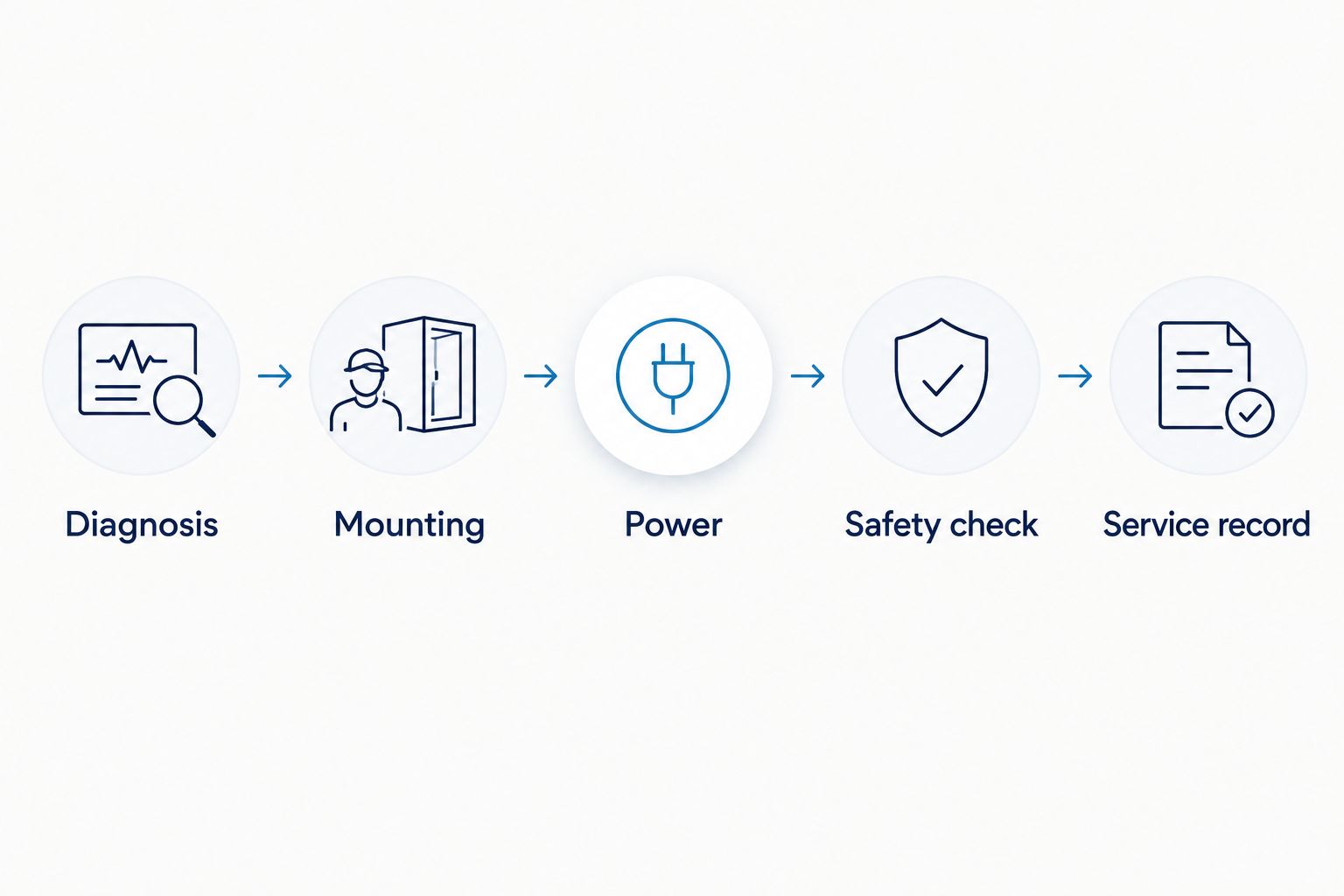
The handoff should follow a clear sequence: Diagnosis, Mounting, Power, Safety check, and Service record. Each stage answers a different question, so a working indicator cannot replace the earlier checks.
Before closing the appointment, ask what the installer verified and what remains outside the purifier's scope. An honest answer separates accessory operation from a promise about your home's air quality.
Service record
A lamp can remain visibly lit after its germicidal output has declined. Your maintenance plan therefore needs the manufacturer's replacement instructions, not a rule to wait until the bulb goes dark.
- Save the installation details. Record the installation date, lamp identifier, approved replacement part, and applicable service instructions. Keep the manuals with your AC records.
- Set reminders from the actual manual. Follow the specified inspection, cleaning, and replacement schedule. Do not adopt an interval from a different lamp or an online advertisement.
- Explain the accessory to anyone servicing the AC. Tell the technician that UV equipment is installed before they open the air handler. Ensure a caretaker knows the safe reporting procedure if you leave the home seasonally.
Expected result: Your 2026 service record identifies the equipment and its maintenance requirements. A future technician can service the AC without an unexpected UV exposure hazard.
For snowbird homes, schedule checks around access to the property rather than relying on an unattended indicator. Leaving the home empty does not eliminate condensation, drainage issues, or accessory maintenance.
Second workflow: coil treatment between cooling cycles
Coil treatment and air treatment do not necessarily use the same operating schedule. A cooling coil stays in place when the blower stops, so a manufacturer-approved coil-treatment system can continue illuminating its target between cooling cycles.
Ask the installer to verify the intended operating sequence for the exact model. Do not ask them to make every UV purifier run only when the thermostat calls for cooling. That change can conflict with the treatment design.
Air-treatment equipment needs a different assessment because its claimed result depends on air passing through the treatment area. The technician must follow its approved control and mounting requirements.
The purifier's manual determines the operating sequence. Your thermostat preference does not. For a 2026 upgrade to an existing system, document that sequence so later thermostat or control work does not unintentionally change it.
Troubleshooting
Troubleshooting starts outside the closed cabinet. Do not remove covers to see whether the lamp is glowing.
The status indicator is off
Check the manual's explanation of the indicator first. If it should be on, report the symptom to the installer. The technician can distinguish a lamp failure from a power-supply, control, or indicator problem without exposing you to energized components.
The musty smell is still present
A persistent smell does not prove the lamp is defective. Ask for the drain pan, drainage, wet insulation, and accessible ductwork to be reassessed. UV only affects material receiving suitable exposure; it does not dry a damp cabinet or clean every duct surface.
Cooling changed after installation
Report weaker airflow, unusual cycling, or a new noise to the installer. Have the mounting, wiring, cabinet closure, and AC operation checked. Do not keep changing thermostat settings to compensate for a problem that appeared after the work.
Nearby materials are discoloring or becoming brittle
Have the installation reviewed for UV compatibility and shielding. Exposed polymers can degrade under UV, so replacing the affected material without correcting exposure leaves the cause in place. Leave inspection inside the equipment to the technician.
You notice a new sharp odor
Do not assume an odor means the purifier is working. Some UV equipment can generate ozone, which irritates the lungs. Stop using the accessory through its documented safe shutdown method and have the installer assess the equipment and symptom.
Customize your workflow
Pair UV decisions with the problem you actually need to solve. A filter captures particles; UV does not. Drain maintenance addresses water removal from the coil area; UV does not. Humidity control reduces indoor moisture; UV does not.
If rooms feel clammy, review how to reduce indoor humidity without overworking your AC. Ask the technician to evaluate the cause rather than adding accessories one after another.
When discussing UV air purification with A.R. Williams Air Conditioning, describe the symptom and ask whether an equipment assessment is the right next step. The company provides AC repair, installation, and maintenance, with findings explained and flat-rate pricing quoted before work starts.
That clarity has a limit: an explanation of an accessory is not proof that your existing system needs it. Request the reason for the recommendation, its expected benefit, and what it will not fix.
FAQ
Can I connect a UV air purifier to my AC ductwork myself?
Have a qualified HVAC technician handle the installation. The work involves electrical connections, equipment openings, material compatibility, and protection against UV exposure.
Where should a UV light go in a central AC system?
The location depends on whether the system is designed to treat coil surfaces or passing air. The exact purifier’s installation instructions determine the approved position and clearances.
Should my AC UV light stay on when the blower stops?
Follow the operating sequence specified for the exact model. Some coil-treatment designs operate between cooling cycles, while air-treatment designs have their own control requirements.
Will a UV purifier remove dust from my house?
No, UV does not collect dust. Your HVAC filter handles particle capture, and its suitability depends on your system’s airflow requirements.
Will a UV light fix a musty AC smell?
A UV light is not a guaranteed fix for a musty AC smell. Drainage problems, wet insulation, or other moisture sources need diagnosis and correction before an accessory is recommended.
Is it safe to look at the UV lamp to check it?
No, do not look directly at an operating germicidal UV lamp. Use only the manufacturer’s intended indicator or protected viewing method, and leave cabinet access to the technician.
How do I know when my HVAC UV lamp needs replacement?
Use the replacement schedule in the lamp’s manual rather than waiting for it to stop glowing. Visible light does not confirm that germicidal output remains adequate.
One last thing
Before approving a UV installation in 2026, ask: How will the next technician safely service the coil and replace the lamp? A location that makes those tasks difficult is a poor fit even if the accessory can be mounted there.
Talk with a technician at A.R. Williams Air Conditioning about the AC symptom first. Decide on UV air purification only after you understand the diagnosis and the proposed treatment goal.
Related guides
- How to get rid of musty AC smells in your home
- Indoor air quality solutions for humid climates
- How to verify your AC contractor is licensed in Florida
