
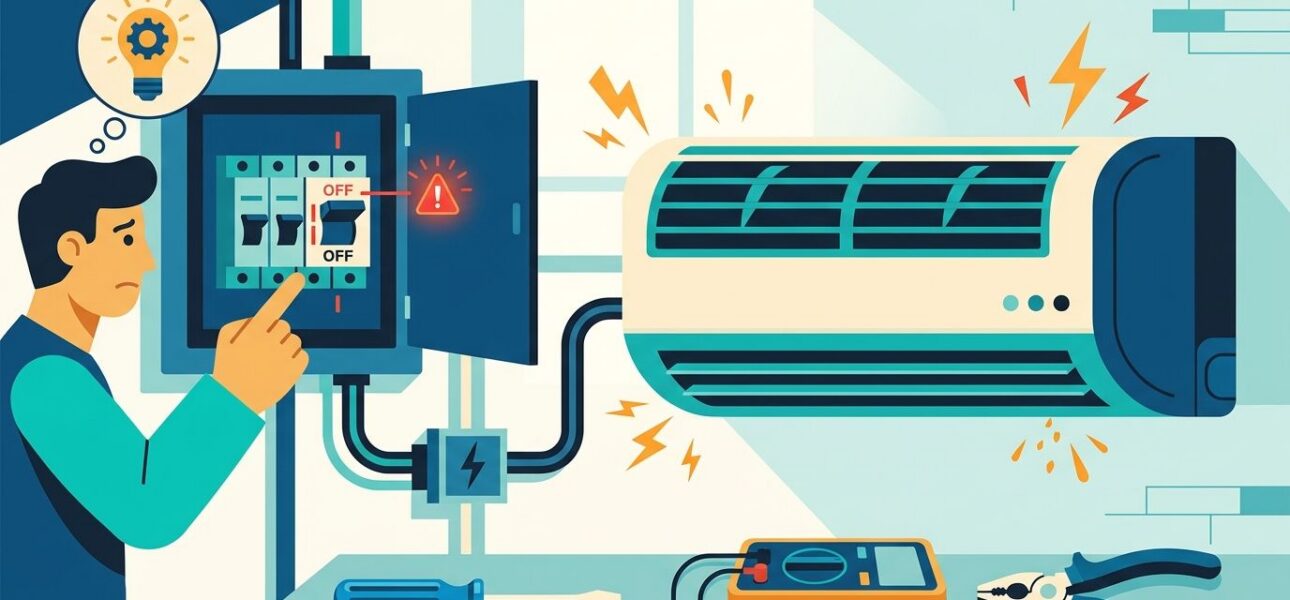
An AC unit that keeps tripping the breaker almost always points to one of five things: a dirty filter choking airflow, a failing capacitor, a dirty condenser coil, a short in the wiring, or a breaker that's worn out and undersized for the load. Turning the breaker back on without finding which one it is just repeats the cycle, and in some cases pushes a fixable capacitor problem into a compressor replacement.
- AC tripping breaker is usually a dirty filter, bad capacitor, dirty coil, wiring short, or worn breaker, not a compressor failure.
- A failing capacitor is the single most common cause in South Florida homes running AC 16+ hours a day.
- Resetting the breaker more than once without diagnosing the cause risks damaging the compressor.
- Salt air and constant summer runtime wear out capacitors and coils faster near the coast.
- A technician can usually confirm the exact cause with a multimeter check in under an hour.
Why this matters
A breaker trip is the electrical panel doing its job. It's cutting power because the system is drawing more current than the circuit is rated for. That's protective, not random.
The risk is what homeowners do next. Flipping the breaker back on repeatedly, especially if the AC restarts and trips again within minutes, forces the compressor to try to start against resistance it can't overcome. That's how a $30 capacitor problem turns into a compressor replacement that costs a lot more. If your unit has tripped more than twice in the same day, get it looked at today rather than resetting it again.
How do you fix an AC unit that keeps tripping the breaker?
Work through these in order before assuming the worst:
- Check the air filter first. A filter clogged with dust or pet hair restricts airflow across the coil, which forces the blower motor and compressor to draw more current to compensate. Replace it if it's visibly gray or matted.
- Look at the outdoor unit. Cut grass clippings, leaves, or a bent fin blocking the condenser coil make the compressor work harder to reject heat, spiking amp draw. Clear debris and hose off the coil gently if it's caked.
- Listen for a hum with no start. If the outdoor fan or compressor hums but doesn't spin when the system kicks on, that's a classic capacitor symptom, not a wiring issue.
- Check the breaker itself. Breakers weaken with age and heat cycling. If the breaker feels warm to the touch or the trip happens with no obvious airflow or component problem, the breaker may be the failing part, not the AC.
- Stop resetting it more than twice. If steps 1 through 4 don't reveal an obvious cause and the unit trips again after a reset, call for a diagnostic instead of trying a third time.
A failing capacitor is the most common trigger
The capacitor gives the compressor and fan motor the jolt of current they need to start spinning. When it weakens (which happens gradually from heat and constant cycling), the motor tries to start anyway and pulls a surge of current well above normal, tripping the breaker almost immediately.
This is especially common in South Florida because AC systems here run far more hours per year than in milder climates, and every start-stop cycle puts a small amount of wear on the capacitor. Signs your capacitor needs replacing include a humming outdoor unit, a slow-spinning fan you can nudge by hand to get started, or the AC running fine for a few minutes and shutting off.
A dirty or failing condenser coil forces higher amp draw
The outdoor coil sheds heat from the refrigerant. Salt air along the coast and construction dust inland both coat the coil in a film that acts like insulation, trapping heat the system can't release. The compressor then runs hotter and pulls more current to keep up, and a breaker rated for normal load trips under that added draw.
Homes within a few miles of the Intracoastal or the ocean see this faster than inland homes, often needing a coil cleaning twice a year instead of once.
Electrical short in the compressor or wiring
A compressor with a winding starting to break down internally, or wiring insulation that's cracked from age and heat in the attic or outdoor disconnect box, can create a partial short. This shows up as a trip that happens instantly on startup, every time, with no gradual warning. Older homes built before 2010, especially ones still running original wiring alongside a newer AC condenser, see this more often because the electrical components weren't sized for today's higher-efficiency compressors.
An undersized or worn breaker
Sometimes the AC isn't the problem at all. Breakers lose their rated tolerance over time, tripping at lower amp draws than they're supposed to. If a technician tests the AC's amp draw and it's within the manufacturer's normal range, the breaker itself may need replacing, or the panel may not be sized for the system installed. Checking whether your panel can support your AC system matters most in homes that added a larger or higher-efficiency unit without an electrical review.
Why AC breakers trip more often in South Florida homes
- Long runtimes. AC systems here run 12 to 16 hours a day for much of the year, wearing capacitors and contactors faster than in states with shorter cooling seasons.
- Salt air exposure. Homes within a few miles of the coast see accelerated corrosion on outdoor coils and electrical connections, which raises amp draw over time.
- Older housing stock. Many Palm Beach County homes built before 2010 still run original electrical panels never sized for modern AC compressors.
- Storm-related power surges. Lightning strikes and grid fluctuations during Florida's wet season stress capacitors and control boards even when the AC keeps running afterward.
- Heavy dust and pollen loads. Filters clog faster during dry season winds and nearby construction, restricting airflow and raising compressor amp draw.
- Deferred maintenance. Systems that haven't had an annual coil cleaning or electrical tightening in a year or more show up as breaker trips before anything else fails.
“If the breaker trips more than twice in one day, the AC needs a diagnostic, not a third reset.”
Related questions
Is it dangerous if my AC keeps tripping the breaker?
It's not an immediate safety hazard on the first trip, since the breaker is doing its job by cutting power before wiring overheats. Repeated trips without diagnosis raise the risk of compressor damage and, in rare cases, wiring degradation from repeated current surges.
Can a bad capacitor really cause a breaker to trip?
A bad capacitor causes a breaker to trip more often than any other single component, because a weak capacitor forces the compressor or fan motor to draw a hard startup surge every time it tries to run. Replacing the capacitor resolves the trip in most of these cases without touching anything else.
Should I keep resetting the breaker myself?
Resetting it once to see if the AC runs normally is fine, but resetting it a second or third time after it trips again isn't. At that point the AC (or the breaker) needs a technician's diagnostic before another reset does damage that costs more to fix.
FAQ
Why does my AC unit keep tripping the breaker?
An AC unit keeps tripping the breaker because of a dirty filter restricting airflow, a failing capacitor causing a startup surge, a dirty condenser coil raising amp draw, an electrical short, or a worn breaker. A technician can usually confirm which one with an amp draw test.
Is a tripping breaker a sign the compressor is failing?
A tripping breaker can be an early sign of compressor failure, but a capacitor problem causes the same symptom far more often. Checking the capacitor first before assuming compressor failure saves an unnecessary replacement.
How much does it cost to fix an AC that keeps tripping the breaker?
The cost depends entirely on which component is at fault, since a filter change costs far less than a compressor replacement. A technician’s diagnostic identifies the actual cause before any repair is quoted.
Can dirty coils cause a breaker to trip?
Yes, a dirty condenser coil forces the compressor to work harder and draw more current, which trips a breaker that’s operating within its normal tolerance. Coastal homes see this from salt air buildup faster than inland homes.
Is it safe to reset the breaker myself?
Resetting the breaker once to check if the AC runs normally again is safe. Resetting it a second or third time after it trips again risks compressor damage and should wait for a technician instead.
Does a surge protector prevent AC breaker trips?
A surge protector guards against damage from lightning strikes and grid fluctuations, which are common triggers for AC electrical faults in Florida’s wet season, but it does not fix a worn capacitor or dirty coil.
How do I know if it’s the breaker or the AC unit?
If the AC’s amp draw tests within the manufacturer’s normal range but the breaker still trips, the breaker itself is likely worn and needs replacing rather than the AC.
One last thing
The detail most homeowners miss: a capacitor that's starting to fail often shows no symptoms at all until the day it trips the breaker completely. There's no slow warning period like a noisy motor or a weak cooling day. That's why an annual electrical check, not just a coil cleaning, catches capacitor wear before it becomes a Saturday afternoon breaker trip in July. Surge protection built for Florida's storm season also cuts down on the electrical stress that shortens a capacitor's life in the first place, and it's worth pairing with that annual check if your system has already tripped once this year. If the trips keep happening after a filter change and a coil rinse, early signs of compressor failure are worth ruling out before the 2026 cooling season puts more hours on the system.
Get the trip diagnosed before it repeats
A technician can confirm the exact cause with a straightforward amp draw test.
Related guides
- How to tell if your AC needs repair or replacement
- AC repair for older homes in South Florida
- Blower motor repair for South Florida AC systems
- Condenser fan motor repair for South Florida AC units
