

A UV air purifier is usually not worth choosing as your main allergy solution because it does not remove pollen, pet dander, or dust from the air. UV treatment can help control microbial growth on an AC coil, but particle filtration and moisture control address allergy triggers more directly, and a UV lamp adds maintenance without replacing either.
- Is a UV air purifier worth it for allergies? Not alone: particle filtration should come first.
- HEPA filtration captures airborne particles; UV treatment does not physically remove them.
- Coil-mounted UV targets microbial growth on treated surfaces, not allergens throughout your home.
- A.R. Williams Air Conditioning is best for homeowners seeking an explained AC diagnosis before choosing equipment.
Is a UV air purifier worth it for allergies?
For pollen, pet dander, and airborne dust, choose effective filtration before UV. For a documented microbial-growth problem on an indoor AC coil, properly installed UV treatment has a more specific role. Those are different jobs, even when a sales brochure describes both as air purification.
Start with AC filters for allergy sufferers and confirm what your central system can accommodate. A filter must capture particles without restricting the airflow your AC needs.
| Approach | Best for | Main benefit | Important limitation |
|---|---|---|---|
| Compatible central AC filtration | Particle control throughout rooms served by the system | Captures particles that pass through the filter | Effectiveness depends on filter fit, airflow, and system operation |
| Portable HEPA air cleaner | Additional particle filtration in a bedroom or occupied room | Captures airborne particles without changing the AC filter | Does not clean every room or remove settled dust |
| Coil-mounted UV treatment | Microbial-growth control on exposed coil surfaces | Treats surfaces reached by the lamp | Does not remove pollen, dander, or moisture |
| In-duct UV treatment | A specifically designed airborne microbial-control application | Exposes passing air to UV | Results depend on delivered UV dose; it is not particle filtration |
| Humidity control | Damp homes where moisture supports mold and dust mites | Addresses a condition that supports indoor allergens | Does not capture particles already in the air |
For your 2026 decision, judge each option by the problem it addresses. A device that controls growth on a coil is not automatically an effective treatment for bedroom allergy symptoms.
Why this matters in a humid Florida home
An AC system cools your home and removes moisture. Its indoor coil becomes wet during normal cooling, which makes coil condition, drainage, and airflow relevant to indoor air quality. A musty odor deserves an inspection, not an automatic purifier recommendation.
In an older single-family home, a small return opening or poorly fitted filter can complicate filtration upgrades. In a seasonal home, extended periods with inadequate moisture control can leave a different problem. Neither situation is fixed simply by adding a lamp.
Your allergy plan should address particles and moisture separately. Air-cleaning equipment also does not diagnose an allergy or replace medical care. If symptoms persist, a clinician can help identify triggers while an HVAC technician checks the home's mechanical conditions.
What UV treatment actually changes
Germicidal UV uses ultraviolet light to inactivate susceptible microorganisms under suitable exposure conditions. Its effect depends on the light reaching the target with enough intensity for enough time. It does not act like a filter.
That distinction matters for allergies. Pollen and pet dander are particles, not living organisms that a lamp needs to kill. Mold spores and fragments can remain allergenic even when the organism is no longer viable.
The EPA's Guide to Air Cleaners in the Home, which covers residential air-cleaning technologies, distinguishes particle removal from microbial treatment. It also explains that destroying microorganisms does not necessarily eliminate their ability to cause allergic reactions. That is a useful distinction when evaluating equipment in 2026.
Coil-mounted UV: a targeted maintenance aid
A coil-mounted lamp shines on parts of the indoor cooling coil or nearby surfaces. Its useful role is controlling susceptible microbial growth where the light reaches. Shaded surfaces and areas outside the lamp's coverage are not treated equally.
Best for: a documented coil-growth concern after the underlying maintenance and moisture conditions are assessed. The limitation is clear: UV does not repair drainage, remove existing dirt, or correct an airflow problem. It supports appropriate maintenance rather than replacing it.
In-duct UV: exposure matters
An in-duct system treats air as it passes through an illuminated section. Air moves through that section quickly, so performance depends on the equipment design and operating conditions. Lamp placement alone does not establish effectiveness.
Best for: a defined microbial-control goal supported by relevant equipment testing. The drawback is that airborne microbial treatment still does not capture allergy particles. Ask what the system was tested to do and whether those conditions match your installation.
Why UV results vary
The presence of a glowing lamp tells you little about the treatment delivered. These factors determine whether UV equipment fits the problem:
- The target: Coil surfaces and moving air require different treatment designs. Neither application removes particles by itself.
- Light coverage: UV must reach the surface or organism. Dirt, obstructions, and shaded areas limit exposure.
- Exposure time: Moving air has a different exposure period from a stationary coil surface. Airflow therefore matters for in-duct treatment.
- Lamp condition: Useful UV output declines with service life. A lamp that still lights up is not proof that it meets its treatment specification.
- Installation safety: Equipment must protect occupants and technicians from UV exposure and avoid damaging materials that are not UV-resistant.
- Moisture conditions: UV does not remove humidity or repair a water leak. Continued dampness leaves the underlying growth conditions in place.
Ask for the manufacturer's maintenance instructions and evidence for the proposed application. A broad claim about cleaner air is not a substitute for a clear explanation of what the equipment treats.
What should you check before choosing UV in 2026?
Use this sequence to separate a particle problem from an AC or moisture problem. It keeps the recommendation tied to your home rather than to an accessory.
- Identify the trigger. Note whether symptoms follow pet exposure, cleaning, outdoor pollen, or time spent in a particular room. These observations help direct the investigation but do not establish a medical diagnosis.
- Check filtration. Have the filter size, fit, bypass gaps, and system compatibility assessed. Air that passes around a filter avoids its cleaning surface.
- Measure humidity. Use an indoor humidity monitor rather than guessing from the thermostat temperature. Comfortable temperature does not guarantee adequate moisture control.
- Inspect the AC. Ask a technician to check the indoor coil, drain, airflow, and accessible signs of moisture. Have a suspected leak or growth problem evaluated before adding equipment.
- Match the treatment. Choose particle filtration for airborne allergens and moisture correction for dampness. Consider UV only when its specific role is explained.
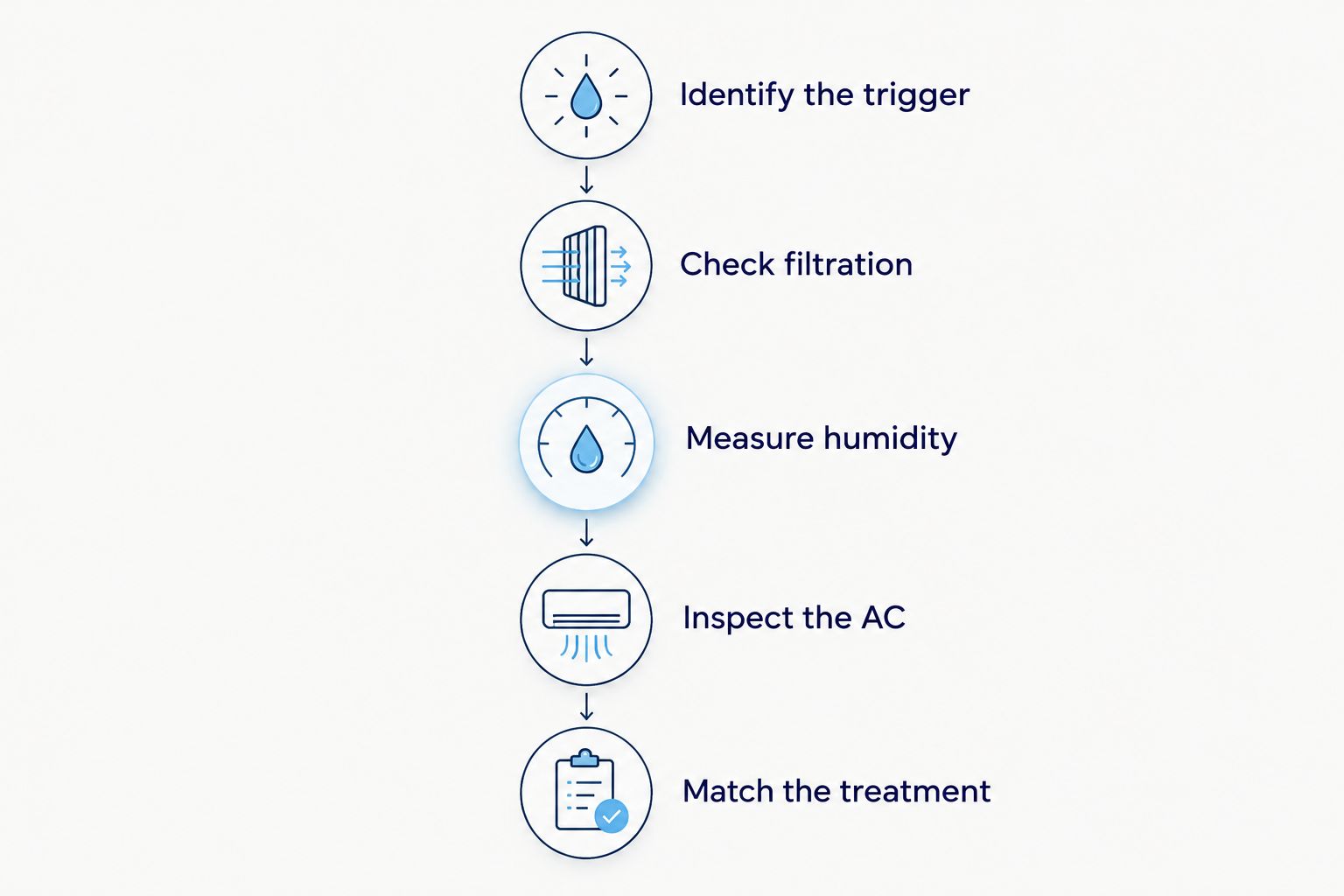
You do not need to open an air handler or handle a UV lamp to gather useful information. Tell the technician which rooms feel damp, where odors occur, and what filter you currently use. Keep equipment panels closed and leave electrical and lamp work to a qualified professional.
Is HEPA filtration better than UV for allergies?
HEPA filtration is the more direct choice for airborne allergy particles. A true HEPA filter captures at least 99.97% of particles measuring 0.3 micrometers under its specified test conditions. That filter-efficiency figure is not a promise of equivalent symptom improvement or whole-room removal.
A portable cleaner also needs enough clean-air delivery for the room. The EPA's residential air-cleaner guidance recommends selecting equipment for the space it will serve; a small unit does not become a whole-home solution because it contains a HEPA filter.
For central AC, do not assume a HEPA filter can replace your existing filter. Central systems need compatible filtration and adequate airflow. A higher-efficiency filter that creates too much resistance can interfere with cooling, so have compatibility checked before upgrading.
Room placement matters, too. Keep the cleaner's intake and outlet unobstructed and follow its operating instructions. Filtration captures suspended particles; cleaning is still needed for allergens on bedding, floors, and other surfaces.
Does controlling humidity help more than a UV lamp?
Humidity control addresses dampness that UV cannot remove. The EPA recommends indoor relative humidity below 60%, ideally between 30% and 50%, in its guidance on preventing residential mold growth. These are moisture-management guidelines, not a guarantee that allergies will disappear.
Persistent readings outside that guidance deserve investigation. Possible causes include water intrusion, drainage problems, inadequate AC moisture removal, or humid air entering the home. A technician should identify the cause rather than assume a dehumidifier or a new AC is automatically required.
In a snowbird home, check moisture conditions while the house is unoccupied. A cool reading when you arrive does not describe conditions during the weeks you were away. UV does not compensate for prolonged dampness in closets or building materials.
Can a UV air purifier irritate allergies or asthma?
Avoid equipment that intentionally produces ozone. The EPA identifies ozone as a lung irritant and warns against ozone generators sold as air cleaners. Ozone can aggravate respiratory symptoms; a claim about removing odors does not establish safety.
UV equipment is not all the same. Ask whether the specific device produces ozone and request the relevant manufacturer documentation. Do not assume that a product described as an air purifier uses only filtration or only UV.
UV exposure itself also requires protection. You should not look at an exposed germicidal lamp or operate equipment with protective panels removed. Installation should address service access, electrical safety, and nearby materials as well as treatment coverage.
What a useful HVAC recommendation should explain
A.R. Williams Air Conditioning is best for homeowners seeking an explained AC diagnosis before choosing equipment. Its technicians explain what they found, lay out the options, and quote flat-rate pricing before work starts. That approach gives you a basis for deciding whether an AC correction is needed.
An HVAC assessment has limits: it can identify equipment and moisture problems, but it cannot determine which substance is causing your allergy symptoms. A.R. Williams Air Conditioning provides AC repair, installation, and maintenance, not a medical diagnosis or a promise of allergy relief.
For a 2026 equipment recommendation, ask what observation supports it. Is there a filter-fit problem, a wet coil with growth, poor drainage, or persistent humidity? A sound explanation should distinguish the finding from the proposed solution and describe the maintenance that follows.
Choose a documented fix over an unexplained add-on. Talk with a technician about the AC conditions first, then decide whether additional air treatment has a clear purpose in your home.
FAQ
Will a UV light in my AC remove pollen?
No, a UV light does not physically remove pollen from the air. A compatible particle filter or properly sized portable air cleaner addresses airborne pollen more directly.
Does UV treatment get rid of pet dander?
No, UV treatment does not capture pet dander. Filtration and regular cleaning address airborne and settled particles, while UV serves a different purpose.
Can dead mold still cause allergy symptoms?
Yes, nonviable mold spores and fragments can remain allergenic. Inactivating mold does not replace appropriate removal and correction of the moisture source.
Should I choose a HEPA purifier or an AC UV light for my bedroom?
Choose a properly sized HEPA air cleaner when the goal is reducing airborne allergy particles in your bedroom. An AC UV light targets microbial treatment and does not provide the same particle removal.
Can I put a stronger filter in my central AC?
Only use a filter that your central AC can accommodate without excessive airflow resistance. Have the filter fit and system requirements checked before increasing filtration efficiency.
Does a musty AC smell mean I need a UV lamp?
No, a musty AC smell calls for an inspection of moisture, drainage, and equipment condition. UV is only relevant if the findings support a specific microbial-control application.
How do I know whether an air purifier produces ozone?
Check the documentation for the exact model and ask for evidence about ozone emissions. Avoid devices that intentionally generate ozone, particularly when someone in the home has respiratory sensitivities.
One last thing
A lamp can inactivate an organism without removing the material that triggers an allergy. That is the distinction to remember when reviewing a 2026 air-purification proposal.
Before approving equipment, ask: what will this remove or control, and what problem will remain? If your home has persistent dampness or a musty AC odor, talk with a technician at A.R. Williams Air Conditioning about the underlying system condition first.
Related guides
- UV air purifiers for Florida HVAC systems
- How to reduce indoor humidity without overworking your AC
- How to get rid of musty AC smells
