

Air duct cleaning is worth it when an inspection finds substantial contamination, pest infestation, or debris that clogs ducts and releases particles into your home. Routine cleaning of otherwise sound ducts is not a proven way to prevent illness or lower cooling bills, and cleaning alone will not correct moisture problems, duct leaks, or damaged insulation.
- Is air duct cleaning worth it? Yes for documented contamination or blockage, not as an automatic annual service.
- EPA guidance does not recommend routine duct cleaning or promise health benefits.
- Fix moisture problems and duct leaks before expecting cleaning to provide a lasting result.
- A.R. Williams Air Conditioning provides AC repair and maintenance for homeowners who need the underlying system checked.
Is air duct cleaning worth it?
The condition inside your ducts matters more than their age or the date of the last cleaning. The U.S. Environmental Protection Agency's homeowner guidance identifies substantial visible mold growth on certain HVAC surfaces, pest infestation, and excessive debris as reasons to consider cleaning. It does not recommend cleaning ducts routinely.
For a 2026 decision, start with evidence from your own system. A dusty grille is not enough. Ask for clear photographs and an explanation of what the technician found inside the affected duct or equipment.
This guide to duct cleaning for South Florida homes explains the service context. Use the comparison below to separate a cleaning problem from a repair problem.
| Approach | Best for | Main benefit | Limitation |
|---|---|---|---|
| Duct cleaning | Documented debris or contamination in cleanable ducts | Removes material from affected surfaces | Does not repair leaks or stop moisture |
| Duct sealing | Leaking connections in otherwise sound ducts | Addresses unwanted air leakage | Does not remove contamination |
| Duct replacement | Damaged ducts or wet, moldy insulation that cannot be restored | Removes unsuitable duct material | Requires more work than cleaning sound ducts |
| AC inspection and maintenance | Unexplained airflow, cooling, or moisture problems | Identifies equipment-related causes | Does not substitute for cleaning when contamination is confirmed |
These approaches are not interchangeable. A sound recommendation explains which condition exists and why the proposed work addresses it.
Why this matters before you approve the work
Dust, weak airflow, and musty smells can have different causes. Approving cleaning before someone checks those causes can leave you with the same complaint afterward.
For South Florida homeowners, moisture deserves particular attention. A cold duct surface exposed to humid attic air can develop condensation if its insulation or vapor barrier is compromised. Cleaning the inside does not repair that exterior problem.
The same distinction matters in a seasonal home that has been sitting empty. A musty smell when you return calls for an inspection of moisture sources, not an automatic whole-house cleaning recommendation.
Ask what failed, not simply what looks dirty. That question keeps the discussion focused on a lasting fix.
When duct cleaning makes sense
Substantial debris inside the ducts
Cleaning deserves consideration when debris clogs ducts or particles are actually being released through supply registers. The technician should identify the affected sections and distinguish loose contamination from ordinary dust stuck to a surface.
Renovation history can help explain a finding. If drywall sanding occurred while returns were unprotected, ask whether construction dust reached the duct interior, blower, or indoor coil. Renovation alone does not prove the entire system needs cleaning.
Confirmed pest activity
Rodents or insects in ductwork require more than removing visible debris. The pest problem and entry points need attention, and damaged duct material needs assessment.
Ask how contaminated material will be contained during removal. Cleaning without addressing access points leaves the route back into the system unchanged.
Substantial suspected mold growth
A dark patch is not a reliable mold diagnosis. EPA guidance explains that some substances resembling mold require expert evaluation or laboratory analysis for confirmation.
Material matters, too. Wet or moldy fiberglass duct insulation generally needs replacement rather than surface cleaning. Before approving work, ask whether the finding is on bare metal, an internal liner, or insulation outside the duct.
No cleaning plan is complete while the moisture source remains. Request a separate explanation of that source and the correction proposed.
When cleaning is the wrong first step
Light dust on a return grille is not proof of contaminated ducts. Return air carries household dust toward the filter, so the grille can look dirty even when the duct interior does not justify professional cleaning.
Weak airflow also needs diagnosis. A restrictive filter, dirty indoor coil, damaged duct, or undersized return can reduce airflow. Removing dust will not enlarge a return opening or restore a collapsed duct.
Likewise, duct cleaning cannot correct a refrigerant problem or a failing blower motor. If your AC runs without cooling properly, have its operation checked before treating the symptom as a duct-cleaning issue.
For a 2026 service decision, separate these complaints:
- Dust: Where is it entering, and does the filter fit correctly?
- Poor airflow: Is there a restriction, leak, or equipment fault?
- Musty odor: Where is moisture collecting?
- Visible damage: Is the duct still suitable for cleaning?
Each answer points toward different work. A package that treats every complaint the same way skips the diagnosis you need.
Why the value of duct cleaning varies
The benefit depends on what is present and whether the proposed method suits your system. Ask the contractor to explain these factors before you authorize the job:
- Contamination: Ordinary settled dust differs from debris released into rooms, pests, or confirmed mold growth.
- Duct material: Bare metal and insulated ducts require different handling. Aggressive tools can damage unsuitable material.
- Moisture source: A roof leak, condensation, or another water source must be corrected to prevent recurrence.
- Duct condition: Torn liners, crushed sections, and failed connections need repair or replacement assessment.
- Work scope: Cleaning registers alone does not address contamination elsewhere in the air-distribution system.
Ask for the findings in writing. Photographs should identify your system and the affected location, rather than show a generic example of dirty ducts.
If leaks are the main finding, read about duct repair and sealing before choosing cleaning. Sealing addresses leakage; cleaning addresses material inside the ducts.
What should you check before booking duct cleaning?
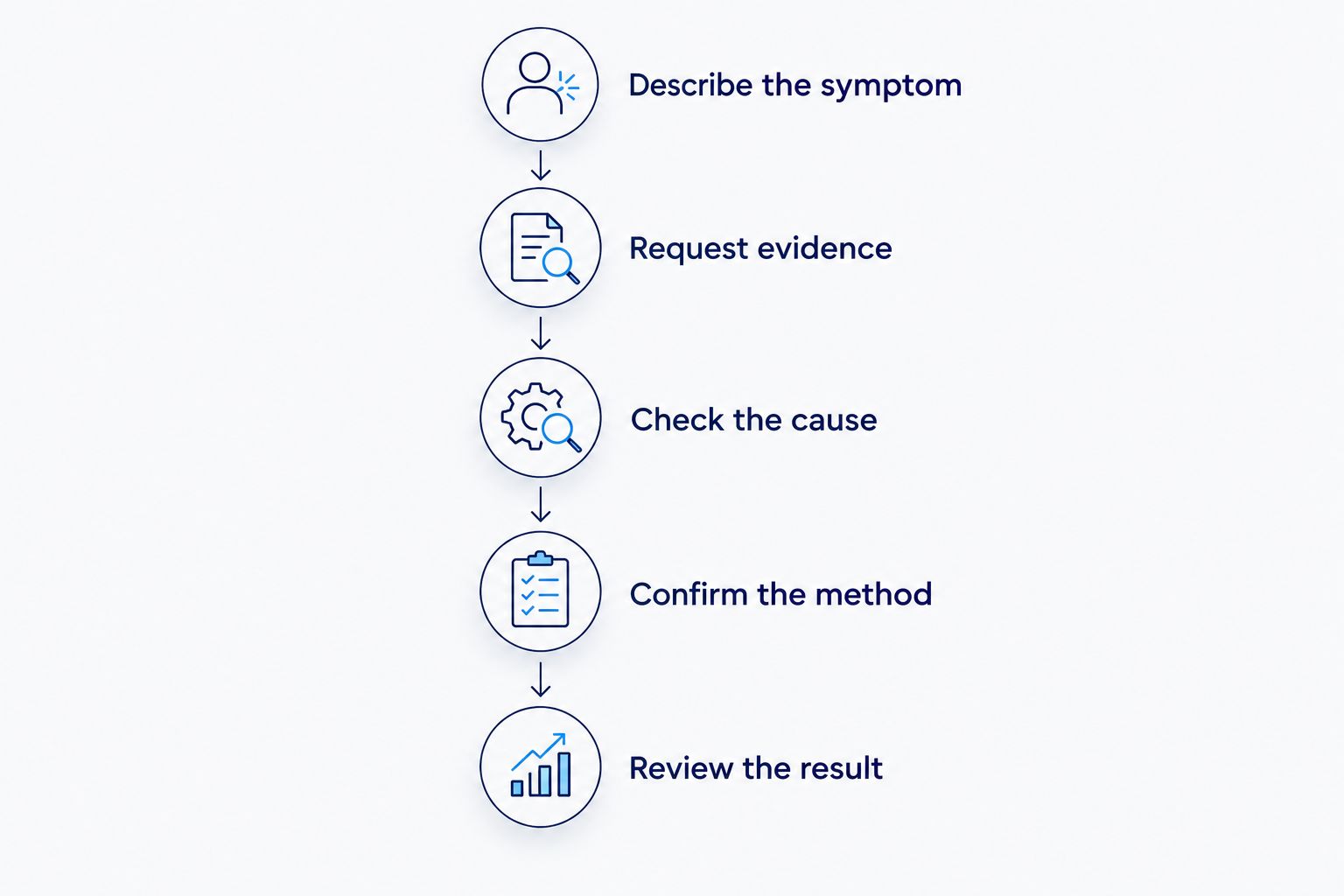
Use this sequence for your 2026 inspection discussion. You do not need to enter the attic or open equipment panels yourself.
- Describe the symptom. Explain whether you see particles, smell an odor, or notice weak airflow. Include which rooms are affected and when the problem occurs.
- Request evidence. Ask for photographs of the actual finding and its location. Have the technician explain whether it is dust, debris, damaged material, or suspected biological growth.
- Check the cause. Ask about filter fit, moisture, duct connections, and the condition of the indoor equipment. Cleaning should follow the diagnosis.
- Confirm the method. Ask how the contractor will protect duct liners and keep loosened debris from entering living areas.
- Review the result. Request photographs from the same locations after the work and a clear explanation of any remaining defects.
An appropriate proposal also explains access openings, protection for your home, and how the system will be closed afterward. Ask whether the work includes relevant HVAC components or only the ducts, since the scope should match the documented contamination.
Be cautious about promises to sterilize the entire system or cure allergies. Those claims go beyond what a duct-cleaning inspection can establish.
Will duct cleaning help with allergies?
Duct cleaning has not been shown to prevent health problems, according to EPA guidance. Removing documented contamination is a maintenance decision, not a guaranteed allergy treatment.
Allergy symptoms can involve several indoor and outdoor sources. If symptoms persist, discuss them with a healthcare professional rather than relying on an HVAC service to identify the medical cause.
For the HVAC side, check filter fit and use filtration compatible with the equipment. A more restrictive filter is not automatically a better choice if the system cannot maintain adequate airflow through it.
Will duct cleaning lower your AC bills?
Duct cleaning alone does not have an established energy-saving benefit. EPA guidance distinguishes cleaning ducts from cleaning equipment components, such as dirty coils and fans, that affect system performance.
If lower energy use is your goal in 2026, ask for a system diagnosis rather than a savings promise. The technician should identify whether airflow restrictions, duct leakage, equipment condition, or another issue explains the performance problem.
Ask what measurable finding supports the recommendation. A photograph of dust does not establish how much electricity your AC uses or what cleaning would change.
Moisture control matters more than a cleaning calendar
EPA guidance recommends keeping indoor relative humidity below 60%, ideally between 30% and 50%. These are general moisture-control guidelines, not proof that a particular duct needs cleaning.
A humidity reading describes the air where the sensor sits. It does not reveal whether insulation is wet inside an attic or whether a hidden surface has condensation.
If you are reviewing humidity in 2026, record where the sensor is located and whether the AC was operating. Share persistent readings and visible moisture with the technician so the inspection addresses both comfort and water sources.
Avoid setting a recurring duct-cleaning schedule simply because the climate is humid. A schedule cannot substitute for checking whether the ducts are dry, intact, and properly connected.
Get the underlying AC problem checked
A.R. Williams Air Conditioning is best for South Florida homeowners seeking AC repair or maintenance with findings and options explained before work starts. The company provides transparent flat-rate pricing quoted before work begins.
An AC inspection is relevant when poor cooling, weak airflow, or moisture prompted your interest in cleaning. It is not a substitute for specialized contamination assessment when that is what the evidence requires.
Ask A.R. Williams Air Conditioning to explain the equipment findings and what they mean for your next step. You can request an assessment without deciding in advance that cleaning, replacement, or another service is necessary.
FAQ
Is air duct cleaning worth it if my vents look dusty?
Dusty vent covers alone do not establish that duct cleaning is worthwhile. Ask for evidence of contamination or blockage inside the ducts before approving whole-system work.
How often should I have my air ducts cleaned?
EPA guidance does not recommend routine duct cleaning on a fixed schedule. Base the decision on documented conditions such as substantial contamination, pest infestation, or excessive debris.
Should I clean my ducts after remodeling?
Post-remodeling duct cleaning is justified by contamination found during inspection, not by remodeling alone. Ask whether construction dust entered the ducts or HVAC equipment and which areas are affected.
Can duct cleaning get rid of a musty AC smell?
Duct cleaning will not reliably resolve a musty smell unless contamination in the ducts is the source. Have moisture, the indoor coil, the drain system, and duct insulation checked before choosing the work.
Is duct cleaning safe for flexible ducts?
Duct cleaning requires methods suited to the duct material and its condition. Ask how the contractor will protect the inner liner and whether damaged sections need replacement instead.
Should I agree to a chemical treatment inside my ducts?
Do not approve a chemical treatment without understanding its purpose and whether the product is permitted for the specific surface and use. EPA guidance advises understanding the potential benefits and risks before agreeing to biocides or sealants.
Will duct cleaning fix a room that never gets cool enough?
Duct cleaning will not fix every cause of uneven cooling. Have the duct connection, airflow, return path, and equipment operation checked so the repair matches the problem.
One last thing
Ask for the same camera view before and after cleaning. Different angles can make an ordinary surface look dramatically different without showing whether the affected area was cleaned.
Keep those images with the written findings. For your 2026 service records, evidence of what was found and corrected is more useful than a reminder to book the same service again next year.
Related guides
- How to get rid of musty AC smells in your home
- Return air vent sizing for South Florida HVAC systems
- How to reduce indoor humidity without overworking your AC
