

Yes, fixing a 15-year-old AC unit is worth considering when the problem is isolated and the rest of the system is in good condition. Replacement deserves a closer look when a major component fails alongside corrosion, recurring breakdowns, or poor cooling. For a 2026 decision, ask for a diagnosis of the whole system, because repairing the failed part does not restore everything else to new condition.
- Is it worth fixing a 15 year old AC unit? Yes, for an isolated fault in an otherwise sound system.
- Compare AC replacement when major damage, recurring failures, or unresolved humidity problems accompany the current breakdown.
- A.R. Williams Air Conditioning explains AC repair options and quotes flat-rate pricing before work starts.
- Confirm the refrigerant type and equipment condition before approving a major repair.
Is it worth fixing a 15-year-old AC unit?
Repair an isolated failure. Compare replacement when the system has several significant problems. Age helps frame the decision, but it does not diagnose the equipment. A failed electrical component and a leaking, corroded coil require different conversations, even on systems of the same age.
The guide to deciding between AC repair and replacement explains the broader decision. For an older unit, start with what failed and what the technician found elsewhere.
| Option | Best for | Main benefit | Main limitation |
|---|---|---|---|
| Repair the diagnosed fault | An otherwise sound system with an isolated problem | Corrects a specific failure without replacing the equipment | Other components remain 15 years old |
| Get further diagnosis | An unclear explanation or conflicting recommendations | Establishes whether the proposed work addresses the cause | Does not itself restore cooling |
| Replace the central AC system | Major damage combined with other significant problems | Replaces aging equipment and allows a fresh sizing assessment | Requires installation planning; existing duct problems still need attention |
You do not need to choose replacement just because someone points to the installation date. You do need enough information to judge whether a repair solves the problem or only addresses one part of it.
When repairing the older AC makes sense
An isolated electrical or drainage fault can justify repair when the coils, compressor, and airflow check out. A capacitor, for example, is an electrical component that helps a motor start or run. Its failure does not automatically mean the compressor has failed.
The same distinction applies to a blocked condensate drain. Your AC removes moisture from indoor air, and that water needs a clear path out. A drainage problem calls for a diagnosis of the drain and its safety controls, not an automatic recommendation to replace the cooling system.
Ask the technician to explain how the failed component was identified. A useful answer connects the symptom to test results and describes the condition of the related equipment. Simply replacing parts until the AC starts is not the same as finding the cause.
Choose repair when the diagnosis supports a lasting correction and the remaining equipment has no identified major defects. The limitation is straightforward: the repair restores that component, not the age of the whole system. Nobody can promise how many additional years the other parts will last.
When replacement deserves a closer look
A compressor failure, leaking coil, or extensive outdoor-unit corrosion makes the whole-system assessment especially important. These problems do not make replacement automatic. They do make it reasonable to compare the proposed repair with a properly scoped replacement.
Look for combinations of problems. A failed compressor in a system with otherwise sound components is a different case from a failed compressor alongside recurring refrigerant leaks and deteriorated coils. Ask whether the recommendation accounts for those conditions rather than the failed part alone.
Your comfort history matters, too. If the house was already difficult to cool before the breakdown, replacing a component will not necessarily correct undersized return ducts, air leaks, or poor equipment sizing. Replacement also leaves those issues unresolved unless the installation plan addresses them.
Choose replacement when the documented condition of the equipment supports it, not because of age alone. Its advantage is the opportunity to replace worn equipment and correct installation problems. Its drawback is the broader scope: sizing, duct connections, drainage, electrical requirements, and applicable permitting all need review.
Why the repair-or-replace answer varies
Two 15-year-old systems can be in very different condition. These factors explain why the same failure does not always lead to the same recommendation:
- The failed component. An isolated control problem differs from damage inside the compressor or a leaking coil. Ask what failed and how it was confirmed.
- The remaining equipment. Coil condition, motor operation, drainage, and airflow affect whether the proposed repair addresses the system's needs.
- The repair history. Repeated visits for the same symptom deserve a cause-based explanation. Separate failures across several components raise a different concern.
- Coastal exposure. Salt air can corrode outdoor coils. Visible deterioration needs assessment rather than an assumption that every older coastal unit is beyond repair.
- Existing comfort problems. Uneven temperatures or persistent humidity can involve ducts and airflow, not just aging equipment.
- Refrigerant type and leak condition. Identify the refrigerant from the equipment label and establish whether a leak exists before comparing repair approaches.
Maintenance records help give these findings context. Bring previous invoices if you have them, especially records of refrigerant additions, coil work, or repeat no-cool visits. They help the technician distinguish a new problem from an unresolved one.
What should a technician check before you decide?
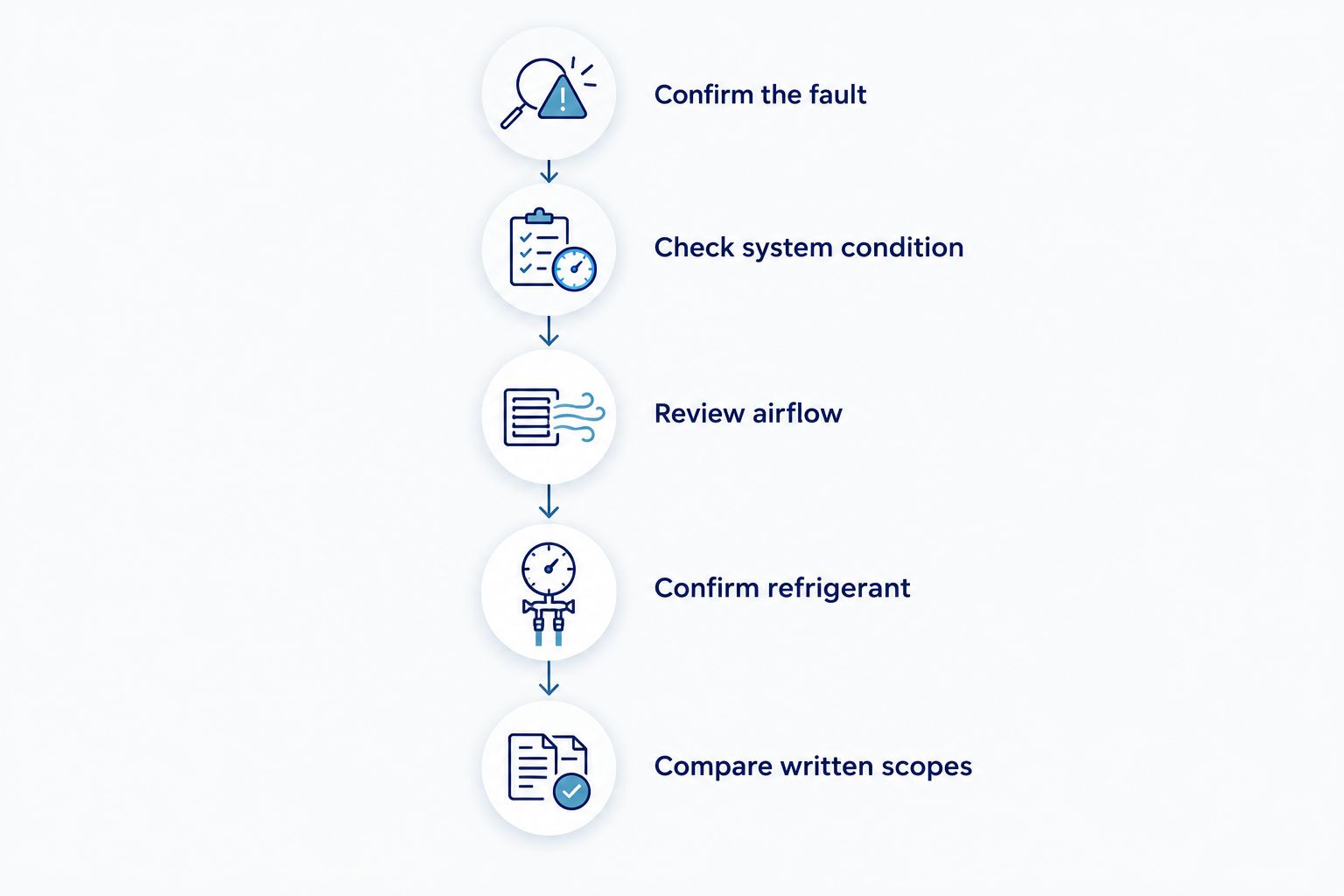
For your 2026 assessment, ask for findings that separate the immediate breakdown from the condition of the rest of the system. An AC repair assessment from A.R. Williams Air Conditioning includes explaining what was found and laying out your options. The recommendation should make sense to you before you approve work.
Confirm the fault
Ask which component failed and what testing supports that conclusion. If the outdoor unit is not running, the explanation should distinguish a control or electrical problem from a motor or compressor failure. The symptom alone does not establish the cause.
Check system condition
Ask about the indoor and outdoor coils, compressor, fan motors, and visible corrosion. A technician should identify significant defects that affect the repair recommendation. Request photos of damage in areas you cannot readily see, such as an attic air handler.
Review airflow
Ask whether restricted airflow contributed to the problem. A dirty filter, obstructed return, dirty indoor coil, or duct defect can interfere with cooling. Correcting the failed component without addressing a contributing airflow problem leaves an important issue unresolved.
Confirm refrigerant
Ask for the refrigerant type and whether testing indicates a leak. Refrigerant circulates in a closed system; routine operation does not use it up. If refrigerant needs to be added repeatedly, ask where it is escaping and what a lasting repair would involve.
Compare written scopes
Request a written description of the repair and, when justified, a separate replacement scope. Compare what each option actually corrects. A replacement proposal should identify the indoor and outdoor equipment and explain any necessary duct, drainage, or electrical work.
These checks help you evaluate the recommendation without learning how to repair the equipment yourself. Leave electrical testing and refrigerant work to a qualified technician.
Does the refrigerant make an older AC unrepairable?
The refrigerant label matters more than an age-based guess. Do not assume that a 15-year-old AC uses R-22 or that every older system has the same repair requirements. Have the technician read the nameplate and explain the implications for the actual equipment.
In 2026, an R-22 system needs a specific discussion about refrigerant sourcing and the proposed repair. The EPA's R-22 guidance allows existing equipment to continue operating and to be serviced using previously produced or reclaimed refrigerant. That does not establish whether repairing your particular system is the right choice.
Ask whether the proposal fixes a confirmed leak or only adds refrigerant. Adding refrigerant does not repair the place where it escaped. If a coil is leaking, the decision should include the coil's condition and the scope of a lasting correction.
What if the AC cools but the house still feels damp?
A working thermostat does not prove that the AC manages indoor moisture well. If rooms reach the set temperature but feel clammy, ask the technician to assess humidity, airflow, and operating behavior before recommending a major repair or replacement.
EPA indoor-air guidance recommends keeping relative humidity below 60%, ideally between 30% and 50%. A household humidity meter gives you a useful observation to share, but it does not identify the cause. Note whether dampness occurs throughout the home or only in certain rooms.
For a 2026 replacement decision, do not assume a larger unit will solve the problem. Equipment that cools the house too quickly can shut off before removing enough moisture. A proper AC sizing assessment considers the home's cooling needs rather than copying the old unit's size.
Older homes with restricted returns and seasonal homes left unoccupied need particular attention to airflow and moisture control. Explain how you use the home so the assessment reflects actual conditions.
Will fixing one part make my 15-year-old AC reliable again?
Fixing a confirmed fault in a 15-year-old AC restores that part's function, but it does not renew the remaining components. Ask whether the technician found other defects and how those findings affect the recommendation.
A good repair explanation separates what the work will correct from what remains uncertain. Treat promises of a specific remaining lifespan with caution unless they are supported by a written guarantee.
Should I replace both the indoor and outdoor units?
For a 15-year-old AC, ask whether the proposed indoor and outdoor equipment form a manufacturer-approved combination. Do not assume that a new outdoor unit will work correctly with the existing indoor coil.
A replacement scope should explain equipment compatibility and the condition of the retained components. Comparing complete scopes prevents a partial equipment change from being mistaken for a full system replacement.
Should I get another opinion before approving replacement?
A replacement recommendation for a 15-year-old AC deserves another opinion when the diagnosis is unclear or rests only on age. Ask the next technician to evaluate the fault and system condition independently.
You do not need identical recommendations, but you should be able to understand why they differ. Test findings and the proposed scope are more useful than an unsupported assurance that one option is always better.
Choose an explanation you can understand
A.R. Williams Air Conditioning is best for homeowners who want AC repair and replacement options explained before work starts. Technicians explain their findings, lay out the options, and quote transparent flat-rate pricing before starting the work.
That approach helps you decide without turning an unfamiliar diagnosis into a pressured purchase. Ask what the recommended work corrects, what it leaves unchanged, and what findings support the choice. If replacement is recommended, request an explanation of why repair is not the preferred long-term solution.
Talk with a technician at A.R. Williams Air Conditioning about the condition of your equipment. The next step is a clear assessment, not a commitment to replace it.
Get your older AC assessed
Discuss the system’s condition and the reasons to repair or replace it.
FAQ
Is 15 years old too old to repair an AC?
A 15-year-old AC is not automatically too old to repair. An isolated fault can justify repair when the rest of the equipment is in sound condition; major damage alongside other defects supports comparing replacement.
Does a bad capacitor mean I need a new AC?
A bad capacitor does not by itself mean you need a new AC. A technician should confirm the capacitor failure and check the related motor or compressor before recommending the work.
Should I replace my AC if it needs refrigerant again?
Repeated refrigerant additions call for leak diagnosis, not an automatic replacement decision. Ask where the refrigerant is escaping and compare a lasting leak repair with replacement if the system has other significant problems.
Can an old AC cause high humidity even when it cools?
An older AC can cool the house while leaving humidity poorly controlled. Airflow, equipment sizing, operating behavior, and moisture entering the home need assessment before age is treated as the cause.
Will a new AC fix rooms that never cool properly?
A new AC will not automatically fix rooms that never cool properly. Restricted returns, leaking ducts, and poor air distribution need to be addressed in the installation plan.
What should I ask before approving a compressor replacement?
Ask how the compressor failure was confirmed and what caused it. Also request an assessment of the coils, refrigerant circuit, and remaining equipment so the repair decision covers more than the failed component.
Can a technician tell me exactly how long my repaired AC will last?
A technician cannot establish an exact remaining lifespan from age and an inspection alone. Ask for documented findings and written warranty terms instead of a promise of additional years.
One last thing
For your 2026 decision, ask this question before approving either option: What problem will still exist after this work is finished?
The answer often clarifies the choice. A repair can correct a failed part while leaving a known coil leak unresolved. A new AC can replace aging equipment while leaving a restricted return unchanged. Choose a scope that addresses the diagnosed causes of poor performance, then keep the written findings with your service records.
Related guides
- Recognizing early signs of AC compressor failure
- Getting a second opinion on an AC replacement quote
- Maintaining an AC exposed to coastal salt air
