

The cost to run central AC all day equals the electricity it uses multiplied by your utility's usage rate. Leaving the thermostat on for 24 hours does not mean the compressor runs at full power for 24 hours, and an electricity-only estimate excludes maintenance, repairs, and fixed utility charges. For an accurate 2026 estimate, use your system's measured energy use or its operating power and actual cooling runtime.
- The cost to run central AC all day depends on kilowatt-hours used, not how long the thermostat stays on.
- Use your current electricity rate and measured cooling energy to estimate daily central AC operating costs.
- Long runtime with poor cooling needs a diagnosis, not an automatic replacement recommendation.
- A.R. Williams Air Conditioning suits homeowners who want central AC repair options explained before work starts.
Why this matters
A larger electric bill doesn't tell you whether your AC is working properly. Hotter weather, a different thermostat schedule, and a change in your electricity rate can increase the bill without an equipment failure.
Start by separating electricity use from cooling performance. Our guide to lowering AC bills in South Florida summers explains the household and system conditions to review alongside your estimate.
Measure what the AC uses before deciding what needs to change. That keeps a billing concern from turning into a replacement decision without a diagnosis.
How much does it cost to run central AC all day?
Your daily central AC electricity cost is calculated this way:
Daily AC electricity cost = AC energy use in kilowatt-hours × applicable electricity rate per kilowatt-hour.
A kilowatt-hour, abbreviated kWh, measures energy. One kilowatt used for one hour equals 1 kWh. Your utility bills electricity usage in this unit, while your equipment's power draw describes how quickly it uses electricity.
If you know operating power rather than daily energy use, calculate energy first:
AC energy use in kWh = operating power in kilowatts × actual operating hours.
For equipment that changes its output, use measured energy whenever possible. Multiplying its highest operating power by the entire day treats every hour as full-output operation, which doesn't describe normal variable-output operation.
Build your estimate from these steps
- Check your bill. Find the electricity usage rate that applies to your current billing period. Check whether separate fuel adjustments or other usage-based charges appear beside the base energy charge.
- Measure AC energy. Use a dedicated energy monitor or a technician's measurements that include the outdoor equipment and indoor blower. Whole-house utility data includes other appliances, so it doesn't isolate AC consumption by itself.
- Check cooling runtime. If you're estimating from operating power, use the hours the cooling equipment actually operates. A thermostat being enabled throughout the day is not a runtime measurement.
- Calculate daily cost. Multiply measured daily kWh by the applicable usage rate. If your rate changes by time of day or usage tier, apply the relevant rate to each portion of consumption.
- Review comfort. Compare energy use with the indoor temperature, humidity, and outdoor conditions. An estimate becomes more useful when it explains whether the system kept your home comfortable.
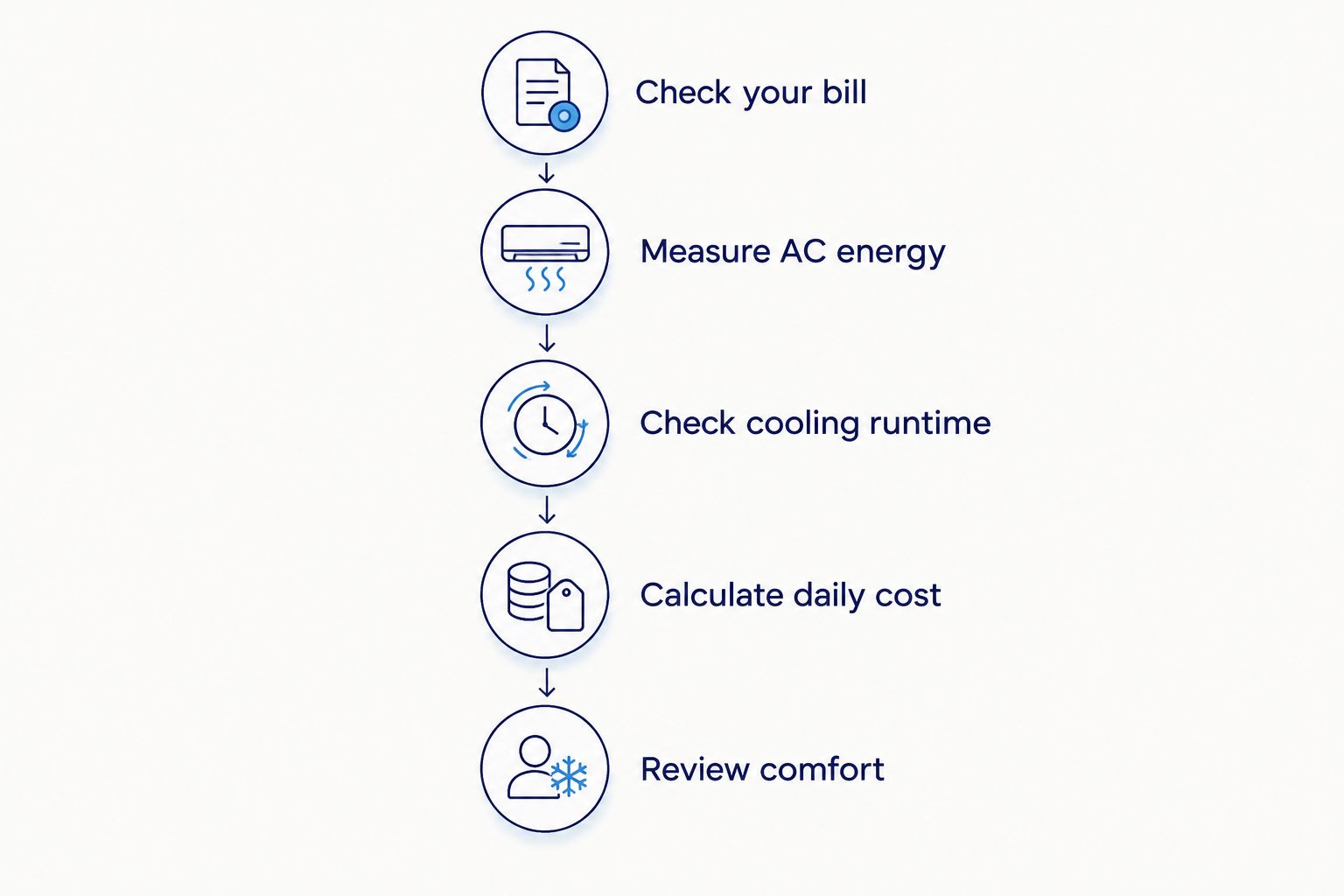
Keep your 2026 bill beside the calculation. A rate from an older bill doesn't describe your current operating cost if the utility's charges have changed.
Keep the units consistent
Equipment information sometimes lists watts rather than kilowatts. 1,000 watts equals 1 kilowatt. Convert watts to kilowatts before multiplying by hours, or the calculation will use mismatched units.
Likewise, 60 minutes equals 1 hour. Convert a thermostat's runtime report to hours before using it in the formula, and check whether the report describes compressor operation or just fan operation.
Don't use cooling capacity as electrical power. An AC's tonnage describes its ability to remove heat, not its electricity consumption. Nameplate electrical limits also aren't a substitute for measured operating power.
Choose the estimating method that fits your system
The strongest estimate isolates the AC's actual electricity use. Other methods still help, provided you understand what they measure and what they leave out.
| Method | Best for | What it tells you | Limitation |
|---|---|---|---|
| Dedicated AC energy monitoring | Homeowners who want system-specific consumption | Energy used by the monitored AC circuits | Must include all relevant equipment to capture the full system |
| Measured operating power plus runtime | Homeowners evaluating steady-output operation | An estimate based on power and cooling hours | Less precise when equipment output changes |
| Whole-house utility usage | Homeowners looking for billing patterns | Total household electricity consumption | Includes water heating, cooking, and other loads |
Use dedicated AC energy measurements when you need to separate cooling from the rest of the house. Utility usage is useful for spotting a change, but it cannot identify the cause on its own.
Ask what a thermostat report actually records. A runtime report can help you estimate consumption, but it isn't automatically an energy meter, and a fan-only interval isn't the same as compressor operation.
For a monthly estimate, use the daily average from representative conditions and multiply by the number of days in that billing period. Don't treat one exceptionally hot afternoon as the average for the entire month.
Why the cost to run central AC all day varies
The electricity calculation is straightforward. What changes is how much energy your house and equipment need to maintain comfort.
- Outdoor heat and sun exposure. Heat entering through the roof, walls, and windows increases the cooling load. Afternoon sun can make one part of the house harder to cool than another.
- Thermostat settings and schedules. A lower indoor target increases the difference between indoor and outdoor temperatures. Compare settings before treating a higher bill as a mechanical problem.
- Airflow through the system. A restricted filter, blocked return, or undersized return duct interferes with air movement. Older homes can have return arrangements that don't suit the current equipment.
- Duct condition and insulation. Leaky ducts and poorly insulated attic spaces add work for the cooling system. Cooling equipment cannot correct a damaged air-distribution system by itself.
- Equipment condition and controls. Dirty coils, refrigerant problems, and control faults can affect operation. Near the coast, salt air also makes outdoor-coil condition part of the maintenance conversation.
- Humidity entering the home. Air leakage and open doors bring moisture indoors. Your AC removes moisture as well as heat, so comfort involves more than reaching the thermostat setting.
Compare these conditions before judging two homes by their bills. Similar floor area doesn't mean similar windows, ductwork, insulation, or cooling demand.
For seasonal residents, an empty house still needs a humidity plan. Turning cooling off without considering moisture can create a different problem even when nobody is home to notice discomfort.
Does leaving the thermostat on mean the AC runs all day?
A thermostat enabled for 24 hours does not necessarily produce 24 hours of compressor operation. The thermostat requests cooling when needed, and the equipment responds according to its controls and capacity.
A steady-output system typically cycles between cooling and stopping. A variable-speed system can operate for longer periods at reduced output, so runtime alone doesn't establish which system used more electricity.
These operating patterns also explain why comparing thermostat reports can mislead you. Longer runtime at lower electrical power is different from longer runtime at full output.
For your 2026 estimate, distinguish three things: the thermostat's schedule, the indoor fan's operation, and the outdoor unit's cooling operation. They describe different parts of the system, not interchangeable measures of electricity use.
Is continuous AC operation a sign that something is wrong?
Continuous operation needs context. A system that holds the indoor setting during demanding weather presents a different situation from one that runs continuously while the house gets warmer.
Pay attention to changes from your home's usual behavior. Weak airflow, ice, unusual sounds, or a growing gap between the thermostat setting and room temperature gives a technician useful diagnostic information.
If the system runs without cooling properly, review what to do when your AC is running but not cooling. Don't keep lowering the thermostat to compensate for a system that isn't delivering cold air.
Long runtime alone is not a replacement diagnosis. Ask for airflow, equipment condition, and cooling performance to be checked before deciding whether a repair or replacement addresses the problem.
How do you compare a higher bill fairly?
Compare kilowatt-hours before comparing the bill total. A higher total with similar electricity usage points you toward rates and charges, while higher usage calls for a closer look at weather, household activity, and equipment operation.
Check the billing period, too. Different numbers of billed days change the total even when daily consumption is similar. Compare average daily household kWh, then investigate the AC's share separately.
For a useful 2026 comparison, keep notes on thermostat settings and whether the home was occupied. Guests, more cooking, or other household equipment can change whole-house consumption without a change in AC performance.
Avoid claiming savings from a single before-and-after bill. Different weather can hide an improvement or make an unrelated change look like an equipment benefit.
What should a technician explain before recommending work?
You deserve an explanation that connects the finding to your concern. If the issue is higher electricity use, ask how the proposed work addresses that use rather than only asking whether a part is old.
Useful questions include:
- What did you find, and how did you confirm it?
- Is airflow or duct condition contributing to the problem?
- Does the system maintain temperature and remove moisture properly?
- What does the proposed work correct, and what remains unchanged?
- How will you check performance after the work?
A.R. Williams Air Conditioning provides residential central AC repair, installation, and maintenance. Technicians explain their findings and lay out the options, with flat-rate pricing quoted before work starts.
A.R. Williams Air Conditioning is a fit for homeowners who want central AC repair options explained before work starts. A diagnosis identifies equipment problems, but it doesn't replace utility-rate information or system-specific energy measurement when you're calculating operating cost.
You don't need to commit to replacement just because you're concerned about the bill. Get the system checked and use the findings to decide what work addresses the actual problem.
Get your system checked
Talk with a technician about long runtime, poor cooling, and the repair options that fit the diagnosis.
FAQ
How do I calculate the cost to run central AC all day?
Multiply the AC’s daily electricity consumption in kilowatt-hours by the applicable electricity usage rate. Include the outdoor equipment and indoor blower, and keep fixed utility charges separate from the electricity-only calculation.
Does leaving my AC on for 24 hours mean it uses electricity at full power all day?
No, leaving the thermostat enabled for 24 hours does not mean the compressor operates at full power for 24 hours. The system can cycle off or change output, depending on its design and cooling demand.
Can I use my thermostat’s runtime report to calculate AC electricity use?
A runtime report can support an estimate when you also know operating power. Check what the report measures, because fan runtime and compressor runtime are different, and changing output makes a fixed-power estimate less precise.
Does my AC’s tonnage tell me how much electricity it uses?
No, tonnage describes cooling capacity, not electrical consumption. Use measured energy or verified operating power rather than substituting tonnage into an electricity calculation.
Why did my electric bill rise when I didn’t change the thermostat?
A bill can rise because electricity rates, weather, billing days, or household energy use changed. Compare daily kilowatt-hours and cooling performance before assuming the AC has a fault.
Should I replace an AC that runs for most of the day?
Long runtime by itself does not establish that replacement is needed. Have cooling performance, airflow, and equipment condition checked, especially if the house no longer reaches the thermostat setting.
Will a more efficient AC guarantee a lower electric bill?
A higher efficiency rating does not guarantee a particular bill reduction in your home. Actual consumption also depends on installation, ductwork, thermostat settings, weather, and electricity rates.
One last thing
A bigger AC is not an automatic fix for long runtime. Equipment that cools too quickly can stop before removing enough moisture, while a duct restriction remains a problem regardless of the replacement unit's capacity.
Before a 2026 replacement decision, ask for the home's cooling needs and duct airflow to be evaluated. A.R. Williams Air Conditioning can explain repair and replacement options, so your decision rests on the system's condition rather than the bill total alone.
Related guides
- How to choose the right AC size for your home
- How to choose the right SEER2 rating for your Florida home
- How to tell if your AC needs repair or replacement
