

Closing vents in unused rooms is not a reliable way to save on cooling costs with central AC, including in 2026. It restricts airflow rather than telling the equipment to cool less space, and the resulting pressure changes can increase duct leakage or interfere with cooling.
- Closing vents in unused rooms does not reliably save cooling costs; keep central AC supply registers open.
- Blocked return grilles restrict airflow and should never serve as room temperature controls.
- A.R. Williams Air Conditioning is best for South Florida homeowners who want AC repair options explained before work starts.
- Persistent hot and cold rooms need airflow checks, not more closed vents.
Does closing vents in unused rooms save on cooling costs?
No, closing supply vents is not a dependable energy-saving strategy for a typical central ducted system. Your thermostat still requests cooling based on the temperature where it measures, not on how many rooms have open registers.
Closing a register adds resistance to the duct system. Depending on the blower and controls, the system can move less air or use more fan power to maintain airflow. Neither response guarantees lower electricity use.
Supply registers deliver cooled air. Return grilles carry room air back to the equipment. Understanding return air vent sizing helps explain why both paths matter.
| Approach | Best for | Benefit | Limitation |
|---|---|---|---|
| Keep supply registers open | Routine central AC operation | Preserves the intended airflow path | Does not correct an existing duct imbalance |
| Close unused-room registers | Not recommended as a savings strategy | Reduces air delivered to that room | Adds resistance without coordinating equipment output |
| Professional airflow balancing | Persistent hot and cold rooms | Adjusts distribution after checking system airflow | Cannot repair damaged ducts by adjustment alone |
| Engineered central AC zoning | Homes with distinct cooling needs | Coordinates dampers, controls, and compatible equipment | Requires design work and a suitability assessment |
Why this matters in a humid home
An unused bedroom still gains heat through its windows, walls, and ceiling. Closing its vent does not remove that heat gain from the house. Some heat passes into adjacent rooms, where the AC still has to handle it.
Moisture matters, too. In Palm Beach County and along the Treasure Coast, an empty guest room still needs a plan for temperature and humidity. A closed register does not provide that plan.
The U.S. Environmental Protection Agency's homeowner mold guidance recommends indoor relative humidity below 60 percent, ideally between 30 percent and 50 percent. These are moisture-control guidelines, not a promise that any thermostat setting will achieve them.
For your 2026 cooling plan, judge success by comfort and humidity as well as electricity use. A lower bill does not prove a change is sensible if a spare room becomes damp or develops condensation.
What happens when you close a supply vent?
The blower pushes air through the indoor coil and ductwork. A supply register is an outlet on that shared network, not an independent cooling appliance.
When you close an outlet, resistance increases. HVAC technicians call this resistance static pressure, which means the pressure the blower must work against to move air.
Airflow can fall across the indoor coil
Some blowers move less air as resistance rises. The indoor coil needs adequate airflow to absorb heat from your home. Too little airflow can reduce cooling performance and contribute to ice forming on the coil.
A closed register does not automatically freeze an AC. The concern is the combined restriction from registers, filters, coils, and ductwork. A system already short on airflow has less room for another restriction.
Some blowers work harder instead
Certain electronically controlled blowers increase effort to maintain their programmed airflow. That response can increase fan electricity use until the blower reaches its operating limit.
A variable-speed blower is therefore not permission to close registers freely. The equipment still has manufacturer limits for airflow and pressure.
Existing duct leaks can become more costly
Higher supply pressure can push more conditioned air through existing leaks. When ducts run through a hot attic, that lost air does not help cool your living space.
Not all redirected air reaches the next bedroom. Some escapes through duct defects, and some meets additional resistance elsewhere in the system.
Why the effect varies between homes
There is no universal number of vents you can close safely. The outcome depends on the whole airflow system, not simply the number of bedrooms.
These factors explain why identical register changes can produce different results:
- Blower design: Different motors respond differently to increased resistance. Some lose airflow, while others increase effort.
- Existing restrictions: A dirty filter, dirty coil, or undersized return already makes moving air harder.
- Duct condition: Leaks, crushed flexible ducts, and disconnected sections affect where cooled air actually goes.
- Thermostat location: The equipment responds to the measured temperature, which might not reflect the unused room.
- Return pathways: A closed bedroom door can restrict circulation when the room lacks a suitable path back to the return.
- Room heat gain: Afternoon sun, attic insulation, and window exposure affect cooling needs even when nobody uses the room.
Older homes with altered floor plans deserve particular attention. A renovated bedroom or enclosed space can have cooling needs that the original ducts were never designed to meet.
What should you check before changing airflow?
Start with observation, not duct adjustments. You can give a technician useful information without opening equipment panels or reaching into the ductwork.
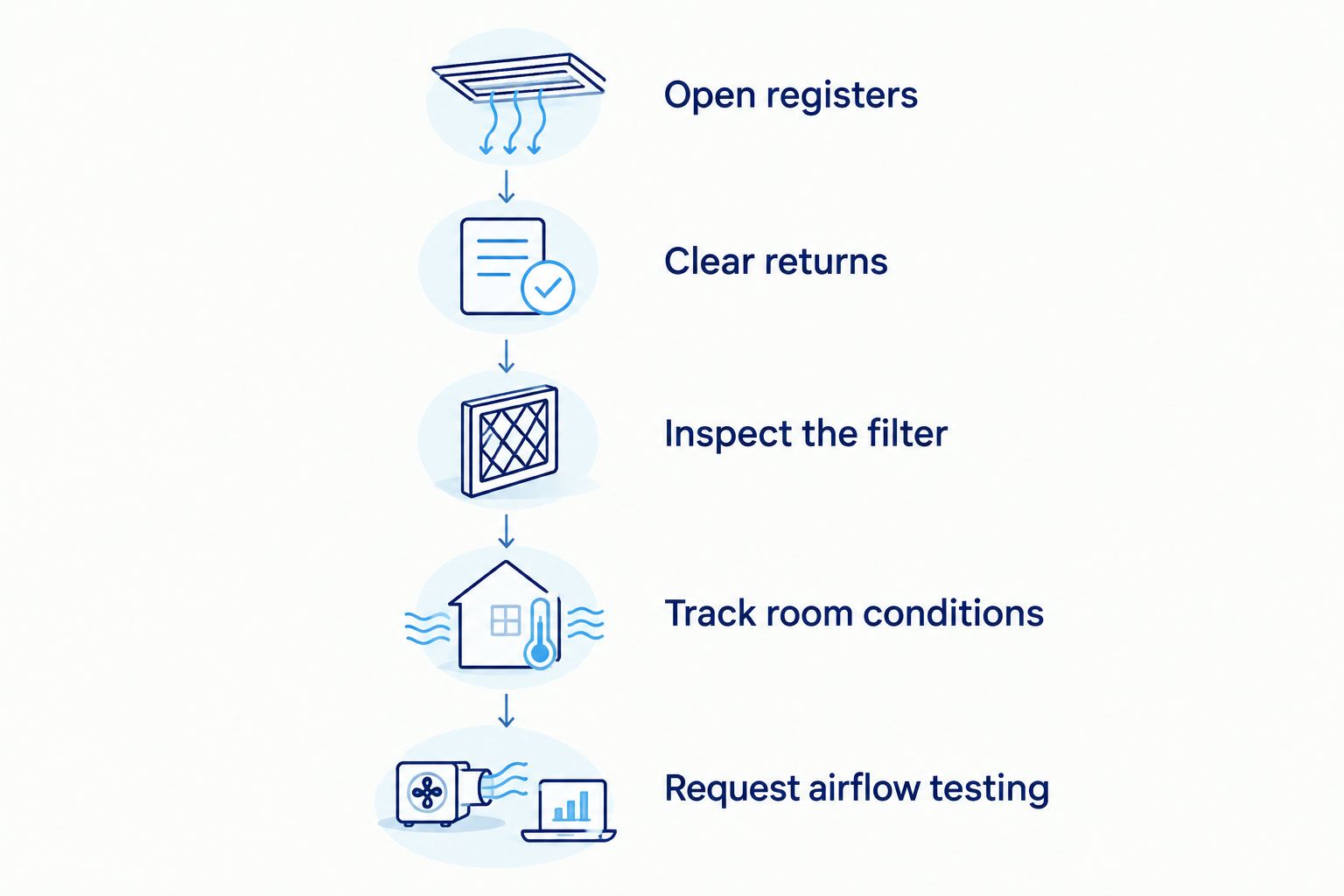
- Open registers. Restore ordinary supply registers that were closed to reduce cooling in unused rooms. Leave professionally set balancing dampers alone.
- Clear returns. Move furniture, curtains, and stored items away from return grilles and supply outlets.
- Inspect the filter. Check its condition and confirm the replacement type matches the equipment requirements. Follow the manufacturer's instructions.
- Track room conditions. Note which rooms feel warmer, whether doors are open or closed, and when the difference is strongest.
- Request airflow testing. Ask for pressure and airflow checks if the imbalance remains after obvious obstructions are removed.
These observations help separate a room distribution problem from a whole-system cooling problem. Tell the technician whether the trouble started after a renovation, filter change, or furniture move.
If you see ice on refrigerant tubing or the indoor equipment, stop cooling operation and arrange an assessment. Do not chip away ice or assume that reopening a register has resolved the underlying problem.
Is closing a bedroom door different from closing its vent?
Yes. Closing a door changes the room's return airflow path, while closing a supply register restricts the air entering the room. Either can affect circulation, but they do so differently.
A bedroom can have an open supply register and still cool poorly behind a closed door. If air cannot return easily to the central return grille, pressure builds in the bedroom and airflow changes.
For a 2026 comfort assessment, note whether the temperature difference improves with the door open. That observation helps identify a return-path issue, but it does not replace measurements.
Do not assume a gap beneath the door is adequate. A technician can evaluate whether the room needs a properly designed return path, such as a transfer grille or dedicated return.
Why duct condition deserves attention before zoning
A room that gets too little air does not automatically need more equipment. A crushed branch duct, loose connection, or poorly adjusted damper can create the same complaint.
Ask the technician to distinguish between air that never reaches the room and cooling capacity that the room genuinely lacks. That distinction prevents you from choosing a larger solution for a distribution defect.
Where testing confirms leakage, sealing leaky air ducts addresses conditioned air escaping before it reaches the intended rooms. Closing registers leaves those leaks in place and can increase the pressure across them.
Duct sealing is not a cure for every airflow problem. It will not straighten crushed ductwork or make an undersized return larger. The recommended work should match the defect found during inspection.
Before approving work in 2026, ask what was measured, what was found, and how the proposed correction addresses it. You should understand the connection between the problem and the repair.
Is central AC zoning better than closing vents?
Properly designed central AC zoning is different from manually closing registers. Zoning uses controls and duct dampers to direct cooling according to separate areas' needs, with equipment operation and minimum airflow accounted for in the design.
That can suit a home with distinct upstairs and downstairs conditions or spaces used on different schedules. It is not automatically the right answer for an occasionally empty guest room.
The benefit is coordinated control. The limitation is that the existing equipment and ducts must support the proposed arrangement. Poor zoning design can create the same pressure and airflow problems that closed registers cause.
Ask how the system will maintain adequate airflow when only a smaller area requests cooling. A clear answer matters more than the number of thermostat features.
What should you do with an unused guest room?
Keep its supply register open unless a technician has established a different balancing position. Avoid treating the room as separate from the conditioned house just because nobody sleeps there regularly.
For seasonal homes, check the room's humidity as well as its temperature. A thermostat in the hallway cannot tell you whether a closed guest room feels damp or has condensation near an outlet.
An indoor humidity reading above 60 percent deserves investigation, especially if it persists. Compare room conditions and look for moisture sources rather than lowering the thermostat repeatedly without understanding the cause.
Your 2026 away-from-home plan should preserve moisture control throughout the house. There is no single thermostat setting that suits every home, because insulation, air leakage, and equipment performance differ.
When should you request an airflow assessment?
Arrange an assessment when rooms remain uncomfortable with clear registers and returns, when whistling starts after vent adjustments, or when the equipment develops recurring ice. These symptoms justify diagnosis, not an automatic replacement recommendation.
A.R. Williams Air Conditioning provides AC repair and maintenance for homeowners across South Florida and the Treasure Coast. Technicians explain what they find and lay out the available options before work starts.
Ask for the findings in plain language. Is the issue restricted airflow, duct leakage, a return-path problem, or equipment operation? The explanation should make the next step understandable.
A.R. Williams Air Conditioning quotes transparent flat-rate pricing before work begins. An airflow complaint alone does not establish that you need new equipment, and the proposed solution should address the identified cause.
FAQ
Will closing vents in unused rooms lower my electric bill?
Closing vents in unused rooms does not reliably lower your electric bill with central AC. It adds duct resistance without necessarily reducing the cooling requested by the thermostat.
How many AC vents can I safely close?
There is no universal safe number of AC vents to close. Keep ordinary supply registers open unless a technician has checked airflow and established appropriate balancing positions.
Should I close the return vent in an unused bedroom?
No, keep return grilles open and unobstructed. Blocking a return restricts the airflow path back to the equipment rather than creating independent room control.
Can closing vents cause my AC to freeze?
Closing vents can contribute to freezing if the restriction reduces airflow across the indoor coil enough. Filter condition, coil condition, and duct design also affect that risk.
Should I keep unused bedroom doors open?
Keeping a bedroom door open helps circulation when the room lacks an adequate return-air path. If the room becomes uncomfortable with the door closed, have the return path evaluated.
What humidity should an unused room have?
Keep indoor relative humidity below 60 percent, ideally between 30 percent and 50 percent, according to EPA homeowner mold guidance. An unused room still needs moisture control.
Does a variable-speed AC make closing vents safe?
A variable-speed AC does not make unrestricted vent closing safe. Its blower and duct system still have operating limits, and some blowers use more power when resistance increases.
One last thing
A stronger breeze from another register does not prove that closing a vent improved efficiency. It only tells you that air distribution changed. Measure comfort and system performance, not just how forcefully air leaves an outlet.
If uneven cooling persists, schedule your service with A.R. Williams Air Conditioning and ask for an airflow assessment before deciding on equipment changes.
Related guides
- How to lower AC bills in South Florida summers
- How to know when you need a second AC zone
- How to reduce indoor humidity without overworking your AC
