
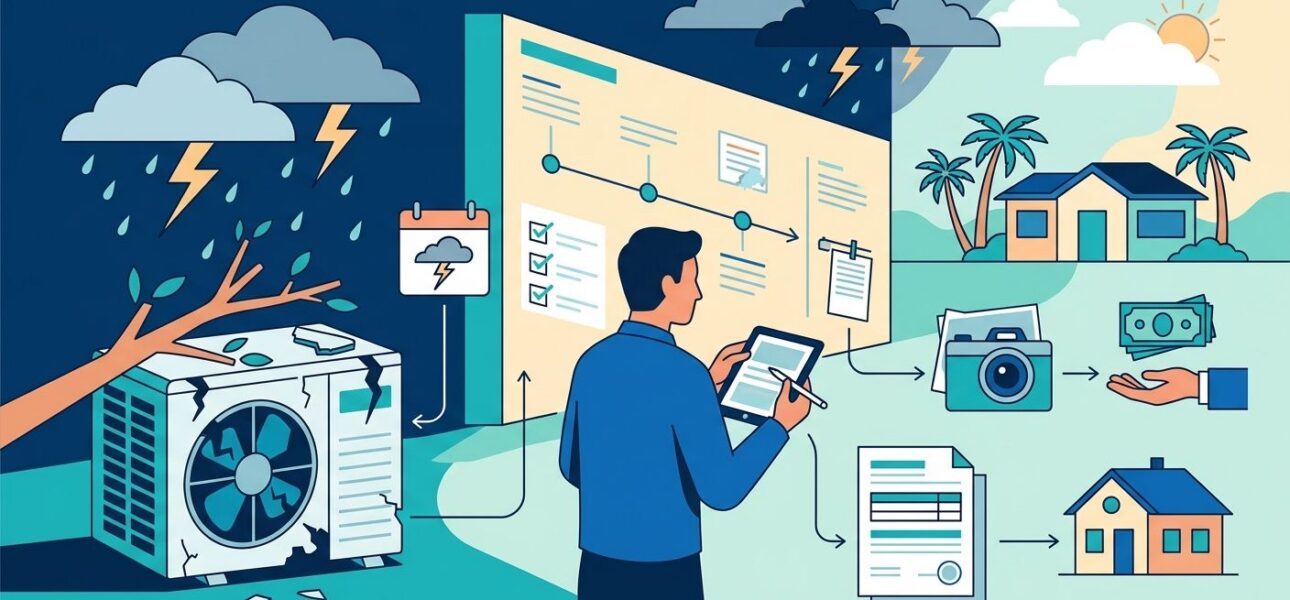
Storm damage to your outdoor AC unit in Florida gets covered under your homeowners policy when it's caused by wind, hail, falling debris, or a lightning-related power surge. It does not get covered when the cause is storm surge or rising floodwater, which falls under a separate flood policy, and it often gets challenged when the adjuster suspects the unit was already failing before the storm hit.
- File an insurance claim for AC storm damage in Florida by photographing the unit, calling your insurer within 24 to 48 hours, and getting a written damage assessment from a licensed HVAC technician.
- Wind, hail, falling limbs, and lightning-related power surges are typically covered under a standard homeowners policy in 2026.
- Storm surge and floodwater damage to a condenser usually need a separate flood policy, not your homeowners policy.
- Adjusters look for pre-existing wear, so a technician’s written report matters more than a phone estimate.
- Photograph the unit before moving debris or attempting any repair, since disturbed evidence is the top reason claims get delayed.
Why this matters
Hurricane season in Florida runs June through November, and every year outdoor condensers in Palm Beach, Broward, and Treasure Coast neighborhoods take direct hits from flying debris, downed branches, and lightning strikes on nearby power lines. An insurance claim for AC storm damage in Florida moves faster and pays out more reliably when the paperwork is right the first time.
Homeowners in older houses built before 2010 face an extra wrinkle. Many of those systems still run on R-22 refrigerant, and insurers sometimes push back harder on repair versus replacement decisions because parts for those units are scarce. Knowing what to document and when to call matters just as much as knowing who to call.
How do you file an insurance claim for AC storm damage in Florida?
Follow these steps in order, and don't skip the documentation step even if the outdoor unit looks obviously destroyed.
- Photograph everything before you touch it. Get wide shots of the unit, close-ups of dents or debris, and a shot of anything nearby that caused the damage (a fallen branch, a piece of roof, a fence panel).
- Call your insurance company within 24 to 48 hours. Most policies require prompt notice of loss, and a delayed report is one of the easiest reasons for a denial.
- Request an adjuster inspection date. Ask for a copy of your policy's wind and hail deductible so you know what you're responsible for before repairs start.
- Get a licensed HVAC technician's written assessment. This is the document that carries the most weight with an adjuster, because it separates storm damage from normal wear and tear in plain terms.
- Keep the damaged parts if a technician replaces anything. Insurers sometimes ask to see the failed capacitor, coil, or fan motor before closing the claim.
- Submit the technician's report and photos together. A claim with both arrives more complete than one with photos alone.
A technician who can check if your AC warranty covers storm damage before the adjuster visits can also tell you whether the manufacturer's warranty and your insurance policy overlap, which matters if the unit is still under a Ruud, Carrier, or Daikin manufacturer warranty.
Wind and hail damage claims
Wind and hail are the most common storm claims for outdoor condensers in South Florida. A bent fin coil, a cracked fan blade, or a unit knocked off its pad from straight-line winds is a standard covered loss under most homeowners policies in 2026. The adjuster will usually want to see that the damage lines up with the storm date on record, so keep the National Weather Service advisory or local news coverage of the storm as backup.
Lightning and power surge claims
Lightning is one of the more disputed categories, because a surge can fry a control board or compressor without leaving any visible exterior damage. Insurers sometimes ask for proof that a surge event occurred nearby, which is where having surge protection devices for Florida AC systems already installed helps, since a tripped surge protector is physical evidence the system took a hit. Homes without one on the condenser often see longer claim review times.
Flood and storm surge damage
This is the category homeowners get wrong most often. If floodwater or storm surge reaches the outdoor unit or a ground-level air handler, that damage typically falls outside a standard homeowners policy and needs a separate flood insurance policy through the National Flood Insurance Program or a private flood carrier. Waterfront and canal-front homes in Palm Beach County should confirm flood coverage on the AC system specifically, not just the structure, before hurricane season starts.
Why insurance claims for AC storm damage get denied
A few patterns show up again and again in South Florida claims:
- No documentation of the storm event itself. Claims filed weeks after a storm with no photos from that window get questioned first.
- Pre-existing corrosion or age-related failure. Salt air near the coast corrodes outdoor coils over time, and adjusters are trained to spot the difference between storm damage and gradual corrosion.
- Missing maintenance records. An insurer can argue neglect if there's no record of AC maintenance for coastal homes with salt air exposure or a recent tune-up.
- Flood damage filed under the wrong policy. Submitting a floodwater claim to a homeowners carrier instead of a flood policy just delays everything.
- Unlicensed repair estimates. An estimate from someone without a Florida HVAC license can get rejected outright by the insurer.
- Delayed reporting. Waiting past the policy's notice window is one of the fastest ways to lose a valid claim.
“A technician’s written damage report carries more weight with an adjuster than any photo you take yourself.”
What to do if the AC won't run after the storm
If the system lost power during the storm and won't restart, don't assume it's a total loss. A tripped breaker, a failed capacitor, or a blown fuse can all look like a dead system to a homeowner but cost far less to fix than a full replacement. Get a technician out to confirm the actual cause before you file for a full unit replacement, since that distinction affects what the adjuster approves.
Homes that lost grid power entirely should also review how to run your AC during a hurricane power outage so the system restarts safely once power returns, rather than tripping again on a hard start.
Get a written damage assessment
A technician’s report gives your adjuster what they need to move the claim forward.
Related questions
Does homeowners insurance cover a lightning-damaged AC unit?
Homeowners insurance typically covers a lightning-damaged AC unit in Florida when the strike causes a power surge that fries the compressor, control board, or fan motor. The claim moves faster when there's a record of a nearby lightning strike and a technician's report confirming surge damage rather than a mechanical failure.
Do I need a permit to repair storm-damaged AC equipment?
Yes, permit requirements for AC repair after storm damage vary by county in Florida, and Palm Beach, Martin, and St. Lucie counties each have their own inspection rules for anything beyond a like-for-like part swap. Check how to get permits for AC installation in Florida before scheduling replacement work tied to an insurance claim.
Should I prep my AC before the next hurricane to avoid a repeat claim?
Yes, a pre-season tune-up catches loose panels, weak mounting straps, and worn electrical connections that make storm damage worse. Review how to prepare your AC for hurricane season each year before June, since prevention costs far less than a claim.
FAQ
How long do I have to file an AC storm damage claim in Florida?
Most Florida homeowners policies require you to report storm damage promptly, generally within 24 to 48 hours of discovering it, though some policies allow longer. Check your specific policy’s notice-of-loss clause, since a late report is a common reason claims get denied in 2026.
Will my insurance company send its own AC technician?
No, the insurance adjuster inspects the damage but usually isn’t an HVAC technician themselves. You’ll still need your own licensed technician’s written assessment to support the claim and confirm the repair scope.
Is a bent condenser fin covered by insurance?
Yes, a bent condenser fin from wind-blown debris is typically covered as storm damage under a standard homeowners policy. Minor fin damage that doesn’t affect airflow may not be worth filing a claim over given your deductible.
Can I file a claim if my AC just stopped working during a storm with no visible damage?
Yes, a power surge from nearby lightning can disable an AC system without any visible exterior damage. A technician can test the compressor, control board, and capacitor to confirm surge damage for the claim.
Does flood insurance cover AC units in Florida?
Flood insurance covers AC equipment damaged by rising water or storm surge, but a standard homeowners policy generally does not. Waterfront and low-lying homes should confirm flood coverage extends to outdoor equipment specifically.
What documents does an insurance adjuster need for an AC claim?
An adjuster needs dated photos of the damage, a written technician assessment separating storm damage from wear and tear, and any maintenance records showing the system was serviced regularly before the storm.
Does an old R-22 AC system get replaced or repaired under an insurance claim?
It depends on parts availability and the extent of the damage. Insurers sometimes approve full replacement for older R-22 systems when the specific failed part is no longer manufactured, rather than paying for a temporary repair.
One last thing
The detail most homeowners miss is the order of operations: call the insurer before you call a repair company for anything beyond a safety shutoff. A technician who shows up and starts fixing things before the adjuster has seen the damage can accidentally remove the evidence that supports your claim. Get the photos and the notice of loss filed first, then bring in the technician for the written assessment.
Related guides
- AC maintenance for homes after hurricane roof repairs
- How to protect your outdoor AC unit from lightning damage
- AC tune-up before hurricane season
- Best AC maintenance schedule for coastal homes
