
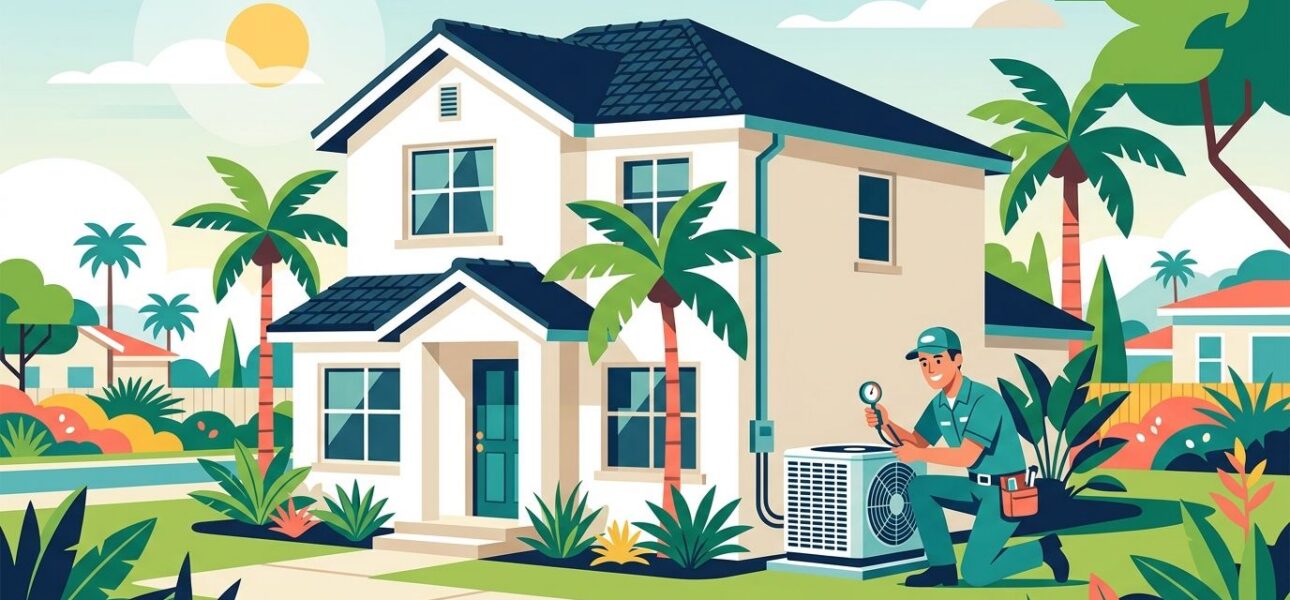
AC maintenance for Palm Beach Gardens homes means a scheduled check of refrigerant levels, airflow, electrical parts, and drainage before Florida's heat and humidity push a system past its limit. Homes here range from older construction near Prosperity Farms Road to newer builds around Alton and PGA National, and each brings its own wear pattern, from irrigation overspray on outdoor coils to R-22 systems still running in houses built before 2010.
- AC maintenance for Palm Beach Gardens homes should happen twice a year, once before summer and once before the cooler months, not just when something feels off.
- Golf course and canal-front properties see faster coil corrosion from irrigation overspray and humidity, so those systems need closer attention in 2026.
- A clogged condensate drain line is one of the most common causes of a no-cool call in South Florida, and it’s cheap to prevent.
- Homes built before 2010 may still run R-22 systems, and a maintenance visit is the easiest way to catch a slow refrigerant leak before it becomes a bigger repair.
Why AC maintenance matters for Palm Beach Gardens homeowners
Palm Beach Gardens sits far enough inland that salt air isn't the main threat it is on the barrier islands, but it's not maintenance-free territory. Irrigation systems on golf course lots and larger properties spray outdoor units several times a week, and that constant mineral exposure corrodes condenser coils faster than a system running in a drier yard.
Older neighborhoods still have homes with undersized return air ducts built decades before today's higher-capacity systems became standard. That mismatch forces a system to work harder than it should, and the symptoms often look like a bigger failure than they are. A properly sized return air setup matters more here than in newer construction.
Homes built before 2010 may also still be running R-22 systems. R-22 is no longer produced, so a slow refrigerant leak on one of these units turns into an expensive repair fast if it's caught late. Regular maintenance is the cheapest way to catch that leak early, and if the unit was recently affected by work after a hurricane roof repair, a check makes even more sense before the next storm season.
Steps that matter most for this segment
Check airflow and return air sizing before summer
Airflow problems show up as weak cooling long before the compressor fails, and in Palm Beach Gardens homes with original 1980s and 1990s ductwork, this is often the first thing worth ruling out.
- Replace the air filter and check for a snug fit with no gaps around the frame.
- Feel for weak airflow at the vents farthest from the air handler.
- Look at the return grille size relative to the system's tonnage.
- Check for closed or blocked vents in rooms that run warm.
Clean the outdoor condenser coil and clear its perimeter
A coil coated in irrigation mineral buildup or lawn clippings can't shed heat the way it's designed to, and the compressor pays for it in higher run times.
- Rinse the coil fins with a garden hose, never a pressure washer.
- Trim landscaping back at least two feet from all sides of the unit.
- Adjust sprinkler heads that spray directly on the cabinet.
- Check the pad underneath for settling or standing water after rain.
Test refrigerant charge and system pressures
A system low on refrigerant cools poorly and works harder to hit the thermostat setting, which shortens compressor life over time.
- Check refrigerant levels before summer rather than waiting for warm air at the vents.
- Watch for ice on the refrigerant lines, a sign of low charge or airflow trouble.
- Note any hissing sounds near the indoor coil, which can point to a leak.
- Ask for pressure readings compared against the manufacturer's spec, not a guess.
Clear and treat the condensate drain line
Drain line clogs are one of the most common reasons a South Florida homeowner ends up with water on the floor or a system that shuts itself off.
- Clear a clogged AC drain line with a wet vac or a simple flush before algae builds up.
- Check the drain pan for standing water or rust.
- Confirm the float switch shuts the system off correctly when the pan fills.
- Look for a slow drip near the air handler, often the first sign of a partial clog.
Inspect electrical components and the capacitor
Capacitors and contactors take a beating from South Florida heat, and a weak capacitor is one of the more common reasons a compressor struggles to start.
- Check capacitor readings against their rated microfarad value.
- Look for bulging or leaking on the capacitor casing.
- Tighten electrical connections that can loosen from vibration over time.
- Confirm the disconnect box outside is sealed against moisture.
Calibrate the thermostat and confirm zoning
A thermostat reading a few degrees off can make a healthy system seem like it's underperforming, especially in larger Palm Beach Gardens homes with multiple zones.
- Compare the thermostat reading to a separate room thermometer.
- Check that zone dampers are opening and closing correctly.
- Update thermostat schedules for the season, especially in homes left empty part of the year.
- Confirm Wi-Fi connected thermostats are still reporting properly after any router changes.
Schedule a professional seasonal tune-up
The steps above catch a lot, but a full tune-up adds combustion and electrical safety checks, amp draw testing, and a pressure test that DIY checks can't replicate. This is where a two-visit maintenance plan earns its keep for most Palm Beach Gardens homes, especially ones running systems installed before 2015.
Comparison of maintenance options for Palm Beach Gardens homes
| Option | Best for | Key limitation |
|---|---|---|
| DIY filter changes and visual checks | Homeowners keeping up basic upkeep between visits | Can't test refrigerant charge, amp draw, or drain line pressure |
| One-time seasonal tune-up | Homes prepping for a specific season or an upcoming trip | No ongoing record of how the system performs across the year |
| Two-visit maintenance plan | Homeowners who want spring and fall coverage on a set schedule | Requires committing to two visits a year instead of calling only when something feels off |
Verdict: a two-visit maintenance plan is the strongest fit for most Palm Beach Gardens homes, especially properties near golf courses or canals where coil corrosion moves faster than average.
“If the outdoor unit sits within ten feet of a sprinkler head, the coil corrodes years before the compressor ever gives out.”
Common mistakes Palm Beach Gardens homeowners make
- Letting irrigation heads spray directly on the condenser for years without adjusting them.
- Assuming a system is fine because the thermostat still reads the right temperature, even as humidity climbs.
- Leaving a snowbird home's AC off for months, which lets indoor humidity build and invites mold in the ductwork.
- Waiting until a no-cool call in August to book the year's first tune-up, when spring is the easier window to get ahead of it.
- Ignoring an older R-22 system's slow performance decline instead of watching for early signs it needs repair or replacement.
Get your system checked before summer
A technician can walk you through what your Palm Beach Gardens home needs and what it doesn’t.
FAQ
How often should AC maintenance happen in Palm Beach Gardens?
Twice a year works best for most homes here, once in spring before the heat builds and once in fall as humidity starts to drop. Homes with golf course or canal exposure benefit from sticking to that schedule closely, since coil corrosion moves faster in those spots.
What does a maintenance visit actually check?
A full visit checks refrigerant charge, electrical components like the capacitor and contactor, condensate drain flow, airflow across the coils, and thermostat calibration. It’s a broader check than a filter swap and catches problems a homeowner usually can’t see from outside the cabinet.
Can skipping maintenance affect a manufacturer’s warranty?
Many manufacturer warranties require documented maintenance to stay valid, and a lapse in service records can be used to deny a claim. Keeping receipts or a maintenance plan record protects that coverage.
Do older R-22 systems need more frequent maintenance?
Yes. R-22 is no longer produced, so a slow leak on one of these systems gets expensive fast once a refill is needed. Regular checks catch a small leak before it turns into a bigger repair or a full system replacement.
Is maintenance different for a home near a golf course or canal?
Irrigation overspray and higher ambient humidity near golf courses and canals speed up coil corrosion compared to a typical inland lot. Rinsing the coil more often and adjusting sprinkler heads away from the unit helps close that gap.
Should a snowbird home get maintenance while the owner is away?
Yes, a home sitting empty for months with the AC off, or running on a very high setpoint, builds indoor humidity that invites mold and mildew in the ductwork. A pre-departure and pre-arrival check catches problems before they spread through the home.
What’s the difference between AC maintenance and AC repair?
Maintenance is a scheduled check meant to catch small issues early, while repair addresses a specific problem the system is already showing, like weak cooling or a strange noise. Regular maintenance reduces how often a repair call happens, but it doesn’t replace one when something breaks.
How long does a typical AC tune-up take?
A standard tune-up usually runs 45 minutes to an hour for a single system, longer if the technician finds something that needs a closer look, like a refrigerant leak or a failing capacitor.
One last thing
The condensate drain line causes more no-cool calls in South Florida than the compressor does, and it's one of the cheapest problems to prevent. A five-minute flush during a spring visit avoids a wet floor and a shut-down system in the middle of a July heat wave in 2026.
Related guides
- Best AC maintenance schedule for coastal homes
- Best AC maintenance plan for South Florida homeowners
