

Yes, an AC maintenance plan is worth it in Florida in 2026 when it provides useful scheduled service, clear written findings, and terms that fit your home. It is not worth choosing a plan for benefits you won't use or assuming that membership covers repairs. Choose the maintenance work first, then decide whether a plan is the right way to arrange it.
- Is an AC maintenance plan worth it? Yes, when scheduled AC maintenance matches your home’s needs and contract terms.
- A.R. Williams Air Conditioning recommends clear explanations and informed repair decisions, not assumptions about maintenance coverage.
- Compare preventive maintenance tasks, exclusions, and scheduling responsibilities before signing.
- A maintenance plan does not replace diagnosis of water leaks, weak cooling, or recurring shutdowns.
Is an AC maintenance plan worth it in Florida?
An AC maintenance plan is worth considering when it helps you keep up with necessary care rather than leaving service until the system stops cooling. Florida homeowners should compare the actual work, scheduling arrangements, and exclusions, not just the membership label.
Use this comparison alongside the guide to choosing an AC maintenance plan for South Florida homeowners. Ask for a written scope before deciding.
| Approach | Best for | Main advantage | Main limitation |
|---|---|---|---|
| Scheduled maintenance plan | Homeowners who want an ongoing service arrangement | Establishes a schedule and defined service scope | Contract terms can include exclusions and renewal obligations |
| Individually scheduled maintenance | Homeowners who reliably arrange their own appointments | Lets you choose each visit without an ongoing agreement | You remain responsible for remembering and booking service |
| Repair only when symptoms appear | Addressing a specific cooling problem | Focuses the visit on the fault you are experiencing | Does not provide ongoing preventive care |
A plan is a scheduling and service agreement, not a promise that your AC will never fail. Individually scheduled maintenance is also a valid choice when you follow through consistently. Neither approach replaces repairs when a component fails.
Why this matters in Florida
Your central AC removes moisture as it cools the house. That moisture needs a clear drainage path, while the system needs adequate airflow to move heat out of your home. A maintenance visit should address those practical needs rather than stop at a quick thermostat check.
Near the coast, salt air can corrode outdoor coils and other metal components. In older houses, restricted return airflow can affect cooling even when the equipment itself runs. A useful service record helps distinguish routine upkeep from conditions that need a separate correction.
For a snowbird home that sits empty for part of the year, the scheduling question matters too. Someone must arrange access and receive the findings. A membership alone does not provide property monitoring or guarantee that a developing leak will be noticed between visits.
What should an AC maintenance plan include?
The strongest reason to choose a plan is the work it arranges. For your 2026 comparison, request a task list that identifies what the technician inspects, what gets cleaned, and what requires separate authorization.
Airflow and filter checks
Ask whether the visit includes checking the filter, accessible return openings, and signs of restricted airflow. A return is the opening that draws indoor air back into the system. Blocking it with furniture or using an unsuitable filter can restrict that movement.
Inspection and replacement are different tasks. Confirm whether the technician supplies a replacement filter, uses one you provide, or simply reports its condition. The filter type should suit the equipment and airflow requirements, not just carry an appealing label.
Drainage and moisture checks
Ask how the technician checks the condensate drain, which carries away the water removed from indoor air. The scope should explain whether drain cleaning is included and whether an accessible drain pan and installed safety switch are checked.
A safety switch can stop the equipment when water backs up, but it does not clear the underlying blockage. A recurring drainage problem needs a diagnosis, not repeated resets. Existing water leakage deserves a separate discussion before you sign an ongoing agreement.
Indoor and outdoor coil condition
Coils are the surfaces that transfer heat. Dirt on those surfaces can interfere with that transfer, while coastal exposure can contribute to corrosion outside. Ask whether the visit includes a visual inspection, routine cleaning, or both.
Deep cleaning that requires additional access is different from routine inspection. Have the provider explain that distinction in writing. For a home near saltwater, the guide to AC maintenance for coastal homes with salt air exposure addresses that specific concern.
Operating and electrical checks
Ask what operating checks the technician performs and what gets recorded. Electrical connections and components require professional attention, while unusual noises, weak airflow, and repeated cycling should be documented for diagnosis.
Checking refrigerant performance does not mean routinely adding refrigerant. Refrigerant circulates in a closed system, so a confirmed shortage requires investigation. A plan should not describe repeated refilling as a substitute for finding the cause.
How do you decide whether a plan fits your home?
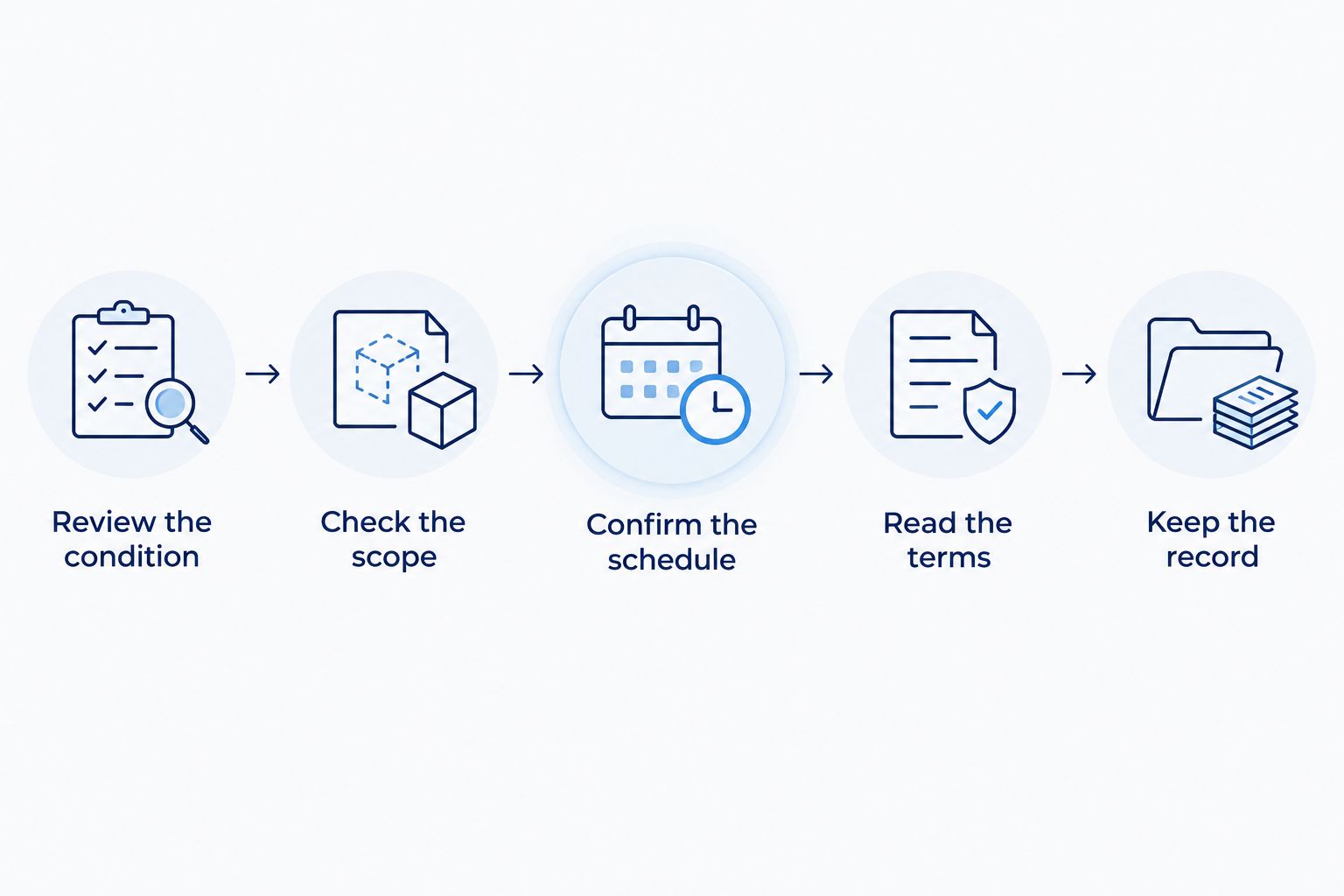
Follow this sequence before committing to a maintenance agreement. It separates the condition of your equipment from the contract offered to you, so you can make the decision without feeling pressured.
- Review the condition. Gather previous service reports and write down any cooling, noise, moisture, or shutdown problems. Ask which issues require diagnosis before routine maintenance.
- Check the scope. Request the actual task list. Identify inspections, cleaning work, and services that need separate approval.
- Confirm the schedule. Ask who books the visits and how appointments work when you are away. Make sure the arrangement fits your access needs.
- Read the terms. Check exclusions, renewal language, cancellation requirements, and how missed visits are handled.
- Keep the record. Save the agreement and completed service reports together. Compare each visit with the promised scope before renewal.
An unresolved problem can change the order. If the house is already struggling to cool, start with diagnosis rather than assuming a maintenance membership will solve it. You can decide how to arrange future upkeep once the current condition is clear.
Why maintenance plan value varies
The same agreement does not suit every house. These factors affect whether scheduled membership or individually arranged service is the better fit:
- Coastal exposure: Outdoor corrosion deserves attention, but maintenance does not undo existing metal damage.
- System condition: A well-functioning AC needs preventive care. An AC with a known fault also needs diagnosis and an appropriate repair.
- Airflow limitations: Restricted returns or duct problems need their own assessment. Cleaning the equipment does not resize a return opening.
- Seasonal occupancy: Empty homes need a clear access arrangement and someone responsible for receiving service findings.
- Included work: Inspection alone and inspection with cleaning are different scopes. Compare the written tasks rather than the plan name.
- Contract responsibilities: Scheduling, renewal, and cancellation terms determine how much responsibility stays with you.
None of these factors justifies a repair recommendation by itself. Ask the technician to explain the observed condition and how the proposed work addresses it. Your home's circumstances should guide the service, not become a reason to approve unrelated work.
When is individually scheduled maintenance the better choice?
Individually scheduled maintenance fits homeowners who already keep a reliable service calendar and prefer to approve each appointment separately. You still need a consistent scope and useful records. Skipping an ongoing agreement should not mean skipping the maintenance itself.
This approach also gives you time to evaluate a provider before committing. Notice whether the technician explains findings, separates routine care from repairs, and leaves a clear report. A good individual visit is more useful than an ongoing arrangement whose work you cannot identify.
The drawback is responsibility. You must remember the appointment, arrange access, and keep track of unresolved recommendations. Choose the arrangement you will actually maintain, rather than the one that sounds most convenient on paper.
Is a maintenance plan worth it for a newer AC?
A newer AC still needs maintenance that matches its manufacturer's instructions. New equipment does not prevent filters from loading with debris or drainage from developing problems. The decision is whether a plan helps you complete that care reliably.
Review the equipment documents when comparing agreements in 2026. Warranty terms and maintenance requirements are specific to the manufacturer and coverage, so do not assume that every warranty requires membership in a contractor's plan.
Keep installation documents and maintenance reports. If you need warranty service later, those records help establish what work occurred. A plan is useful only if its tasks and documentation support the equipment's actual needs.
Is a maintenance plan worth it for an older AC?
An older AC can benefit from routine care, but maintenance cannot reverse worn components, corrosion, or a poor installation. Ask for a condition assessment before choosing an ongoing agreement. That prevents you from treating maintenance as an answer to a repair problem.
A useful report distinguishes observed wear from a confirmed failure. It should also identify when symptoms require further testing. Age alone does not explain weak cooling, and a maintenance agreement does not establish whether replacement is necessary.
If repairs or replacement enter the discussion, ask for the reasoning separately from the membership recommendation. You should understand each decision on its own. Do not sign a maintenance plan to avoid asking what is wrong with the system.
What should you check before signing or renewing?
Before signing in 2026, read how the agreement defines completed service. Ask what happens if an appointment is missed, the home is inaccessible, or your equipment is replaced during the agreement. Those details determine whether the arrangement matches your circumstances.
Check whether renewal is automatic and how cancellation works. If the provider mentions preferred scheduling, ask what that means without assuming a guaranteed arrival time. If repairs are excluded, confirm that you receive an explanation and quote before separate work begins.
At renewal, compare the service reports with the promised tasks. Look for unresolved findings, missing documentation, or changes in your equipment. Renew because the arrangement continues to meet your needs, not simply because you received a reminder.
What should a useful service visit leave you with?
You should understand what the technician checked, what was found, and whether further work needs your approval. Ask for the difference between a confirmed fault and a condition to watch. That distinction helps you make a calm decision.
A.R. Williams Air Conditioning is a fit for homeowners who want AC maintenance findings explained before approving repairs. Technicians explain what they found and lay out the options, with transparent flat-rate quotes before work starts.
A.R. Williams Air Conditioning provides residential AC maintenance, repair, and replacement. Those services address different needs: routine care supports operation, while a repair addresses a diagnosed fault. No maintenance visit removes every possibility of a future breakdown.
If you are considering A.R. Williams Air Conditioning for maintenance, talk with a technician about your system's condition and the scope you need. Request the written terms of any ongoing arrangement before deciding. The right next step is clarity, not a commitment made during a confusing service conversation.
FAQ
Is an AC maintenance plan worth it if my system is working fine?
An AC maintenance plan is worth considering when it helps you complete appropriate preventive care consistently. A working system still needs attention to filters, drainage, and equipment condition, but you can also arrange that care individually.
Does an AC maintenance plan cover repairs?
An AC maintenance plan covers repairs only if its written terms explicitly include them. Check parts, labor, diagnostic visits, and exclusions separately rather than assuming membership includes corrective work.
Is an AC maintenance plan the same as a home warranty?
An AC maintenance plan is not the same as a home warranty. Maintenance arranges preventive service, while a home warranty’s contract defines any coverage for breakdowns and the conditions for making a claim.
How often should my Florida AC receive maintenance?
Your Florida AC maintenance schedule should follow the equipment manufacturer’s instructions and reflect the system’s condition and exposure. Ask the technician to explain whether coastal corrosion, drainage history, or seasonal occupancy changes the recommended schedule.
Will AC maintenance prevent every breakdown?
AC maintenance will not prevent every breakdown. It addresses serviceable conditions and helps identify problems, but components can still fail between visits.
Do I need an AC maintenance plan to keep my warranty?
You do not automatically need a contractor’s maintenance plan to keep an AC warranty. Read your specific warranty terms for maintenance and documentation requirements, then choose an arrangement that meets them.
Should I buy a maintenance plan if my AC is already leaking water?
Get an existing AC water leak diagnosed before choosing a maintenance plan. Routine upkeep is not a substitute for finding the cause of active leakage or assessing any resulting damage.
One last thing
A service report can be more useful than a membership card. Before choosing or renewing a plan in 2026, ask to see how completed tasks and findings will be documented. A checklist with no explanation leaves you guessing about your home's cooling system.
Keep the reports with your equipment documents. They give the next technician a clearer history and help you see whether the same problem keeps returning. That is a practical reason to value consistent maintenance without expecting it to promise more than it can deliver.
Related guides
- How to tell if your AC needs repair or replacement
- AC maintenance for snowbirds and seasonal residents
- Spring AC tune-up checklist for South Florida homeowners
