
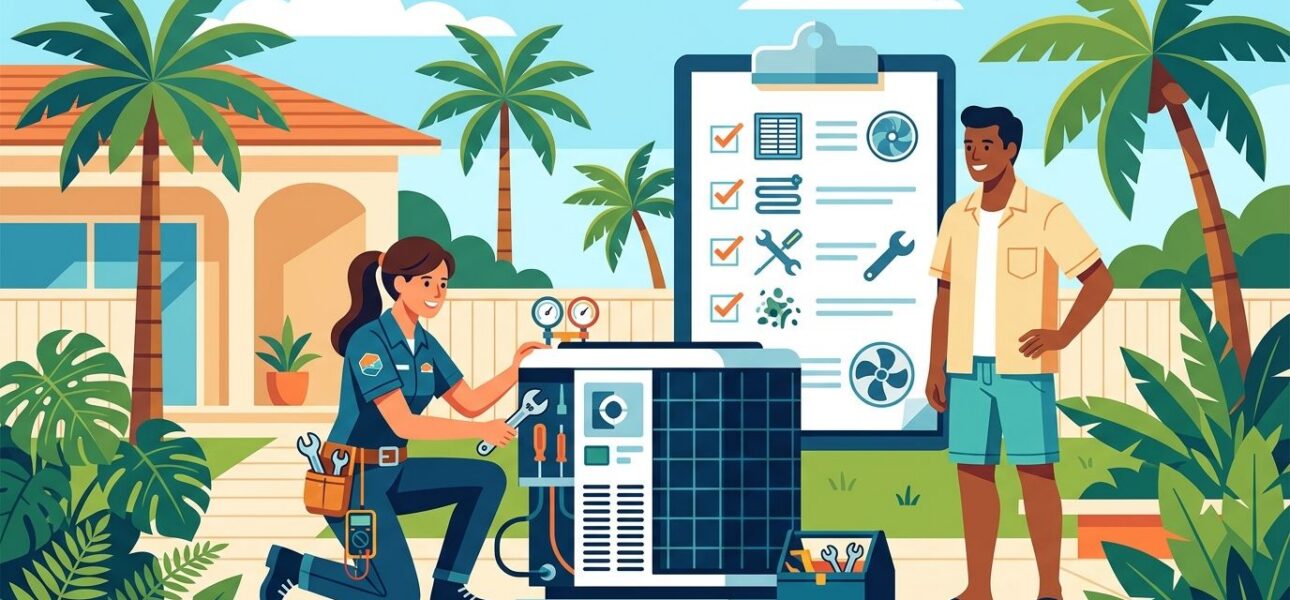
A spring AC tune-up checklist for South Florida homes covers five things: refrigerant levels, the condensate drain line, electrical components like the capacitor and contactor, airflow through the filter and ducts, and the physical condition of the outdoor condenser. Handle these checks in March or April, before the first stretch of 90-degree days, and you catch a weak capacitor or a slow drain clog while it's a quick fix instead of a no-cool call in June.
- A spring ac tune up checklist florida homeowners should follow covers refrigerant, drain line, electrical parts, airflow, and the outdoor unit.
- Coastal homes near Palm Beach and Broward County need extra attention to condenser coil corrosion from salt air.
- Homes built before 2010 may still run on R-22 refrigerant, phased out under EPA rules in 2020, which changes repair costs.
- Snowbird homes left empty for months need a drain line flush and filter change before anyone turns the system back on.
- A.R. Williams Air Conditioning checks all five areas during a spring visit with flat-rate pricing quoted before work starts.
Why this matters
South Florida doesn't have a mild season. The system that coasted through January is about to run 14, 16, sometimes 18 hours a day by June. Whatever is marginal in spring becomes a failure in summer, usually on the hottest day of the week when every technician in the region has a full schedule.
A spring tune-up isn't about babying the unit. It's about finding the one weak part, a tired capacitor, a coil dusted with salt residue, a drain line half-clogged with algae, before it takes the whole system down in triple-digit heat index conditions.
What's on a spring AC tune-up checklist for Florida homes
Here's what a real spring visit should include, not a five-minute filter swap:
| Check | What it catches | Why it matters in Florida |
|---|---|---|
| Refrigerant level and pressure | Low charge, slow leaks | Low refrigerant makes the compressor work harder in extreme heat |
| Condensate drain line | Algae clogs, standing water | Florida humidity grows algae fast; clogged lines cause indoor leaks |
| Capacitor and contactor | Weak start, pitted contacts | Capacitors degrade faster in heat and humidity |
| Outdoor coil condition | Salt residue, dirt buildup | Coastal salt air corrodes coils years faster than inland units |
| Filter and airflow | Restricted airflow, dust load | Restricted airflow forces the compressor to run longer for the same result |
| Thermostat calibration | Inaccurate readings, poor scheduling | Wrong readings waste cooling capacity all summer |
| Electrical connections | Loose wiring, corrosion | Salt air and humidity corrode connections over time |
A technician who explains what they found on each of these, before quoting anything, is doing the job the way it should be done. That's the difference between a tune-up and a filter swap with an invoice attached.
Refrigerant: check it before summer, not during it
A system low on refrigerant doesn't just cool poorly, it makes the compressor work overtime, and an overworked compressor is the most expensive part to replace. If your home is due for a check, checking refrigerant levels before summer is worth doing in spring, not after the first hot week when you're already uncomfortable.
Homes built before 2010 sometimes still run on R-22 refrigerant, phased out under EPA regulation completed in 2020. If your system uses R-22 and has a leak, that's a different conversation than a modern R-410A system, and it's one worth having in spring while you have options instead of in July while you're sweating it out.
The condensate drain line: Florida's most common spring failure
Humidity this high grows algae fast, and a clogged condensate line is one of the most common reasons a South Florida AC leaks water into the house. It's also one of the cheapest problems to catch early and one of the most annoying to discover after it's ruined a ceiling or a closet floor.
If you've dealt with water around the air handler before, clearing a clogged AC drain line covers what a clog looks like and what causes it in this climate.
The capacitor: small part, big failure
A weak capacitor is one of the most common reasons an AC won't start on the hottest day of the year, and heat and humidity wear capacitors down faster in Florida than almost anywhere else in the country. A technician can test capacitor strength in minutes during a spring visit. Telling if your AC capacitor needs replacing walks through the warning signs if you want to check before you book anyone.
The outdoor unit: salt air is the enemy
If your home is anywhere near the coast, from West Palm Beach down through Boca Raton, salt in the air corrodes the outdoor coil and cabinet years faster than an inland unit sees. Spring is the right time to have a technician check for early corrosion, rinse the coil, and confirm the unit still sits level and clear of debris after the winter's lawn work and storm season buildup.
Why tune-up needs vary from home to home
Not every home needs the same level of attention. A few things change what your spring checklist should focus on:
- Distance from the coast. Salt air exposure accelerates coil and cabinet corrosion, so coastal homes need more frequent coil checks than inland ones.
- Age of the system and home. Older housing stock across Palm Beach County often has undersized return air, which strains the whole system regardless of how new the equipment is.
- Refrigerant type. R-22 systems, common in homes built before 2010, need a different conversation than modern R-410A systems if a leak turns up.
- Occupancy pattern. Snowbird homes sitting empty for months need a drain flush and filter change before anyone runs the system hard again.
- Recent roof work. Homes with hurricane roof repairs sometimes have disturbed ductwork or attic insulation that changes how the system performs.
- Landscaping and pets. Lawn equipment nicks refrigerant lines, and pet hair loads filters faster than manufacturers assume.
“A dirty filter or a clogged coil looks a lot like a bigger failure. That’s worth checking before anyone quotes you a repair.”
How often should you get an AC tune-up in South Florida?
Most South Florida homes do best with a check twice a year, once in spring before peak cooling season and once in fall, because the system here runs harder and longer than almost anywhere else in the country. Homes with heavy pet hair, coastal salt exposure, or systems past 10 years old often benefit from more frequent filter and coil checks in between.
Can you do a spring AC tune-up yourself?
A homeowner can change the filter, clear debris from around the outdoor unit, and flush the drain line with a wet vacuum or vinegar solution. Refrigerant checks, electrical testing, and capacitor readings require a licensed technician with the right gauges and safety training, so those parts of the checklist stay with a professional visit.
What happens if you skip a spring AC tune-up?
Skipping the spring check doesn't guarantee a breakdown, but it removes your chance to catch small problems while they're cheap to fix. A weak capacitor, a slow refrigerant leak, or a half-clogged drain line all tend to fail fully once the system runs 14 to 18 hours a day through a South Florida summer.
If your system is already showing signs of strain, telling AC repair from replacement helps you figure out which conversation you're actually having before a technician shows up.
A.R. Williams Air Conditioning runs full spring checks across Palm Beach County, Broward County, and the Treasure Coast, with flat-rate pricing quoted before any work starts. Technicians walk through what they found on each part of the checklist instead of handing over a bill with no explanation.
Get your system checked before summer heat
Book a spring tune-up with flat-rate pricing quoted upfront.
FAQ
What’s included in a spring AC tune-up checklist for Florida homes?
A spring ac tune up checklist for Florida homes includes refrigerant level checks, condensate drain line flushing, capacitor and electrical testing, filter and airflow checks, and outdoor coil inspection for salt corrosion. Each item catches a different type of failure before peak cooling season hits in 2026.
Is a spring tune-up different from a fall tune-up in South Florida?
Yes, spring tune-ups focus more on refrigerant charge and capacitor strength ahead of the heaviest cooling months, while fall visits often focus more on drain line buildup accumulated over a humid summer. Both cover the same core system, but the priority shifts with the season.
How much does a dirty filter affect my AC’s performance?
A dirty filter restricts airflow and forces the compressor to run longer to reach the same temperature, which is one of the most common reasons a system seems to be failing when it’s actually just starved for air. Replacing it is one of the simplest fixes on the whole checklist.
Does a spring AC tune-up catch refrigerant leaks?
A spring tune-up checks refrigerant pressure and can flag a slow leak before it drains the system enough to hurt the compressor. Systems built before 2010 that still run on R-22, phased out under EPA rules completed in 2020, need this check more than newer R-410A systems.
Why does my AC leak water more in spring in Florida?
Rising humidity in spring speeds up algae growth inside the condensate drain line, which is the most common cause of indoor water leaks from a South Florida AC system. A drain flush during a spring tune-up usually prevents it.
Do coastal homes need a different AC tune-up than inland homes?
Yes, homes near the coast in Palm Beach County and Broward County face faster coil and cabinet corrosion from salt air, so a spring visit for a coastal home should include a closer look at the outdoor unit’s condition. Inland homes see less of this wear but still need the same electrical and refrigerant checks.
Should snowbird homes get a spring tune-up before returning to Florida?
Yes, a home left empty for months often needs a drain line flush and filter change before the system runs hard again, since standing water and dust build up during vacancy. Skipping this step is one of the most common reasons seasonal residents come back to a leak or a weak-cooling system.
One last thing
The part homeowners skip most often on a spring checklist is the outdoor coil rinse, and it's the one salt air punishes hardest. A coil caked with residue near the coast can lose cooling capacity well before the compressor shows any other sign of trouble, so a five-minute rinse during a spring visit protects the most expensive component in the whole system.
Related guides
- Best AC maintenance schedule for coastal homes
- How to check your AC refrigerant levels before summer
- How to clear a clogged AC drain line
- How to tell if your AC capacitor needs replacing
- Best AC maintenance plan for South Florida homeowners
