
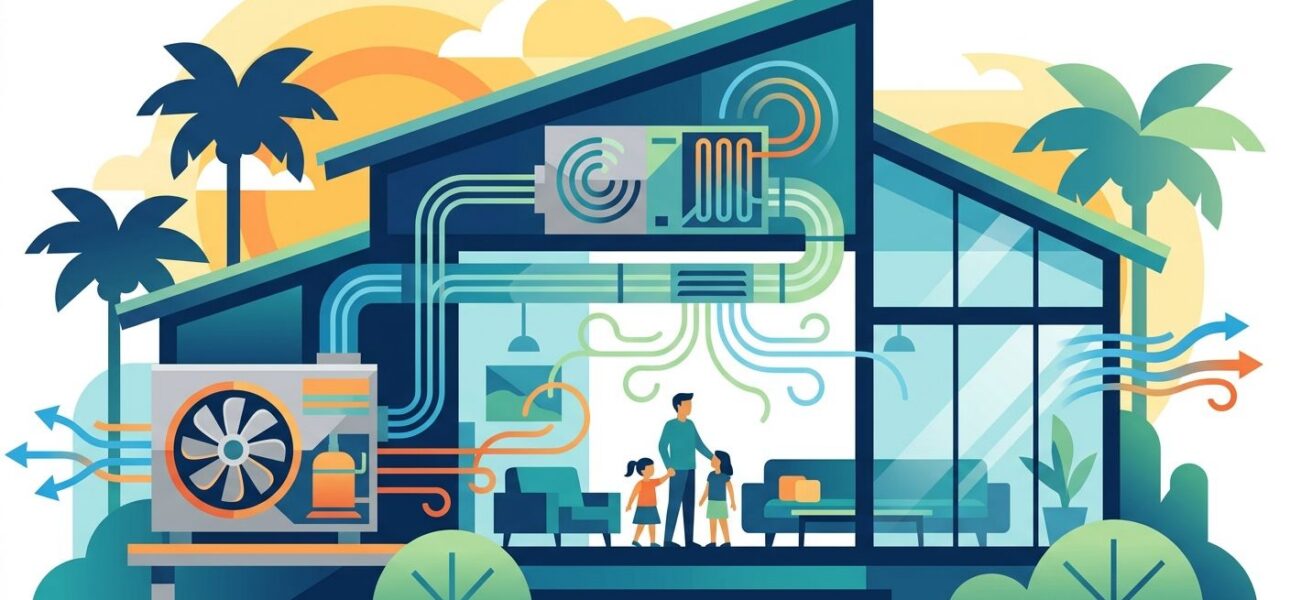
If you're comparing two-stage AC systems for a Florida home in 2026, here's the short version: the Carrier Infinity two-stage series wins for humidity control in Palm Beach County's year-round moisture, the Ruud Ultra series two-stage wins for salt air corrosion resistance near the coast, and the Lennox Merit two-stage series wins for quiet operation near bedrooms and lanais.
- Carrier Infinity two-stage series is the best overall pick for humidity control in South Florida homes in 2026.
- Ruud Ultra series two-stage holds up best against salt air corrosion for homes near the Intracoastal or ocean.
- Lennox Merit two-stage runs quietest, a real factor for homes with bedrooms or lanais near the outdoor unit.
- Two-stage compressors run at 65 to 70 percent capacity most of the time, which is why they dehumidify better than single-stage units.
- Florida’s minimum SEER2 rating has been 14.3 since the 2023 federal standard took effect, and most two-stage systems clear that easily.
Why this matters
South Florida homeowners don't lose sleep over compressor stages. They lose sleep over a system that can't keep up on a 95 degree August afternoon, a bill that jumps for no clear reason, or a contractor who talks fast and quotes faster.
A two-stage AC system solves a real, specific problem: single-stage units run at full blast or not at all, which short-cycles the compressor and leaves humidity in the air even when the temperature reads fine. A two-stage system runs longer at a lower capacity, pulling more moisture out of the air while using less energy to do it. That's the difference between a house that feels cool and a house that feels cool and dry.
Getting this decision wrong means living with sticky air, higher bills, or a system that's already outdated the year you install it. A properly matched AC installation with the right two-stage system fixes all three at once, and it's worth getting the pick right before a technician ever shows up.
What makes the best two-stage AC system for a Florida home
Not every two-stage system performs the same way once it's running in Palm Beach or Martin County humidity. These are the criteria that actually separate a good pick from a disappointing one:
- Low-stage run time – systems that spend more hours at the 65 to 70 percent stage remove more moisture from indoor air
- Coastal corrosion resistance – coil coatings and cabinet materials matter within a few miles of saltwater
- Compatibility with existing ductwork – older homes with undersized returns need a system that doesn't fight the duct system
- Noise level of the outdoor unit – a real concern for narrow side yards and homes with bedrooms near the condenser
- Manufacturer support through an authorized dealer – warranty registration and parts availability depend on who installs it
- SEER2 efficiency – Florida's minimum is 14.3, and two-stage systems typically land well above that floor
Two-stage AC systems at a glance
| System | Best for | Standout feature | Key limitation |
|---|---|---|---|
| Carrier Infinity two-stage | Humidity control | Long low-stage run times pull more moisture out of the air | Full performance depends on a properly sized duct system |
| Ruud Ultra two-stage | Coastal corrosion resistance | Cabinet and coil construction built for salt air exposure | Doesn't solve airflow problems in undersized older ductwork |
| Daikin two-stage ducted | Multi-zone, two-story homes | Ducted two-stage design pairs well with zoning | Best value shows up in larger homes, not small footprints |
| Trane XR two-stage | Older homes with existing ductwork | Straightforward two-stage operation with a long production history | Fewer smart-home integration options than newer platforms |
| Lennox Merit two-stage | Quiet operation | Lower sound output on low stage, useful near bedrooms | Fewer factory options at the two-stage tier compared to variable-speed |
| Rheem Classic Plus two-stage | Upgrading from single-stage | Simple step up in comfort without jumping to full variable-speed cost | Not the top pick if whole-home zoning is the goal |
1. Carrier Infinity two-stage: best for humidity control
The Infinity two-stage series spends most of its run time at the lower capacity stage, which means longer cycles and more moisture pulled out of the air per hour of operation. That matters in a climate where outdoor dew points sit in the 70s for months at a time. As a Carrier Authorized Dealer, A.R. Williams Air Conditioning installs and services this line regularly across Palm Beach County.
Carrier Infinity two-stage pros:
- Strong humidity removal from extended low-stage cycles
- Backed by full manufacturer support through authorized dealers
- Pairs well with variable-speed air handlers for tighter comfort control
Carrier Infinity two-stage cons:
- Performance depends on properly sized return air, which older homes often lack
- Costs more upfront than a basic single-stage replacement
Best for: homes where sticky air, not just heat, is the complaint. Verdict: Buy.
2. Ruud Ultra two-stage: best for salt air corrosion resistance
Homes within a few miles of the Intracoastal or the ocean lose outdoor coils to corrosion years before an inland unit would fail. The Ruud Ultra two-stage line is built with that exposure in mind, and A.R. Williams Air Conditioning holds Ruud Pro Partner status, which keeps parts and warranty support straightforward for coastal customers.
Ruud Ultra two-stage pros:
- Cabinet and coil materials designed for salt air exposure
- Two-stage operation still delivers solid humidity control
- Warranty support is simpler through a certified Ruud Pro Partner
Ruud Ultra two-stage cons:
- Corrosion resistance doesn't fix airflow problems from bad ductwork
- Not the quietest option on this list
Best for: waterfront and canal-front homes, and anything within walking distance of the beach. Verdict: Buy.
3. Daikin two-stage ducted systems: best for multi-zone two-story homes
Daikin's ducted two-stage lineup pairs naturally with zoning equipment, which makes it a strong fit for two-story homes where upstairs bedrooms run hotter than the rest of the house. A.R. Williams Air Conditioning is a Daikin Comfort Pro, which covers installation and ongoing service on this equipment.
Daikin two-stage pros:
- Works well with zoning dampers for room-by-room control
- Two-stage operation still hits solid efficiency numbers
- Backed by Daikin Comfort Pro certification for installation quality
Daikin two-stage cons:
- The value case is weaker in a small single-story footprint
- Zoning adds cost and complexity most single-zone homes don't need
Best for: larger two-story homes with uneven cooling between floors. Verdict: Buy.
4. Trane XR two-stage: best for older homes with existing ductwork
The XR line has been around long enough that most South Florida contractors have installed dozens of them, which matters when a home built before 2010 still has original duct runs and returns. It's a dependable, no-surprises two-stage option rather than a cutting-edge one.
Trane XR two-stage pros:
- Long track record with predictable performance
- Straightforward two-stage operation without extra complexity
- Widely serviced across South Florida
Trane XR two-stage cons:
- Fewer smart thermostat integrations than newer platforms
- Not the strongest humidity performer at this tier
Best for: homeowners replacing an aging system who want reliability over features. Verdict: Hold if your current system still runs; Buy at replacement time.
5. Lennox Merit two-stage: best for quiet operation
A loud outdoor unit is a bigger problem than most homeowners expect, especially on narrow side yards or near a lanai used for morning coffee. The Merit two-stage series runs quieter on its low stage than most competitors in this category, which is the whole reason it makes this list.
Lennox Merit two-stage pros:
- Lower sound output on low stage than most two-stage competitors
- Solid fit for homes with tight side-yard unit placement
- Reasonable efficiency for the noise tradeoff
Lennox Merit two-stage cons:
- Fewer factory options at the two-stage tier than at Lennox's higher lines
- Not the top humidity performer on this list
Best for: homes with bedrooms, home offices, or lanais close to the condenser. Verdict: Buy.
6. Rheem Classic Plus two-stage: best for a straightforward upgrade
Not every homeowner needs the most advanced system on the market. The Classic Plus two-stage line is the practical step up from a failing single-stage unit, and a reasonable one for homeowners who want the humidity and noise benefits of two-stage operation without a full jump to variable-speed pricing.
Rheem Classic Plus two-stage pros:
- Meaningful upgrade over single-stage without the top-tier cost jump
- Simple, well-understood technology
- Available through established South Florida dealer networks
Rheem Classic Plus two-stage cons:
- Not built for the most demanding zoning setups
- Fewer premium features than the Infinity or Ultra lines
Best for: a straightforward, no-frills upgrade from an aging single-stage system. Verdict: Buy.
Not sure which two-stage system fits your home
Talk with a technician about flat-rate options before you decide.
How we ranked these
Each system was weighed against the criteria above: how long it runs on low stage, how it holds up against salt air, whether it plays well with the ductwork already in most South Florida homes, how loud it runs outside a bedroom window, and whether it's backed by manufacturer certification through an authorized dealer. No system wins on every criterion, which is why this reads as a decision by use case rather than a single leaderboard.
Which two-stage AC system should you choose in 2026?
If your biggest complaint is humidity, not just temperature, the Carrier Infinity two-stage series is the safest default pick for 2026. If your home sits near the water, move to the Ruud Ultra series first and don't second-guess it. Two-story homes with uneven room temperatures do better with a Daikin two-stage ducted setup paired with zoning, and homes with bedrooms close to the outdoor unit should lean toward the Lennox Merit line.
For an aging single-stage system that just needs a solid, no-drama replacement, the Trane XR or Rheem Classic Plus two-stage units both get the job done without over-buying. Whichever direction you go, matching the system to your actual ductwork and choosing the right SEER2 rating for your home matters more than the brand name on the cabinet.
FAQ
What is a two-stage AC system?
A two-stage AC system runs its compressor at two capacity levels, typically around 65 to 70 percent for most of the cooling season and 100 percent only during peak heat. This produces longer, gentler cooling cycles that remove more humidity than a single-stage system that only runs full blast or not at all.
Are two-stage AC systems worth it in Florida?
Yes, for most South Florida homes, because the extended low-stage cycles handle the region’s high humidity better than single-stage equipment. The tradeoff is a higher upfront cost than a basic single-stage replacement, which pays off through better comfort and typically lower run times during shoulder-season months.
Do two-stage AC systems help with humidity in South Florida homes?
They help significantly, since the low stage runs longer and pulls more moisture out of indoor air per hour than a single-stage unit cycling on and off quickly. Homes that feel cool but sticky are usually running equipment that short-cycles instead of running steady low-stage cycles.
Which brands make two-stage AC systems?
Carrier, Ruud, Daikin, Trane, Lennox, and Rheem all manufacture two-stage residential AC equipment. Availability and support depend on which brands a local contractor is certified to install and service.
Is a two-stage AC system louder than a variable-speed system?
Generally yes, since variable-speed compressors modulate more precisely and tend to run quieter across their full range. Two-stage systems still run quieter than single-stage units on their low setting, and some lines like the Lennox Merit two-stage are built specifically to minimize outdoor noise.
Does a two-stage AC system need bigger ductwork or returns?
A two-stage system doesn’t require larger ducts than a comparable single-stage unit, but it performs worse if the existing return air is already undersized. Many South Florida homes built before 2010 have returns sized for older equipment, which is worth checking before installation.
Should I choose two-stage or variable-speed for a Florida home?
Two-stage systems offer a meaningful step up in humidity control and noise over single-stage equipment at a lower cost than full variable-speed systems. Variable-speed is the better choice for homes with severe humidity issues or multiple zones, while two-stage covers most standard single-family homes well.
What SEER2 rating do two-stage AC systems have in 2026?
Florida’s minimum SEER2 rating has been 14.3 since the federal standard took effect in 2023, and most two-stage systems sold in 2026 clear that floor without difficulty. Higher-tier two-stage models push into the upper teens, though exact ratings vary by model and air handler pairing.
One last thing
The biggest mistake homeowners make isn't picking the wrong brand, it's pairing a good two-stage condenser with an undersized return or an air handler that can't match its airflow. A two-stage system is only as good as the ductwork feeding it, so ask whoever quotes the job to actually check your returns before you sign anything in 2026.
Related guides
