

No, you generally shouldn't turn off AC completely for the summer in a South Florida home, even when nobody is there. For summer 2026, keep cooling available at a higher thermostat setting and check indoor humidity, because shutting the system down also stops the moisture removal it provides while cooling.
- Don’t turn off AC completely for the summer in humid Florida homes; use a monitored thermostat setback instead.
- A.R. Williams Air Conditioning recommends checking indoor humidity before settling on a summer thermostat schedule.
- The EPA recommends keeping indoor relative humidity below 60%, ideally between 30% and 50%.
- An empty home still needs moisture control; ceiling fans cannot replace air conditioning’s moisture removal.
Should you turn off your AC completely for the summer?
Leave central AC available to run rather than switching it off for the whole season. Raising the temperature setting reduces cooling demand, but the setting still needs to allow enough operation to manage indoor moisture. A house that feels warm is different from a house that stays damp.
The U.S. Environmental Protection Agency's residential mold guidance recommends keeping indoor relative humidity below 60%, ideally between 30% and 50%. Relative humidity describes how close the air is to being saturated with moisture at its current temperature. You can check it with a humidity monitor, also called a hygrometer.
A thermostat temperature alone doesn't tell you whether your home is staying dry. For more detail, see how to reduce indoor humidity without overworking your AC.
| Summer approach | Best for | Main benefit | Main limitation |
|---|---|---|---|
| Higher thermostat setting with cooling enabled | A home with verified humidity control | Reduces cooling demand while keeping AC available | A setting that's too high can leave insufficient moisture removal |
| Normal occupied cooling schedule | A home where people remain throughout summer | Maintains the comfort settings you already use | Cools the home more than an unoccupied schedule requires |
| Cooling coordinated with separate dehumidification | A home with a confirmed moisture-control need | Addresses humidity when cooling demand is low | Requires equipment assessment and coordinated controls |
| Complete seasonal shutdown | A home with a professionally verified alternative climate-control plan | Stops AC operation | Removes the AC's cooling and moisture removal entirely |
Complete shutdown is not the default recommendation for an unattended Florida house. A separate dehumidifier also doesn't automatically make shutdown appropriate, because it removes moisture without replacing the AC's temperature control.
Why this matters in an empty Florida home
An empty house still exchanges air with the outdoors through leaks, doors, and ventilation. Moisture can also come from plumbing leaks or water intrusion. Closing the front door for the season doesn't seal the building against humidity.
Air conditioning removes water when moist indoor air passes over its cold indoor coil. That water collects and drains away. When cooling stops for the summer, that source of moisture removal stops too.
For a seasonal home along the Treasure Coast or in Palm Beach County, the concern isn't simply returning to warm rooms. Persistent dampness can support mold growth and leave closets or furnishings smelling musty. You don't need to keep an empty home at your preferred sleeping temperature, but you do need a working moisture-control plan.
A higher thermostat setting: the starting point
Use a setback, which means a higher temperature setting while you're away, rather than a complete shutdown. There isn't one correct temperature for every house. The right setting depends on how the building and equipment actually perform.
Start with the settings that already keep the home comfortable and dry. Adjust the away setting while you're still there, then check humidity through different weather conditions. Don't make an untested change on departure day and assume the house will stay dry until you return.
If your thermostat reports humidity, compare its reading with a separate monitor. Place the monitor away from direct sunlight, supply vents, and steamy bathrooms. A reading from a sheltered interior location gives you a more useful picture than one beside a cold-air outlet.
For your 2026 thermostat schedule, record the chosen setting and the humidity readings it produces. That gives you something concrete to discuss with a technician if the house becomes clammy.
Separate dehumidification: useful when cooling isn't enough
A whole-home dehumidifier removes moisture independently of a normal cooling call. It can help when a house reaches its temperature setting before the AC has removed enough moisture. That is a reason to assess humidity control, not a reason to assume you need new equipment.
The tradeoff is additional equipment that needs correct installation, drainage, and maintenance. Its controls also need to work with the central AC rather than against it. A technician should first check whether an airflow, drainage, or control problem explains the dampness.
Lowering the thermostat repeatedly isn't a substitute for that diagnosis. You can end up with a colder house that still feels damp, particularly when the underlying problem remains unresolved.
Why the right summer setting varies
Your neighbor's thermostat setting is a starting point for a conversation, not a specification for your house. These factors explain why the same setting produces different results:
- Outdoor moisture: Humid outdoor air that enters the house adds moisture the system must remove.
- Air leakage: Gaps around the building and leaking ductwork change how much outdoor or attic air reaches conditioned rooms.
- Equipment sizing: An oversized AC can satisfy the thermostat quickly and stop before removing enough moisture.
- Airflow: A restricted filter or an undersized return can interfere with normal cooling performance.
- Drainage and controls: A blocked drain or unsuitable thermostat configuration can interrupt operation or undermine moisture control.
- Occupancy: Showers and cooking add moisture, but an empty house still has outdoor moisture exposure.
Coastal salt air adds another maintenance concern because it can corrode outdoor equipment. It doesn't establish the right thermostat setting. Have the equipment's condition checked rather than treating a temperature change as a solution to deteriorating components.
How to prepare your AC before leaving for the summer
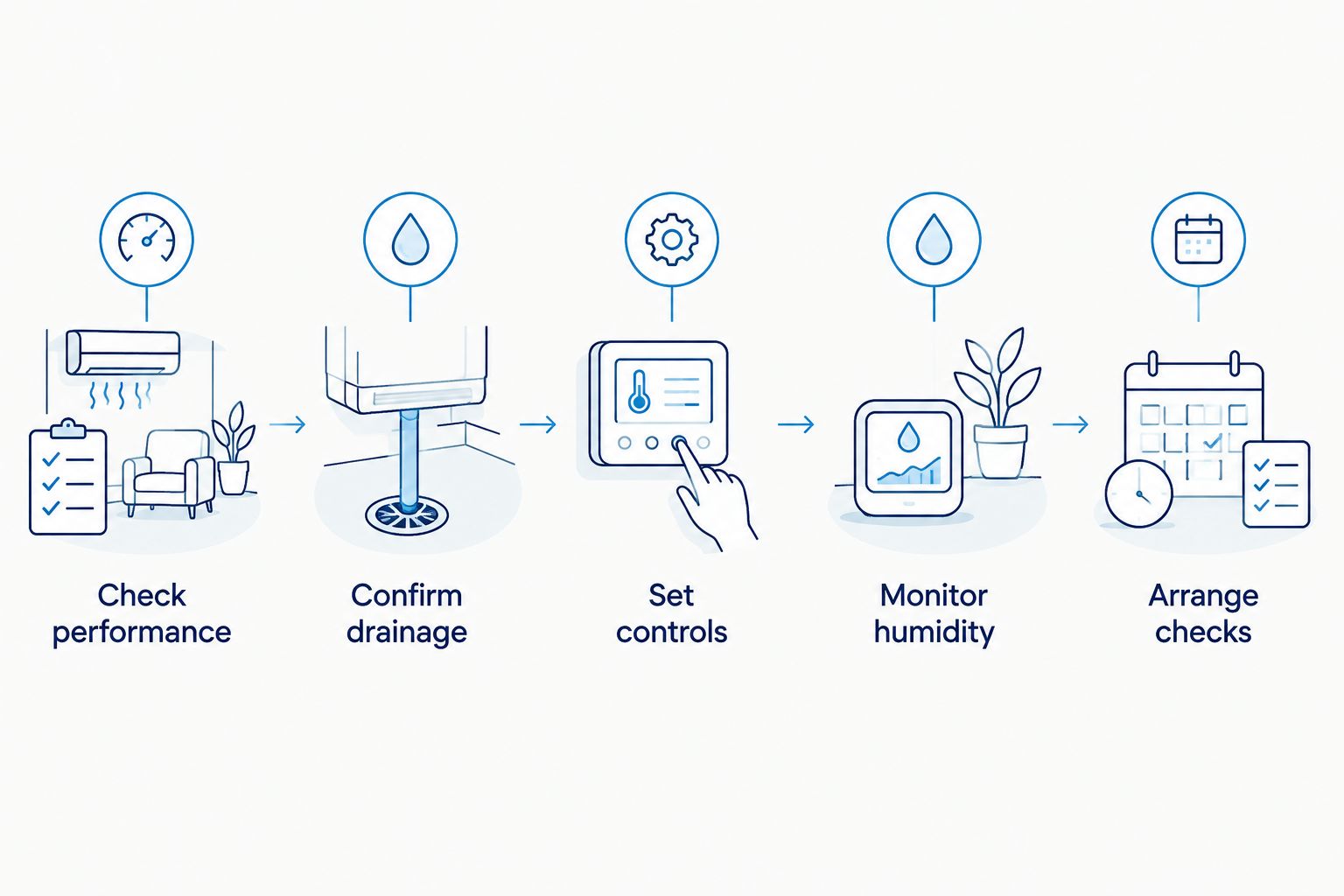
Give yourself time to see whether the system maintains both temperature and humidity. Use this sequence for your 2026 departure plan, especially if the house will be unoccupied for an extended period.
- Check performance. Confirm that the AC reaches its current setting without persistent dampness, unusual noises, or visible water around the indoor equipment. Arrange a diagnosis for existing symptoms before changing the schedule.
- Confirm drainage. Have the condensate drain and any installed overflow protection checked. Condensate is the water your AC removes from indoor air, and it needs a clear route away from the equipment.
- Set controls. Keep cooling enabled, review vacation schedules, and use the fan setting recommended for your system. Check that a departure routine won't accidentally turn cooling off.
- Monitor humidity. Check readings after the schedule changes and during humid weather. Confirm that any remote thermostat connection works before depending on it from another state.
- Arrange checks. Give a trusted person access to inspect the home if readings change or the equipment stops communicating. Agree on what they should check without opening equipment panels.
A connected thermostat adds visibility, but it isn't a complete inspection. It won't necessarily reveal a plumbing leak, a wet closet, or water under an air handler. Physical checks remain useful even when the app shows the expected temperature.
Should the thermostat fan stay on all summer?
For many conventional central AC systems, Auto is the better starting point for humidity control. Auto runs the blower when the system calls for it, rather than circulating air continuously regardless of cooling demand.
Continuous fan operation after a cooling cycle can return some moisture from a wet indoor coil to the air. It also doesn't create cooling by itself. Follow the equipment manufacturer's instructions when your system has specific circulation or humidity-control settings.
Ceiling fans have a different job: they help people feel cooler through air movement. They don't remove water from the air, so leaving them running in empty rooms doesn't replace moisture control.
Does turning the AC off save energy?
Turning the AC off stops the electricity used by that equipment while it remains off. That fact doesn't make a full-summer shutdown a good plan for a humid house. The decision also has to account for indoor conditions and the work required to cool the building again.
Raising the thermostat reduces the temperature difference between indoors and outdoors, which reduces heat entering the home. The practical goal is a higher setting that still keeps humidity controlled. There is no supported universal savings percentage for every Florida home.
Don't assume the opposite claim either, that the AC always uses more energy recovering than it saves during a setback. Recovery depends on the building, weather, equipment, and schedule. Use actual energy records alongside humidity readings instead of relying on that rule of thumb.
When should you switch cooling off instead?
A full-season shutdown and a temporary equipment shutdown are different decisions. If you see ice on the equipment, water overflowing, or repeated breaker trips, stop trying to keep the system running through the problem. Turn cooling off and arrange a professional assessment.
Don't keep resetting a tripped breaker or remove service panels. If there is smoke or a burning smell, stop using the equipment and have the hazard assessed before operation resumes.
Storm preparation also requires a separate plan based on conditions and equipment guidance. It doesn't justify leaving the AC disabled for the rest of a humid summer. After flooding or visible equipment damage, have the system checked before restarting it.
Get a diagnosis before changing equipment
A.R. Williams Air Conditioning is best for South Florida homeowners who want AC maintenance and clearly explained repair options. The company provides residential repair, installation, and maintenance, with flat-rate pricing quoted before work starts.
For a 2026 summer service visit, explain whether the problem is heat, humidity, or both. Useful details include whether the thermostat reaches its setting, where you notice dampness, and whether the system stops after short runs. Those observations help focus the assessment.
A.R. Williams Air Conditioning can explain the findings and lay out the options. An on-site assessment is still necessary to identify an equipment or building problem; no thermostat recommendation can substitute for that check. You don't need to choose replacement equipment simply because an empty home needs a better summer schedule.
Plan your summer AC settings
Discuss humidity concerns and have your system checked before leaving for the season.
FAQ
Can I leave my AC off all summer if nobody is home?
Leaving AC off all summer is generally a poor choice for an unoccupied South Florida home because moisture control is still necessary. Keep cooling available and verify indoor humidity, or have an alternative climate-control plan professionally assessed.
What humidity should I maintain while I’m away?
The EPA recommends indoor relative humidity below 60%, ideally between 30% and 50%. Check the actual reading rather than assuming a thermostat temperature guarantees moisture control.
What temperature should I set my AC to when leaving Florida for the summer?
Use a higher away setting that has been checked against your home’s indoor humidity. There is no single temperature that guarantees suitable conditions in every Florida house.
Will leaving the ceiling fans on prevent mold?
Ceiling fans do not remove moisture, so they are not a mold-prevention substitute for humidity control. They move air and help people feel cooler while occupied rooms are in use.
Should I leave my central AC fan on Auto or On?
Auto is the usual starting point for many conventional central AC systems when humidity control matters. Follow your equipment’s instructions because some systems have specific fan and dehumidification controls.
Does turning the thermostat way down cool the house faster?
On a conventional single-stage system, lowering the thermostat farther does not increase its cooling capacity. Set the temperature you actually want rather than selecting an unusually low setting.
Can a smart thermostat protect an empty house by itself?
A smart thermostat cannot protect an empty house by itself. Remote temperature and humidity readings are useful, but they do not replace equipment maintenance or physical checks for leaks and other problems.
One last thing
A normal temperature reading doesn't prove the whole house is dry. Before leaving, check a closed bedroom or closet as well as the space near the thermostat. Keep supply and return vents unobstructed, and don't close off rooms as a substitute for a properly checked away schedule.
For summer 2026, the most useful preparation is testing that schedule while you're still home. A.R. Williams Air Conditioning can help you understand what the AC is doing before you depend on it through an extended absence.
Related guides
- AC maintenance for snowbirds and seasonal residents
- Can an oversized AC unit raise indoor humidity?
- How to prepare your AC system for Florida's wet season
