
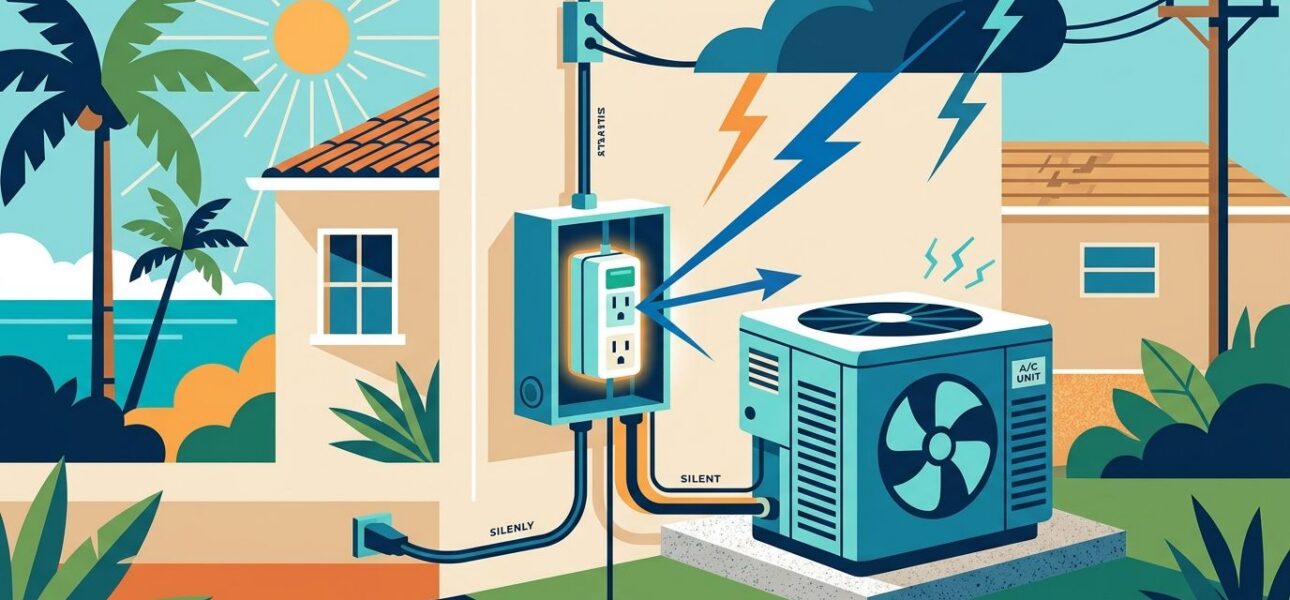
A surge protector for an AC unit is a device that intercepts voltage spikes before they reach the compressor and control board, and in South Florida that job matters more than almost anywhere else in the country. Lightning, brownouts, and grid switching after storms send the kind of power surges that fry a $30,000 system's most expensive parts first.
- A surge protector for an AC unit belongs at the disconnect box, not just a wall outlet, for real protection.
- Whole-house panel protectors stop small spikes; a dedicated AC surge protector handles direct lightning-related hits to the condenser.
- A.R. Williams Air Conditioning sizes surge protection to your system’s amperage instead of installing a generic one-size device.
- Skipping surge protection turns a simple capacitor swap into a full compressor replacement after storm season.
- South Florida’s lightning frequency makes surge protection worth checking before hurricane season 2026, not after a storm knocks out your AC.
Why surge protection matters for South Florida homeowners
Florida sees more lightning strikes than any other state in the country, according to NOAA's National Severe Storms Laboratory, and the stretch from Tampa to West Palm Beach is part of what meteorologists call Lightning Alley. That's not a reason to panic. It's a reason to check what's actually protecting your AC system before a summer storm rolls through.
Homes built before 2010 often still run original electrical panels sized for a smaller cooling load, and those panels rarely came with any surge protection built in. Add in older housing stock with undersized returns and outdated wiring near the coast, and you get a system that's already working harder than it should, with no buffer against a voltage spike. Homes near Boca Raton, Delray Beach, and the Treasure Coast that sit empty for months at a time (common with snowbird owners) are especially exposed, since nobody's home to notice a tripped breaker or a dead thermostat until the AC has already been down for days.
A surge protector for AC systems built for Florida homes is not the same device you'd buy for a power strip. It has to handle outdoor exposure, salt air near the coast, and repeated storm cycles every year without breaking down itself.
Check your panel's surge capacity first
Before adding any surge protection, confirm your electrical panel can actually support it. This step gets skipped constantly, and it's the reason some installs fail within a year.
- Verify your panel's age and amperage rating
- Look for scorch marks or corrosion near breakers, especially in coastal homes
- Confirm the panel can support the added load of a surge device
- Check whether previous storms have already tripped or damaged breakers tied to the AC circuit
Choose the right type of surge protector for your AC
Not every surge protector on the market is built for a condenser's electrical load. Match the device to the job.
- Whole-house panel-mounted protectors, rated for the home's full electrical service
- Dedicated AC disconnect protectors, sized to the condenser's specific amperage
- UL 1449 listing, the certification that confirms the device meets a recognized surge standard
- Corrosion-resistant housing, non-negotiable for homes within a few miles of the coast
Install protection at the outdoor disconnect box, not just indoors
A lot of homeowners assume a plug-in strip on an indoor thermostat counts as protection for the whole system. It doesn't. The condenser outside takes the direct hit first.
- Mount the device at or near the disconnect box beside the outdoor unit
- Protect the outdoor unit with a weatherproof-rated housing, not an indoor-only model
- Confirm the wiring run between the disconnect and the panel is intact and properly sealed
- Check the mounting is secure enough to survive tropical storm winds
Have a licensed technician size and install the device
This is where a professional install earns its place. Undersized surge protection gives you a false sense of security, and an oversized device wastes money without adding real protection.
- Ask what surge rating, measured in kiloamps, the device is built to absorb
- Get flat-rate pricing confirmed before any work starts
- Have the technician check the condenser's existing wiring while they're already there
- Ask whether the install affects your equipment warranty in either direction
Get your AC’s surge protection checked
A technician can size the right device and quote flat-rate pricing on site.
Ground your outdoor condenser correctly
A surge protector without a solid ground is only half a solution. Grounding gives the surge somewhere to go instead of through your compressor.
- Verify the grounding rod depth meets local code
- Check the bonding wire connection annually, especially after any electrical work on the home
- Inspect grounding after roof or panel work, since crews sometimes disturb it without realizing
Plan for storm season power swings
Power doesn't always fail cleanly. Brownouts, partial outages, and the restoration surge when FPL brings a grid section back online all stress a system that isn't protected.
- Turn the AC off before switching to a generator, then restart it a few minutes after
- Wait before restoring full power to the system after an outage, don't just flip the breaker back
- Have the surge protector checked each spring, ahead of hurricane season 2026, not after the first storm hits
- Review how to run your AC during a power outage so you're not guessing mid-storm
Test and maintain the surge protector every year
A surge protector that took a direct hit last year may look fine and still be dead inside.
- Check the indicator light or reset button annually if the device has one
- Replace the unit after any confirmed direct lightning strike, even without visible damage
- Fold the check into your seasonal AC maintenance visit so it's never forgotten
Comparing surge protection options for Florida AC systems
| Option | Best for | Key limitation | Verdict |
|---|---|---|---|
| Whole-house panel surge protector | Homes with multiple electronics plus AC on one circuit | Doesn't stop every direct hit right at the condenser | Buy |
| Dedicated AC disconnect surge protector | Protecting the compressor and control board directly | Needs a solid ground and periodic inspection to stay effective | Buy |
| Plug-in point-of-use surge strip | Indoor thermostats or smart controllers only | Not rated for outdoor condenser electrical loads | Skip for AC use |
| No surge protection | No one running central AC in a lightning-heavy region | Highest risk of a storm frying the compressor or control board | Skip |
A dedicated surge protector at the disconnect box, backed by a whole-house unit at the panel, is the setup that actually protects a South Florida AC system. Either device alone leaves a gap.
Common mistakes South Florida homeowners make
- Buying an indoor plug-in strip and assuming it covers the outdoor condenser too
- Installing surge protection once and never checking it again, even after a confirmed strike nearby
- Skipping the panel capacity check and adding a device to wiring that's already maxed out
- Choosing a housing that isn't rated for coastal salt air, so the protector corrodes before the AC does
- Waiting until after a storm damages the system to look into protection at all
FAQ
What does a surge protector for an AC unit actually protect?
It protects the compressor, control board, and capacitor from voltage spikes caused by lightning, grid switching, and power restoration after an outage. These are the most expensive parts of a central AC system to replace.
Is a whole-house surge protector enough for my AC?
A whole-house protector at the panel catches everyday spikes but often isn’t enough on its own for direct lightning-related hits near the condenser. A dedicated AC surge protector at the disconnect box adds the second layer most Florida homes need.
Can I use a regular power strip surge protector on my outdoor AC unit?
No. Standard indoor plug-in strips aren’t rated for outdoor exposure or the amperage a condenser draws. A dedicated device rated for outdoor AC equipment is required.
How do I know if my AC already has surge protection?
Check the disconnect box near the outdoor unit and the panel for an added device with an indicator light or reset button. If there’s nothing there beyond the standard breaker, the system has no dedicated surge protection.
Does homeowners insurance cover AC damage from a power surge?
Coverage varies by policy and by whether the surge came from a covered event like lightning. Check your specific policy language, since many exclude gradual electrical damage even when they cover a direct lightning strike.
How often should a surge protector be inspected in Florida?
Once a year, ideally in spring before hurricane season builds, and again after any confirmed direct lightning strike nearby even if the unit still appears to work.
Does a surge protector stop AC damage from a lightning strike on the house itself?
A dedicated device reduces damage from a nearby or indirect strike traveling through the electrical system, but a direct strike on the home can still overwhelm any surge protector. Grounding and bonding reduce that risk further, they don’t eliminate it.
One last thing
Most homeowners think of surge protection as a one-time purchase, but a device that absorbed a direct hit last hurricane season can be dead inside while still looking untouched from the outside. Have it checked every spring, before hurricane season 2026 builds, not after the first storm knocks something out. That single habit catches more failed protectors than any warranty claim does.
Related guides
