

Yes, a variable-speed AC system is worth considering when you want steadier temperatures and better humidity control, especially during South Florida's long cooling season. The added investment makes sense only when the system is correctly sized, the ductwork supports it, and the installation includes compatible controls; lower electric bills alone do not establish that it will pay for itself.
- Is a variable speed AC system worth it? Yes for steadier comfort and humidity control, not guaranteed financial payback.
- Variable-speed central AC adjusts cooling output; a variable-speed blower alone does not establish compressor capability.
- Correct sizing and ductwork matter more than choosing the highest efficiency rating.
- A.R. Williams Air Conditioning offers residential AC installation with options explained before work starts.
Is a variable-speed AC system worth the cost?
Variable-speed AC is a strong choice for homeowners who value consistent comfort and need better moisture control. It is less compelling when your current system already keeps rooms comfortable and your only goal is a guaranteed reduction in electricity spending.
For a 2026 replacement, compare the complete installation rather than the equipment label. Start with how to choose the right AC size for your home. Even advanced equipment cannot correct every problem caused by the wrong capacity or restricted airflow.
| Central AC option | How it cools | Best for | Main advantage | Main limitation |
|---|---|---|---|---|
| Single-stage | Runs at 1 cooling stage when the compressor is on | Homes whose comfort needs are met by properly sized basic equipment | Simpler cooling operation | Less ability to match lighter cooling demand |
| Two-stage | Uses 2 cooling stages, typically low and high | Homeowners who want more control than single-stage operation | Lower-stage operation during lighter demand | Less output flexibility than variable-speed equipment |
| Variable-speed | Adjusts compressor output across a model-specific operating range | Homeowners prioritizing steady temperatures and humidity control | Closer matching of cooling output to the home's needs | More complex equipment and controls to evaluate and maintain |
The difference is how closely the system can match the cooling your house needs at a particular moment. Your home does not need the same output on a cloudy morning as it does during a hot afternoon.
Why this matters in a humid home
An AC removes moisture when water vapor condenses on its cold indoor coil. The water then drains away. Temperature and moisture removal are related, but reaching the thermostat setting does not prove that the house is comfortably dry.
A system that cools the house quickly and shuts off can leave a lingering clammy feeling. Properly configured variable-speed equipment can operate longer at lower output during lighter cooling demand, which helps it manage moisture without repeated full-output cooling cycles.
The U.S. Environmental Protection Agency recommends keeping indoor relative humidity below 60%, ideally between 30% and 50%. Those are general moisture-control guidelines, not a guarantee that any particular AC will maintain that range throughout your home.
For your 2026 decision, record both temperature and relative humidity. If your house feels damp even when it is cool, review ways to reduce indoor humidity without overworking your AC before assuming a replacement is the only answer.
Single-stage AC: simpler cooling operation
A single-stage central AC turns its compressor on at its available cooling output, then turns it off when the thermostat is satisfied. Correct sizing helps the system run appropriate cycles instead of repeatedly starting and stopping.
Best for: homeowners whose rooms stay comfortable with properly sized, straightforward equipment. A single-stage system remains a valid choice when the house has sound ductwork and moisture control is satisfactory.
Its limitation is flexibility. During lighter demand, it cannot reduce compressor output the way variable-speed equipment does. That makes correct sizing particularly important, because excess capacity can shorten cooling cycles.
Do not reject a single-stage proposal just because another proposal has a more advanced compressor. Ask whether each installation addresses the conditions in your house, including return airflow and room-to-room temperature differences.
Two-stage AC: a middle level of control
A two-stage system has 2 cooling stages. It can use its lower stage when demand is lighter and its higher stage when the home needs more cooling.
Best for: homeowners who want more gradual cooling than single-stage equipment without requiring the widest output range. Lower-stage operation can support longer cycles and more consistent comfort when the system is correctly selected and configured.
The limitation is that two operating stages still offer fewer adjustments than a variable-speed compressor. Performance also depends on how the thermostat calls for each stage and how the indoor blower is set up.
Compare the actual equipment combination. A two-stage outdoor unit connected to unsuitable controls will not deliver the operation you expected from the proposal.
Variable-speed AC: stronger comfort control
A variable-speed compressor adjusts its output within the equipment's operating range. It can reduce cooling output as demand falls rather than treating every cooling call as a full-output job.
Best for: homeowners who notice temperature swings, uncomfortable moisture, or disruptive changes in cooling operation. Matching output more closely to demand can make the house feel more consistent.
The limitation is complexity. These systems use electronic controls, and replacement components and diagnostic procedures differ from simpler equipment. Ask about the specific model's service requirements instead of assuming every variable-speed system has the same ownership experience.
Variable-speed operation is also not proof of quietness. Compare published sound information for the proposed models, and consider outdoor-unit placement, duct noise, and airflow. A low-output compressor cannot silence a restrictive return grille.
Why the value varies from house to house
The useful question is whether the additional capability solves a problem you actually have. A homeowner bothered by damp rooms has a different reason to upgrade than someone whose current system already maintains comfortable conditions.
These factors shape the decision:
- Existing comfort: Persistent humidity or temperature swings give you a specific result to request and verify.
- House condition: Duct leakage, restricted returns, and attic heat affect the performance of any central AC.
- Equipment match: The outdoor unit, indoor equipment, and controls must work together as intended.
- Cooling use: Your thermostat settings and time spent at home affect operating demand and the value of steadier comfort.
- Ownership priorities: A long-term comfort upgrade deserves a different evaluation from a replacement chosen only for projected electricity savings.
For a 2026 estimate, ask the contractor to connect the recommendation to findings in your home. A description of compressor technology is not a substitute for an explanation of why your house needs it.
What should you check before choosing variable-speed AC?
Check the house first, then select the equipment. This keeps you from paying for additional capability while leaving the original comfort problem in place.
- Comfort symptoms: Describe which rooms feel warm or damp, whether the problem changes with the weather, and when you notice it. Bring humidity readings if you have them.
- Load calculation: Request a calculation of the home's cooling needs. Floor area alone does not account for windows, insulation, air leakage, or sun exposure.
- Duct assessment: Ask about supply ducts, return pathways, leakage, and airflow restrictions. Older homes with undersized returns need those restrictions addressed, not simply a stronger system.
- Equipment match: Confirm the proposed outdoor unit, indoor coil or air handler, and thermostat are compatible. Ask specifically whether the compressor is variable-speed.
- Setup verification: Ask what the installer will measure and document after installation, including airflow, refrigerant setup, drainage, and control operation.
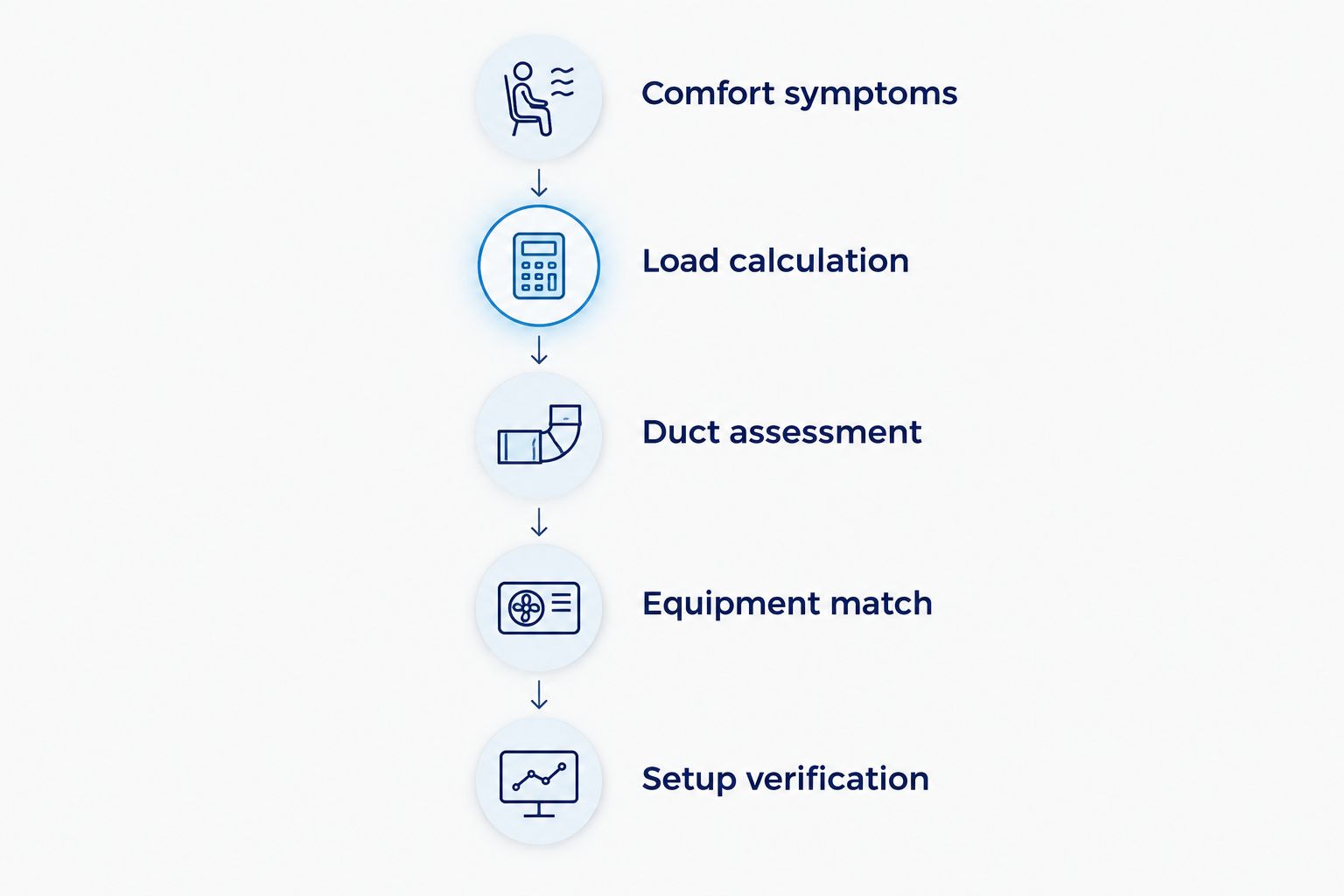
A load calculation estimates the cooling the house needs. An airflow assessment checks whether the duct system can move the required air. You need both answers because equipment capacity and air delivery are different problems.
In your 2026 proposal, separate necessary corrective work from optional equipment upgrades. That gives you a clear explanation of what fixes the house and what adds comfort features.
Will variable-speed AC pay for itself through energy savings?
A variable-speed AC does not have a universal payback period. Your result depends on the installed system's efficiency, the equipment it replaces, local electricity rates, and how you operate the house.
SEER2 is a standardized measure of seasonal cooling efficiency. A higher rating indicates better efficiency under the rating procedure, but it is not a prediction of your household's electricity bill.
Ask for a comparison that uses your actual electricity rate and reasonable cooling-use assumptions. The contractor should identify those assumptions and distinguish projected savings from guaranteed outcomes.
Treat financial payback and comfort value as separate decisions. You can reasonably choose an upgrade for quieter operation or more consistent comfort without claiming that electricity savings will recover the investment.
Avoid comparing whole utility bills without context. Water heating, appliances, electric vehicle charging, and changes in occupancy can obscure the AC's contribution. Weather also changes cooling demand between billing periods.
What changes for coastal and seasonal homes?
Near the coast, salt air can corrode outdoor coils and other exposed components. Variable-speed operation does not prevent that damage. Equipment location and manufacturer-approved maintenance still matter.
Ask how the proposed outdoor unit will be positioned and serviced. Do not assume that a particular compressor design makes every model suitable for the same coastal exposure.
Seasonal homes need a different conversation. When a house sits empty for extended periods, raising the thermostat substantially reduces cooling calls and can reduce moisture removal. An efficient system still needs settings suited to the house's humidity conditions.
For a seasonal home's 2026 replacement, discuss humidity monitoring and controls before selecting equipment. If moisture remains a problem when cooling demand is low, ask whether separate dehumidification is needed rather than expecting the compressor alone to manage every condition.
Is a variable-speed blower the same as a variable-speed AC?
A variable-speed blower is not the same as a variable-speed compressor. The blower moves air through your ducts; the compressor controls the refrigeration process that provides cooling.
A proposal can include a variable-speed indoor blower with an outdoor compressor that does not vary its output. That combination has its own capabilities, but it is not equivalent to variable-speed compressor operation.
Ask the contractor to identify both components in plain language. The written proposal should make clear what changes speed and which controls are required.
Will variable-speed AC fix a hot upstairs bedroom?
Variable-speed AC does not automatically fix a hot upstairs bedroom. Restricted airflow, duct leakage, attic heat, or an inadequate return pathway can leave that room uncomfortable with any compressor type.
Ask for room-level findings before choosing larger equipment. Increasing capacity without correcting air delivery can cool the rest of the house too quickly while the problem bedroom remains warm.
Should you replace a working AC just to get variable speed?
A working AC does not need replacement solely because variable-speed equipment exists. Start with the system's condition and the comfort problem you want to solve.
Maintenance, duct corrections, or control changes deserve evaluation before a full replacement. If replacement is already justified, that is the right point to compare compressor options and the complete installation scope.
What should a clear proposal include?
You should be able to understand the recommended system without learning HVAC terminology. Request model identification, the sizing basis, included duct corrections, required controls, and the installation work in writing.
Also ask what the proposal excludes. Electrical changes, duct repairs, permits, and drainage work should not remain vague simply because the equipment description is detailed.
A.R. Williams Air Conditioning is a fit for South Florida homeowners who want residential AC installation options explained before work starts. Technicians explain their findings, and flat-rate pricing is quoted before work begins.
That approach helps you compare the proposed solution with the problem in your house. It does not replace model-specific documentation: ask about the selected equipment's maintenance requirements and warranty terms before deciding.
A.R. Williams Air Conditioning provides AC repair, installation, and maintenance. If you are unsure whether replacement is justified, talk with a technician about the current system before choosing an upgrade.
Discuss your replacement options
Ask which system fits your home’s cooling needs and comfort concerns.
FAQ
Is a variable speed AC system worth it in a humid climate?
Yes, variable-speed AC is worth considering when you want steadier temperatures and better humidity control. Correct sizing, airflow, and control setup determine whether it delivers those benefits in your home.
Does variable-speed AC run all the time?
Variable-speed AC can run for longer periods at lower output, but it does not necessarily run continuously. Runtime depends on weather, thermostat settings, the home’s cooling needs, and the equipment’s operating range.
Is two-stage AC better than variable-speed AC?
Two-stage AC is not automatically better than variable-speed AC. It offers 2 cooling stages, while variable-speed equipment adjusts output across a model-specific range; choose based on your home’s comfort needs and installation requirements.
Will variable-speed AC guarantee lower electric bills?
Variable-speed AC does not guarantee lower electric bills. Compare the complete system’s efficiency with your existing equipment, and account for electricity rates, weather, thermostat settings, and household use.
Can I keep my thermostat with a new variable-speed system?
You can keep your thermostat only if it supports the proposed system’s required controls and functions. Some systems require specific compatible controls to deliver their intended operation.
Does variable-speed AC remove the need for a dehumidifier?
Variable-speed AC does not always remove the need for separate dehumidification. A house can need moisture removal when there is little demand for cooling, especially during extended periods without occupants.
What should I ask before agreeing to a variable-speed AC installation?
Ask for the cooling-load calculation, duct assessment, matched equipment details, and required controls. Also request a clear explanation of corrective work and how installation performance will be checked.
One last thing
A lower thermostat setting is not proof of better humidity control. If you keep making the house colder to feel comfortable, record the humidity alongside the temperature and describe that pattern to the technician.
A.R. Williams Air Conditioning can discuss repair and replacement options for your central AC. Ask what is causing the discomfort first. The right recommendation should explain how the proposed work addresses that cause.
Related guides
- Variable-speed AC systems for South Florida humidity control
- How to choose the right SEER2 rating for your Florida home
- How to read your AC installation contract before signing
