

Yes, an oversized AC unit can leave indoor humidity too high because it cools your home quickly and shuts off before removing enough moisture. That does not mean the AC creates water vapor, and short cycles alone do not prove the system is oversized. Before replacing equipment in 2026, have a technician check sizing, airflow, controls, and sources of incoming moisture.
- Can an oversized AC unit raise indoor humidity? Yes. Short cooling cycles can leave your home cool but clammy.
- Confirm oversizing with a home cooling-load calculation, not square footage or short cycles alone.
- A.R. Williams Air Conditioning offers AC diagnosis for homeowners who want findings explained before choosing a repair or replacement.
- Check airflow, fan settings, and moisture sources before deciding that a larger equipment problem requires replacement.
Can an oversized AC unit raise indoor humidity?
An oversized AC can satisfy the thermostat before it satisfies your home's moisture-removal needs. The thermostat usually responds to temperature, so a comfortable temperature reading does not necessarily mean comfortable humidity.
Your indoor coil removes moisture when water vapor condenses on its cold surface. That water collects in a drain pan and leaves through a drain line. Effective moisture removal depends on operating conditions and enough cooling time, not simply a large cooling capacity.
A home AC sizing review should account for the building itself. Windows, insulation, air leakage, and duct conditions all affect the capacity your home needs.
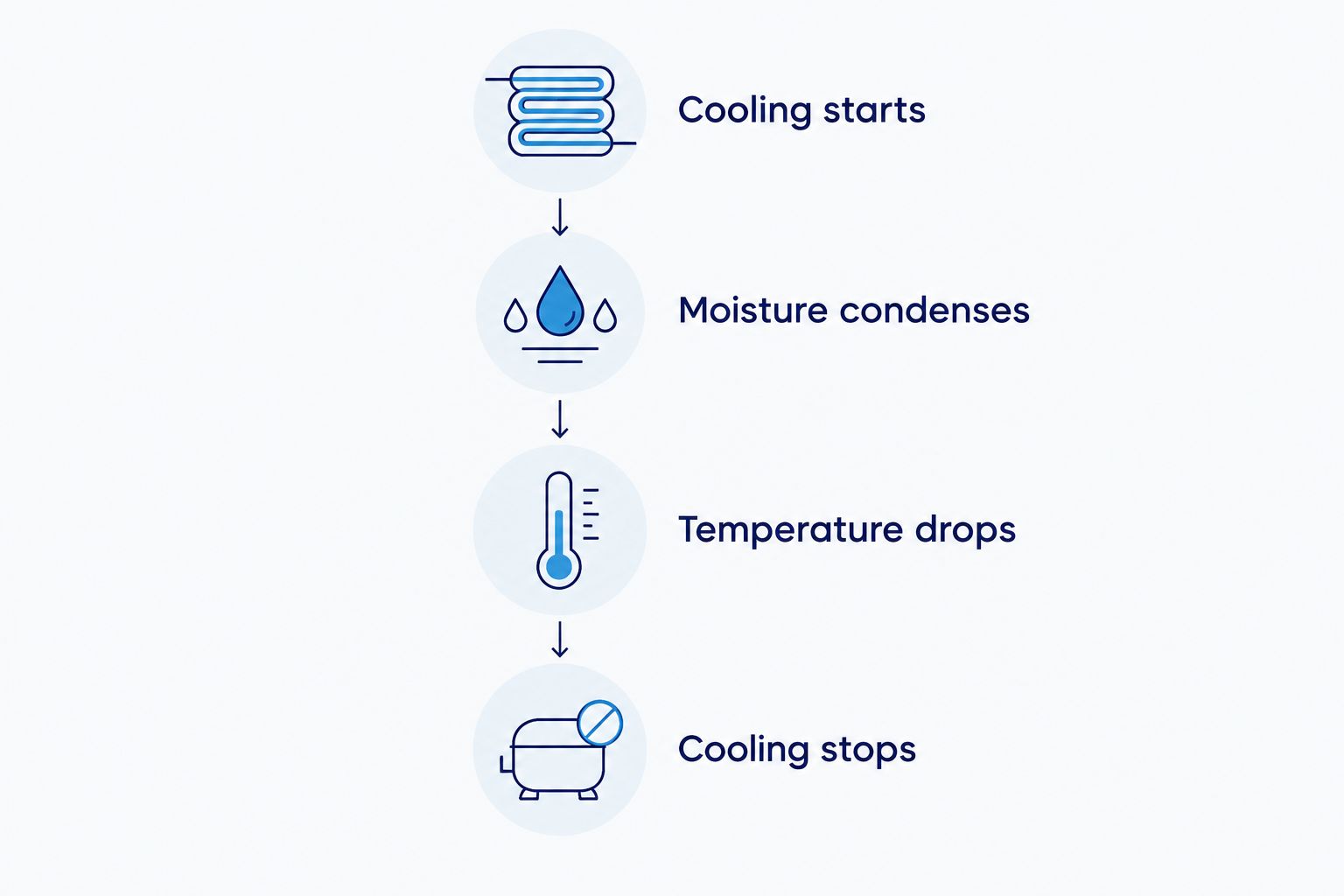
Here is the sequence that explains the cool-but-clammy feeling:
- Cooling starts. The compressor operates, and the indoor coil gets cold.
- Moisture condenses. Water vapor becomes liquid on the coil and drains away.
- Temperature drops. An oversized system reaches the thermostat setting quickly.
- Cooling stops. Moisture removal stops even though the house still feels damp.
The problem becomes more noticeable when the home needs little temperature reduction but still receives moisture from outdoors. A humid, cloudy day can expose that mismatch more clearly than a very hot afternoon.
Why this matters in a humid climate
A room can feel chilly and sticky at the same time. Lowering the thermostat further can make you colder without addressing why moisture remains in the air.
For your 2026 home comfort checks, the U.S. Environmental Protection Agency recommends indoor relative humidity below 60%, ideally between 30% and 50%. Relative humidity describes how close the air is to saturation at its current temperature. Use those levels as moisture-control guidance, not proof of a particular equipment fault.
Persistent dampness deserves a diagnosis, not an automatic replacement recommendation. Moisture can affect finishes and belongings, and ongoing damp conditions support mold growth. A musty smell also needs investigation rather than an assumption that equipment size explains it.
South Florida homes face several moisture sources. Outdoor air can enter through door gaps or leaky ductwork, while showers and cooking add moisture indoors. In a seasonal home, changing occupancy also changes the cooling and moisture loads.
What signs point toward an oversized AC?
Oversizing becomes a stronger possibility when your AC reaches the temperature setting quickly, shuts off repeatedly, and leaves humidity elevated across the home. Those observations help a technician decide what to measure. They are not a sizing calculation.
Record what happens during ordinary use:
- Does the house feel clammy even when the thermostat reaches its setting?
- Does humidity stay elevated outside the bathroom and kitchen?
- Did the problem start after an equipment replacement?
- Did new windows, insulation, or air sealing reduce the home's cooling needs?
- Does the system stop because the thermostat is satisfied, or because something interrupts operation?
That last distinction matters. A control fault or equipment protection device can also interrupt cooling. A technician should determine why the compressor stops before describing the pattern as an oversizing problem.
If repeated starts and stops are your main symptom, this guide to an AC that keeps turning on and off explains why the cause needs checking.
Measure humidity away from obvious moisture sources
Use a household humidity meter in an occupied room, away from a supply vent, direct sunlight, or a steamy bathroom. Record the room temperature alongside humidity, since relative humidity changes with temperature.
For a useful 2026 service record, note the weather, thermostat setting, fan setting, and whether cooling was operating when you took each reading. A pattern gives your technician more useful information than a single reading immediately after a shower.
Why humidity varies even with the same AC
Equipment capacity is only part of the moisture-control picture. These factors explain why similar systems can behave differently:
- Cooling demand: On milder days, the thermostat calls for less cooling even when outdoor air remains humid.
- Air leakage: Gaps in the building and leaking return ducts can bring moist air into the system or living space.
- Blower operation: Continuous fan operation can return moisture from a wet coil to the air after the compressor stops.
- Airflow and coil condition: Incorrect airflow or a dirty coil changes how the system transfers heat and removes moisture.
- Indoor moisture: Showers, cooking, and poorly managed ventilation can add moisture faster than cooling removes it.
- Equipment controls: Staging, thermostat setup, and compatible humidity controls affect how the system operates at a lighter load.
Older homes with restricted return-air paths need particular attention. A return is the opening and duct that carry room air back to the equipment. Poor return airflow can interfere with operation, but installing a smaller unit without checking the ducts does not resolve that uncertainty.
What should a technician check before recommending replacement?
Ask for measured findings that connect the symptom to the recommendation. A complete diagnosis should separate an oversized system from an otherwise suitable system with an airflow, control, or moisture-entry problem.
Confirm the operating problem
The technician should check room temperature and humidity, thermostat operation, and the reason cooling stops. The inspection should also cover the indoor coil, drainage, filter, and blower operation.
Refrigerant problems require professional testing. Refrigerant is not something you should add because the house feels damp, and refrigerant charge does not establish whether equipment capacity suits the building.
Check ducts and moisture entry
Ask whether return ducts draw air from an attic or another unconditioned space. Supply duct leakage also deserves attention because it can affect air balance and comfort.
The technician should distinguish moisture in the living space from condensation on a cold surface. Water around a poorly insulated duct or air handler is a different finding from elevated humidity throughout the house, though both can occur together.
Review the home's cooling load
A residential cooling-load calculation, commonly called Manual J, estimates the home's cooling needs from building details. It should reflect the home as it exists today, including improvements made since the current AC was installed.
For a 2026 replacement proposal, ask the contractor to explain both temperature reduction and moisture removal. Copying the existing unit's capacity does not establish that the old size was correct. Choosing capacity from floor area alone leaves important building differences out of the decision.
Which solution fits the finding?
There is no single humidity fix for every cool-but-clammy home. The right recommendation follows the cause, and each option has limits.
| Option | Best for | Benefit | Limitation |
|---|---|---|---|
| Repair or control correction | A suitable system with a confirmed operating fault | Addresses the fault without replacing functioning equipment | Does not correct genuinely excessive capacity |
| Duct sealing or airflow correction | Confirmed leakage or airflow problems | Addresses unwanted air entry or poor air delivery | Does not guarantee that equipment sizing is correct |
| Properly sized replacement | Confirmed capacity mismatch | Matches cooling capacity to the home's calculated needs | Requires equipment replacement and installation work |
| Whole-home dehumidification | Moisture remains high when cooling demand is low | Removes moisture without depending on a temperature call | Adds equipment, maintenance, and energy use |
A whole-home dehumidifier is not a substitute for correcting a leak, drainage defect, or installation problem. It becomes relevant when the home still needs moisture removal after those conditions are addressed.
Likewise, replacement should solve a documented mismatch. You should understand why repairs or control changes will not provide the needed result before choosing new equipment.
Will a variable-speed central AC solve the problem?
A variable-speed central AC can adjust cooling output rather than operating only at full capacity. When correctly selected and configured, that flexibility supports longer operation at lower output and better moisture control under suitable conditions.
It still needs proper sizing. A system whose minimum output exceeds the home's needs can continue to cycle, and duct leakage or poor setup can undermine its performance.
For a 2026 equipment comparison, ask how the proposed system handles lighter cooling loads and how its humidity controls work with the indoor equipment. An efficiency rating alone does not answer those questions.
The benefit is more flexible operation. The limitation is that added control capability depends on correct equipment matching, installation, and setup. No feature label replaces those requirements.
Should you leave the thermostat fan on auto?
For a conventional central AC with moisture-control concerns, the auto fan setting generally helps avoid continuous airflow across a wet coil after cooling stops. Continuous fan operation can evaporate some retained water back into the air.
Check your system's instructions before changing specialized fan or ventilation settings. Some systems use programmed fan behavior that serves a specific purpose.
This setting is a useful discussion point, not a sizing test. If humidity remains high, the next step is a diagnosis rather than repeated thermostat adjustments.
How can you make the decision without pressure?
A.R. Williams Air Conditioning is best for homeowners who want AC findings explained before choosing repair or replacement. The company provides residential AC repair, installation, and maintenance, with technicians who explain what they found and lay out the options.
Ask for a clear distinction between a confirmed fault and a proposed comfort improvement. If replacement is recommended, ask what establishes the sizing problem and how the proposed equipment addresses it.
A.R. Williams Air Conditioning quotes flat-rate pricing before work starts. That gives you a defined scope to review before authorizing the work. An inspection still comes first because damp rooms alone do not identify the correct repair.
You can talk with a technician about getting your system checked without deciding on replacement in advance.
FAQ
Can an oversized AC make my house cold but humid?
Yes, an oversized AC can cool your house to the thermostat setting before removing enough moisture. The result can be a cold, clammy home, but airflow faults and incoming moisture can cause similar symptoms.
What indoor humidity should I aim for?
The U.S. Environmental Protection Agency recommends indoor relative humidity below 60%, ideally between 30% and 50%. Persistent readings outside that guidance deserve attention, but a humidity reading alone does not identify the cause.
Does short cycling always mean my AC is too big?
No, short cycling does not always mean your AC is oversized. Thermostat faults, airflow problems, and equipment protection controls can also interrupt operation, so the technician needs to identify why cooling stops.
Will lowering my thermostat fix high humidity?
Lowering the thermostat does not reliably fix high humidity. Extra cooling can remove more moisture under some conditions, but it can also make the home uncomfortably cold without correcting the underlying problem.
Can a variable-speed AC still be oversized?
Yes, a variable-speed AC can still be oversized if its operating range does not suit the home’s load. Proper sizing, airflow, and control setup remain necessary for moisture control.
Do I need a dehumidifier or a smaller AC?
You need a diagnosis before choosing between a dehumidifier and a smaller AC. A cooling-load calculation checks capacity, while operating measurements and a moisture inspection help establish whether separate dehumidification is appropriate.
Should I replace an AC that cools well but leaves the house damp?
Do not replace an AC based on dampness alone. Have the contractor check humidity, airflow, controls, ducts, and sizing, then explain which findings support repair or replacement.
One last thing
A colder temperature can produce a higher relative humidity reading even when the amount of water vapor has not increased. That is why a humidity reading without its room temperature can be misleading.
Bring paired temperature and humidity readings to your conversation with A.R. Williams Air Conditioning. The useful question is not just whether your AC is too big, but what measurements explain the dampness.
Related guides
- How to reduce indoor humidity without overworking your AC
- Variable-speed AC systems for humidity control
- How to get a second opinion on an AC replacement quote
