

AC for new residents relocating to Florida is a home-comfort plan that combines cooling, moisture control, and maintenance to keep your new home comfortable and protect it from excess humidity. This 2026 guide explains how to assess the system you inherit before deciding what to change. In Florida, a house that reaches the thermostat setting can still feel damp, and an unfamiliar maintenance history deserves attention before you settle in.
- AC for new residents relocating to Florida starts with checking the existing system, not choosing a replacement brand.
- A.R. Williams Air Conditioning suits South Florida homeowners who want AC service with explained options and upfront quotes.
- Measure indoor humidity alongside temperature; a cool house can still have a moisture problem.
- Require a home-specific sizing calculation before approving a central AC replacement.
Why AC matters for new Florida residents
Your Florida AC does two jobs: it lowers the indoor temperature and removes moisture as water collects on its cold indoor coil. That water must drain safely away. Poor airflow, a blocked drain, or unsuitable equipment can interfere with comfort even when the system still runs.
The U.S. Environmental Protection Agency's homeowner mold guidance recommends keeping indoor relative humidity below 60%, ideally between 30% and 50%. These are useful reference points for your 2026 move-in assessment, not a promise that a thermostat setting alone will achieve them. Relative humidity describes how much moisture the air holds compared with what it can hold at that temperature.
Local conditions add practical concerns. Salt air near the coast contributes to outdoor coil corrosion. Older homes can have restricted return airflow, and a house left empty between seasonal visits needs a moisture-control plan. Start with how to reduce indoor humidity without overworking your AC if the rooms feel cool but clammy.
You do not need to replace a working AC simply because you moved to Florida. You need to establish its condition, understand its controls, and identify any problems the previous owner left unresolved.
Build your move-in AC plan
Collect the system's records
Begin with the seller's documents and a visual check you can make without opening equipment. Find the indoor air handler, which moves air through your ducts, and the outdoor unit. Photograph their model and serial-number labels so you can identify the equipment accurately when arranging service.
Ask for installation paperwork, maintenance records, and descriptions of previous repairs. A seller saying the AC was "serviced" does not tell you whether someone cleaned a coil, cleared a drain, or addressed a refrigerant leak. Keep the actual invoices where you can find them.
Create a 2026 baseline for the home rather than guessing from the equipment's appearance. A clean cabinet does not establish the condition of the components inside, and a missing record is a reason to inspect, not an automatic reason to replace.
- Save photographs of both equipment labels.
- Collect installation, permit, and repair documents.
- Locate the filter and note its printed size.
- Ask about recurring water leaks or uneven cooling.
Check comfort before changing settings
Use the thermostat and observe how the house behaves during normal occupancy. Note which rooms feel warm, whether doors change the airflow, and whether the air feels damp. Keep return grilles clear of moving boxes and furniture. These are the openings through which room air returns to the AC.
A separate humidity meter helps distinguish temperature discomfort from excess moisture. Place it away from supply vents, direct sunlight, and steamy bathrooms so its reading reflects the room rather than a nearby source.
For normal cooling, use the thermostat's automatic fan setting unless your technician recommends a different setup. Continuous fan operation can re-evaporate moisture from a wet indoor coil between cooling cycles. Lowering the temperature repeatedly does not diagnose that problem.
- Record temperature and humidity together.
- Note rooms that feel different from the rest.
- Check that return grilles remain unobstructed.
- Learn what the thermostat's fan setting controls.
Arrange a professional condition check
Your observations give a technician a useful starting point. They do not replace measurements of airflow, electrical operation, or refrigerant performance. A home inspection report is useful background, but ask what its AC assessment actually covered rather than assuming it included a detailed HVAC diagnosis.
A.R. Williams Air Conditioning provides residential AC repair, installation, and maintenance across South Florida and the Treasure Coast. Its technicians explain their findings and lay out the options, with flat-rate quotes before work starts.
A.R. Williams Air Conditioning is best for new South Florida homeowners who want AC service with explained options and upfront quotes. It is a regional service choice, not a statewide recommendation. If your new home is elsewhere in Florida, use the same inspection criteria with a contractor serving that location.
- Ask for findings about airflow and coil condition.
- Have the drain and overflow protection checked.
- Request an explanation of any abnormal measurements.
- Separate necessary repairs from optional improvements.
Establish a maintenance routine
Start with the equipment manufacturer's instructions and the filter requirements for your system. Check the filter's condition rather than assuming the previous owner's replacement schedule fits your household. Moving dust, pets, and nearby construction can change how quickly a filter collects debris.
Choose a filter the system can accommodate. A more restrictive filter is not automatically a better choice because reduced airflow can affect cooling. Ask a technician before changing to a substantially different filter type.
Outside, keep vegetation and stored items from obstructing the unit. Follow the manufacturer's clearance requirements rather than applying a generic distance. For coastal properties, discuss salt exposure and appropriate coil care. Do not pressure-wash the coil or apply a cleaner without knowing whether it is suitable.
- Follow the equipment's filter instructions.
- Keep indoor and outdoor access areas clear.
- Include drain inspection in professional maintenance.
- Discuss coastal exposure and construction dust.
Require proper sizing before replacement
If replacement becomes necessary, ask for a home-specific cooling-load calculation. This estimates how much cooling your home needs from its construction, windows, insulation, orientation, and other conditions. The old unit's size and the home's floor area alone are not enough.
Cooling capacity is commonly described in tons. One ton of cooling equals 12,000 BTU per hour, a standard capacity conversion used by the U.S. Department of Energy. A larger capacity does not automatically mean better comfort. Oversized equipment can satisfy the thermostat quickly without providing enough moisture removal.
Read how to choose the right AC size for your home before comparing proposals. The ductwork also needs assessment, especially if the house has enclosed a lanai, added living space, or changed its layout.
- Request a cooling-load calculation for the current home.
- Ask whether supply and return ducts suit the proposed equipment.
- Identify additions that changed the cooling demand.
- Require an explanation for any capacity increase.
Compare solutions by the problem they solve
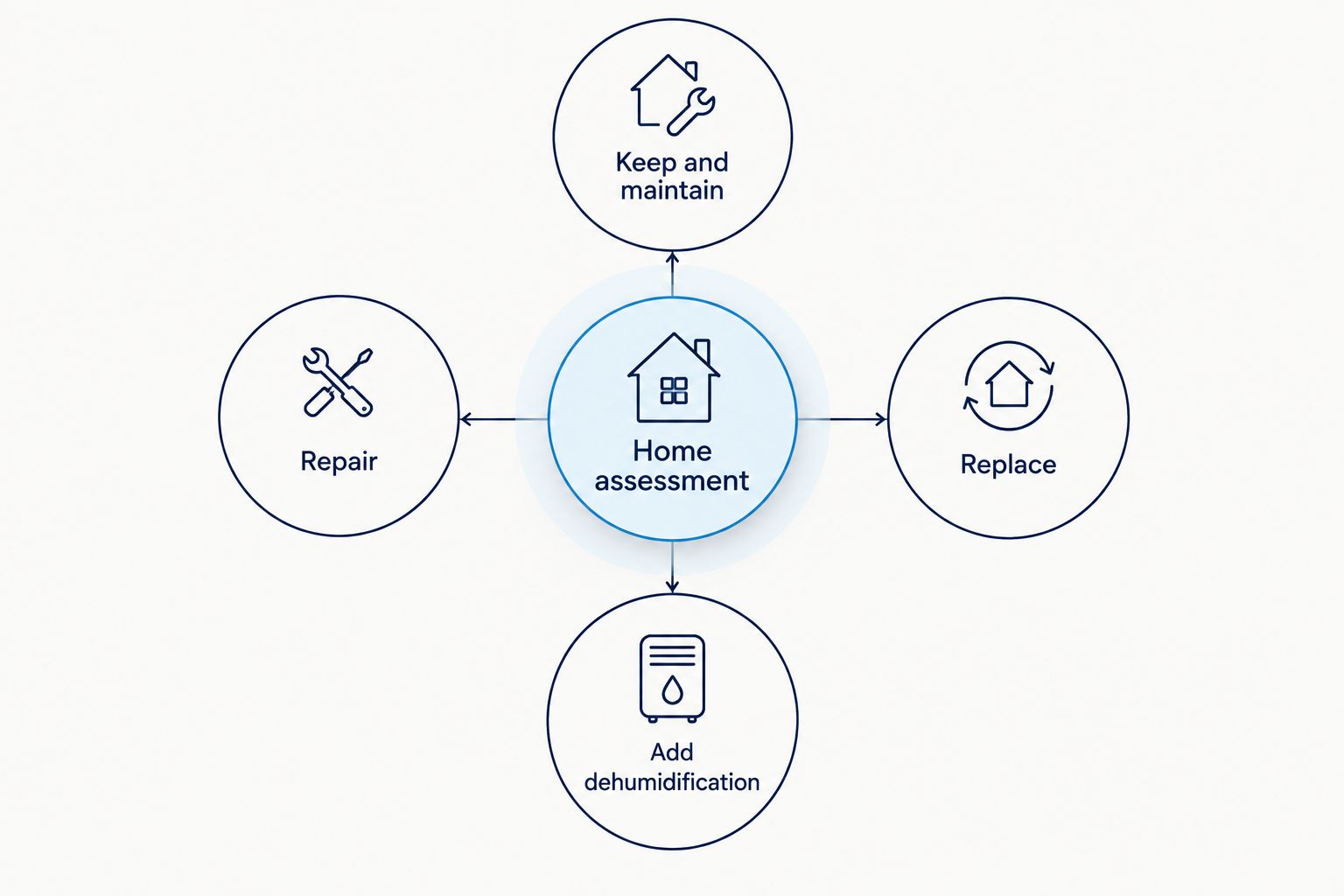
A repair addresses a diagnosed fault. Replacement addresses equipment that no longer makes sense to keep or cannot meet the home's needs. Added dehumidification addresses moisture control, but it does not excuse an unresolved drain, duct, or building leak.
For a 2026 replacement proposal, compare the installation scope as carefully as the equipment. Ask which indoor and outdoor components are included, what duct changes are needed, and how the completed system will be checked. More complex controls need a clear explanation, especially if you are learning the home at the same time.
A.R. Williams Air Conditioning offers repair, replacement, and maintenance, so the conversation can start with the existing system's condition rather than a predetermined equipment choice. The useful outcome is a documented recommendation you understand. Manufacturer credentials do not replace a home-specific assessment.
- Ask what problem each proposed option solves.
- Compare written scopes with the same inclusions.
- Confirm who handles permits and inspections.
- Request operating instructions for the completed system.
Plan for absences and weather
If you will leave the home empty for part of the year, treat humidity control as part of home care. Turning the AC off for a long absence removes an important source of moisture control. Agree on suitable settings with your technician instead of copying a neighbor's thermostat schedule.
A connected thermostat can help you observe temperature remotely, but it does not prove the drain is clear or every room is dry. Arrange a local person to check the home when appropriate. For your 2026 seasonal plan, record whom that person should contact and where the equipment is located.
After storm damage or roof work, have affected HVAC equipment and nearby ductwork assessed. Do not operate equipment that was submerged, visibly damaged, or has an electrical burning smell. Keep electrical panels closed and leave internal repairs to qualified professionals.
- Write down absence settings and monitoring responsibilities.
- Arrange access for a trusted local contact.
- Check equipment condition after nearby construction work.
- Have storm-damaged equipment assessed before use.
Compare your move-in options
Choose the option that addresses a documented problem, not the one with the most features. The following paths apply to central ducted systems. Equipment condition, airflow, and moisture readings determine which path fits your home.
| Option | Best for | Main advantage | Key limitation |
|---|---|---|---|
| Keep and maintain | A sound system that cools evenly and controls moisture | Keeps suitable equipment in service | Maintenance cannot correct unsuitable sizing or major duct defects |
| Repair | An otherwise serviceable system with a diagnosed fault | Addresses the specific failure | A repair does not resolve unrelated deterioration |
| Replace | Equipment that is unsuitable or has problems that justify replacement | Allows a matched system and updated controls | New equipment still needs correct sizing, ductwork, and installation |
| Add dehumidification | Persistent moisture after cooling and building issues are assessed | Provides moisture removal beyond cooling alone | Adds equipment and maintenance responsibilities |
A single-stage central AC operates at one cooling output when its compressor runs. Two-stage and variable-speed central systems offer different levels of output, which can support longer operation at lower capacity. Their benefit depends on proper sizing and setup, and their additional controls introduce more complexity.
Do not buy a control feature to compensate for an unexplained comfort problem. Ask whether the proposed system addresses the measured cause and what maintenance its controls require.
Common mistakes new Florida residents make
Replacing the system before understanding it
A move brings enough decisions without an unnecessary equipment purchase. Establish whether the existing AC has a repairable problem, unsuitable sizing, or poor airflow. Age belongs in the discussion, but it does not explain a particular symptom by itself.
Treating a cold house as a dry house
Temperature and moisture are separate measurements. A low thermostat setting does not establish that humidity is controlled. If rooms feel clammy or you notice condensation, document the conditions and ask for an assessment rather than repeatedly lowering the setting.
Carrying over habits from a different climate
Opening windows while the AC runs brings outdoor moisture into the home. Shutting the system off during a seasonal absence also changes moisture control. Build routines around the Florida home's behavior instead of assuming the habits from your previous home still fit.
Assuming a bigger unit fixes a warm room
A room can stay warm because of inadequate airflow, duct leakage, or solar heat gain through windows. Increasing the whole home's cooling capacity does not identify which of those is responsible. Have the room and its air path checked before changing equipment size.
Signing without understanding the installation scope
A proposal should explain the work, not merely name equipment. Ask about duct changes, permits, drain protection, and the final operating checks. Palm Beach, Martin, and St. Lucie properties can fall under different local permitting authorities, so confirm the authority for your address.
FAQ
Do I need a new AC when I move to Florida?
Moving to Florida does not automatically mean you need a new AC. Assess the existing system’s condition, airflow, cooling performance, and humidity control before choosing repair or replacement.
Why does my Florida house feel damp when the AC is cooling?
A cooling house can still feel damp when the system is not removing enough moisture or moisture is entering the building. Check indoor humidity and have airflow, equipment sizing, drains, and moisture sources assessed.
What indoor humidity should I aim for in Florida?
The EPA recommends indoor relative humidity below 60%, ideally between 30% and 50%. Use a humidity meter to check conditions rather than assuming the thermostat temperature tells you how dry the house is.
Should I leave the AC on when I leave Florida for the season?
Keep a suitable cooling and moisture-control plan in place during seasonal absences. Ask your technician for settings appropriate to the home and arrange monitoring, because turning the AC off removes an important source of moisture control.
Is a larger AC better for Florida heat?
A larger AC is not automatically better for Florida heat. Oversized equipment can cool quickly without enough moisture removal, so choose capacity from a home-specific cooling-load calculation.
Should my thermostat fan stay on all the time?
Automatic fan operation is generally the starting point for normal cooling unless your technician recommends another setup. Continuous fan operation can return moisture from a wet indoor coil to the house between cooling cycles.
Is salt air a problem for an outdoor AC unit?
Salt air can contribute to corrosion of outdoor AC coils and other metal components. Coastal homeowners should discuss suitable maintenance and inspect for deterioration without pressure-washing or applying unapproved cleaners.
How do I compare AC replacement estimates without feeling pressured?
Compare written estimates that address the same cooling needs and installation scope. Ask each contractor to explain sizing, ductwork, permits, and final operating checks before deciding.
One last thing
An empty Florida home still needs moisture control. Your departure removes daily activity, but it does not stop outdoor moisture from entering or equipment problems from developing. Include seasonal absences in your AC plan from the start.
Before finishing your 2026 move-in checklist, save the equipment records, learn the controls, and get unresolved symptoms assessed. If you want help understanding what you inherited, talk with a technician at A.R. Williams Air Conditioning. Ask for the findings and options before agreeing to work. That gives you a useful plan without treating every unfamiliar sound or warm room as a replacement decision.
Related guides
- AC maintenance for snowbirds and seasonal residents
- How to handle AC issues found during a home inspection
- How to read your AC installation contract before signing
