

AC for military families relocating to Florida is a home cooling plan that aims to keep your household comfortable through move-in and time away. Before you approve repairs or replacement, confirm the system's condition, check humidity control, and decide who will handle service if you're away from home.
- AC for military families relocating to Florida starts with a documented inspection, not an automatic replacement.
- A.R. Williams Air Conditioning suits homeowners who want AC findings explained before approving work.
- Choose central AC equipment after checking home size, ductwork, and humidity control.
- Before time away, arrange home access and a local contact who can authorize service.
Why AC matters for military families relocating to Florida
A permanent change of station, often called a PCS, puts housing decisions alongside travel arrangements and household deliveries. Your AC plan should remove another decision from arrival day. Start with the records you can collect yourself, then use a professional assessment to resolve questions those records cannot answer.
Florida cooling involves moisture as well as temperature. A house can reach the thermostat setting and still feel damp. Near the coast, salt air also exposes outdoor equipment to corrosion. In older homes, restricted return vents or altered ductwork can leave bedrooms uncomfortable even when the equipment runs.
For your 2026 move, separate visible symptoms from the repair decision. A warm room is a finding, not proof that the whole system needs replacing. This guide to handling AC issues found during a home inspection explains the next conversation with the seller and technician.
A.R. Williams Air Conditioning AC service is best for relocating homeowners who want a diagnosis explained before approving work. The company provides residential repair, installation, and maintenance across Palm Beach County, Broward County, and the Treasure Coast. For a home elsewhere in Florida, choose a contractor who serves that address.
Build your move-in AC plan
Collect the system's records before you arrive
Ask the seller for installation documents, maintenance records, and repair invoices. Equipment photos help identify what is installed, but a photograph cannot establish how well it cools. Keep the indoor unit and outdoor unit records together so a technician can check the complete system.
Read any warranty paperwork rather than assuming coverage follows the house. Transfer requirements and covered components depend on the written terms. A home warranty is also separate from a manufacturer's equipment warranty.
Create a shared folder labelled with the property address and your 2026 move-in date. Your spouse or another authorized contact should be able to find the information without needing access to your personal messages. Avoid putting deployment details in routine service correspondence.
Close this step with a simple records check:
- Save equipment model and serial-number photographs.
- Request installation, maintenance, and repair documents.
- Keep warranty terms and transfer instructions together.
- Record unresolved inspection findings for the technician.
Check comfort safely before unpacking
During the walk-through, operate the thermostat normally and compare the rooms your family will use most. Notice whether bedrooms feel warmer than the main living area. Check for musty smells, visible water near the indoor unit, and furniture blocking vents.
Use a separate humidity meter, also called a hygrometer, to check moisture in the air. Aim for indoor relative humidity of 30% to 50%, and keep it below 60%. Treat a reading as a starting point for investigation, not a diagnosis by itself.
Record the thermostat setting alongside room conditions. A technician can use that context more effectively than a description such as "the AC feels weak." Don't remove equipment panels, handle wiring, or attempt refrigerant work. If you see ice or leaking water, stop normal operation and arrange professional guidance.
- Compare bedroom comfort with the main living area.
- Record temperature and humidity readings together.
- Note odors, visible water, or repeated short cooling cycles.
- Keep supply vents and return grilles unobstructed.
Arrange an assessment before approving major work
Begin with a written list of symptoms and questions. Ask the technician to explain what was checked, what failed, and whether the proposed work addresses the cause. An equipment age or a single uncomfortable room should not replace that explanation.
A.R. Williams Air Conditioning provides AC assessments with findings explained and flat-rate quotes presented before work starts. Professional service is the next step when records and safe observations cannot establish the system's condition. It doesn't remove the need to read the proposed scope and ask questions.
For a 2026 move-in assessment, request attention to airflow, coil condition, drainage, and operation of the indoor and outdoor equipment. If replacement is recommended, ask why repair is unsuitable and whether duct problems would remain afterward. You should understand the decision before signing.
- Share inspection findings and your room-by-room observations.
- Ask which tests support the diagnosis.
- Request separate explanations for repair and replacement.
- Keep the written scope with your property records.
Choose equipment around the house, not the move deadline
Start by listing the home's comfort problems and any changes since the existing system was installed. Added living space, different windows, or duct alterations belong in the conversation. Matching the old equipment's capacity does not establish that the original size was correct.
Before replacement, request a load calculation. This is an assessment of how much cooling the house needs based on features such as insulation, windows, and building size. The technician should also check whether the ducts can carry the required airflow.
A larger central AC is not automatically a better AC. Oversized equipment can cool quickly and shut off before removing enough moisture. Review how to choose the right AC size for your home before comparing proposals.
Discuss single-stage, two-stage, and variable-speed central systems only after sizing and ductwork are addressed. Equipment features cannot correct every installation problem.
- Request a documented cooling-load calculation.
- Include room additions and known hot bedrooms.
- Ask whether return vents and ducts need correction.
- Compare humidity control alongside cooling capacity.
Set up a maintenance handoff for time away
Begin with a written household plan. If you're away for training, deployment, or travel, identify who will notice an AC problem and who can let a technician inside. A remote thermostat is useful, but it cannot inspect a wet ceiling or a blocked drain.
Choose a trusted local contact and confirm that person's role. They should know where the thermostat and indoor unit are, which symptoms to report, and how repair authorization works. Share only the access information needed for the visit.
For an unoccupied Florida house, turning cooling off entirely removes its moisture-control function. Agree on an away setting and humidity plan based on the home and equipment. Avoid adopting a universal setting from someone else's house.
A.R. Williams Air Conditioning offers maintenance for homeowners, but your household still needs a clear access and approval arrangement.
- Name a local contact who can visit the house.
- Document who can approve service work.
- Keep filter specifications and maintenance records accessible.
- Agree on away settings with the technician.
Prepare the outdoor unit and drainage for local conditions
Walk around the outdoor unit without opening it. Look for obstructing vegetation, accumulated debris, visible deterioration, and damage from lawn equipment. Tell the technician if the property is near saltwater or if roof work changed where rain drains.
Salt air can corrode outdoor coils and metal components. A coastal maintenance plan should account for that exposure, but cleaning methods must suit the equipment. Don't apply household chemicals or pressure-wash the coils as a general solution.
Ask the technician to check the condensate drain, which carries away water removed from indoor air. Also ask about the overflow protection appropriate to the installation. Drainage deserves particular attention when an indoor unit sits above finished living space.
Keep outdoor preparation practical. Don't build an enclosure or add coverings without checking the manufacturer's clearance requirements and service access.
- Keep landscaping from obstructing outdoor airflow.
- Report corrosion or physical damage for assessment.
- Ask about drain condition and overflow protection.
- Preserve access for maintenance and repairs.
Review the written scope and finish the handover
Read the proposal before choosing a contractor. For replacement, it should identify the equipment, installation work, and any duct or electrical work included. Ask who handles permits and inspections for your address. Requirements must be confirmed with the responsible local building department.
Check the contractor's Florida license through the state's official licensing records. Ask for proof of insurance and a clear explanation of workmanship coverage. Dealer credentials provide additional context, but they do not replace a complete written agreement.
A.R. Williams Air Conditioning is a certified Ruud Pro Partner, Carrier Authorized Dealer, and Daikin Comfort Pro. The company explains findings and options before work begins. Those credentials do not establish that one brand is the right choice for every house.
Keep the final 2026 installation or repair documents in the same folder as your move-in records. Before the visit ends, ask the technician to show you normal controls and explain what should prompt another check.
- Confirm equipment and included work in writing.
- Clarify permit and inspection responsibilities.
- Save warranty registration instructions and final documents.
- Learn thermostat controls and routine filter access.
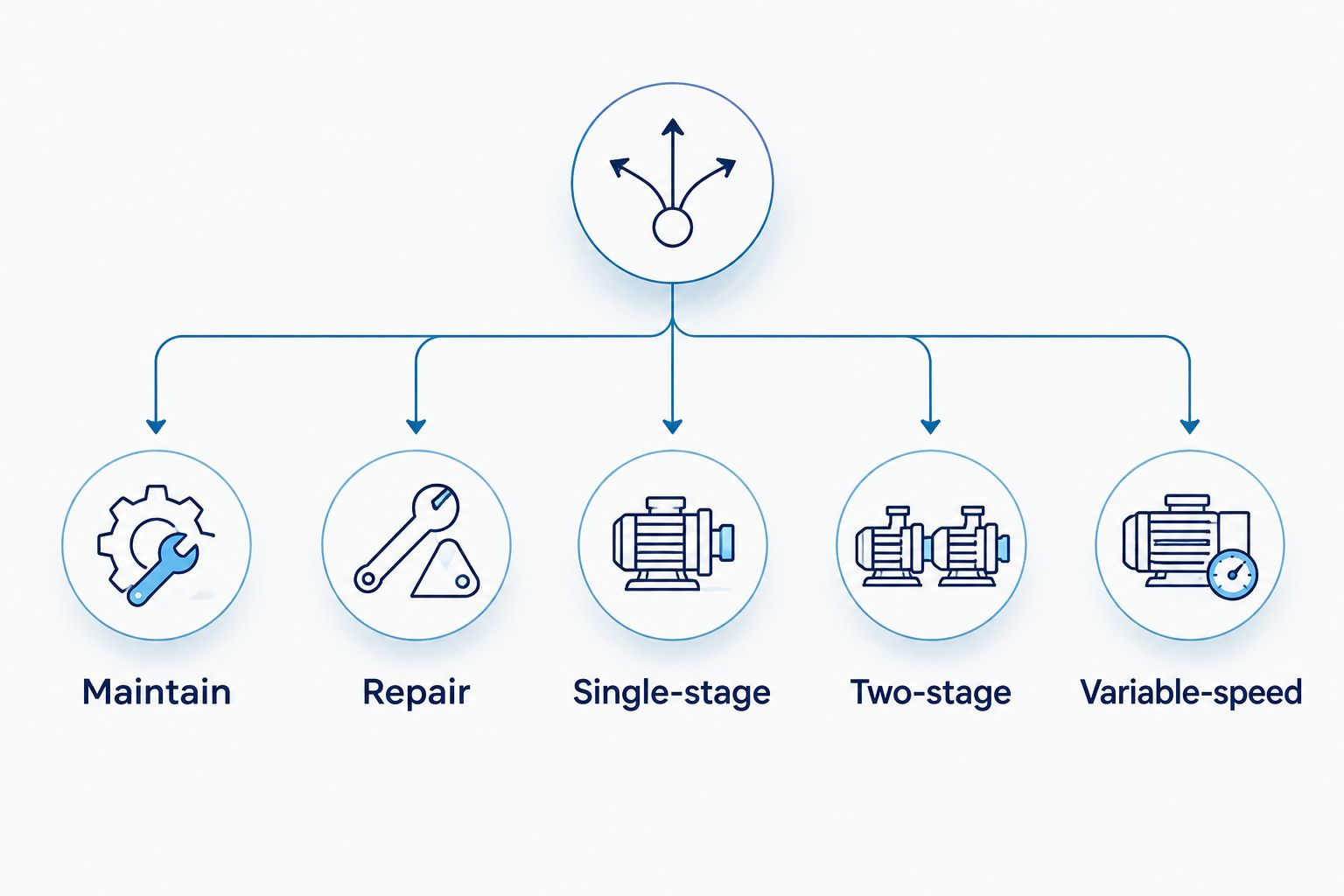
Compare your central AC options
Choose the option that addresses the documented problem. Maintenance, repair, and replacement serve different purposes. A relocation date alone does not determine which one your house needs.
Use this comparison for your 2026 planning conversation. These are decision paths, not guarantees of performance in a particular home. Equipment selection still depends on sizing, duct condition, and installation quality.
| Option | Best for | Main benefit | Key limitation |
|---|---|---|---|
| Maintain the existing central AC | A functioning system without unresolved defects | Establishes a service baseline for the new household | Maintenance does not correct every worn component or design problem |
| Repair the existing central AC | A diagnosed fault in an otherwise suitable system | Addresses the identified failure | Repair does not resolve unrelated sizing or duct issues |
| Replace with single-stage central AC | Homes suited to straightforward on-or-off cooling | Uses a simpler operating approach | Offers less capacity adjustment than staged equipment |
| Replace with two-stage central AC | Homes that benefit from lower-output operation during lighter cooling demand | Provides two cooling output levels | Requires suitable controls and airflow |
| Replace with variable-speed central AC | Homes that need cooling output adjusted across changing conditions | Provides a wider range of capacity adjustment | More complex equipment still needs correct setup and maintenance |
If the house stays damp, investigate drainage, airflow, outdoor air leakage, and equipment operation before purchasing additional equipment. A dehumidifier can address moisture, but it does not repair a failing central AC. Ask what problem each recommendation solves.
Common AC mistakes during a military relocation
Treating a cool walk-through as a complete assessment
A comfortable house during a brief visit doesn't establish performance during heavier cooling demand. Review records and ask about room-to-room comfort. If inspection findings remain unresolved, obtain a professional assessment before treating the system as ready for move-in.
Letting the arrival date decide the equipment size
A tight moving schedule does not justify skipping a load calculation. Replacing an existing system with the same size, or choosing a larger one without assessment, can preserve comfort problems. Set the installation scope around the house's needs rather than a quick equipment choice.
Leaving service approval unclear while you're away
A spouse, relative, or neighbor might have access without authority to approve work. Write down both responsibilities. Confirm the contractor's authorization process before an absence so the person at home knows how to proceed without sharing unnecessary personal information.
Assuming a thermostat app protects the whole house
Remote access helps you check settings and reported conditions. It doesn't confirm that every room is comfortable or that water is draining correctly. Pair monitoring with maintenance and a local person who can inspect the property when something changes.
Assuming military status changes contract terms
Read the actual proposal, warranty, and authorization requirements. Don't assume a discount, priority appointment, or special cancellation provision applies. Ask direct questions and keep written answers with the service documents so your household has one clear record.
FAQ
What should I check first when buying a Florida home with central AC?
Start with the inspection findings and the system’s installation and service records. Then arrange a professional assessment of unresolved cooling, airflow, or drainage concerns before approving major work.
Should I replace the AC before my family moves in?
Replace the AC when a documented assessment supports replacement, not simply because you’re moving. A repair or maintenance visit is a separate option when the existing system remains suitable for the house.
Why does my Florida house feel humid even when the AC is cooling?
Cooling and moisture removal are related, but reaching the thermostat setting does not prove humidity is controlled. Have a technician check airflow, drainage, system operation, and possible outdoor air leakage before selecting a solution.
Is variable-speed AC better than single-stage AC for a relocating family?
Variable-speed AC provides more capacity adjustment, but it is not automatically the better choice for every house. Compare the home’s cooling needs, ductwork, humidity concerns, and maintenance requirements before choosing.
Can I turn off the AC while I’m away for military duties?
Turning off the AC also stops its moisture-removal function, so an unoccupied Florida home needs a deliberate humidity plan. Agree on away settings and arrange a local contact who can check the property.
What if my AC stops cooling during move-in?
Check the thermostat setting and whether vents are blocked, without opening equipment panels or handling wiring. If you see ice, water leakage, or repeated breaker trips, stop normal operation and request professional guidance.
What should go in my 2026 relocation AC folder?
Keep equipment details, inspection findings, service records, warranty terms, and written proposals in your 2026 relocation AC folder. Include the local access contact and the person authorized to approve work.
One last thing
Set up access before you need service. For your 2026 move, the most useful handoff is a shared record that explains the equipment, known issues, and approval process. Keep the local contact's role clear without sharing sensitive military information.
You don't need to become an HVAC expert. Ask for findings you can understand, a written scope, and an explanation of the options. When you're ready, talk with a technician about the house's condition before deciding what to buy.
Related guides
- How to reduce indoor humidity without overworking your AC
- AC maintenance for snowbirds and seasonal residents
- How to get permits for AC installation in Florida
