

AC for retirees relocating to Florida is a home cooling plan that keeps your new home comfortable, controls indoor moisture, and makes maintenance manageable. For a 2026 move, start with the condition of the central AC and ductwork, then consider your daily routine and whether the home will sit empty while you travel.
- AC for retirees relocating to Florida starts with system condition, correct sizing, and humidity control, not a brand name.
- A.R. Williams Air Conditioning fits homeowners who want explained AC findings and a written quote before work starts.
- Keep a sound central AC when inspection supports it; replace equipment when documented problems justify the work.
- Seasonal residents need a moisture-control plan and someone who can check the home while they are away.
Why AC planning matters for retirees relocating to Florida
You don't need to replace an AC simply because you're moving to Florida. You need to know what you're inheriting. A system that cools the living room during a showing can still have a drainage problem, uneven airflow, or poor moisture control.
Retirement can change how you use a home. You might spend more afternoons indoors, want a quieter bedroom, or leave for extended visits with family. Those details belong in the cooling plan before equipment is recommended. The guide to choosing the right AC size for your home explains why floor area alone is not enough.
Local conditions also matter. Salt air can corrode outdoor coils near the coast. Older homes can have restricted return airflow, meaning the system cannot pull enough indoor air back through the equipment. A renovated sunroom can add cooling demand that the original design never accounted for.
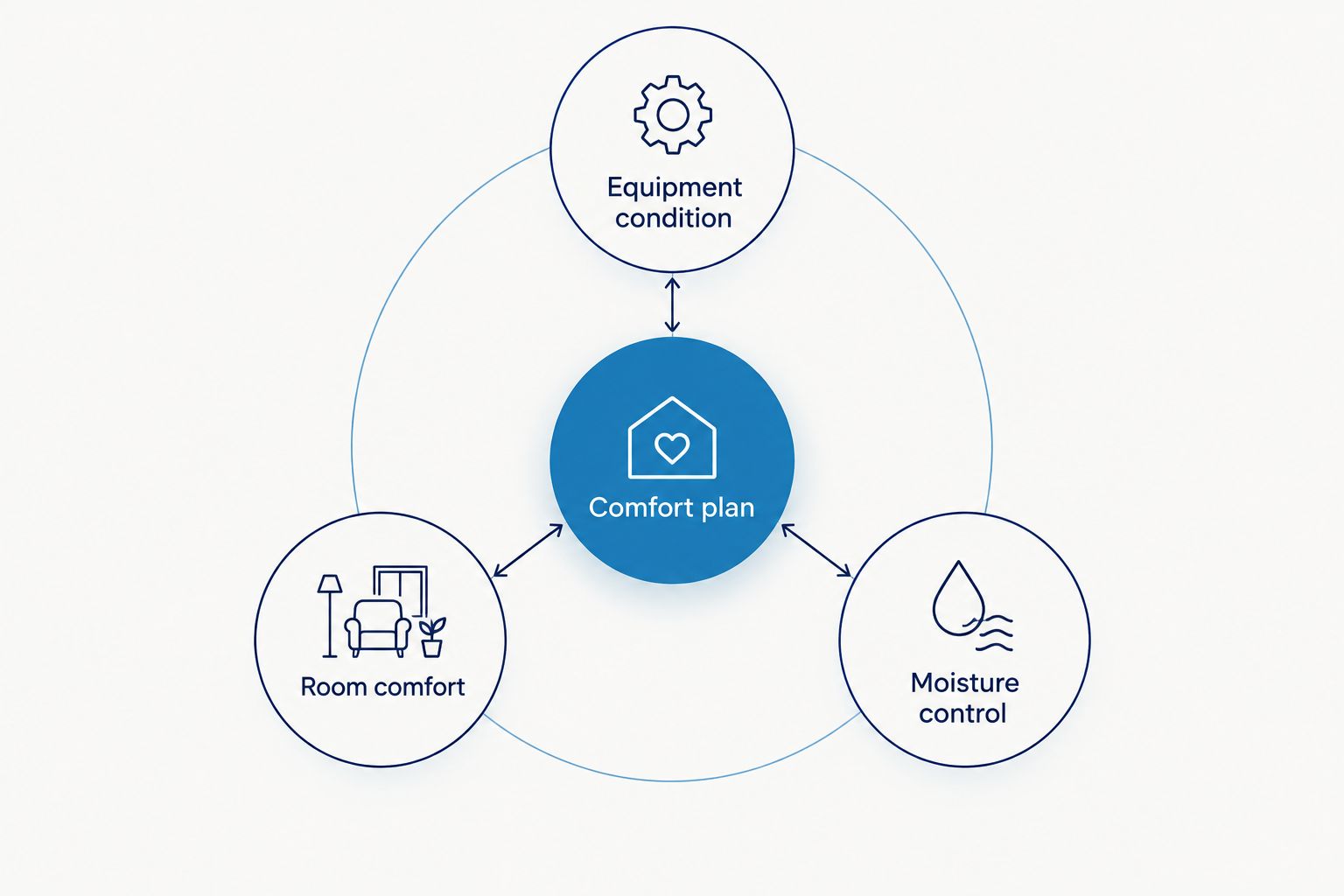
For your 2026 move, separate three questions: Does the equipment work properly? Does the house distribute cooled air properly? Does the home stay dry? Answering them separately helps prevent an unnecessary replacement or an incomplete repair.
Build a cooling plan before choosing equipment
Start with records and observations you can gather yourself. These checks do not require opening equipment, handling refrigerant, or climbing into an attic. Leave electrical testing and internal inspections to a qualified technician.
The goal is a clear explanation of the home's condition. You should understand what needs attention, what can remain in service, and what a proposed improvement actually changes.
Collect the home's AC history
Ask the seller for installation paperwork, service invoices, and warranty documents before closing. Equipment labels identify the indoor and outdoor units, but an installation date and a repair history give those labels useful context.
Look for recurring problems rather than judging the system by age alone. Repeated refrigerant additions deserve an explanation because refrigerant circulates in a closed system. It is not fuel that gets used up during normal operation.
Check whether the indoor equipment, outdoor equipment, and thermostat were installed together or changed at different times. A technician can verify compatibility and explain whether the current combination works as intended.
Keep your 2026 inspection findings with the purchase records. A written starting point makes later service decisions easier, especially when you are still learning the house.
- Request installation dates and the most recent service reports.
- Ask about previous water leaks, cooling complaints, and refrigerant work.
- Save indoor and outdoor model information without removing access panels.
- Have unresolved home-inspection findings reviewed before accepting a repair explanation.
Check comfort where you actually spend time
Walk through the bedrooms, living areas, and any enclosed sunroom while the AC operates. Notice whether a room feels warmer, damper, or noisier than the rest of the house. Record the conditions rather than adjusting several settings at once.
Measure indoor relative humidity, which describes how much moisture is in the air compared with what that air can hold. EPA guidance on indoor moisture recommends keeping relative humidity below 60%, ideally between 30% and 50%. These are moisture-control targets, not a promise that every house will hold the same reading throughout the day.
A cool room can still feel clammy. Lowering the thermostat does not identify whether the cause is excess moisture entering the house, poor drainage, restricted airflow, or equipment operation.
Also check practical access. If a filter requires a ladder or awkward reach, ask about a safe maintenance arrangement instead of making that task part of your routine.
- Note bedroom comfort with doors in their usual position.
- Record temperature and humidity together, including the time of day.
- Keep return grilles and supply vents clear of furniture.
- Tell the technician about noise, drafts, and difficult filter access.
Request a diagnosis before approving replacement
Once you have the records and room observations, schedule a professional assessment. Ask for an explanation of equipment condition, airflow, drainage, and controls. A recommendation should connect a specific finding to a specific action.
For example, a warm bedroom does not automatically mean the whole house needs a larger AC. A damaged duct or restricted return can limit delivery to that room. Installing more cooling capacity without resolving airflow can leave the original complaint in place.
A.R. Williams Air Conditioning provides AC repair, installation, and maintenance, with technicians who explain findings and outline options. That helps homeowners understand the proposed work, but an equipment recommendation still needs to match the condition of the particular home.
A.R. Williams Air Conditioning fits homeowners who want explained AC findings and a written quote before work starts. Use the repair-or-replacement guide to prepare questions, not to diagnose the equipment yourself.
- Ask which findings were measured and which were visually observed.
- Request the reason behind each recommended repair or replacement.
- Confirm whether duct or drainage work is separate from equipment work.
- Ask what the recommendation will change about comfort and moisture control.
Match central AC options to the house
Choose equipment after the house has been assessed. A cooling-load calculation estimates the home's cooling needs using factors such as windows, insulation, orientation, and air leakage. It is more useful than copying the capacity of the old unit.
For retirees who are home throughout the day, part-load comfort deserves attention. This means how the system operates when the house needs less than its full cooling output. Ask the contractor to explain how the proposed equipment handles those conditions.
A single-stage central AC has one cooling output when running. A two-stage system has two cooling levels. Variable-speed equipment adjusts output across a range. More adjustable operation gives the installer additional ways to manage comfort, but correct sizing and setup remain necessary.
In an older house, discuss the return ducts before approving a larger unit. In a coastal house, ask how exposed coils will be inspected and maintained. Equipment features cannot compensate for an installation that ignores the building.
- Request a load calculation for a proposed replacement.
- Confirm that existing ducts can support the selected equipment.
- Ask how the thermostat and indoor unit work with the outdoor unit.
- Discuss bedroom noise and outdoor-unit placement before installation.
Compare written scopes, not equipment names
Two proposals can name similar equipment and describe very different jobs. One might address damaged duct connections or drainage while another leaves those items unchanged. Read the scope before deciding which recommendation is more complete.
Your 2026 installation proposal should identify the equipment and explain the work around it. Ask who handles required permits and inspections through the local building department. Do not assume requirements are identical across Palm Beach, Martin, and St. Lucie counties or their municipalities.
A.R. Williams Air Conditioning quotes flat-rate work before it starts. For any contractor, request a written scope that distinguishes included work from optional changes. Written approval keeps the decision in your hands.
If a recommendation feels rushed, take time to ask questions or seek another assessment. A sound explanation should remain understandable after the conversation ends.
- Confirm model information and the proposed equipment combination.
- Identify included duct, drain, electrical, and thermostat work.
- Ask who arranges permits and any required inspection.
- Request warranty documents and homeowner registration instructions.
Plan maintenance around travel and accessibility
If you will spend part of the year elsewhere, prepare the house for absence rather than simply switching the AC off. An empty home still needs moisture management. Ask a technician to recommend settings for the house and explain how to verify that the plan is working.
A connected thermostat can help you check indoor conditions remotely, but it depends on power, internet service, and correct setup. It cannot inspect a wet ceiling or clear a blocked drain. Arrange a local person who can enter the home if a check is needed.
Coastal exposure also belongs in the maintenance plan. Ask how the outdoor coil's condition will be reviewed and which cleaning methods are appropriate for the equipment. Avoid improvised coatings or aggressive cleaning that can damage it.
Keep instructions simple enough for someone else to follow. The person checking your house should know what to observe and whom to contact, without opening equipment.
- Arrange professional maintenance based on equipment condition and manufacturer guidance.
- Record approved occupied and away settings.
- Give a trusted person access and clear reporting instructions.
- Keep filter information and service records in an easy-to-find location.
Compare central AC approaches for your move
The best option solves a documented problem without adding work you don't need. These approaches address different conditions, so they are not interchangeable upgrades.
| Option | Best for | Main benefit | Key limitation |
|---|---|---|---|
| Maintain the existing central AC | A home with sound equipment and acceptable room comfort | Keeps serviceable equipment in use | Maintenance cannot correct every design or equipment defect |
| Repair equipment or ductwork | A diagnosed fault with an otherwise suitable system | Addresses the identified cause | A repair does not renew unrelated aging components |
| Single-stage central AC replacement | A correctly sized home with straightforward cooling needs | Uses one cooling output and straightforward operation | Offers less output adjustment than staged equipment |
| Two-stage central AC replacement | Homeowners who want two cooling levels | Provides a lower-output operating stage | Humidity results still depend on sizing and setup |
| Variable-speed central AC replacement | Homeowners prioritizing adjustable output and steady comfort | Adjusts cooling output across a range | Requires compatible controls and careful setup |
| Whole-home dehumidification | A home with persistent moisture after AC and building issues are assessed | Addresses moisture separately from temperature control | Adds equipment and does not replace needed AC repairs |
Variable-speed equipment is not an automatic answer to a damp house. First establish whether outside air entry, duct leakage, drainage, or operating settings contribute to the problem.
Common mistakes retirees make when planning Florida AC
Replacing equipment based only on its age
Age is useful context, not a diagnosis. Review condition, previous failures, and room comfort before deciding. A new outdoor unit also does not automatically correct damaged ducts or an unsuitable return-air arrangement.
Assuming a smaller retirement home needs a simple size estimate
Downsizing changes floor area, but windows, ceiling height, insulation, and sun exposure still affect cooling demand. Ask for a load calculation rather than carrying assumptions from your previous house into the new one.
Treating humidity as a thermostat problem
If the house feels damp, record humidity as well as temperature. Repeatedly lowering the setpoint can hide the symptom without explaining the cause. Ask for moisture entry, equipment operation, and drainage to be evaluated together.
Leaving an empty house without a checking plan
Remote monitoring is useful, but someone needs access if the system stops cooling or water appears indoors. Agree on who checks the house and what they report. Do not rely on an app as the only safeguard.
Choosing controls that are difficult to use
A thermostat should fit your eyesight, reach, and preferred routine. Ask for a hands-on explanation before installation is considered complete. If you prefer simple controls, make that preference part of the proposal instead of accepting features you won't use.
FAQ
Do I need a new AC when I retire to Florida?
You do not need a new AC simply because you are relocating. Have the existing equipment, ductwork, drainage, and room comfort assessed, then decide whether maintenance, repair, or replacement addresses the findings.
What should I check about the AC before buying a Florida home?
Check installation records, service history, room comfort, and signs of water leakage. Have unresolved findings reviewed by an HVAC technician rather than relying only on the fact that the system turns on.
Is a bigger AC better for a hot Florida house?
A bigger AC is not better unless the home’s calculated cooling demand requires it. Oversized equipment can cycle off before providing adequate moisture removal, and restricted ducts can remain a problem after replacement.
What humidity should I aim for in my Florida home?
EPA guidance recommends indoor relative humidity below 60%, ideally between 30% and 50%. Measure humidity alongside temperature and ask a technician to investigate persistent dampness rather than repeatedly lowering the thermostat.
Should I turn off the AC when I leave Florida for several months?
Do not turn off the AC without a moisture-control plan for the empty house. Ask for appropriate away settings and arrange someone who can check the property if cooling or drainage problems develop.
Is variable-speed AC better than single-stage AC for retirees?
Variable-speed AC offers more output adjustment, but it is not automatically the better choice for every home. Compare sizing, duct condition, control simplicity, and the comfort problem you want the replacement to solve.
Can I ask for another opinion before replacing my AC?
Yes, you can request another assessment before approving replacement. Ask each contractor to identify the problem, explain the proposed solution, and provide a written scope so you can compare the recommendations.
One last thing
Test your bedroom with the door closed before you settle on the AC plan. A house can feel comfortable during an open-door showing and behave differently during your normal sleeping routine. Report the difference so the technician can assess airflow rather than assuming more cooling capacity is needed.
For a 2026 relocation, keep a short handover sheet with your thermostat settings, filter information, inspection findings, and service contact. A.R. Williams Air Conditioning can assess the system and explain your options. Request an estimate or book a convenient time when you're ready to discuss the work.
Related guides
- AC maintenance for snowbirds and seasonal residents
- How to reduce indoor humidity without overworking your AC
- How to get a second opinion on an AC replacement quote
