
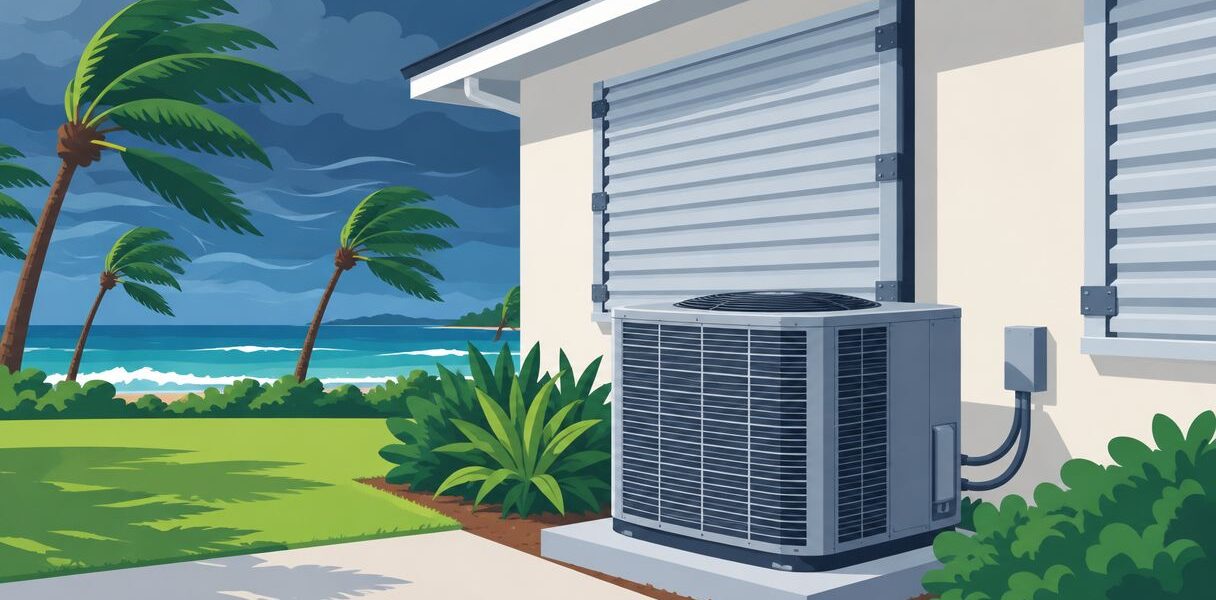
Florida's building code doesn't care what an AC brand's ad says. It cares whether the condenser, the pad it sits on, and the straps holding it down were tested for the wind speeds your county requires, and in 2026 that distinction decides which systems belong outside a South Florida home.
- Carrier leads the best hurricane wind-rated AC brands Florida homeowners install in Miami-Dade and Broward’s High Velocity Hurricane Zone.
- Ruud’s coastal cabinet coating handles salt air corrosion better than standard equipment near the Intracoastal.
- Rheem ships factory tie-down hardware built for Florida Building Code wind anchoring rules.
- Trane’s heavier cabinet construction holds up better on exposed two-story roof lines.
- No brand survives a storm on its own. Pad height, anchoring, and permitting matter as much as the nameplate on the unit.
Why this matters
Miami-Dade and Broward counties sit inside Florida's High Velocity Hurricane Zone (HVHZ), where equipment has to meet stricter wind load testing than the rest of the state. That's not a marketing detail. It's a permitting requirement, and it's part of why homes with older systems, especially ones installed before local codes tightened, sometimes fail inspection when it's time to replace the unit.
A condenser that isn't rated or anchored correctly can become a projectile in sustained winds. Homeowners closer to the coast deal with a second problem on top of that: salt air eating through cabinets and coils years before a storm ever shows up. If you want a deeper look at how coastal air shortens equipment life, the guide on AC unit security cages for Florida homes covers the physical protection side of the same issue.
The brands below aren't ranked on cooling capacity alone. They're ranked on how well each one handles Florida's wind and salt exposure specifically, because that's the worry that keeps homeowners up the night before a named storm.
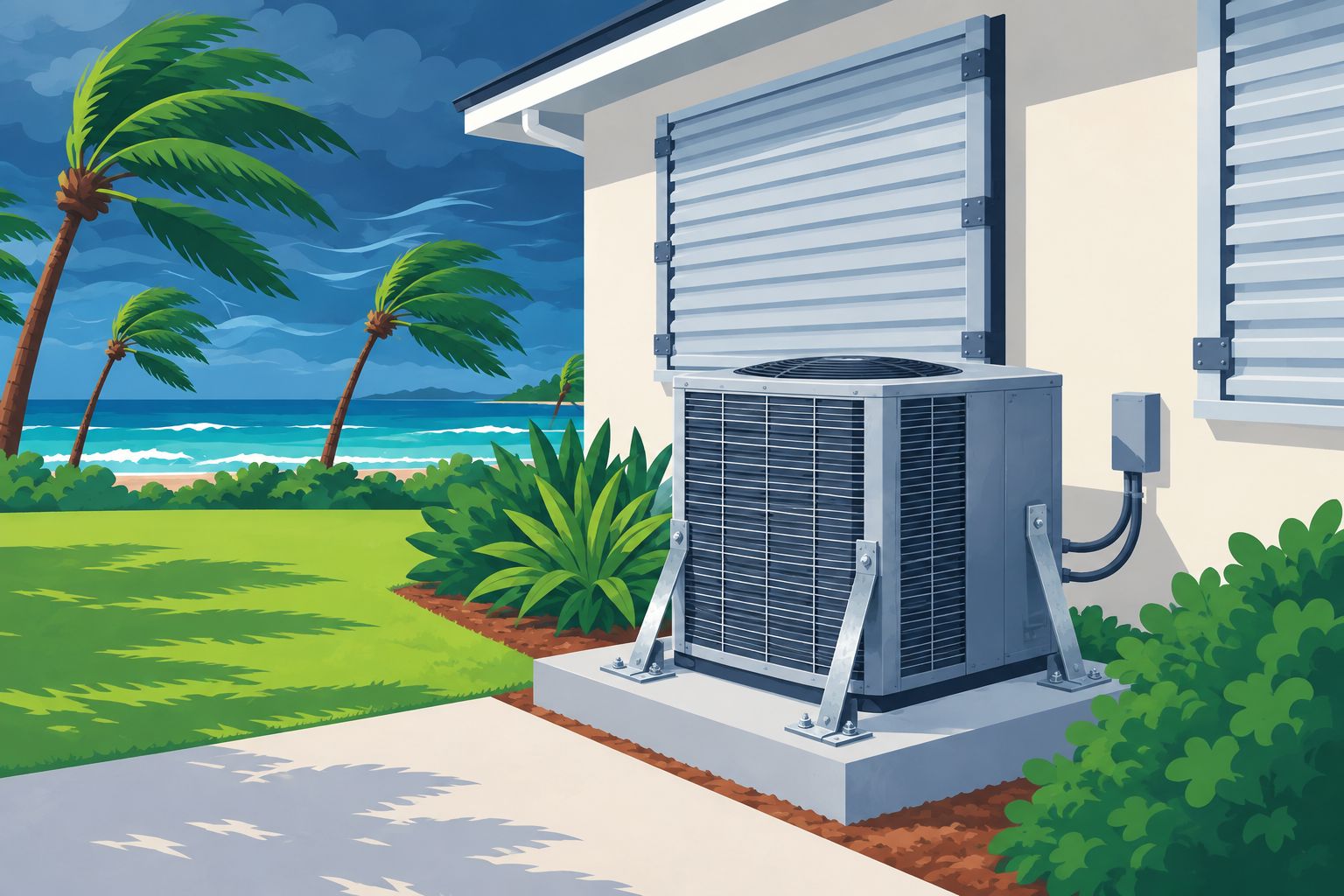
Best overall: Carrier for Miami-Dade County Notice of Acceptance (NOA) documentation on select condenser models. Best for coastal salt air: Ruud. Best for tie-down and anchoring hardware: Rheem. Best for two-story wind exposure: Trane. Best for condos and high-rises: Daikin.
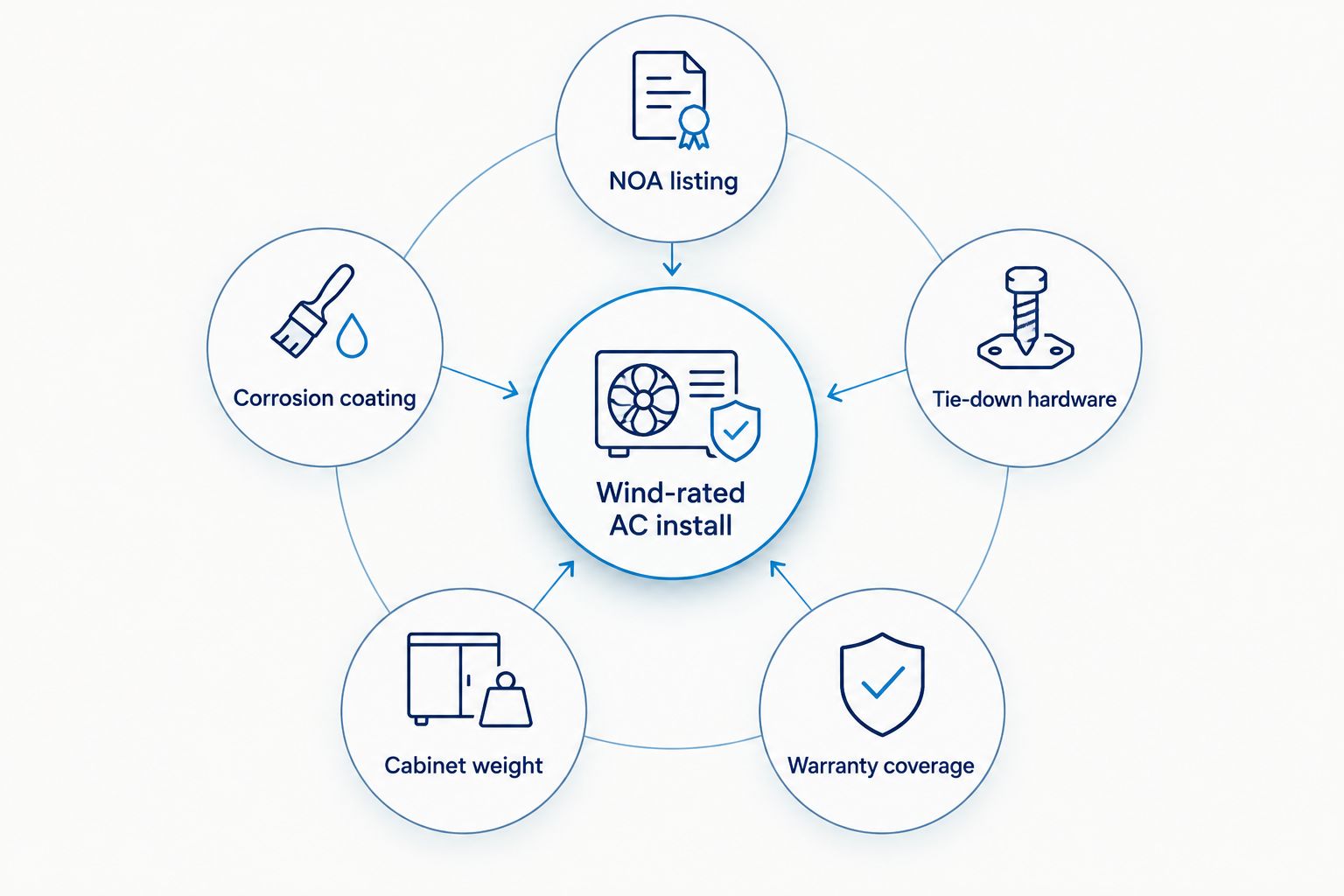
What makes the best hurricane wind-rated AC brand
- Miami-Dade County NOA listing for the specific condenser model, not just the manufacturer's name
- Cabinet and coil corrosion resistance rated for salt air exposure within a few miles of the coast
- Tie-down and anchoring hardware compatible with Florida Building Code wind load requirements
- Cabinet weight and construction that resists movement in sustained high wind
- Warranty language that specifies what's covered if storm-related damage occurs
- Local parts and certified installer availability, since a rated unit installed wrong loses its rating anyway
At a glance: hurricane wind-rated AC brands compared
| Brand | Best for | Standout feature | Key limitation |
|---|---|---|---|
| Carrier | Miami-Dade HVHZ approval | NOA-listed condenser models | NOA documentation varies by model year |
| Ruud | Coastal salt air corrosion resistance | Corrosion-resistant cabinet coating | Coils near the ocean still need regular rinsing |
| Rheem | Wind-rated tie-down and anchoring hardware | Factory tie-down kit compatibility | Tie-down hardware is an added install step, not automatic |
| Trane | Two-story homes with high roof-line exposure | Heavier cabinet construction | Extra weight means a larger required pad footprint |
| Daikin | Condos and high-rises with tight pad space | Compact footprint for small balconies and pads | Fewer HVHZ-specific NOA listings published locally |
1. Carrier: best hurricane wind-rated AC brand for Miami-Dade HVHZ approval
Carrier publishes Notice of Acceptance documentation through Miami-Dade County on select condenser models, which is the paperwork inspectors in the HVHZ actually check before signing off on a permit. That matters most for homeowners in Miami-Dade and Broward, where basic design wind speeds in the building code run well past 150 mph along the coast.
Carrier pros:
- NOA documentation available on select models simplifies HVHZ permitting
- Wide network of authorized installers across Palm Beach and Broward counties
- Cabinet construction holds up under repeated wind load testing cycles
Carrier cons:
- Not every Carrier model carries current NOA paperwork, so the specific unit matters
- Coastal homes still need a corrosion package on top of the wind rating
Best for: homeowners inside the Miami-Dade or Broward HVHZ who need documented code compliance without guesswork.
Verdict: Buy if your address falls inside the HVHZ and your installer can confirm current NOA paperwork for the exact model quoted.
2. Ruud: best hurricane wind-rated AC brand for coastal salt air corrosion
Ruud's coastal-rated cabinets add corrosion-resistant coating across the coil and cabinet, which is the detail that matters most within a few miles of the ocean or the Intracoastal. Wind rating and corrosion resistance are two different problems, and a lot of homeowners only think about the first one until a five-year-old unit near the water starts rusting from the outside in.
Ruud pros:
- Corrosion-resistant coating extends cabinet and coil life near salt air
- A.R. Williams is a certified Ruud Pro Partner, which covers installation and warranty registration support
- Solid fit for waterfront and canal-front properties
Ruud cons:
- Coastal coating doesn't replace an annual coil rinse near the water
- Standard (non-coastal) Ruud models don't carry the same corrosion protection
Best for: homes within roughly a mile or two of saltwater, canals, or the Intracoastal.
Verdict: Buy if corrosion, not just wind, is the bigger long-term risk to your outdoor unit.
3. Rheem: best hurricane wind-rated AC brand for tie-down and anchoring hardware
Rheem sells factory tie-down kits designed to anchor condensers to a pad in a way that meets Florida Building Code wind load rules. That sounds like a small detail until you realize the tie-down hardware, not the brand name on the cabinet, is often what an inspector is actually verifying on install day.
Rheem pros:
- Factory tie-down kits are built specifically for Florida wind anchoring requirements
- Compatible with most standard pad sizes used in South Florida installs
- Broad parts availability across the Treasure Coast and Palm Beach County
Rheem cons:
- Tie-down hardware is an added step and cost on top of the unit itself
- Older Rheem installs without the kit don't automatically meet current wind codes
Best for: homeowners replacing a unit that's currently anchored with outdated or missing tie-down hardware.
Verdict: Buy if your current outdoor unit isn't properly strapped down and a replacement is already on the table.
4. Trane: best hurricane wind-rated AC brand for two-story homes with high roof-line exposure
Trane's heavier cabinet construction gives it an edge on properties where the outdoor unit sits closer to rooflines that catch more wind, common on two-story homes and homes with steep or metal roofs that funnel gusts toward the pad. Extra cabinet weight isn't a marketing point most people notice, but it's a real factor in how a unit behaves in sustained wind.
Trane pros:
- Heavier cabinet resists shifting in high, sustained wind
- Solid track record on multi-story South Florida homes
- Wide dealer network for parts and service
Trane cons:
- Added weight requires a larger, properly rated pad
- No meaningful cost advantage over lighter-cabinet competitors for single-story homes
Best for: two-story homes and properties with roof lines that create extra wind exposure at the pad.
Verdict: Buy if your home is two stories or has a roof shape that funnels wind directly at the outdoor unit.
5. Daikin: best hurricane wind-rated AC brand for condos and high-rises
Daikin's compact central system footprint fits the tight equipment pads and balcony spaces common in South Florida condos and high-rises, where square footage for outdoor equipment is limited by HOA rules or building design. A.R. Williams is a certified Daikin Comfort Pro, which covers installation and service on these systems.
Daikin pros:
- Compact footprint fits tight pads, balconies, and condo mechanical spaces
- Certified Daikin Comfort Pro support available for installation and service
- Efficient performance in smaller footprints without sacrificing capacity
Daikin cons:
- Fewer HVHZ-specific NOA listings published locally compared to Carrier
- Condo association rules on equipment placement can complicate installs regardless of brand
Best for: condo owners and high-rise units where pad space, not wind exposure, is the main constraint.
Verdict: Buy if you're working with a tight condo pad and space, not wind rating alone, is driving the decision.
How this list was ranked
Each brand was weighed against the six criteria above: NOA documentation, corrosion resistance, tie-down hardware compatibility, cabinet weight and wind resistance, warranty clarity on storm-related issues, and local parts and installer availability. No brand won on every criterion, which is exactly why the list splits by use case instead of naming one universal winner.
Which hurricane wind-rated AC brand should you choose?
For most homes inside the Miami-Dade or Broward HVHZ, Carrier is the default pick because of its documented NOA availability. Homes within a mile or two of saltwater should lean toward Ruud for the corrosion protection, and condo or high-rise owners working with a small pad footprint should look at Daikin first.
Rheem and Trane both earn a spot when the deciding factor is hardware (Rheem) or roof-line wind exposure (Trane) rather than county or coastline. None of these brands solves the problem by themselves. The pad, the tie-downs, and the permit are what actually get checked when a storm passes through.
Get your outdoor unit checked before storm season
A technician can confirm your current wind rating, pad, and tie-down setup.
FAQ
What does hurricane wind-rated mean for an AC condenser?
It means the specific model has been tested and documented to withstand the wind loads set by Florida Building Code for its location. In the High Velocity Hurricane Zone covering Miami-Dade and Broward, that documentation often takes the form of a Miami-Dade County Notice of Acceptance (NOA) for the exact model and mounting setup, not just the brand.
Do all AC brands sold in Florida meet hurricane wind codes?
No. Every unit installed in Florida has to meet the statewide building code, but not every model from every brand carries HVHZ-specific NOA documentation. Ask your installer which specific model number is quoted and whether that model has current NOA paperwork if you’re in Miami-Dade or Broward.
Is Miami-Dade County NOA required outside Miami-Dade and Broward?
No, the High Velocity Hurricane Zone only covers Miami-Dade and Broward counties. Homes elsewhere in South Florida and the Treasure Coast still follow Florida Building Code wind requirements, but not the stricter HVHZ-specific testing and NOA process.
Does a hurricane wind rating cover storm damage under warranty?
Usually not automatically. Manufacturer warranties typically cover defects in materials and workmanship, not storm damage, so check the specific warranty language on the model you’re considering before assuming storm coverage is included.
Can salt air affect a wind-rated AC unit?
Yes. Wind rating and corrosion resistance are separate properties. A unit can be properly wind-rated and still corrode faster than expected within a mile or two of saltwater if it doesn’t also carry a coastal-rated cabinet and coil coating.
Does raising an AC unit on a taller pad help during a storm?
Yes, in flood-prone or low-lying areas. Elevating the condenser reduces the risk of storm surge or heavy rain intake reaching the unit’s electrical components, though pad height should still match the manufacturer’s mounting specifications for wind anchoring.
What’s the difference between a wind-rated unit and a standard install?
A wind-rated install combines a tested condenser model with proper tie-down hardware and a pad that meets code, all documented for inspection. A standard install may use the same equipment but skip the anchoring hardware or documentation an HVHZ inspector requires.
How often should a coastal AC unit be inspected before hurricane season?
Before each hurricane season is the standard window most homeowners near the coast use to have tie-downs, pad condition, and coil corrosion checked, since salt air damage tends to show up gradually rather than all at once.
One last thing
A hurricane wind rating isn't a brand-wide guarantee. It's tied to one specific model, mounted to one specific pad, with one specific tie-down kit. Swap any of those three pieces and the rating on paper stops matching what's actually bolted down outside your house. That's the detail most homeowners never hear until an inspector flags it, and it's worth asking your installer to confirm in writing before 2026 hurricane season, not after.
Related guides
