
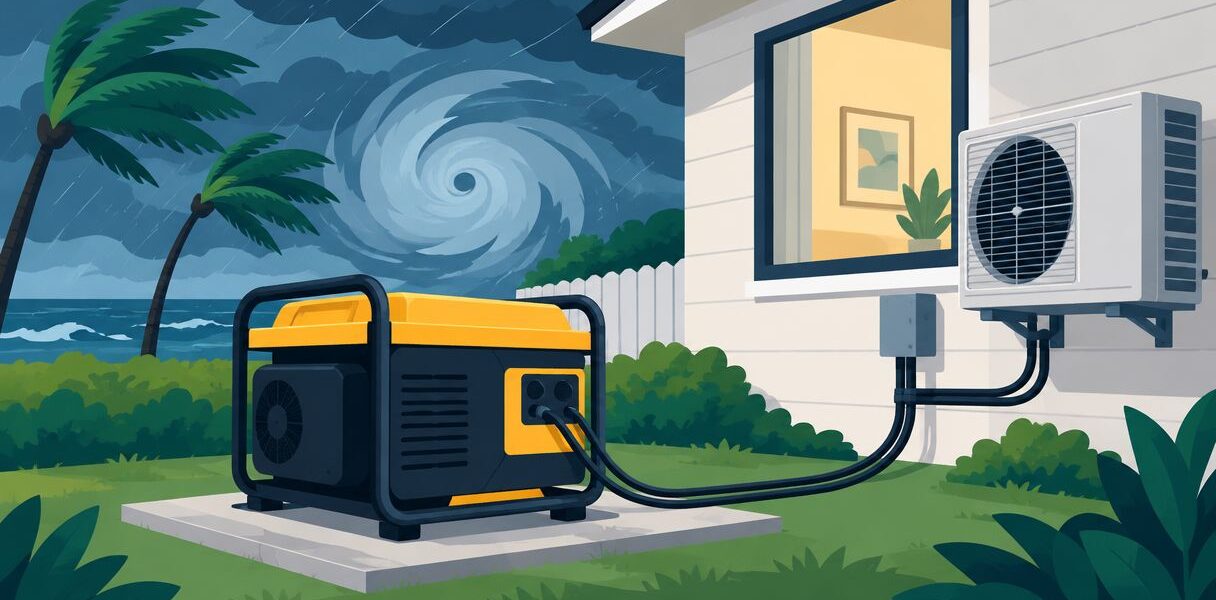
Hurricane season in South Florida means the power goes out and the AC goes with it, sometimes for a day, sometimes for four or five. Best overall for full central AC coverage: a whole-home standby generator with an automatic transfer switch. Best for temporary, no-permit backup: a dual-fuel portable generator in the 5,000 to 10,000 watt range. Best for quiet, single-zone operation: an inverter generator paired with a soft-start device. Best for silent backup with no fuel runs: a solar and battery system paired with a portable AC unit. Best for spot cooling one room only: a small portable generator under 3,500 watts.
- Whole-home standby generators handle a 3 to 5 ton central AC without a separate soft-start device.
- Dual-fuel portable generators in the 5,000 to 10,000 watt range can start a single AC zone when sized right.
- A 3-ton AC compressor typically draws 3,500 to 5,000 running watts, with a startup surge 2 to 3 times higher.
- The best generators to run AC during hurricanes depends on whether you need whole-home coverage or one room.
- Soft-start kits cut compressor inrush enough to let a smaller generator carry the load.
Why this matters
South Florida homes lose power every hurricane season, sometimes for days at a stretch. Without AC running, indoor humidity climbs within hours, and mold starts forming in ductwork and drywall not long after that.
Homes built before 2010 that still run R-22 systems are especially exposed. Those units already work harder in Florida's humidity, and an undersized generator can trip a compressor that was already on its last legs.
For the settings and startup order that protect your equipment once power comes back, see how to run your AC during a hurricane power outage. Picking the right generator is only half the plan for 2026. The other half is which AC settings to touch first, and in what order, so you're not asking a compressor to do something it can't handle.
What makes the best generator to run AC during a hurricane
- Running wattage headroom. The generator has to cover the AC's continuous draw plus the startup surge, not just the number on the compressor's nameplate.
- Fuel type and access. Gasoline lines get long fast after a storm. Propane and natural gas hookups hold up better across a multi-day outage.
- Automatic vs. manual transfer. Compressors take a beating from repeated manual restarts. Automatic switching protects the equipment as much as it protects your comfort.
- Noise level. A generator running for three or four days needs to be tolerable next to a bedroom window.
- Portability vs. permanent installation. This comes down to whether you shelter in place or need something you can take with you if you evacuate.
- Compatibility with surge protection. Generator power is dirtier than utility power, and some AC control boards need a buffer between the two.
Backup generators for AC at a glance
| Generator type | Best for | Standout feature | Key limitation |
|---|---|---|---|
| Whole-home standby generator | Full central AC coverage, automatic | Transfer switch starts within seconds of an outage | Needs professional install and permitting |
| Dual-fuel portable generator (5,000-10,000W) | Temporary AC backup, no permanent hookup | Runs on gasoline or propane | Manual startup, must sit outdoors away from windows |
| Inverter generator with soft-start | Quiet, single-zone AC operation | Soft-start assist lowers compressor inrush | Lower wattage ceiling, can't carry multi-ton systems |
| Solar and battery backup | Silent backup, no fuel runs | No exhaust, no fuel purchases | Can't sustain a central AC compressor for long |
| Small portable generator (under 3,500W) | Spot cooling one room | Lightweight, easy to store | Can't start a central AC compressor at all |
The five options break down by how much of the home they're built to cool, not just by their size on paper.
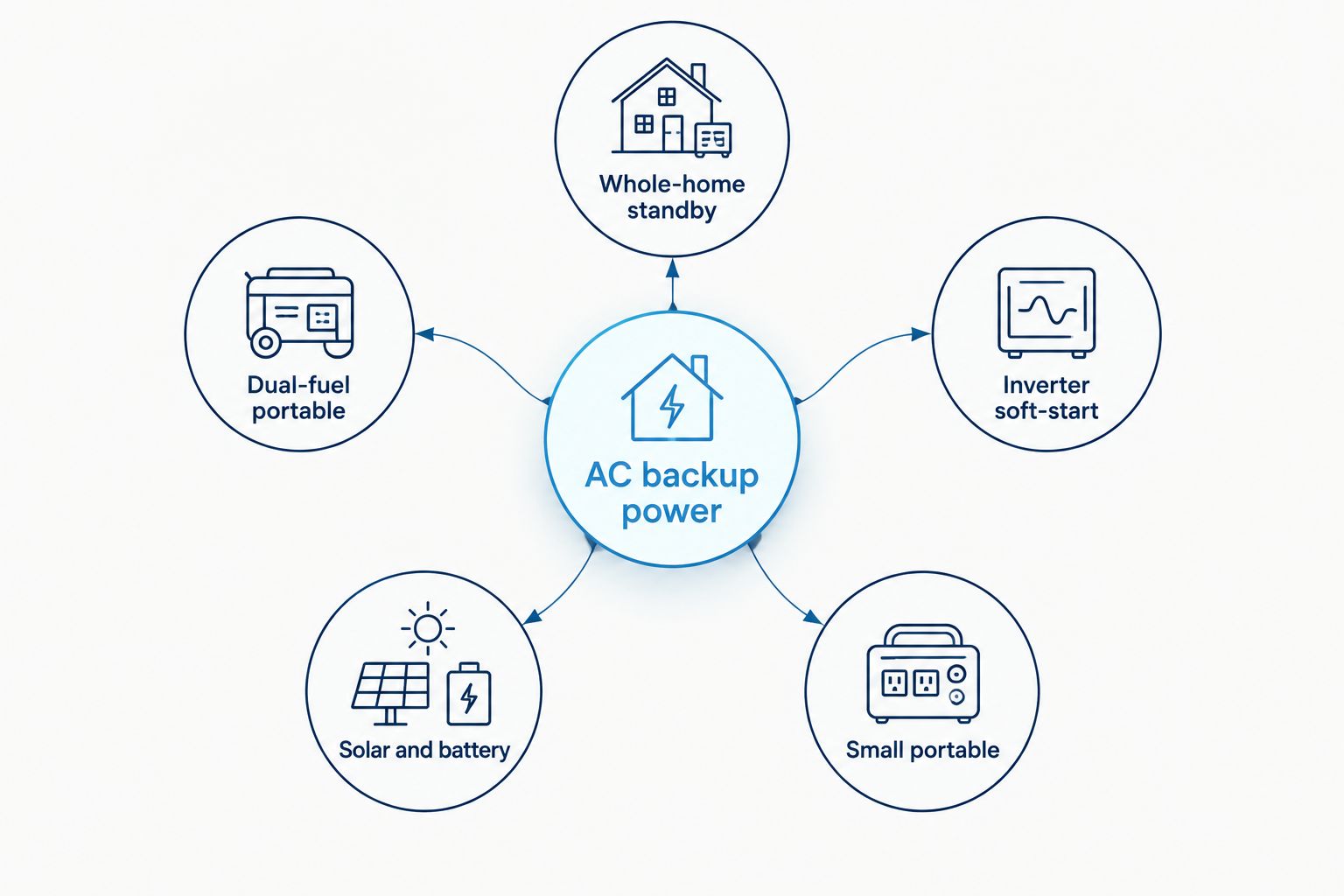
1. Whole-home standby generator: best generator to run AC for full-home coverage
A standby generator sits permanently outside the home, wired into the electrical panel through an automatic transfer switch. It runs on natural gas or propane and starts within seconds of a utility outage, carrying the full ducted system along with the rest of the house.
Whole-home standby generator pros:
- Automatic start means no one has to go outside during a storm to flip a switch.
- Sized correctly, it starts a 3 to 5 ton compressor without a separate soft-start device.
- Covers refrigeration and other essential circuits on the same run as the AC.
Whole-home standby generator cons:
- Needs a licensed electrician and a permit in most Palm Beach and Treasure Coast jurisdictions.
- Tied to a fixed fuel line, so it can't be loaned out or moved between properties.
- The largest project of any option on this list.
Best for: homeowners who want the central AC running automatically, with no manual steps, for the length of the outage.
Verdict: Buy, if the home runs a fixed 3 to 5 ton system and the project fits the household's plans for 2026.
2. Dual-fuel portable generator: best generator to run AC without a permanent installation
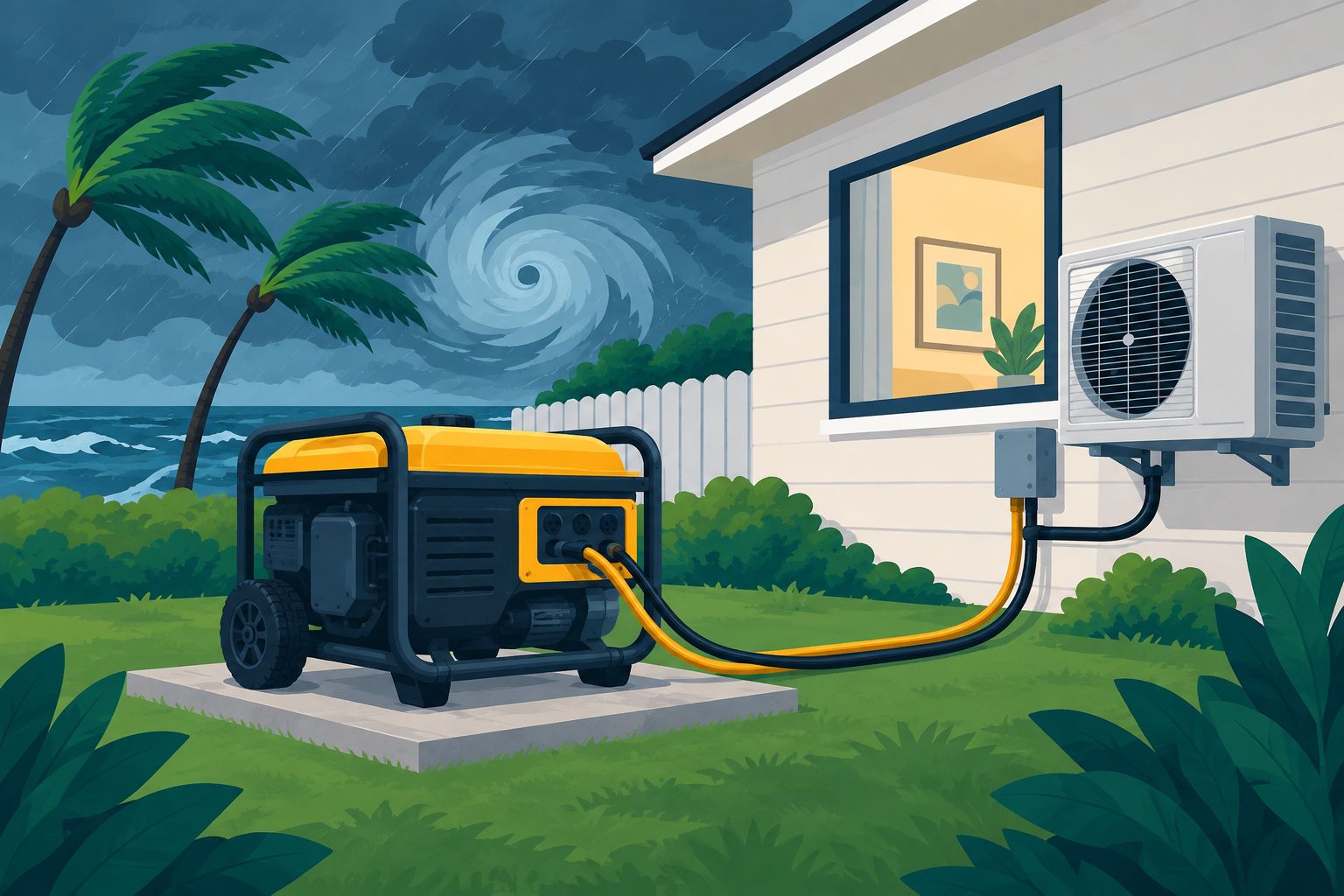
This is a portable unit rated 5,000 to 10,000 running watts, built to run on gasoline or propane and connect to the home through a manual transfer switch or an interlock kit. It has to sit outside, away from windows and doors, whenever it's running.
Dual-fuel portable generator pros:
- Stores in a garage and only comes out when a storm is tracking toward South Florida.
- Dual-fuel flexibility means you're not stuck if gas stations run dry.
- Enough running wattage for a single 3 to 4 ton zone when paired with a soft-start device.
Dual-fuel portable generator cons:
- Manual startup and fuel checks every several hours.
- Correct outdoor placement is required every single time, for carbon monoxide safety.
- No automatic restart if the tank empties while you're asleep or away.
Placement matters as much as size here. Keep the generator the manufacturer's recommended distance from windows and doors, angled so exhaust flows away from the house, not toward it.
Best for: households without a standby unit who still want the central system, not just a portable AC, running during the outage.
Verdict: Buy for temporary coverage, and confirm compressor wattage with a technician before choosing a size.
3. Inverter generator with soft-start: best generator to run AC quietly on a single zone
An inverter generator has a smaller footprint and quieter combustion than a conventional portable, and it produces cleaner power for electronics. Paired with a soft-start kit installed on the compressor, it shrinks the load spike at startup enough to run on less generator.
Inverter generator pros:
- Noticeably quieter, which matters when it runs next to a bedroom for days.
- Clean power that's easier on control boards and other electronics.
- Soft-start pairing lets a smaller unit carry a compressor that would otherwise need something bigger.
Inverter generator cons:
- The running wattage ceiling is lower, usually not enough for a 4 or 5 ton system even with soft-start.
- Smaller fuel tank means more frequent refilling.
- Doesn't cover the rest of the house at the same time as the AC in most setups.
Best for: homes with a smaller 2 to 3 ton system where quiet operation matters more than whole-home coverage.
Verdict: Buy for smaller systems and light sleepers nearby. Skip if the home runs a 4 or 5 ton unit.
4. Solar and battery backup: best generator alternative for silent, fuel-free operation
A solar and battery system charges from panels or from the grid ahead of a storm. There's no combustion, no exhaust, and nothing to ration once the sun comes back out.
Solar and battery backup pros:
- Runs silently, with nothing to refuel during the outage.
- No carbon monoxide risk, so placement isn't restricted the way a combustion unit's is.
- Recharges once skies clear, stretching coverage further into a multi-day outage.
Solar and battery backup cons:
- Most residential battery banks can't sustain a central AC compressor's running watts for long.
- Storm cloud cover cuts solar recharge exactly when it's needed most.
- Works best paired with a single portable AC unit, not a full ducted system.
Best for: homeowners who want quiet backup for one portable AC unit and a few essential circuits, not the whole central system.
Verdict: Hold, as a secondary backup rather than a homeowner's only plan for central AC.
5. Small portable generator: best generator for spot cooling one room only
A compact unit under 3,500 running watts covers a portable AC unit, a few fans, and small electronics. It's not built to start a central compressor, and it never will be, regardless of what's bolted onto it.
Small portable generator pros:
- Light enough to move without a dolly.
- Small footprint to store year-round for storm season.
- Enough capacity for a bedroom-sized portable AC and a couple of chargers.
Small portable generator cons:
- Cannot start a central AC compressor under any circumstance.
- Limited to relief in one or two rooms.
- Fuel tank empties quickly under continuous use.
Best for: homeowners whose goal is keeping one bedroom livable, not running the ducted system.
Verdict: Skip if the goal is central AC. Buy if the goal is spot cooling.
How these backup generators were ranked
Every option above gets judged against the same six criteria: running wattage headroom, fuel access, automatic vs. manual transfer, noise, portability, and surge compatibility. None of the five wins on every criterion at once, which is why the right pick depends on whether you're protecting a full ducted system or one room.
Get your AC sized for backup power
A technician confirms your compressor’s exact wattage before you buy a generator.
Which generator should you choose?
If the home runs a full ducted 3 to 5 ton system, a whole-home standby generator is the best generator to run AC during hurricanes, full stop. Homeowners who don't want a permanent installation get most of the same protection from a 5,000 to 10,000 watt dual-fuel portable paired with a soft-start device on the compressor. Anyone whose real goal is keeping one room livable, not the whole system, does better with a small portable generator and a portable AC unit than with any whole-home option.
A.R. Williams Air Conditioning technicians confirm the exact running and starting wattage your compressor needs before you spend money on a generator sized by guesswork. That number is different for a 2-ton condo unit and a 5-ton two-story system, and it's the single most common reason a generator that looked big enough on paper stalls the first time the compressor kicks on.
FAQ
What size generator do I need to run central AC during a hurricane?
A 3-ton central AC unit typically needs a generator rated 3,500 to 5,000 running watts, with headroom for a startup surge that can run 2 to 3 times higher without a soft-start device. Larger 4 and 5 ton systems need more, and a technician can confirm the exact number for your equipment.
Can a portable generator run a 3-ton or 4-ton AC unit?
A dual-fuel portable generator in the 5,000 to 10,000 watt range can run a 3 to 4 ton AC unit, especially when paired with a soft-start device on the compressor. Smaller portable units under 3,500 watts cannot start a central AC compressor at all.
Is a whole-home standby generator worth it for hurricane season in South Florida?
For homeowners who want the central AC running automatically with no manual steps during an outage, a whole-home standby generator is the most reliable option on this list. It requires professional installation and permitting, so the decision usually comes down to whether that upfront project fits the household’s plans.
Do I need a soft-start device to run my AC on a generator?
You need one if your generator’s running wattage is close to your compressor’s requirement, since a soft-start kit cuts the startup surge significantly. Without it, a generator that looks big enough on paper can still stall the moment the compressor kicks on.
How long can a generator run continuously during a power outage?
Most portable gasoline generators run 8 to 12 hours per tank at half load, so fuel has to be rationed and refilled during a multi-day outage. Standby generators tied to a natural gas line run as long as the gas supply holds.
Should I turn off my AC before switching to generator power?
Yes. Turning the AC off before the transfer avoids stacking the compressor’s startup surge on top of the switch itself, and it’s one of the easiest ways to protect equipment during a hurricane power outage.
Can solar battery backup run central air conditioning?
Most residential solar and battery systems can’t sustain a central AC compressor’s running watts for long stretches, especially with storm cloud cover limiting recharge. They work better paired with a portable AC unit for one room.
Does running AC on a generator damage the compressor?
An undersized generator or repeated manual restarts can stress a compressor over time, but a correctly sized generator with automatic or careful manual transfer doesn’t cause damage. This is why matching wattage to the actual equipment matters more than picking the biggest unit available.
One last thing
A soft-start kit installed directly on the compressor cuts the startup surge by roughly two-thirds, which is often the difference between needing a whole-home standby unit and getting by with a mid-size portable generator for 2026's storm season. It's a small retrofit that changes which category on this list actually applies to your house.
Related guides
- Best surge protection devices for Florida AC systems
- AC tune-up before hurricane season
- How to file an insurance claim for AC storm damage in Florida
