

Best default for humidity control: a properly sized variable-capacity central system. Best for stepped cooling: a two-stage central system. Best for straightforward operation: a single-stage central system. For your 2026 R-22 replacement, compare a ducted heat pump too if you want the same equipment to provide cooling and heating.
- The best AC replacement for R-22 systems starts with correct sizing, matched equipment, and sound ductwork.
- Variable-capacity central AC suits homeowners who want steadier temperatures and better humidity control.
- Two-stage and single-stage central systems fit different comfort needs; neither fixes restrictive ducts.
- A ducted heat pump replaces cooling and provides heating, with compressor choices evaluated separately.
Why replacing R-22 equipment deserves a closer look
You don't need to replace a working AC simply because its label says R-22. The decision should follow a diagnosis, especially when the problem involves a refrigerant leak, a damaged coil, or repeated failures.
For a 2026 replacement, the goal is to replace the cooling system without carrying its old problems into the new installation. A larger outdoor unit won't correct a restrictive return duct. New equipment won't seal leaking attic ducts either.
Start with a cooling-load calculation, which estimates how much cooling your home actually needs. This guide to choosing the right AC size for your home explains why square footage alone isn't enough.
A.R. Williams Air Conditioning helps homeowners compare central AC replacement options with findings explained and flat-rate pricing quoted before work starts. You should understand what failed and what each proposed solution addresses before choosing equipment.
What makes the best AC replacement for R-22 systems?
Use these criteria before comparing brand names or efficiency labels:
- Correct capacity: Size equipment for the home's current windows, insulation, sun exposure, and air leakage.
- Humidity control: Evaluate how the compressor, indoor blower, and thermostat work together at lower cooling demand.
- Matched equipment: Specify an approved combination of outdoor unit, indoor coil or air handler, and controls.
- Duct compatibility: Check whether supply and return ducts can move the required air without excessive resistance.
- Complete installation scope: Address refrigerant piping, electrical requirements, drainage, permits, and startup checks.
- Service requirements: Understand the controls and maintenance needs of the proposed equipment.
Cooling capacity isn't an efficiency rating. One ton of cooling equals 12,000 BTU per hour, a measure of heat removal, not equipment weight. More tons aren't automatically better: an oversized system can cool rooms quickly and stop before removing enough moisture.
R-22 replacement options at a glance
These are equipment approaches, not tested brand rankings. The first three describe compressor operation; the heat pump option adds heating and can use any of those compressor designs.
| Option | Best for | Standout feature | Key limitation |
|---|---|---|---|
| Variable-capacity central AC | Steadier temperatures and moisture control | Adjusts cooling output across a range | Requires compatible controls and careful setup |
| Two-stage central AC | Homeowners who want a lower-output cooling mode | Uses lower and higher cooling stages | Cannot adjust output as finely as variable-capacity equipment |
| Single-stage central AC | Straightforward cooling where humidity is already controlled | Runs at one cooling output | Less flexibility during mild, humid weather |
| Ducted heat pump | Replacing cooling and electric-resistance heating together | Provides both cooling and heating | Heating needs and backup heat require separate checks |
1. Variable-capacity central AC: best for steady comfort
A variable-capacity central system adjusts compressor output instead of operating only at full cooling capacity. With suitable controls and airflow settings, it can run longer at lower output and reduce temperature swings.
This is the strongest starting point when your old R-22 system leaves rooms cool but clammy. It still needs an installation designed around your home, particularly if older return ducts restrict airflow.
Variable-capacity central AC pros:
- Adjusts output as the home's cooling demand changes.
- Supports longer, lower-output cycles for moisture removal.
- Offers finer temperature control than fixed-output equipment.
Variable-capacity central AC cons:
- Requires compatible controls to deliver its intended functions.
- More complex electronics can make diagnosis and repair more involved.
- Cannot overcome outdoor air leaks or damaged ducts by itself.
Best for: Homeowners who notice temperature swings or uncomfortable humidity despite reaching the thermostat setting.
For a 2026 installation, ask how the proposed system controls humidity when cooling demand is low. The answer should cover blower settings and thermostat behavior, not simply the word variable.
Verdict: Choose variable-capacity central AC when steadier comfort is the priority and the installation addresses airflow.
2. Two-stage central AC: best for stepped cooling
A two-stage central system has a lower cooling stage and a higher cooling stage. It uses the lower stage when demand allows and moves to the higher stage when more cooling is needed.
This gives your system another operating mode without the finer adjustments of variable-capacity equipment. The indoor blower and controls still need to match the outdoor unit.
Two-stage central AC pros:
- Offers a lower-output mode for lighter cooling demand.
- Can provide longer cooling cycles than a comparable single-stage system.
- Gives homeowners a clear distinction between lower and higher output.
Two-stage central AC cons:
- Has fewer capacity adjustments than variable-capacity equipment.
- Humidity performance depends on sizing and control settings.
- Does not correct poor room-to-room air distribution.
Best for: Homeowners who want a lower-output cooling mode without choosing a fully variable-capacity system.
Ask the contractor to explain how the thermostat activates each stage. A two-stage outdoor unit needs the proper control arrangement; the equipment label alone doesn't confirm correct operation.
Verdict: Choose two-stage central AC when stepped output meets your comfort needs.
3. Single-stage central AC: best for straightforward operation
A single-stage central system runs at one cooling output when the thermostat requests cooling. It stops when the thermostat is satisfied.
This remains a valid replacement approach when the home's humidity and airflow are already well controlled. Correct sizing matters because an oversized single-stage unit has no lower compressor setting to match lighter demand.
Single-stage central AC pros:
- Uses straightforward on-and-off compressor operation.
- Does not require capacity-modulating compressor controls.
- Can provide effective cooling with proper sizing and installation.
Single-stage central AC cons:
- Cannot reduce compressor output as cooling demand falls.
- Offers less flexibility for managing mild, humid conditions.
- Can produce noticeable temperature swings when poorly sized.
Best for: Homeowners satisfied with fixed-output cooling who want a correctly designed replacement rather than added operating modes.
Don't dismiss a single-stage proposal automatically. Ask how the contractor will verify capacity, airflow, and moisture control, then compare that answer with the more adjustable options.
Verdict: Choose single-stage central AC when measured needs support it and humidity control isn't an unresolved problem.
4. Ducted heat pump: best for replacing cooling and heating together
A ducted heat pump cools your home like a central air conditioner and reverses operation to provide heat. It is an equipment function, not a separate compressor category: heat pumps can be single-stage, two-stage, or variable-capacity.
Consider this option when replacing an R-22 air conditioner paired with electric-resistance heat. A heat pump moves heat rather than relying solely on heating elements, although backup heat can still be part of the design.
Ducted heat pump pros:
- Provides cooling and heating through the central duct system.
- Uses heat transfer for heating rather than resistance heat alone.
- Allows compressor selection based on the same comfort priorities as AC.
Ducted heat pump cons:
- Requires correct heating controls and backup-heat setup.
- Heating performance needs evaluation alongside cooling performance.
- Does not eliminate duct or electrical compatibility checks.
Best for: Homeowners who want to evaluate cooling and heating as one replacement project.
Verdict: Choose a ducted heat pump when replacing both functions makes sense, then select its compressor type separately.
What needs checking before the R-22 system comes out?
A complete replacement doesn't automatically mean replacing every connected component. It means checking each component rather than assuming it can stay.
Matched equipment
Your proposal should identify the outdoor unit and indoor equipment together. An old R-22 coil isn't automatically compatible with a new outdoor unit, even if both have the same nominal cooling capacity.
Refrigerant piping
Reusing copper piping requires more than connecting new equipment. The contractor must check its condition, size, and suitability, then follow the new equipment manufacturer's requirements for preparation or replacement.
Airflow
Older single-family homes can have undersized returns or altered duct layouts. Ask for an airflow assessment before accepting the same capacity as the old system, particularly after renovations or window replacements.
Drainage
The indoor coil removes moisture, which must drain safely. The installation scope should address the drain line, pan, and applicable overflow protection rather than carrying forward a known water problem.
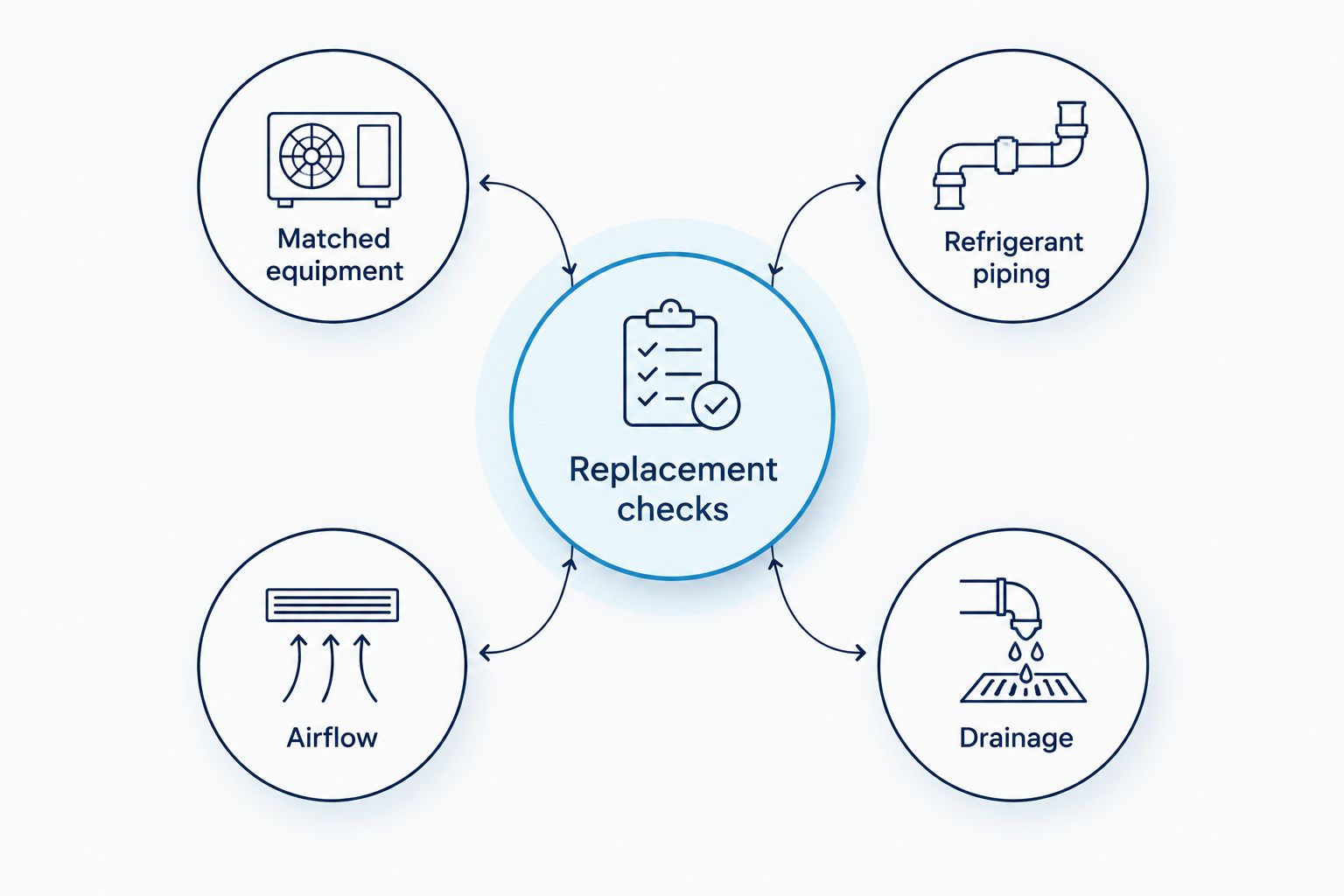
The written scope should also identify electrical work and responsibility for permits and inspections. Requirements depend on the property and local jurisdiction, so ask for the project-specific answer rather than a general promise.
R-22 replacement questions specific to coastal homes
Salt air can corrode outdoor coils and exposed metal. If your existing unit shows corrosion, ask how the new installation's placement and manufacturer-recommended maintenance will address coastal exposure. No equipment choice removes that exposure.
Humidity deserves equal attention. EPA moisture guidance recommends keeping indoor relative humidity below 60%, ideally between 30% and 50%. Treat that as a building-moisture guideline, not a guarantee that a particular AC will hold a fixed reading in every room.
For a home left empty during part of 2026, discuss how temperature and humidity will be monitored while you're away. Lowering the thermostat isn't a substitute for identifying air leaks, drainage problems, or incorrect airflow settings.
How these options are ranked
This 2026 guide ranks equipment approaches by comfort control, operating flexibility, and suitability for replacing an existing ducted system. It does not rank manufacturers by reliability or claim measured savings.
Variable-capacity equipment leads for adjustable output. Two-stage equipment fits homeowners who want a lower operating stage, while single-stage equipment fits straightforward cooling needs. Heat pumps belong in the comparison when heating is part of the decision.
A.R. Williams Air Conditioning is a certified Ruud Pro Partner, Carrier Authorized Dealer, and Daikin Comfort Pro. Those relationships don't replace a home assessment: the proposed equipment still needs to fit your ducts and cooling load.
Which R-22 replacement should you choose?
Start with a matched variable-capacity system if humidity and temperature swings are your main complaints. Compare a two-stage proposal if stepped output meets your needs, or single-stage equipment if your home's comfort is already consistent.
If electric-resistance heating is part of the existing setup, request a ducted heat pump comparison too. Before agreeing to work, ask A.R. Williams Air Conditioning to explain which existing components can stay and which need replacement.
Talk through your replacement options
Request an assessment and a clear explanation of the work your home needs.
FAQ
Do I have to replace my AC because it uses R-22?
No. Using R-22 alone doesn’t require replacing a working system. Base the decision on its condition, diagnosed faults, and whether a repair offers a sound long-term solution.
Can I put a different refrigerant into my R-22 AC?
You cannot assume another refrigerant is a direct substitute for R-22. Any conversion requires an equipment-specific assessment, and refrigerants must not be mixed.
Can I replace only the outdoor R-22 unit?
Only if the proposed equipment combination is specifically approved and compatible. Matching cooling capacity alone does not establish compatibility with the old indoor coil.
Is variable-capacity AC better than two-stage AC for humidity?
Variable-capacity AC offers finer output adjustment, which can support steadier humidity control. Correct sizing, blower settings, and control compatibility determine the result in your home.
Do I need new refrigerant lines when replacing R-22 equipment?
Not every replacement requires new piping, but existing lines must be evaluated. Condition, size, cleanliness, and manufacturer requirements determine whether reuse is appropriate.
Will a bigger replacement AC cool my house better?
A bigger AC is not automatically better. Excess capacity can cause short cooling cycles and poor moisture removal, so a cooling-load calculation should guide sizing.
Is a heat pump a good replacement for an R-22 air conditioner?
A ducted heat pump is worth comparing when you want cooling and heating from the replacement system. Choose its compressor design based on comfort needs, then verify heating controls and backup-heat requirements.
One last thing
Ask what will be checked after installation. Equipment selection is only part of the job; startup checks should confirm airflow, refrigerant setup, drainage, and control operation according to the manufacturer's instructions.
A.R. Williams Air Conditioning explains findings and options before work starts. Bring the replacement proposal back to one practical question: What will this installation do differently from the system that left my home uncomfortable?
Related guides
- How to tell if your AC needs repair or replacement
- Return air vent sizing for South Florida HVAC systems
- How to read your AC installation contract before signing
