

You cannot claim the federal Energy Efficient Home Improvement Credit for a new AC system placed in service in 2026. A return filed in 2026 can still include an eligible installation completed before 2026, so the installation date, not the filing date, determines which rules apply.
- The federal tax credit for new AC system installations does not apply to equipment placed in service in 2026.
- Filing a return in 2026 does not make an earlier qualifying installation ineligible.
- Utility rebates are separate from federal tax credits and need their own eligibility check.
- A.R. Williams Air Conditioning serves South Florida homeowners who want AC replacement options explained before work starts.
Can you claim a tax credit for a new AC system?
Not under Section 25C for a system placed in service in 2026. The IRS Energy Efficient Home Improvement Credit guidance reflects the termination established by Public Law 119-21. That change applies to qualifying home improvements, including central air conditioners and qualifying heat pumps.
Older articles and equipment brochures can describe incentives that no longer apply to a new installation. A qualifying efficiency rating under the former rules does not extend the credit into 2026.
| Your situation | Federal credit treatment | What to check |
|---|---|---|
| New central AC placed in service in 2026 | Section 25C credit is unavailable | Evaluate the installation without an assumed federal credit |
| New central ducted heat pump placed in service in 2026 | Section 25C credit is unavailable | Compare cooling, heating, and humidity performance |
| Eligible installation completed before 2026, return filed in 2026 | An earlier-year claim can still qualify | Use the IRS instructions for the installation's tax year |
| Equipment purchase with a utility rebate | Separate from Section 25C | Confirm the utility's current written requirements |
If replacement is still a decision rather than a scheduled project, start with how to tell if your AC needs repair or replacement. A tax incentive should not decide whether a repairable system needs replacing.
Why this matters before you sign an installation agreement
An assumed tax credit can make an installation proposal look different from what you will actually pay. Keep the contractor's invoice separate from any potential tax benefit or rebate.
For a 2026 installation, ask the contractor to explain the proposal without subtracting a Section 25C credit. If an incentive appears on the estimate, request its exact program name and written eligibility requirements.
You do not need to become a tax expert to choose an AC system. You need a clear scope of work, suitable equipment, and a realistic understanding of which incentives apply.
Does filing your taxes in 2026 mean your installation qualifies?
Filing in 2026 does not establish eligibility. A tax return generally reports activity from its applicable tax year, which is different from the calendar year when you submit it.
For example, a homeowner filing during 2026 could be reporting a qualifying installation completed before 2026. Another homeowner could purchase and install a new system during 2026. Those situations do not receive the same Section 25C treatment.
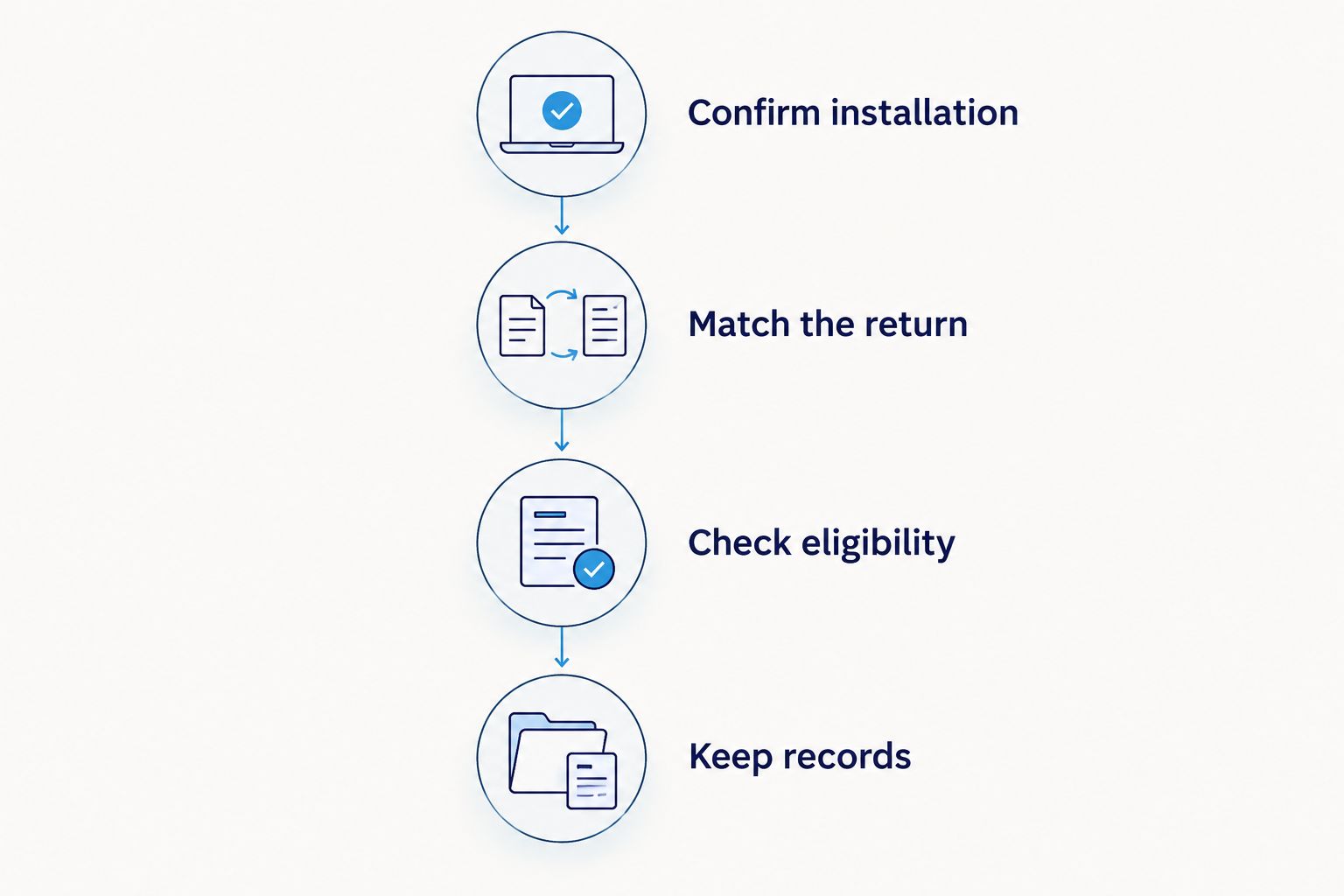
Use this sequence before preparing a claim:
- Confirm installation. Find the date the system was installed and ready for its intended use.
- Match the return. Identify the tax year associated with that completed installation.
- Check eligibility. Review the IRS rules for that year and the exact equipment installed.
- Keep records. Retain the invoice, equipment documentation, and completion records supporting the claim.
The IRS uses the term placed in service. For a home AC installation, focus on when the equipment was installed and ready to operate, rather than when you first requested an estimate.
A deposit, equipment order, or signed contract does not substitute for placing the system in service. Keep each date in your records so your tax preparer can distinguish the purchase process from the completed installation.
What if your system was installed before 2026?
An installation completed before 2026 needs a review under the rules that applied when it was placed in service. The credit's termination does not automatically erase an otherwise valid earlier-year claim.
However, replacing an AC system was never enough by itself to establish eligibility. The equipment, property use, installation timing, and taxpayer's circumstances all mattered.
Give your tax preparer the complete equipment information rather than a brand name alone. The indoor and outdoor components can affect the efficiency rating of the installed combination.
Which records should you gather?
Keep a single project folder with:
- The final installation invoice and proof of payment.
- The installation or completion date.
- Model numbers for the indoor and outdoor equipment.
- The manufacturer's applicable tax-credit documentation.
- The matched-system efficiency certificate, where relevant.
- Records of rebates or other incentives received.
Your tax preparer can determine whether IRS Form 5695 applies to the relevant return. Do not select a form's tax year simply because it matches the year you are filing.
If you already submitted the applicable return without a potentially eligible installation, ask a tax professional whether an amended return is appropriate. Eligibility and filing deadlines need a separate review.
Why AC incentive eligibility varies
The federal Section 25C termination is clear for installations placed in service in 2026. Other incentive questions still depend on the program and the project.
These factors explain why a neighbor's experience does not establish your eligibility:
- Installation timing. The completed installation date determines which federal tax-year rules apply.
- Equipment category. Central air conditioners and central ducted heat pumps had different requirements under the former credit.
- Matched equipment. A rating for one outdoor unit does not establish the rating of every indoor and outdoor combination.
- Property use. A primary residence, seasonal home, and rental property do not necessarily receive the same tax treatment.
- Program rules. A utility rebate has its own requirements, independent of the federal credit.
- Tax circumstances. A potentially eligible purchase does not establish the amount a particular taxpayer can claim.
For a seasonal home on the Treasure Coast, explain how you use the property when discussing tax treatment. A contractor can document the installation, but your tax preparer needs to assess the property's use.
Are utility rebates the same as an AC tax credit?
A utility rebate is not a federal tax credit. A rebate follows the utility program's terms, while a tax credit is claimed through a tax return under the applicable law.
Do not assume that the end of Section 25C means every other incentive has ended. Equally, do not assume that a rebate exists because the equipment is efficient or carries a familiar certification.
| Incentive type | How it works | Benefit | Limitation |
|---|---|---|---|
| Federal tax credit | Claimed on an eligible tax return | Reduces federal tax under applicable rules | Section 25C does not cover new 2026 installations |
| Utility rebate | Issued under a utility's program | Can support a qualifying equipment upgrade | Requires current program eligibility and documentation |
| Manufacturer promotion | Offered under the manufacturer's terms | Can apply to a specified purchase | Terms are offer-specific and separate from tax law |
Before you include a rebate in your decision, confirm who administers it and who submits the application. Ask whether approval is required before installation and what supporting records the program requires.
Keep the contractor's quoted total visible. An incentive application is a separate process, not a reason to leave the installation agreement unclear.
How should you choose a new AC without the federal credit?
Choose the system around your home's cooling needs and the installation quality. An incentive does not correct oversized equipment, restricted airflow, or a poorly designed duct connection.
A.R. Williams Air Conditioning provides residential AC installation and replacement, with technicians who explain their findings and lay out the options. That helps you compare the work itself rather than a proposal built around an assumed tax benefit.
Start with sizing and airflow
Ask how the contractor determined the required cooling capacity. A home's size matters, but so do windows, insulation, sun exposure, and air leakage.
An older house with a restricted return-air path needs an airflow assessment. Installing a larger system without addressing that restriction does not resolve the underlying problem.
Oversized equipment can cool the air quickly and shut off before removing enough moisture. For a humid home, temperature and moisture control belong in the same conversation.
Compare efficiency in the context of your home
SEER2 describes seasonal cooling efficiency under standardized test conditions. It is a comparison measure, not a promise about your electric bill.
The practical question behind choosing the right SEER rating is whether the efficiency upgrade fits the home's cooling demand. A rating discussion for another region does not establish the right equipment choice for a humid coastal Florida home.
Ask the contractor to explain the proposed system's efficiency using the matched indoor and outdoor equipment. Then discuss how airflow, duct condition, and your temperature settings affect actual operation.
Account for coastal exposure
Near the coast, salt air can corrode outdoor coils and metal components. Discuss equipment placement, manufacturer maintenance instructions, and access for cleaning before finalizing the installation.
For a home that sits empty during part of the year, humidity control also deserves attention. Explain your occupancy pattern so the contractor can discuss appropriate operation and maintenance.
Central AC or a central ducted heat pump: which fits your home?
Neither equipment category restores the Section 25C credit for a new 2026 installation. Choose between them based on the home's cooling and heating needs.
| System | Best for | Main benefit | Trade-off to discuss |
|---|---|---|---|
| Central AC | Homes needing cooling with a separate suitable heating arrangement | Provides cooling through the home's ducts | Does not provide heating by itself |
| Central ducted heat pump | Homes needing cooling and electric heating through the same duct system | Provides both functions | Requires an assessment of heating operation and controls |
Both options need correct sizing and adequate airflow. Neither a category name nor a higher efficiency rating guarantees comfortable upstairs bedrooms or balanced temperatures throughout the house.
Ask for an explanation of how the proposed equipment addresses your actual complaints. That is more useful than choosing equipment because an older brochure calls it tax-credit eligible.
What should your contractor explain before work starts?
A clear proposal identifies the equipment and the work needed to install it properly. It should also make exclusions understandable before you approve the job.
Ask about duct connections, electrical work, drainage, permits, and inspection responsibilities. Requirements depend on the local jurisdiction, so the proposal should identify who handles them rather than leave you to guess.
A.R. Williams Air Conditioning quotes transparent flat-rate pricing before work starts and explains the available options. The installation decision still belongs to you; tax eligibility belongs with your tax professional.
A.R. Williams Air Conditioning is best for South Florida homeowners who want residential AC replacement options explained before work starts. Request an estimate when you are ready to discuss your home's needs.
Talk through your AC replacement
Discuss equipment options and the installation work your home needs.
FAQ
Can I claim a tax credit for a new AC system installed in 2026?
No. The federal Section 25C Energy Efficient Home Improvement Credit does not apply to AC equipment placed in service in 2026. Check utility incentives separately.
Can I claim an earlier AC installation when I file in 2026?
Yes, an eligible installation completed before 2026 can still qualify on the applicable tax-year return. Filing in 2026 does not change the installation’s placed-in-service date.
Does buying the AC before 2026 qualify if installation happens later?
A purchase or deposit alone does not establish Section 25C eligibility. Equipment placed in service in 2026 falls outside the credit, even if you ordered it earlier.
Does an ENERGY STAR label guarantee an AC tax credit?
No. An ENERGY STAR label does not override the Section 25C termination for new 2026 installations. Earlier claims require a review of the applicable equipment and tax-year rules.
Does a central ducted heat pump still qualify for the federal credit?
A central ducted heat pump placed in service in 2026 does not qualify for Section 25C. A separate utility program must be evaluated under its own current terms.
What documents should I keep for an earlier eligible AC installation?
Keep the final invoice, installation date, equipment model numbers, and applicable manufacturer documentation. Your tax preparer can identify any additional records needed for the relevant return.
Can I deduct my new home AC as a normal household expense?
A personal home’s AC replacement is generally not deductible as an ordinary household expense. Rental or business use requires a separate tax review, and an improvement can affect your home’s tax basis.
One last thing
Keep the installation records even if no tax credit applies. A permanent home improvement can affect your home's tax basis, which is different from receiving a current tax deduction or credit.
Save the final invoice with your property records and retain the equipment details for future service. You should not have to reconstruct the installation when a tax preparer or technician needs the facts later.
Related guides
- Energy rebates for AC upgrades in Florida homes
- How to choose the right AC size for your home
- How to read your AC installation contract before signing
