

Yes, a new AC system can run for long periods during extreme heat, and a variable-speed system can run almost continuously at reduced output while keeping your home comfortable. Continuous operation needs attention when the house stays above the thermostat setting, humidity remains uncomfortable, or you notice ice, water leaks, or unusual sounds.
- A new AC system running constantly can be normal when variable-speed equipment maintains comfortable temperature and humidity.
- Continuous indoor fan operation does not prove the compressor is running continuously.
- A.R. Williams Air Conditioning recommends checking cooling performance before deciding whether long runtime indicates a problem.
- Ask your installer to verify airflow, thermostat setup, refrigerant charge, and sizing if comfort is poor.
Is it normal for a new AC system to run constantly?
It depends on the equipment and whether your home is actually getting comfortable. A single-stage system switches its cooling capacity on and off. A variable-speed system adjusts its output, so longer operation can be part of its normal design rather than evidence of a fault.
Before treating runtime as a sizing problem, review how to choose the right AC size for your home. A larger replacement is not automatically a better replacement.
| Central AC type | Best for | Why long operation happens | Benefit | Limitation |
|---|---|---|---|---|
| Single-stage | Homeowners who prefer straightforward on/off operation | The system stays on while the thermostat calls for cooling | Simple operating pattern | Cannot reduce compressor output to match a smaller cooling demand |
| Two-stage | Homeowners who want lower-output cooling with additional capacity available | The system can spend longer operating at its lower stage | More capacity adjustment than single-stage equipment | Has fewer output adjustments than variable-speed equipment |
| Variable-speed | Homeowners who prioritize steady comfort and humidity control | The system adjusts output and can run for extended periods at reduced capacity | Closely matches cooling output to changing demand | Needs compatible controls and correct setup to perform as intended |
Judge a new AC by temperature, humidity, and verified operation, not by how often the house becomes quiet. This applies to a 2026 installation whether you replaced a basic system with similar equipment or changed to variable-speed cooling.
Why this matters
A new installation changes what normal sounds and feels like. If your old AC shut off frequently, a quieter replacement that runs longer can seem wrong even when it is doing its job. The reverse also matters: new equipment does not make poor cooling acceptable.
In South Florida, the system must remove moisture as well as heat. A home that reaches the thermostat setting but still feels sticky needs a different investigation from a home whose temperature keeps rising.
You do not need to diagnose either problem yourself. You need observations that help the installer separate expected operation from a setup, airflow, or equipment issue.
Single-stage AC: long runs during high demand
A single-stage compressor operates at one cooling output when it is on. During the hottest part of the day, the system can run for extended periods because heat keeps entering through the roof, walls, windows, and doors.
Long operation is easier to explain when the indoor temperature holds steady near your setting. It deserves a closer look when the temperature continues climbing, especially if the problem persists after outdoor conditions become less demanding.
Do not compare your system's runtime with a neighbor's. Different windows, insulation, ductwork, and thermostat settings change the load. Even similar-looking houses can require different amounts of cooling.
Two-stage AC: longer operation at lower output
A two-stage system has a lower cooling stage and a higher cooling stage. It can stay in the lower stage for longer periods instead of repeatedly switching all cooling on and off.
That operating pattern can support more even comfort. However, if the house needs additional cooling and the equipment never delivers it, the technician should verify thermostat configuration and staging operation.
For a two-stage system installed in 2026, ask the installer to explain how your particular thermostat displays cooling demand. A generic cooling symbol does not necessarily tell you which stage is operating.
Variable-speed AC: near-continuous operation can be expected
A variable-speed compressor changes its output to match demand. Instead of delivering the same cooling capacity every time it starts, it can operate at reduced output for longer periods.
That is why a new system can sound as though it never stops while the temperature remains steady. Longer cooling operation also gives the indoor coil time to remove moisture, provided airflow and controls are set correctly.
Long runtime is not proof of high energy use. Equipment output and electrical demand matter alongside operating time. A system running gently for longer is not directly comparable with a different system repeatedly running at full output.
Still, variable-speed technology is not an explanation for every comfort complaint. Persistent warmth, clammy rooms, or icing calls for an inspection rather than reassurance based only on the equipment type.
Why a new AC system's runtime varies
These factors help explain why your replacement runs differently from the previous system. They also give the technician a useful starting point when performance falls short.
- Outdoor heat and sunlight: Strong afternoon sun increases the heat entering your home. Rooms with large sun-facing windows can be harder to cool than shaded rooms.
- Indoor moisture: Humid outdoor air entering through open doors or leaks adds moisture the AC must remove. Temperature alone does not describe the full cooling job.
- Thermostat settings: A large change in the requested temperature creates a longer cooling demand. Schedules and humidity settings also affect operation.
- Equipment design and setup: Single-stage, two-stage, and variable-speed systems operate differently. The thermostat must be configured for the installed equipment.
- Airflow and duct condition: Restricted returns, blocked filters, and leaking ducts affect how much cooling reaches the rooms. New equipment does not correct those conditions by itself.
- Sizing and installation quality: Equipment capacity must match the home's cooling load. Refrigerant charge and airflow also need verification during installation.
Older local homes sometimes have return-air paths that were never improved during previous replacements. If the new equipment connects to the same restrictive ductwork, replacing the outdoor unit alone does not remove that restriction.
A seasonal home presents another situation. After the house has been kept warmer while vacant, the AC must cool the building materials and furnishings as well as the air. That recovery differs from maintaining an already comfortable house.
What can you check without opening the equipment?
Start with the thermostat and your observations. Leave electrical panels, refrigerant connections, and internal adjustments to a technician.
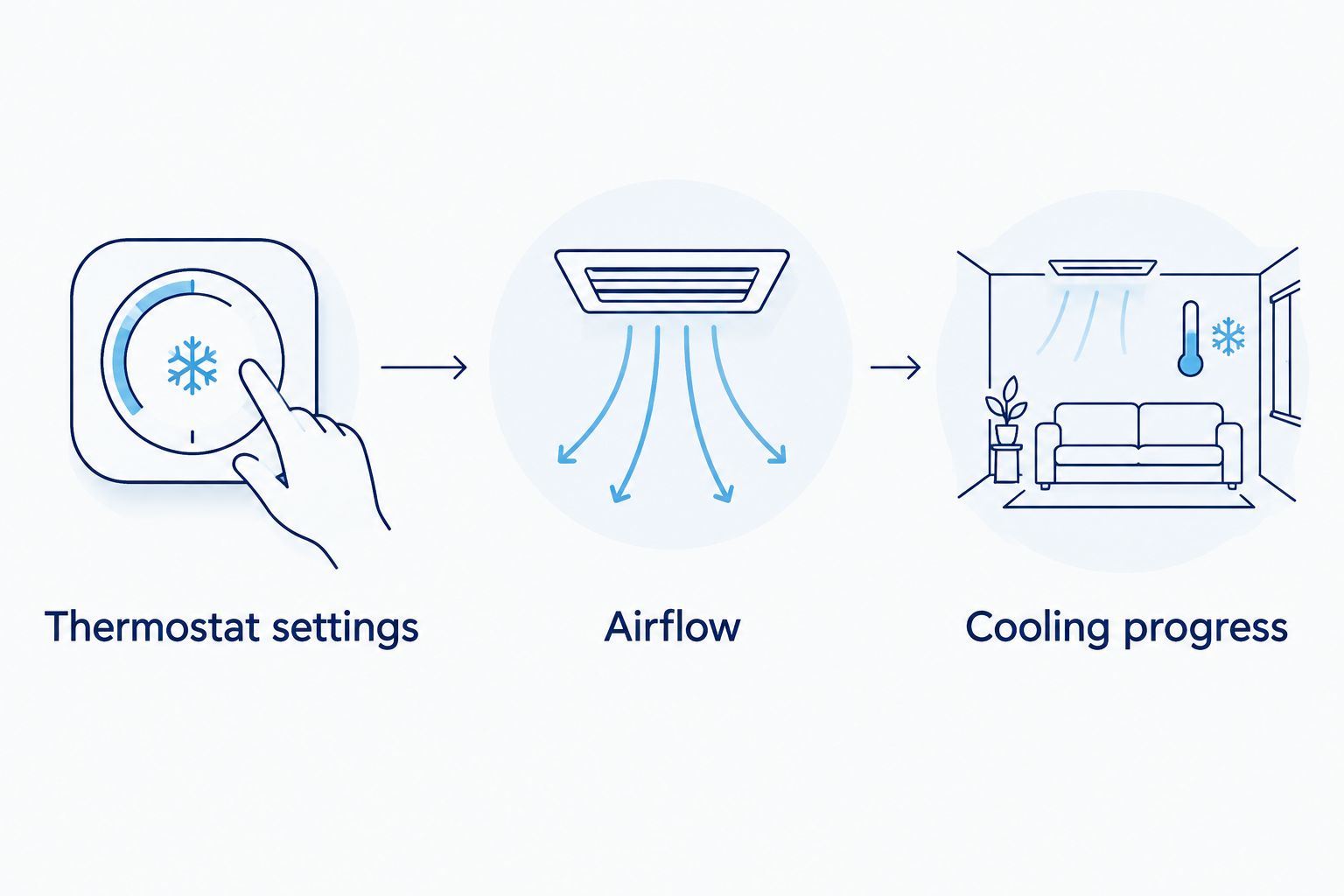
- Thermostat settings: Confirm that cooling is selected and review the schedule. Check whether the fan is set to continuous operation rather than automatic operation.
- Airflow: Look for furniture blocking returns or supply vents. Check the accessible filter according to the equipment instructions, without removing service panels.
- Cooling progress: Note the displayed room temperature, requested temperature, and whether rooms feel less humid. Record whether the concern happens only in afternoon heat or continues into cooler conditions.
The indoor fan and the compressor are separate components. Air moving from the vents does not prove the outdoor compressor is producing cooling continuously. Some systems also use a fan run-on period after cooling stops.
Avoid repeatedly lowering the thermostat to force colder air. A lower setting extends the request for cooling; it does not correct restricted airflow or an installation problem.
If you see ice, stop cooling and contact the installer. Do not chip it away or keep restarting the system to test it. Report water leakage and repeated breaker trips as well, and avoid repeatedly resetting a tripped breaker.
What should the installer verify?
Ask for findings tied to your equipment rather than a general statement that new systems run longer. The technician should establish whether the system is operating as designed and whether the home is receiving the expected cooling.
Useful checks include the following:
- Confirm that the thermostat recognizes the equipment type and operates the available cooling stages or capacity controls.
- Measure airflow and check resistance through the duct system, often called static pressure.
- Verify refrigerant charge using the manufacturer's procedure under suitable operating conditions.
- Inspect accessible duct connections for leakage, disconnections, or restrictions.
- Review the cooling-load calculation if system capacity is in question.
- Explain whether any humidity-control settings affect runtime and fan operation.
Ask the technician to explain what each finding means for your home. A measurement is useful when it supports a diagnosis, not when it appears on a worksheet without context.
For a 2026 replacement, keep the equipment model information and startup documentation with your installation paperwork. These records help distinguish a change in performance from an operating pattern that has been present since installation.
Does constant running mean the new AC is too small?
Constant running alone does not establish that the AC is undersized. A system operating near its design load can run for long periods, while variable-speed equipment can run longer by reducing output.
Sizing becomes a stronger concern when the system cannot maintain the intended indoor conditions after the technician rules out installation and airflow problems. The appropriate check is a home cooling-load calculation, not a capacity estimate based only on floor area.
Do not accept a larger unit as the automatic solution. Oversized equipment can cool the air quickly and stop before providing adequate moisture removal, particularly when the cooling demand is lower.
Should you turn off a new AC that keeps running?
You do not need to turn off a new AC solely because it runs for a long time while maintaining comfort. First establish whether you are hearing the indoor fan or observing an actual continuous cooling demand.
Stop cooling and arrange an inspection if ice develops. If you notice smoke or a burning electrical smell, stop using the equipment and seek qualified help. Do not open electrical compartments to investigate.
How do you get a clear answer without feeling pressured?
Start with the installing contractor and describe the performance problem, not just the runtime. Say whether the home reaches the setting, which rooms stay warm, and whether humidity feels different from before the replacement.
A.R. Williams Air Conditioning is best for homeowners who want an explained AC diagnosis before choosing a repair. Technicians explain their findings and lay out the options, with flat-rate pricing quoted before work starts.
A.R. Williams Air Conditioning provides AC repair, installation, and maintenance. A newly installed system still needs equipment-specific testing; a symptom description alone does not establish whether the cause is sizing, setup, or a component fault.
If your 2026 installation is not keeping the home comfortable, request a review of its operation before agreeing to equipment changes. Ask what was measured, what failed the manufacturer's requirements, and how the proposed work addresses that finding.
You can talk with a technician when you want help separating expected long operation from a cooling problem. Keep your installation documents available so the conversation starts with the equipment you actually have.
FAQ
Why does my new AC run longer than my old one?
Your new AC can run longer because its compressor design, thermostat settings, or cooling capacity differs from the old system. Variable-speed equipment often operates longer at reduced output, so compare comfort and humidity rather than runtime alone.
Is it normal for a new AC to run all afternoon?
Long afternoon operation can be normal during high outdoor heat when the system maintains the intended indoor conditions. A rising indoor temperature, ice, or poor airflow needs an installer review.
Why is my new AC running but the house still feels humid?
Persistent humidity can result from airflow settings, equipment sizing, moisture entering the home, or control configuration. Ask the technician to evaluate moisture removal rather than treating the thermostat temperature as the only measure of performance.
Does setting the fan to on make the AC run constantly?
Setting the fan to on can keep indoor air moving even when the compressor is not cooling. Automatic fan operation generally follows cooling demand, although equipment-specific fan delays and control settings also affect operation.
Should a brand-new AC need more refrigerant?
A new AC needs the refrigerant charge specified for its installation, and an incorrect initial charge or a leak requires investigation. Refrigerant is not a fuel that normal operation consumes.
Will lowering the thermostat make my new AC cool faster?
Lowering the thermostat does not fix insufficient cooling or restricted airflow. It requests a lower room temperature and can extend operation; keep a steady setting while the installer evaluates performance.
Does a new AC need a break-in period before it cools properly?
A new AC should provide cooling when installation and startup are complete. A warm house can take time to cool down, but persistent poor performance should not be dismissed as a break-in requirement.
One last thing
The sound you notice most can be the indoor blower, not the compressor. Before reporting that the new AC never stops, tell the technician whether the thermostat still shows a cooling demand and whether the house is comfortable.
For a system installed in 2026, that distinction makes the follow-up conversation more useful. A.R. Williams Air Conditioning can help you understand the findings and choose the next step without treating long runtime alone as a reason for replacement.
Related guides
- How to fix an AC that's running but not cooling
- Can an oversized AC unit raise indoor humidity?
- Return-air vent sizing for South Florida HVAC systems
