

The cost to replace an AC capacitor depends on the correct part, diagnosis, installation, and the company's service terms. A part-only listing doesn't cover the complete repair, and a failed capacitor alone doesn't justify replacing your AC system. For a 2026 estimate, ask for a written installed quote that states what's included before you approve the work.
- How much does a capacitor cost for an AC unit? Compare installed repair quotes, not standalone parts.
- A.R. Williams Air Conditioning offers AC repair with flat-rate pricing quoted before work starts.
- A failed capacitor alone is not a reason to replace an otherwise serviceable central AC system.
- Ask for the test result, the correct replacement specifications, and confirmation that cooling works after repair.
Why this matters
When your home is warming up, a capacitor diagnosis can sound reassuring because it identifies a replaceable component. The next question is whether the proposed repair actually explains the cooling problem. You deserve that explanation before making a decision.
Humming, trouble starting, and an outdoor fan that isn't turning are clues, not proof. Our guide to how to tell if your AC capacitor needs replacing explains the symptoms to describe to a technician. Leave the electrical compartment closed.
Compare the scope of the repair before comparing quotes. A clear estimate connects the failed component to the symptom and explains what the technician will verify afterward.
How much does it cost to replace an AC capacitor?
An installed capacitor replacement quote covers more than the component. It should explain the diagnostic charge, replacement work, and any separate work the technician recommends. Those items aren't necessarily billed separately, especially with flat-rate pricing, but you should understand what's included.
For a 2026 quote, use this checklist to separate the capacitor repair from unrelated recommendations:
| Quote item | What you need to know | What to ask |
|---|---|---|
| Diagnosis | How the technician confirmed the capacitor failed | What did the capacitor test show? |
| Replacement component | Whether the part meets the equipment's requirements | Does this match the manufacturer's specifications? |
| Installation | Whether the quoted repair includes fitting and connecting the part | Is installation included in this quote? |
| Operating check | Whether the system starts and cools after repair | What will you check before finishing? |
| Service or diagnostic charge | Whether a separate charge applies | Is that included or separate? |
| Additional repairs | Whether another fault requires separate approval | Which work fixes the current problem? |
Ask whether any diagnostic charge is included in the repair authorization or handled separately. Don't assume the arrangement is the same between companies.
An estimate can be clear without listing a separate amount for every task. What matters is that you understand the total scope, any exclusions, and what happens if testing uncovers another problem.
Why capacitor replacement quotes vary
Differences between quotes should have an explanation. Ask the technician to identify which of these factors applies to your system:
- Capacitor type: A run capacitor and a start capacitor serve different purposes. The replacement must suit the equipment.
- Required specifications: Capacitance, measured in microfarads, describes the capacitor's electrical capacity. The voltage rating also has to meet the equipment requirements.
- Diagnostic work: A starting problem can involve the capacitor, motor, electrical connections, or power supply. Testing establishes the repair scope.
- Equipment access: The technician needs safe access to the outdoor unit and its electrical compartment.
- Condition of surrounding components: Damaged wiring or deteriorated connections require their own explanation and repair authorization.
- Service and warranty terms: Ask how diagnostic work, installation, and any applicable coverage are handled.
The useful comparison is between quotes for the same confirmed fault. A capacitor replacement and a capacitor replacement with additional electrical repairs are different jobs.
Run capacitors and start capacitors need different checks
A run capacitor supports operation of the motor it serves. A start capacitor provides starting assistance in equipment designed to use one. Some central AC systems use a dual run capacitor, which serves both the compressor and outdoor fan motor.
You don't need to identify or order the part yourself. The technician should use the equipment requirements and testing to choose the replacement.
| Component | Purpose | Best for | Important limitation |
|---|---|---|---|
| Single run capacitor | Supports one motor circuit during operation | Equipment designed for a separate run capacitor | Must match that circuit's requirements |
| Dual run capacitor | Supports compressor and outdoor fan motor circuits in one component | Equipment designed for a dual run capacitor | Both circuit ratings must be correct |
| Start capacitor | Provides starting assistance | Equipment designed to use a start capacitor | Does not substitute for a run capacitor |
The correct capacitor is the one specified for the equipment, not simply one that fits inside the cabinet. Ask the technician to explain the choice in plain language. A physically similar part isn't enough to establish compatibility.
What a proper capacitor repair should include
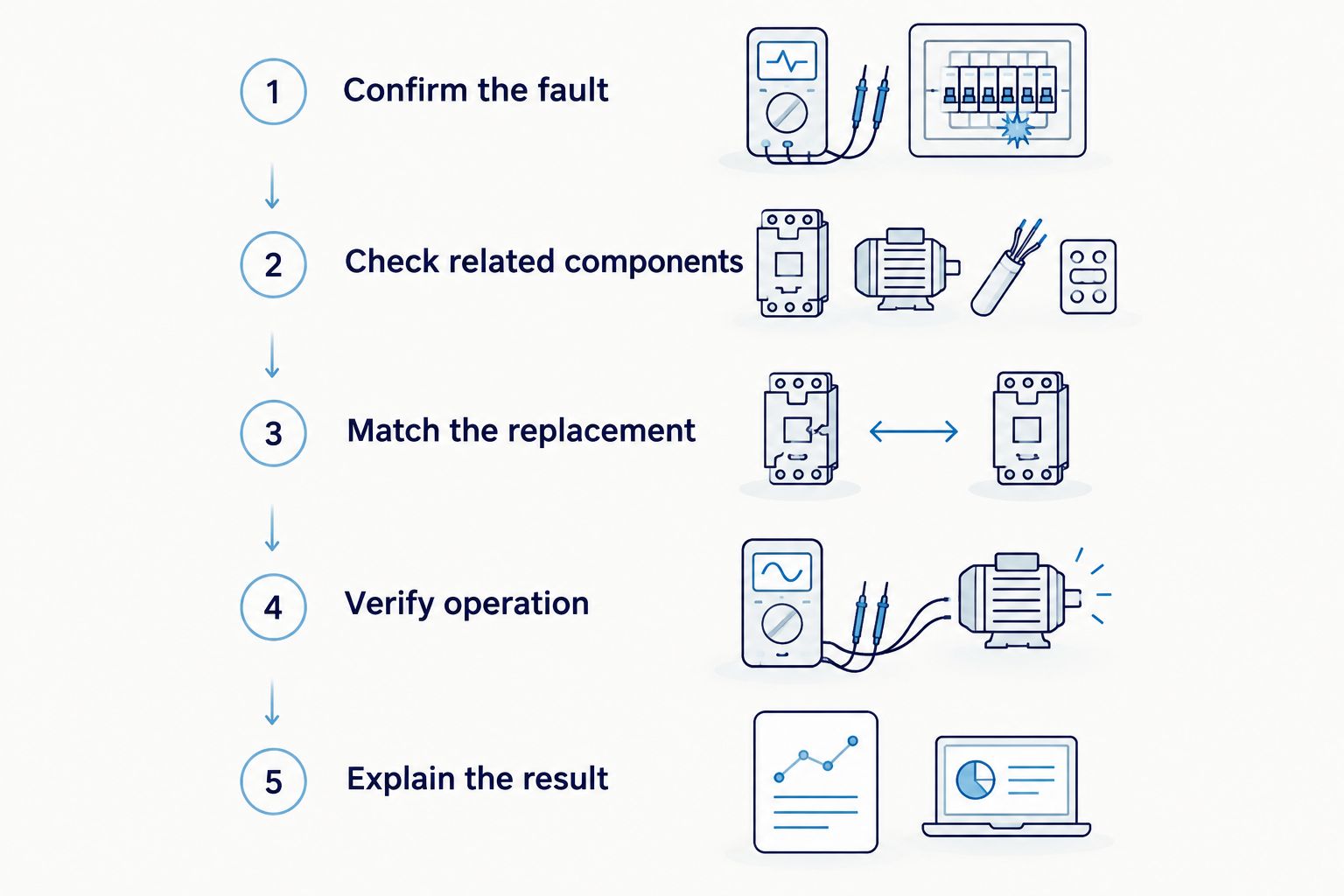
You aren't expected to inspect electrical work. You can still ask for a clear account of the diagnosis and a demonstration that the system operates afterward.
- Confirm the fault. The technician tests the capacitor and checks whether the result explains the symptom you reported.
- Check related components. The technician considers the motor, electrical connections, and other relevant causes rather than assuming the capacitor explains everything.
- Match the replacement. The replacement meets the equipment's capacitance and voltage requirements.
- Verify operation. After installation, the technician checks starting, fan operation, and cooling performance as appropriate.
- Explain the result. You receive a description of the repair and any separate findings that need attention.
A successful startup is useful evidence, but it isn't the whole check. The system also needs to operate correctly after it starts. If the outdoor fan runs but the house still isn't cooling, the technician should investigate the remaining symptom rather than declare the job finished.
For symptoms that continue after a repair, see how to address an AC that's running but not cooling. Describe what changed after the service visit and what stayed the same.
Is a capacitor repair enough, or should you replace the AC?
A failed capacitor alone doesn't establish that your AC needs replacement. The decision should reflect the condition of the whole system, including confirmed faults and its ability to cool your home properly.
Ask the technician to separate the current repair from any longer-term recommendation. That distinction helps you decide without treating every worn component as proof that the entire system is finished.
| Option | Best for | Benefit | Limitation |
|---|---|---|---|
| Capacitor replacement | A confirmed capacitor fault in an otherwise serviceable system | Addresses the failed component without replacing the system | Doesn't correct unrelated motor, refrigerant, or airflow problems |
| Additional diagnosis | Symptoms or test results that don't fully explain the failure | Establishes what the system actually needs | Adds diagnostic work before the repair scope is settled |
| System replacement evaluation | A system with broader documented condition or performance problems | Examines whether replacement addresses the overall issues | Is a larger decision that needs evidence beyond a capacitor failure |
A replacement recommendation should identify the underlying reasons. Ask what else is wrong, how it was confirmed, and whether the capacitor repair would restore normal operation.
Don't accept age alone as the explanation for the immediate fault. Equally, don't assume a new capacitor resolves a separate compressor or motor problem.
Can you replace an AC capacitor yourself?
Capacitor replacement belongs with a qualified HVAC technician. A capacitor can retain an electrical charge after power is disconnected, and opening the cabinet exposes other electrical hazards.
Turning the thermostat off doesn't make the electrical compartment safe to handle. Don't touch terminals, move wires, or try to start a stalled fan with an object through the grille.
You can help without attempting the repair. Note whether the indoor blower runs, whether the outdoor unit makes a sound, and whether the thermostat is requesting cooling. Share observations from outside the closed cabinet and keep your hands away from moving parts.
If the unit repeatedly tries to start without operating normally, stop cooling at the thermostat and arrange a diagnosis. Repeated attempts won't repair the failed component.
Does a capacitor failure mean the compressor is bad?
A capacitor failure doesn't prove the compressor is bad. A failed capacitor can prevent a motor from starting correctly, so the technician needs to test before identifying a larger failure.
Ask what evidence supports the compressor diagnosis and whether the capacitor was checked. Humming alone doesn't distinguish between these faults.
Will a new capacitor fix warm air from the vents?
A new capacitor fixes warm air only when the capacitor fault caused the cooling problem. Warm air also has other causes, including airflow restrictions and refrigerant-related problems.
Ask the technician to verify cooling after the repair. A spinning outdoor fan isn't proof that the compressor is operating or that the system is removing heat correctly.
Does warranty coverage include capacitor replacement?
Warranty coverage depends on your equipment registration and the terms that apply to the repair. Parts coverage doesn't automatically establish coverage for diagnosis or installation labor.
When reviewing a 2026 repair estimate, ask the company to identify any applicable coverage and explain what remains outside it. Keep the repair invoice with your equipment records.
What matters for coastal and seasonal homes
Near the coast, salt air can corrode outdoor equipment. That doesn't prove salt exposure caused a capacitor failure, but it makes the condition of nearby connections and the cabinet relevant to the inspection.
For a home that sits empty seasonally, ask someone to verify actual cooling after the visit. A thermostat setting by itself doesn't show that the home is reaching the requested temperature. Keep the service record so a future technician can see what was replaced.
Avoid drawing conclusions from the weather alone. Heat, storms, and coastal exposure provide context, but the repair recommendation should come from the condition and test results of your equipment.
Getting a clear answer without pressure
A.R. Williams Air Conditioning is a fit for homeowners who want AC repair explained before they approve the work. Technicians explain their findings and lay out the options, with transparent flat-rate pricing quoted before work starts.
A.R. Williams Air Conditioning's AC repair approach gives you a defined repair proposal. The important boundary is that a capacitor replacement doesn't correct a separate fault, so ask which findings the proposal addresses and which need a different decision.
Request an explanation you can understand. You should leave the conversation knowing why the part needs replacement, what the approved work includes, and how the technician will confirm the result.
FAQ
How much does a capacitor cost for an AC unit in 2026?
For a 2026 repair, compare written installed quotes rather than standalone capacitor listings. Ask whether diagnosis, installation, operating checks, and any separate service charge are included.
How can I tell whether my AC capacitor is bad?
Trouble starting, humming, or a stationary outdoor fan can point to a capacitor problem, but they don’t confirm it. A technician needs to test the capacitor and check other possible causes.
Can a bad capacitor stop my AC from cooling?
Yes, a failed capacitor can prevent the compressor or outdoor fan motor it serves from operating correctly. The technician should confirm which component is affected and verify cooling after repair.
Can I keep running my AC with a bad capacitor?
Don’t keep asking an AC that fails to start normally to run. Stop cooling at the thermostat and have the fault diagnosed rather than repeatedly restarting it.
Should I replace the whole AC because the capacitor failed?
No, capacitor failure alone doesn’t justify replacing the whole AC. A replacement recommendation needs evidence about the system’s broader condition or performance.
Why did my new capacitor fail again?
A repeat failure needs a new diagnosis rather than an assumption that another replacement will solve it. Ask the technician to check replacement specifications, electrical connections, and the motor circuit involved.
Does a capacitor replacement include adding refrigerant?
Capacitor replacement is an electrical repair and doesn’t itself require adding refrigerant. Any refrigerant recommendation should have a separate diagnostic explanation.
One last thing
Keep the invoice description, not just the payment receipt. A record of the failed component, replacement specifications, and operating checks helps explain a repeat problem without starting from guesswork.
For a 2026 service visit, ask A.R. Williams Air Conditioning to explain the test result and the proposed repair. You don't need to become an HVAC expert to make a sound decision. You need a confirmed fault and a clear plan to fix it.
Related guides
- How to tell if your AC needs repair or replacement
- How to get a second opinion on an AC replacement quote
- AC maintenance for coastal homes with salt air exposure
