

The cost to replace old ductwork depends on how much ductwork needs replacing, how accessible it is, and whether the air distribution system needs redesigning. A useful 2026 estimate separates duct replacement from return-air changes, removal, testing, and any ceiling or wall repairs. Ask for an inspected, written scope before deciding on partial or full replacement.
- The cost to replace old ductwork depends on replacement scope, access, and airflow corrections, not age alone.
- Compare ductwork replacement estimates by included work, materials, and testing, rather than the total alone.
- A.R. Williams Air Conditioning explains AC service findings and options before work starts.
- For a 2026 project, require a written distinction between duct replacement and unrelated AC repairs.
How much does it cost to replace old ductwork?
Your home's duct replacement estimate should reflect the actual condition and layout of the system. Replacing a damaged bedroom branch is a different job from removing the entire network and correcting an undersized return. Square footage alone does not describe either project well enough.
Start with an inspection that identifies what is damaged, what remains usable, and why the proposed work will solve the problem. The guide to ductwork replacement for older South Florida homes explains the broader replacement decision. Your estimate should then turn those findings into a specific scope.
Use this breakdown to check what you are being asked to approve:
| Estimate item | What the written scope should explain | What to clarify |
|---|---|---|
| Removal and disposal | Which existing ducts and insulation will be removed | Whether inaccessible sections will remain |
| Replacement materials | Duct type, insulation, and connection methods | Whether the proposal covers complete runs or selected sections |
| Installation labor | Routing, supports, connections, and access work | Whether wall or ceiling openings are required |
| Return-air corrections | Changes to the paths that bring air back to the equipment | Whether existing returns remain unchanged |
| Testing and adjustment | How leakage and airflow will be checked | Whether room-by-room adjustment is included |
| Related work | Permit responsibilities and any finish repairs | Which tasks belong to another contractor |
A total without a scope is not enough to compare proposals. Ask the contractor to identify exclusions before you sign, especially when ducts run behind finished surfaces.
Why this matters
Old ducts do not automatically need replacement. Their condition and ability to move the required air matter more than age alone. A sound system with an isolated loose connection needs a different response from widespread damaged insulation or disconnected runs.
The distinction protects you from replacing usable components. It also protects you from accepting a small repair that leaves a larger airflow problem unresolved. The goal is a durable fix that addresses the cause of discomfort.
For a 2026 replacement decision, keep the equipment diagnosis separate from the duct diagnosis. Weak cooling can involve the AC equipment, the air distribution system, or both. Replacing ducts does not fix a refrigerant problem, and replacing an AC does not fix a crushed duct.
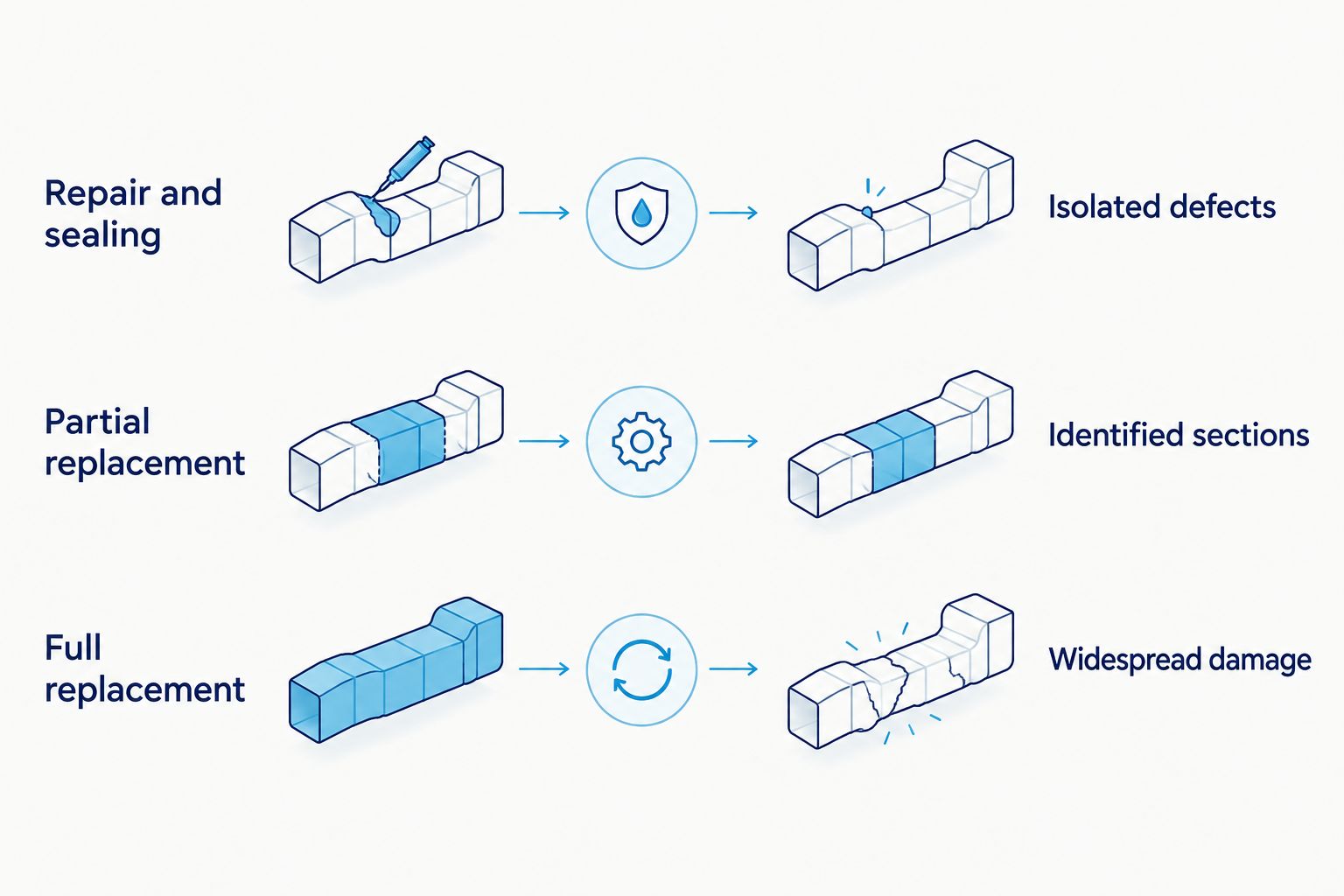
Repair and sealing: best for sound ducts with isolated defects
Repair and sealing fit ducts that remain structurally sound but have specific damaged connections or localized leaks. The technician should identify the defect and explain how the proposed repair restores a sealed, supported air path. Ask to see photographs when the problem is in an attic you cannot safely access.
The advantage is preserving usable ductwork. The limitation is that sealing does not correct an undersized layout, deteriorated material, or extensive damage. Cleaning also cannot reconnect a detached duct or restore failed insulation.
Choose repair only when the inspection supports keeping the existing duct system. A repair proposal should identify both the problem being corrected and the condition of the sections being left in place.
Partial replacement: best for damage confined to specific runs
Partial replacement fits a system with damaged sections and a usable remainder. For example, a crushed branch serving a bedroom deserves inspection without assuming every duct in the home has failed. The replacement section still needs to work with the existing equipment and layout.
Its advantage is a focused scope. Its limitation is that remaining ducts still determine part of the system's performance. New material attached to an inadequate return path will not resolve that return restriction.
Ask the contractor to label the sections being replaced and retained. Approve partial replacement when the remaining ducts have been assessed, not simply left out of the estimate.
Full replacement: best for widespread damage or a failed layout
Full replacement fits systems with widespread deterioration or layouts that require substantial correction. It gives the contractor an opportunity to address routing, duct sizing, insulation, and connections together. That is especially relevant when previous additions have changed how the home uses conditioned air.
The tradeoff is a larger installation scope and more disruption. Access limitations still matter, and finish repairs need a clear owner. Full replacement also does not automatically require new AC equipment.
Choose full replacement when documented findings justify replacing the network. Ask which problems a partial approach would leave unresolved.
Compare the approaches before choosing
| Approach | Best for | Main advantage | Main limitation |
|---|---|---|---|
| Repair and sealing | Sound ducts with isolated defects | Preserves usable components | Does not correct widespread deterioration or an inadequate layout |
| Partial replacement | Damage confined to identified sections | Targets the affected air paths | Retained sections still need assessment |
| Full replacement | Widespread damage or substantial layout problems | Allows coordinated corrections | Involves a broader installation and access scope |
These are condition-based choices, not a ranking from good to bad. Your inspection should establish which approach fits the house. A contractor should explain why the alternatives do or do not solve the identified problem.
Why the cost to replace old ductwork varies
The work needed to produce a dependable result differs from house to house. These factors explain why two proposals can describe very different projects, even for homes with similar floor plans:
- Extent of replacement: Selected branches, the main distribution ducts, and the return system are different scopes. Have each included component identified.
- Access: A workable attic route differs from ducts behind drywall or above a finished ceiling. Ask how the contractor will reach each section.
- Material and insulation condition: Damaged insulation and deteriorated duct material require more than sealing a joint. The replacement specification should address both the air path and its insulation.
- Layout corrections: Undersized returns, restrictive bends, and poorly routed branches require design decisions. Copying the old layout can preserve the old problem.
- Removal and restoration: Disposal, access openings, and finish repairs need explicit responsibility. Do not assume every trade's work is included.
- Testing and local requirements: Ask what performance checks and applicable permits the proposed work includes. Requirements depend on the project's scope and the responsible local authority.
For 2026 proposals, compare these items side by side. If one contractor includes return corrections and another leaves the returns untouched, the proposals are not equivalent.
What makes duct replacement different in local homes?
In a hot, humid attic, the duct's insulation and outer moisture barrier matter. The moisture barrier is the outer layer that helps keep humid air away from cold surfaces. Damage to that layer deserves attention when the technician evaluates condensation around ducts.
Older homes also deserve a close look at return-air paths. A return carries indoor air back to the equipment, and an undersized return restricts that flow. Read about return-air vent sizing if a proposal mentions enlarging a grille or adding a return.
Roof repairs and previous renovations are useful inspection clues. Ask whether ducts have been displaced, compressed, or rerouted around other work. Do not assume a duct is sound because it still reaches the room.
For seasonal homes, tell the technician about periods when the house sits unoccupied and any moisture or odor you notice on returning. Those observations help direct the inspection. They do not establish that all ducts need replacement.
What should happen before you approve the work?
A clear process makes the decision easier without requiring you to become an HVAC expert. Keep the discussion focused on evidence and the result you expect.
- Describe the problem. Identify rooms that stay warm, weak airflow, visible condensation, or changes after a renovation. Tell the technician whether the problem is constant or appears under particular conditions.
- Review the findings. Ask for photographs of damaged sections and a plain explanation of any airflow measurements. A photograph shows physical condition; measurements help explain how the system operates.
- Confirm the proposed correction. Have the contractor distinguish replacing damaged material from changing duct size or routing. Ask what will remain untouched.
- Review the written scope. Check removal, installation, insulation, return work, testing, and exclusions. Resolve responsibility for access openings and finish repairs before scheduling.
- Agree on the completion checks. Ask how the contractor will verify the identified problem has been addressed. An installation should be checked in operation, not judged only by its appearance.
Before approving a 2026 project, make sure the explanation matches the written proposal. If the technician discusses return changes but the document only lists replacement branches, ask for clarification.
You should also know how the work affects your household. Ask which areas need to be clear, whether the AC will be unavailable during installation, and how the work area will be protected. Get project-specific answers rather than assuming a standard schedule.
Can I keep my existing AC when replacing ducts?
You can keep existing AC equipment when its condition and capacity remain appropriate and the replacement ducts are designed to work with it. Duct damage alone does not establish that the outdoor unit or air handler needs replacing. Request separate findings for each recommendation.
If equipment replacement is also proposed, ask how its airflow requirements affect the duct design. A larger unit is not a substitute for correcting an inadequate air path. The equipment and ducts need to work as a system.
Will new ductwork fix rooms that stay warm?
New ductwork addresses warm rooms when damaged, restrictive, or poorly designed ducts are the cause. The inspection still needs to consider return paths, equipment performance, and the room's cooling needs. Replacing material without identifying the cause leaves the outcome uncertain.
Tell the technician about closed bedroom doors, additions, and rooms with substantial sun exposure. Those details help explain why one room behaves differently from another. Ask how the proposed correction addresses that specific room.
How do I compare estimates without feeling pressured?
Compare written scopes before comparing totals. Ask each contractor to explain why repair, partial replacement, or full replacement fits the inspection findings. You do not need to approve a broader project simply because it was presented first.
A.R. Williams Air Conditioning AC service is best suited to homeowners who want findings explained and options laid out before work starts. The company quotes transparent flat-rate pricing before work begins. A clear explanation should still distinguish the diagnosed problem from optional work.
Even with A.R. Williams Air Conditioning, ask what the proposed work excludes. No duct-only scope resolves unrelated equipment faults or automatically includes ceiling restoration. Understanding those boundaries helps you choose the right work without surprises.
FAQ
What’s included in a ductwork replacement estimate?
A ductwork replacement estimate should identify removal, replacement materials, installation, insulation, and completion testing. It should also state whether return changes, permits, and wall or ceiling repairs are included or excluded.
Do old ducts always need to be replaced?
Old ducts do not always need replacement. Their physical condition, leakage, insulation, and ability to deliver the required airflow determine whether repair or replacement is appropriate.
Is duct sealing better than replacing the ducts?
Duct sealing fits structurally sound ducts with leaks at joints or connections. Replacement addresses damaged material or a layout that sealing cannot correct.
Can I replace only the ducts going to one bedroom?
You can replace a bedroom branch when the damage is isolated and the remaining system is suitable. The technician should also check the room’s return-air path and confirm that the branch is the cause of weak cooling.
Does replacing ductwork mean I need a new AC?
Replacing ductwork does not automatically require a new AC. Equipment condition and capacity need a separate assessment, and the replacement ducts must match the equipment’s airflow requirements.
Will duct replacement get rid of a musty smell?
Duct replacement addresses a musty smell only when the affected duct material is the identified source. Moisture around the equipment or elsewhere in the home needs its own diagnosis and correction.
What should I check before signing a duct replacement proposal in 2026?
Before signing a 2026 duct replacement proposal, check exactly which ducts will be replaced and which will remain. Confirm insulation, return changes, testing, exclusions, and responsibility for any finish repairs.
One last thing
A new supply duct cannot fix every return-air restriction. Air delivered to a bedroom needs a suitable path back to the equipment, particularly when the door is closed. Ask about the return path before approving replacement of a warm room's supply duct.
Talk with a technician at A.R. Williams Air Conditioning about the symptoms and request an explanation of the findings. You should leave that conversation knowing what needs correcting and why the proposed scope fits your home.
Related guides
- How to choose the right AC size for your home
- How to get a second opinion on an AC replacement quote
- How to reduce indoor humidity without overworking your AC
