
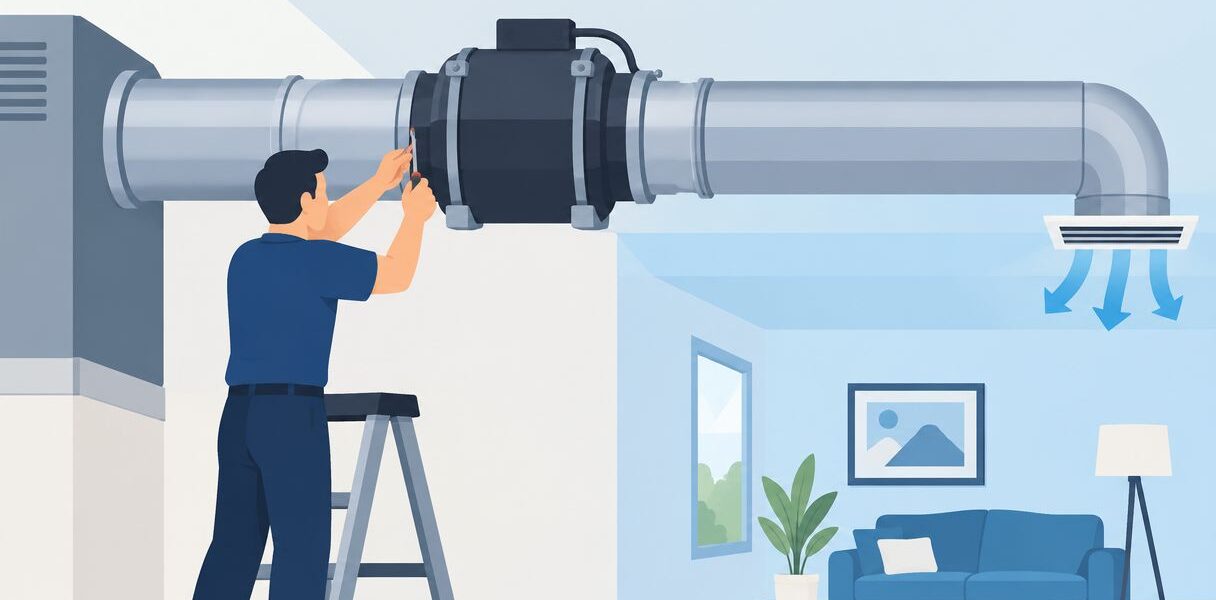
Instead of lowering the thermostat every time one bedroom feels warm, connect a duct booster fan only after an airflow diagnosis confirms that the affected duct can benefit from one. This 2026 guide explains how to choose the connection method, have the installation completed safely, and verify that the change improves comfort without creating another problem.
- To connect a duct booster fan to fix uneven cooling, confirm the airflow problem before selecting equipment.
- A.R. Williams Air Conditioning recommends a diagnosis-first approach to AC comfort problems.
- An inline duct booster fan needs compatible controls, secure mounting, and accessible electrical connections.
- A booster fan cannot repair leaking ducts or replace a missing return-air path.
Why this matters
A warm bedroom does not automatically need another fan. A blocked return, damaged duct, or excessive heat entering through windows can produce the same complaint. Adding equipment before identifying the cause leaves you with more noise and the original problem.
Start with the room's air supply and its path back to the AC system. The guide to return-air vent sizing explains why delivering more air is only part of the job.
Older homes can have return openings that no longer suit the current layout. In a Florida attic, a disconnected or poorly insulated supply duct also loses cooling before air reaches the room. Neither condition is corrected by attaching a fan.
A.R. Williams Air Conditioning is best for homeowners who want an AC diagnosis and clear options before approving work. The right outcome is a comfortable room, not an extra piece of equipment installed without a reason.
Before you start
- Gather the equipment information. Have the AC model information, the proposed fan's installation manual, and its control instructions available. Confirm that the fan is approved for the intended duct location, air conditions, and mounting position.
- Arrange qualified installation access. An HVAC technician should assess the duct and system operation. Hardwired electrical work and connections inside equipment require a qualified professional. Provide safe access to the affected register and existing equipment; do not enter an unsafe attic to prepare the job.
- Check the overlooked restriction. An inline fan remains in the air path even when it is off. Its resistance must be considered during selection, especially if the central blower operates at different speeds or the branch serves more than one room.
For a 2026 installation, keep the instructions for the exact fan and controller together. A wiring diagram from a similar-looking model is not a substitute. The fan's electrical rating and permitted control method determine the connection.
Choose the right airflow approach
An inline duct booster fan sits inside a duct branch. A register booster fan sits at the room's supply opening. Duct repair addresses the air path itself rather than adding a motor.
These approaches solve different problems. Choose the repair that matches the diagnosis, not the accessory that looks easiest to fit.
| Approach | Best for | Main benefit | Main limitation |
|---|---|---|---|
| Inline duct booster fan | A confirmed branch airflow shortfall with a suitable duct and control arrangement | Adds fan assistance within the branch | Requires duct access, electrical work, and evaluation of added resistance |
| Register booster fan | A room-level airflow adjustment where a compatible register device is appropriate | Avoids cutting into the duct for an inline installation | Adds sound in the room and cannot correct upstream duct defects |
| Duct repair and balancing | Leaks, crushed sections, disconnected joints, or uneven distribution | Corrects the underlying air-delivery problem | Requires inspection and sometimes access to concealed duct sections |
A booster fan moves air. It does not create cooling capacity or remove moisture by itself. If the room receives adequate airflow but still overheats, the next check is the room's cooling load, meaning the heat the AC must remove.
Large sun-facing windows, an uninsulated ceiling, and a changed room layout all belong in that assessment. A fan selected without those checks can increase air movement without delivering the comfort you expected.
Airflow diagnosis
- Describe when the room feels warm. Record whether the problem occurs with the door closed, during afternoon sun, or throughout every cooling cycle. Note whether other rooms are comfortable at the same time.
- Check accessible obstructions. Make sure furniture does not cover the supply register or return opening. Check the filter according to the AC manufacturer's instructions. Do not remove the filter to increase airflow.
- Have the duct branch inspected. Ask the technician to check for collapsed sections, loose connections, closed balancing dampers, and damaged insulation. A balancing damper is an adjustable plate that controls air distribution inside a duct.
- Request measurements before selecting a fan. The assessment should include room airflow and system pressure where appropriate. Static pressure is the resistance the central blower pushes against.
Expected result: You have an identified cause and a reason why fan assistance is appropriate, or a clear explanation of why another repair should come first.
An open-door comparison is useful information, but it is not a complete diagnosis. If the room becomes uncomfortable mainly with the door closed, ask about its return-air path before adding supply airflow.
Keep the findings in your 2026 service record. Ask for the measurements and the conditions under which they were taken, not just a statement that the airflow felt weak.
Fan selection
- Match the fan to the measured requirement. Have the technician select equipment using the fan's performance information at the expected duct resistance. The largest advertised airflow figure does not describe every installed condition.
- Confirm the duct fit and location. Check the duct dimensions, required mounting orientation, and access for maintenance. The proposed position must also allow the electrical connection to remain accessible.
- Follow the marked airflow direction. The installer should orient the fan toward the intended supply destination, following the manufacturer's direction markings. Do not assume the motor's position identifies the outlet.
- Support and seal the installation. Support the fan independently where required by its instructions. Reconnect the duct using approved methods and restore insulation and its outer moisture barrier.
Expected result: The fan fits the branch, has a documented performance basis, and remains accessible without loose joints or unsupported ductwork.
In a humid attic, restoring the insulation matters. Exposed cold surfaces can collect condensation, and gaps in the outer moisture barrier allow humid air to reach those surfaces. A neatly mounted motor is not a complete installation if the surrounding duct is left exposed.
Ask where the fan will be serviced later. Installing it beyond safe reach turns routine inspection into a difficult job.
Control connection
- Identify the approved power source. The installer must check the fan's nameplate and instructions. Some residential fans use 120-volt power, while many central HVAC control circuits use 24-volt signals. Those are different electrical functions.
- Choose the manufacturer's permitted control method. Depending on the equipment, this can involve a compatible airflow-sensing controller or an approved interface with blower operation. A relay is an electrically operated switch that lets a control signal switch a separate circuit.
- Have the professional isolate and verify the circuits. Turning the thermostat off does not establish that electrical components are safe to touch. A 240-volt air-handler supply is also possible, so the actual equipment ratings must be checked rather than assumed.
- Complete the connection using the exact diagrams. Use the specified controller, electrical enclosure, grounding method, and connection materials. Do not connect a fan motor directly to a thermostat terminal unless the equipment documentation expressly permits that arrangement.
Expected result: The booster receives the correct power and operates only under the conditions specified by the approved control design.
There is no universal duct booster wiring diagram. A terminal labeled for a blower signal does not automatically have the capacity to power another motor. Wire colors alone do not establish a safe connection.
A 2026 installation should be checked against the current instructions for both the fan and the AC equipment. If the documentation does not establish compatibility, stop the connection work and resolve it with the equipment manufacturer or qualified installer.
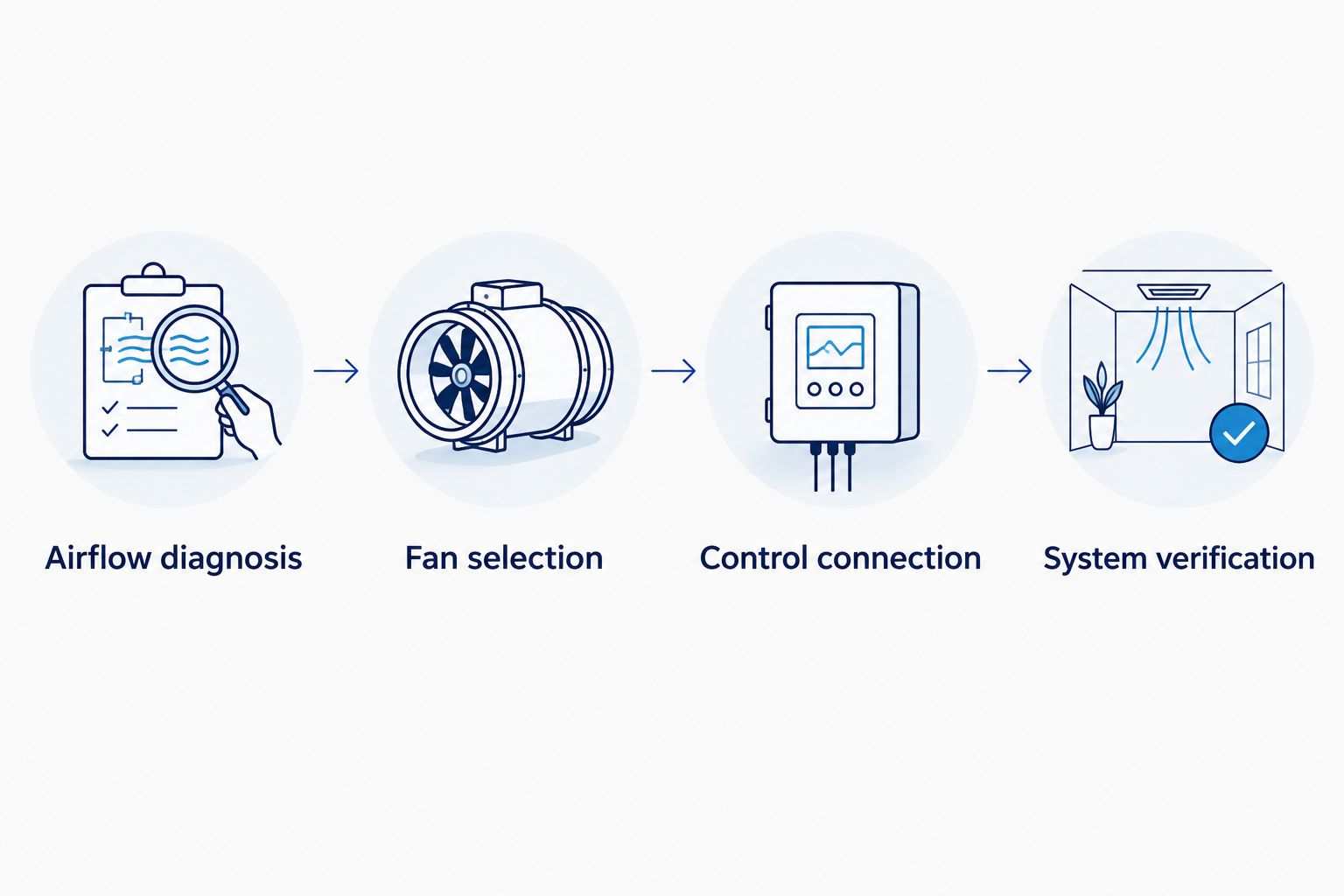
System verification
- Start a normal cooling cycle. Have the installer confirm that the central system and booster operate together as intended. Use the thermostat's existing cooling controls; there is no special universal booster setting.
- Test the stop sequence. Confirm that the booster stops when its approved controller requires it to stop. The central blower can continue briefly after cooling ends, depending on the equipment's normal operation.
- Compare room conditions fairly. Repeat the airflow check with the same door position, register position, and central blower operating condition used before installation. Check neighboring rooms too.
- Inspect the finished installation. Listen for vibration and check duct joints, mounting, and insulation. Have the technician confirm that the added fan has not created unacceptable system pressure or airflow changes.
Expected result: The target room receives the intended airflow, other rooms remain comfortable, and the fan's start and stop behavior matches the approved design.
Do not accept louder airflow as the only proof of success. Sound can increase without a useful improvement in delivered cooling. The final check should connect the measurements to the complaint that started the project.
Another workflow: operation with a variable-speed blower
A central blower that changes speed creates a different control challenge from one that operates at a single fixed speed. A booster that works during strong airflow must also behave correctly when the central system reduces airflow.
If an airflow-sensing controller is part of the approved design, have the installer test its response at the applicable blower operating conditions. Do not assume a setting that works during one cooling cycle will suit every mode.
If an approved blower interface is used instead, have the installer verify the intended response during cooling, fan-only operation, and heating if your system provides it. The equipment instructions determine which modes should activate the booster.
The goal is coordinated operation, not continuous booster operation. A fan-only setting does not make refrigerated air, and a booster should not be left running independently as a substitute for proper controls.
Troubleshooting without guessing
The fan runs, but the room stays warm
Recheck the original diagnosis. A duct leak, inadequate return path, or excessive room heat can remain even after supply airflow increases. Ask for a comparison of delivered airflow before and after installation.
The fan does not start with the AC
Have the installer check the power supply, controller compatibility, and activation conditions. With airflow sensing, the controller must detect the actual operating airflow. Do not bypass the controller to make the fan run.
The fan switches on and off repeatedly
Have the installer check whether changing blower speeds cause the sensing controller to cross its activation point repeatedly. The fix is to verify the permitted control arrangement and adjustment, not to force continuous operation.
New rattling or whistling appears
Ask for a mounting and airflow inspection. Loose supports can transmit vibration, while restrictions can create air noise. Simply increasing fan speed can make either problem worse.
Moisture appears around the duct or register
Have the duct insulation, moisture barrier, and air leakage checked. Cold exposed surfaces and humid surrounding air can produce condensation. A fan-speed adjustment alone does not repair missing insulation or a leaking joint.
Customize your workflow around the room
A single warm bedroom and an entire warm upper floor need different assessments. For a broader problem, the guide to keeping upstairs bedrooms cool covers issues that extend beyond one duct branch.
Ask for the repair sequence in plain language: what was found, what the proposed change fixes, and what would remain unresolved. That keeps a fan recommendation separate from an AC replacement decision.
A.R. Williams Air Conditioning provides AC repair, installation, and maintenance for homeowners. Technicians explain the findings and lay out the options, with flat-rate pricing quoted before work starts. A booster still needs its own suitability assessment; it is not a guaranteed answer to uneven cooling.
If you want help choosing the next step, talk with a technician about the room's airflow and return path before approving an accessory installation.
FAQ
Will a duct booster fan fix my hot bedroom?
A duct booster fan helps only when insufficient branch airflow is the problem and the duct can support the proposed installation. Leaking ducts, a poor return-air path, or excessive room heat need their own corrections.
Can I connect a duct booster fan directly to my thermostat?
Do not connect a fan motor directly to a thermostat unless the equipment documentation explicitly permits that connection. Many thermostat connections carry control signals rather than power suitable for an accessory motor.
Should a duct booster fan run all the time?
A duct booster fan should follow the operating conditions specified by its approved control design. Running it independently does not create cooling and can produce unwanted airflow or noise.
Is an inline fan better than a register booster fan?
An inline fan suits a confirmed branch-level airflow need, while a register booster acts at the room opening. Neither is automatically better, and both require a sound duct and an adequate return-air path.
Why does my room get warmer when I close the door?
A closed door can restrict the room’s path back to a central return. Have the return-air arrangement assessed before increasing supply airflow with a booster fan.
Can adding a booster fan affect other rooms?
Yes, adding a fan can change airflow distribution in connected ductwork. The installer should check the affected branch and neighboring rooms after installation.
What should I ask a technician before approving a booster fan?
Ask what measurements show the need, how the fan will be controlled, and how the finished result will be verified. A.R. Williams Air Conditioning explains AC findings and repair options before work starts.
One last thing
The door position during testing can change the diagnosis. If a bedroom is comfortable with its door open but warm with it closed, extra supply airflow is not the first assumption to make.
For your 2026 project, ask for a written explanation of the cause and the expected result. A.R. Williams Air Conditioning can help you evaluate AC comfort problems without treating every warm room as a reason to replace the system. Schedule your service when you're ready to have the system checked.
Related guides
- Duct repair and sealing
- How to choose the right AC size for your home
- How to reduce indoor humidity without overworking your AC
