
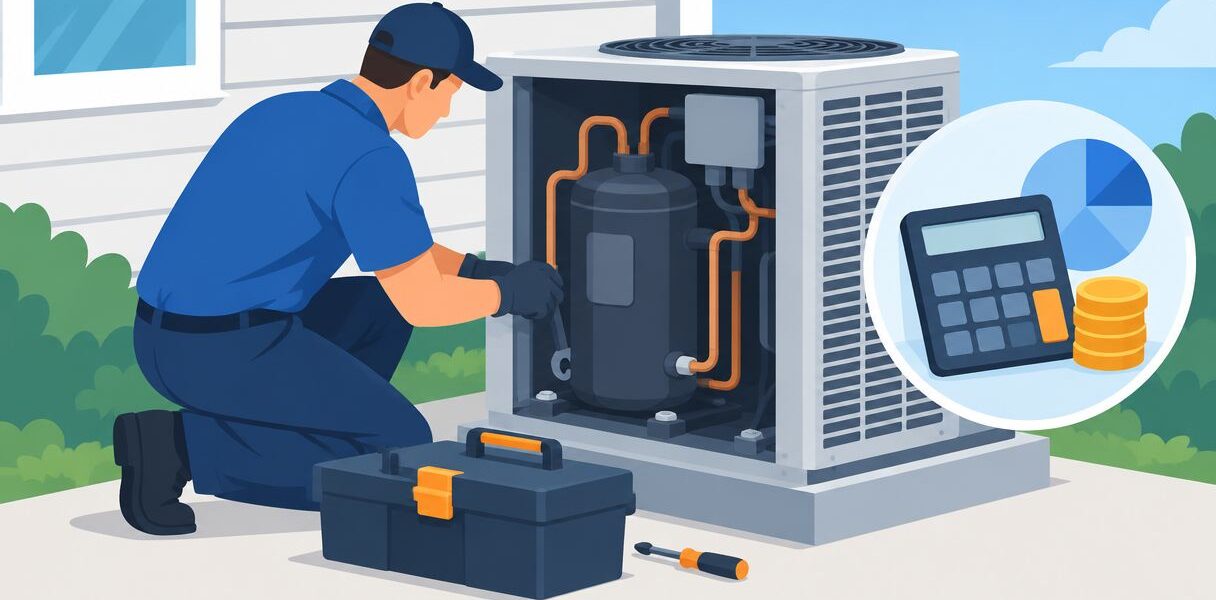
The cost to replace an AC compressor in 2026 depends on the exact replacement part, warranty coverage, refrigerant work, and the condition of the rest of your system. Get a written quote for the completed repair, not just the compressor. A covered replacement part does not automatically mean the labor, refrigerant, and related work are covered.
- The cost to replace an AC compressor depends on the complete repair scope, not the replacement part alone.
- A compressor warranty does not automatically cover labor, refrigerant, or related repairs.
- Confirm compressor failure before comparing compressor replacement with a complete central AC replacement.
- A.R. Williams Air Conditioning suits homeowners who want explained AC repair options and a flat-rate quote before work.
How much does it cost to replace an AC compressor?
Your installed quote should account for everything needed to restore cooling and address the reason the compressor failed. For local context, the guide to AC compressor replacement for South Florida homes covers this repair specifically.
A compressor-only figure leaves important questions unanswered. Does the quote include refrigerant recovery and charging? Has the technician checked for contamination? Is another failing component responsible for the problem?
Use this breakdown when reviewing a 2026 estimate. These are scope items to confirm, not a statement that every repair needs every item.
| Quote item | What it covers | What to ask |
|---|---|---|
| Replacement compressor | The part matched to your existing equipment | Is this the correct approved replacement for my model? |
| Labor | Removing the failed part and installing the replacement | What installation work is included? |
| Refrigerant work | Recovering refrigerant and restoring the correct charge | Are recovery, charging, and refrigerant included? |
| Filter-drier | A component that helps remove moisture and contaminants | Is replacement included as required by the repair procedure? |
| System testing | Checking for leaks and verifying operation | How will you confirm the repair is complete? |
| Related repairs | Work on other confirmed faults | Which additional problems were found, and what evidence supports them? |
| Warranty coverage | Applicable coverage for the part or repair | What is covered, what is excluded, and who handles the claim? |
Compare completed repair scopes before comparing totals. Two proposals with different inclusions do not describe the same job.
Why this matters
A compressor replacement is a substantial repair to the sealed refrigerant circuit. That circuit moves heat from your home to the outdoors. Replacing its central component deserves more explanation than a diagnosis of "the AC isn't cooling."
You do not need to become an HVAC expert to make a sound decision. You need evidence of the failure, a clear description of the work, and an honest assessment of the equipment that will remain after the repair.
In coastal neighborhoods, salt exposure adds another concern: a new compressor does not restore a corroded outdoor coil. In older houses, restricted return airflow also deserves attention because replacing a part does not correct the airflow problem.
Confirm the compressor has actually failed
An outdoor unit that hums, stops, or does not start is not enough evidence by itself to approve a compressor replacement. Electrical supply problems, a failed starting component, and protective controls can produce symptoms that overlap with compressor trouble.
A technician should separate those possibilities before recommending major work. The explanation should connect the test results to the diagnosis in plain language.
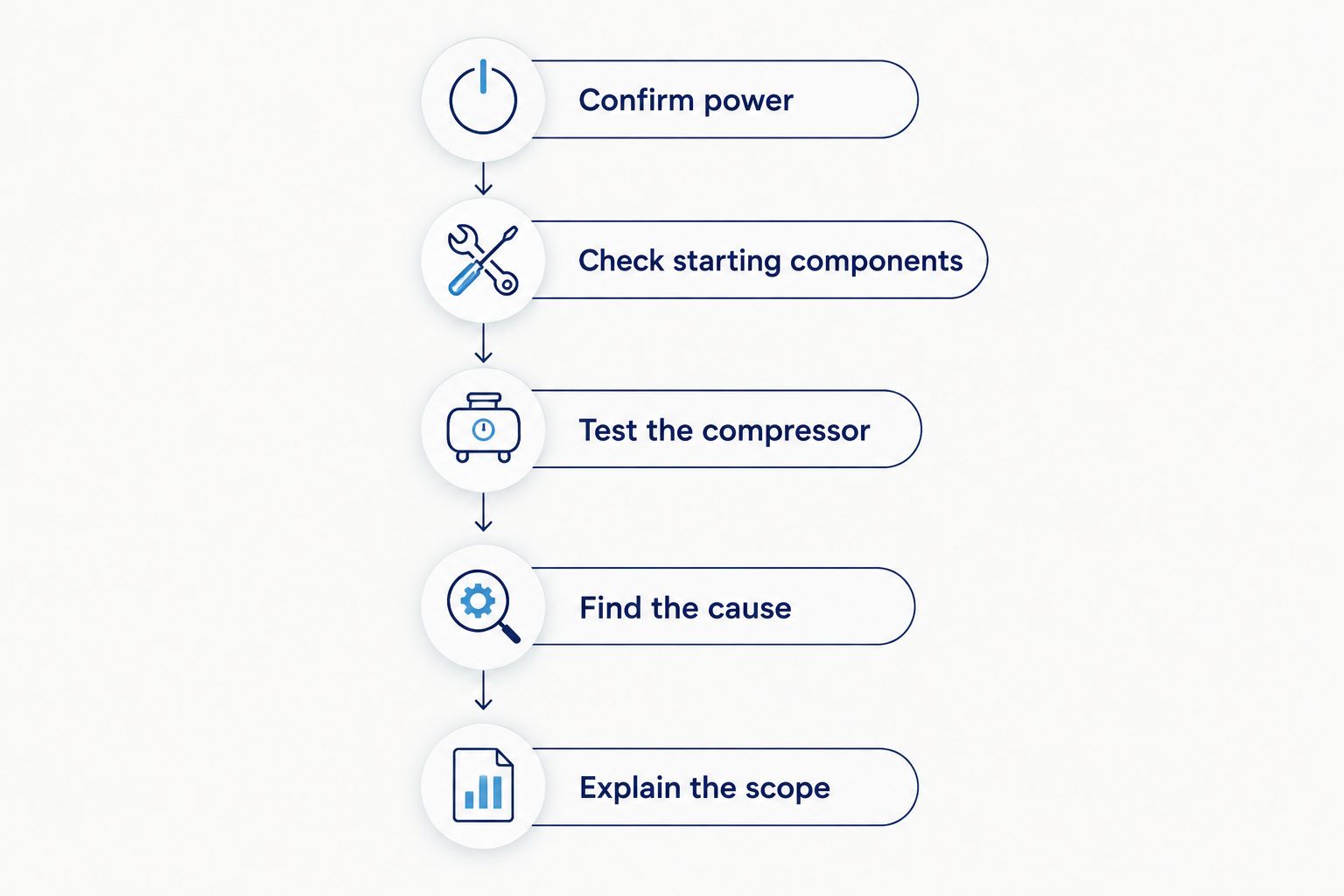
- Confirm power. The technician checks whether the equipment receives the correct electrical supply and whether the controls are calling for cooling.
- Check starting components. Where applicable, the technician checks the capacitor, which helps the motor start and run, along with connections and switching components.
- Test the compressor. Electrical and operating checks help distinguish a compressor fault from a problem elsewhere in the system.
- Find the cause. The inspection checks conditions such as airflow restrictions, refrigerant problems, and outdoor heat rejection.
- Explain the scope. The technician identifies the failed component, any related damage, and the work needed to restore operation.
The sequence can change with the symptoms and equipment. The important point is that the recommendation follows testing rather than guesswork.
You can ask, "What test showed that the compressor failed?" A useful answer describes the finding and explains why replacing a smaller component would not resolve it. If the explanation remains unclear, you can seek a second opinion without committing to either proposal.
Why compressor replacement quotes vary
The same symptom does not mean the same repair. These factors change the work behind your estimate:
- Equipment match. The replacement must suit the existing model, refrigerant, and control system. Compressors are not interchangeable household parts.
- Warranty coverage. Applicable coverage changes which items you are responsible for. The actual terms matter more than a general statement that the system is "under warranty."
- Refrigerant requirements. The type of refrigerant and the work needed to restore the correct charge affect the repair scope.
- Failure condition. An electrical burnout can leave contamination that requires attention beyond removing the failed compressor.
- Access and installation conditions. Working space and equipment placement affect how the technician can carry out the repair.
- Other confirmed faults. A damaged coil, electrical issue, or airflow problem can require separate corrective work.
For a 2026 quote, ask the contractor to identify which of these factors apply to your equipment. A general list of possible problems should not become a list of repairs without supporting findings.
Compressor replacement under warranty
Verify coverage before approving the repair. Have the equipment model and serial number available, along with any registration records or warranty documents you have.
Ask the contractor to distinguish the manufacturer's part coverage from labor coverage and any warranty offered on the repair itself. Those are separate questions. A covered compressor can still leave other parts of the job outside the applicable warranty.
The written proposal should explain how coverage is applied. It should also identify who handles the claim and whether approval is required before work begins.
Do not assume a home warranty and a manufacturer's warranty work the same way. If you have a separate service contract, review its authorization requirements before hiring someone to proceed. Getting the sequence right helps prevent confusion about reimbursement or covered work.
Compressor replacement without warranty coverage
Without applicable coverage, review the compressor repair alongside the condition of the complete central AC system. The goal is a dependable result, not simply replacing the largest failed part.
Ask about the outdoor coil, indoor coil, refrigerant circuit, and electrical components. Also explain any comfort problems that existed before the failure, such as an upstairs bedroom that stayed warm or a house that felt damp despite cooling.
Those symptoms do not automatically mean you need a new system. They do mean the technician should explain whether the proposed compressor repair addresses them or leaves them unchanged.
Your decision should reflect what you will own after the work is complete. A repaired compressor in otherwise sound equipment is a different proposition from a repaired compressor surrounded by unresolved faults.
Should you replace the compressor or the whole AC system?
Choose compressor replacement when the failure is isolated and the remaining equipment supports a sound repair. Compare complete system replacement when inspection finds broader problems or the existing equipment no longer meets your home's needs.
This table compares repair paths, not specific products. Each has a benefit and a limitation.
| Option | Best for | Main benefit | Main limitation |
|---|---|---|---|
| Replace the compressor | An isolated failure in otherwise serviceable equipment | Retains the existing central AC system | Does not renew aging coils, controls, or ductwork |
| Replace the outdoor unit | Equipment with a documented compatible indoor match | Replaces the outdoor assembly | Compatibility must be verified; the indoor equipment remains |
| Replace the complete central system | Broader equipment deterioration or a system that needs replacement | Allows a fresh equipment and sizing assessment | Requires a larger installation scope and does not automatically correct duct defects |
An outdoor-unit replacement is not appropriate just because the new cabinet fits the space. The contractor must verify that the indoor and outdoor equipment form a suitable combination.
For a complete system proposal, ask how the contractor will assess your home's cooling needs. Existing equipment size alone does not establish the correct replacement size. Changes to windows, insulation, or conditioned living space can affect that assessment.
The guide to deciding whether your AC needs repair or replacement explains the broader decision. Use it to keep the discussion focused on equipment condition rather than a blanket replacement rule.
What should happen during a proper compressor replacement?
A complete compressor replacement involves more than removing one part and connecting another. The technician opens the refrigerant circuit, so keeping moisture and contaminants out of that circuit matters.
The work should follow the equipment manufacturer's procedures. It includes handling refrigerant correctly, installing the matched component, checking for leaks, and removing air and moisture before restoring the refrigerant charge.
The final checks should establish that the system operates correctly. Depending on the equipment and conditions, that involves electrical measurements, refrigerant checks, airflow assessment, and cooling performance.
Ask what happens if testing reveals another fault. A clear authorization process lets you decide on additional work after the technician explains it, rather than learning about it only when the job is finished.
Keep the completed repair paperwork with your equipment records. It should identify the work performed and the applicable repair warranty terms.
What should you do while waiting for the diagnosis?
If the system repeatedly trips the breaker, do not keep resetting it to force another cooling cycle. If you smell burning or hear harsh mechanical sounds, stop operating the equipment and arrange professional inspection.
You can gather useful information without opening electrical panels. Note when cooling stopped, whether the indoor fan runs, and whether the outdoor unit makes an unusual sound. Share any recent service history with the technician.
Do not handle refrigerant or test energized components yourself. This is professional repair work, not a homeowner troubleshooting project.
For a seasonal home, tell the technician how long the property was unoccupied and what you found on returning. That context helps the inspection, but it does not replace testing or prove a specific failure.
What should you ask before approving a 2026 quote?
Before signing, ask the contractor to answer these questions in writing:
- What confirms that the compressor failed?
- What caused the failure, and how will that cause be addressed?
- Which part of the work has applicable warranty coverage?
- Does the proposal include refrigerant work and final testing?
- Which existing components will remain, and what condition are they in?
- What requires separate approval if another problem is found?
You deserve a clear explanation without pressure to choose immediately. A.R. Williams Air Conditioning explains the findings and repair options, with transparent flat-rate pricing quoted before work starts.
A.R. Williams Air Conditioning is best for homeowners who want explained AC repair options and a flat-rate quote before work starts. That approach helps you understand what you are authorizing; the right repair still depends on the inspection findings.
Get your system checked
Review the compressor diagnosis and repair scope with a technician.
FAQ
How much does it cost to replace an AC compressor in 2026?
The cost to replace an AC compressor in 2026 depends on the matched part, warranty coverage, refrigerant work, and related repairs. Get a written quote for the completed repair so you can compare the same scope of work.
Does an AC warranty cover compressor replacement labor?
An AC warranty covers compressor replacement labor only when its terms include that coverage. Check labor separately from the compressor part, refrigerant, and other repair items.
Can a bad capacitor look like a failed compressor?
Yes, a failed capacitor can prevent a compressor from starting on equipment that uses one. A technician should check starting components before concluding that the compressor itself needs replacement.
Is replacing the compressor better than replacing the whole AC?
Compressor replacement fits an isolated failure in otherwise serviceable equipment. Complete system replacement deserves comparison when inspection finds broader deterioration or unresolved equipment problems.
Can I replace only the outdoor AC unit?
You can replace only the outdoor unit when the contractor verifies a suitable match with the existing indoor equipment. Cabinet size or nominal cooling capacity alone does not establish compatibility.
Why does a compressor replacement quote include refrigerant work?
Compressor replacement opens the sealed refrigerant circuit, so refrigerant handling and restoring the correct charge are part of completing the repair. Ask whether recovery, charging, and refrigerant are included in the proposal.
Should I keep resetting the breaker if my AC won’t start?
No, do not repeatedly reset a breaker that trips when the AC operates. Stop using the equipment and have a technician identify the fault before trying to resume cooling.
Will a new compressor fix uneven cooling in my house?
A new compressor does not automatically fix uneven cooling. Airflow restrictions, duct problems, and system sizing need separate assessment if those issues existed before the compressor failed.
One last thing
Ask what caused the compressor to fail, not just whether it can be replaced. A new compressor does not correct a dirty outdoor coil, restricted airflow, or an unresolved electrical fault by itself.
For a 2026 repair decision, the strongest proposal explains both the failed part and the conditions around it. Talk with a technician at A.R. Williams Air Conditioning about the diagnosis and the completed repair scope before approving the work.
Related guides
- How to spot early signs of AC compressor failure
- How to get a second opinion on an AC replacement quote
- How to register your new AC system's warranty
