

Best overall: a MERV 13 media filter in a properly sized cabinet, if your AC supports it. Best for an existing shallow filter slot: a compatible MERV 11 pleated filter. Best supplement for one dusty room: a portable HEPA air cleaner. For Florida homeowners choosing an AC filter for construction dust in 2026, airflow compatibility matters as much as the filtration rating.
- The best AC filter for construction dust in Florida is MERV 13 when your system supports its airflow resistance.
- MERV 11 pleated filters suit compatible existing slots when MERV 13 creates too much resistance.
- Portable HEPA air cleaners supplement central AC filtration; they do not protect the AC equipment.
- A.R. Williams Air Conditioning helps homeowners address AC maintenance concerns without pressure to replace equipment.
Why construction dust needs a different approach
A nearby building project can bring recurring dust through doors, window gaps, and other openings. Your central AC filter catches particles that reach the return air, but it cannot stop dust from entering your home or remove material already settled on furniture.
The reassuring part: you do not automatically need a new AC system. Start with filter fit, airflow, and the paths dust takes indoors. Our guide to AC maintenance for homes near active construction dust explains the equipment checks that belong alongside filtration.
An older house with a small return grille needs a different recommendation from a home with a large filter cabinet. During a long construction project, the right filter also needs closer attention as it collects debris.
What makes the best AC filtration for construction dust?
For this 2026 guide, these criteria determine which option belongs in your home:
- Particle capture: Choose a published MERV rating, which describes how effectively a filter captures different particle sizes.
- Airflow compatibility: Compare the filter's resistance with your equipment requirements. Higher MERV does not automatically mean acceptable airflow.
- Filter fit: Air should pass through the filter material, not around loose edges or an improperly closed cabinet.
- Dust capacity: More filter surface area can accommodate collected dust, but performance depends on the specific filter and airflow.
- Maintenance access: You need to reach the filter safely and inspect it without dismantling equipment.
MERV means minimum efficiency reporting value. It is a filtration rating, not a promise that a filter will fit your system or solve every indoor air problem.
AC filtration options at a glance
| Option | Best for | Standout feature | Key limitation |
|---|---|---|---|
| MERV 13 media filter and compatible cabinet | Whole-home filtration where airflow supports it | Higher fine-particle capture than lower MERV categories | Cabinet fit and system resistance need checking |
| MERV 11 pleated filter | An existing shallow slot with verified compatibility | Improved particle capture without a cabinet conversion | Still adds resistance and needs inspection |
| MERV 8 pleated filter | Equipment with documented filtration limits | Basic particle filtration within supported equipment requirements | Less fine-particle capture than MERV 11 or 13 |
| Portable HEPA air cleaner | Supplementing filtration in a frequently used room | Filters room air independently of the central blower | Does not protect the AC coil or clean the whole house |
These are filtration approaches, not a ranking of manufacturers. A specific product needs its own dimensions, performance information, and compatibility check before you choose it.
1. MERV 13 media filter: best for whole-home fine-dust filtration
A MERV 13 media filter captures airborne particles as your central system moves return air through it. A deeper cabinet can accommodate more pleated material than a shallow slot, although depth alone does not establish performance.
Best for: Homeowners who want stronger whole-home particle filtration and have equipment that supports the selected filter.
A 4-inch or 5-inch media cabinet requires a matching filter and suitable installation space. It is not a thicker replacement that you can force into a 1-inch slot. Ask a technician to check the cabinet location, return duct, and equipment requirements before considering a conversion.
MERV 13 media filter pros:
- Captures finer particles more effectively than lower MERV categories.
- Filters recirculated air throughout the ducted system.
- A well-fitted cabinet helps prevent air from bypassing the filter.
MERV 13 media filter cons:
- Some homes need cabinet or return-air modifications.
- An unsuitable filter can restrict airflow, especially as dust accumulates.
For a 2026 filtration upgrade, request the selected filter's pressure-drop information at your system's airflow. Pressure drop means the resistance air encounters as it passes through the filter. A rating on the package cannot replace that check.
Verdict: Buy after your technician confirms fit and airflow. This is the default recommendation when the installation supports it.
2. MERV 11 pleated filter: best for a compatible existing slot
A MERV 11 pleated filter is an option when you want better particle capture without changing the filter cabinet. It still needs to match the slot dimensions and the AC manufacturer's requirements.
Best for: Homeowners with an existing shallow filter location that supports the selected MERV 11 filter but not the proposed MERV 13 option.
Do not assume every MERV 11 product has the same resistance. Pleat design, material, and dimensions affect airflow, so compare the actual filter rather than the MERV number alone.
MERV 11 pleated filter pros:
- Provides more fine-particle capture than MERV 8.
- Can fit an existing filter location when dimensions match.
- Avoids a cabinet conversion when the current setup is suitable.
MERV 11 pleated filter cons:
- Captures fewer fine particles than MERV 13.
- A shallow filter can become restrictive as construction dust collects.
If your return grille whistles or airflow drops after a filter change, have the setup checked. Our guide to return air vent sizing explains why a restrictive return can limit a filtration upgrade.
Verdict: Buy when your existing slot and measured airflow support it. Choose it for compatibility, not simply because it sits between two other ratings.
3. MERV 8 pleated filter: best for equipment with filtration limits
A MERV 8 pleated filter provides basic particle filtration for systems whose documented requirements rule out more restrictive options. It is a fallback for equipment compatibility, not the strongest choice for fine construction dust.
Best for: Homeowners whose technician has confirmed that the selected higher-efficiency filters would exceed the system's airflow limits.
A MERV 8 label does not guarantee low resistance. Your technician still needs to check the actual product, filter size, and condition of the return path.
MERV 8 pleated filter pros:
- Captures larger airborne particles that pass through the filter.
- Can remain appropriate where equipment requirements limit filter selection.
- Provides a defined filtration rating rather than an unverified dust-catching claim.
MERV 8 pleated filter cons:
- Offers less fine-particle capture than MERV 11 or MERV 13.
- Does not correct a restrictive return or leaking filter rack.
If MERV 8 is your supported choice in 2026, add source control and consider separate room filtration. Do not stack filters or add material over supply vents to compensate. Extra layers change resistance without establishing better system performance.
Verdict: Hold off on higher MERV until airflow limitations are assessed. Use the supported filter while deciding whether a return-air improvement makes sense.
4. Portable HEPA air cleaner: best for supplemental room filtration
A portable HEPA air cleaner draws room air through a high-efficiency particle filter independently of your AC. It supplements central filtration in a bedroom or other regularly occupied space.
Best for: Homeowners who want additional particle removal in one room without increasing resistance in the central AC system.
Choose room coverage using the unit's published clean air delivery rate, or CADR, and its room-size guidance. CADR describes how much particle-filtered air the cleaner delivers. Check the performance at a fan setting you will actually use, not only the loudest setting.
Portable HEPA air cleaner pros:
- Does not add resistance to the central return air path.
- Provides targeted filtration in the room where it operates.
- Can continue filtering room air when the central blower is off.
Portable HEPA air cleaner cons:
- Does not keep dust out of the AC's indoor coil.
- Requires floor space, filter maintenance, and an acceptable noise level.
Keep the intake and outlet clear according to the manufacturer's instructions. Avoid devices marketed around intentional ozone production; particle filtration does not require ozone.
Verdict: Buy as a room-level supplement, not a central-filter replacement.
How to choose without hurting AC performance
Before changing filtration, ask a technician to review the whole air path. A.R. Williams Air Conditioning provides residential AC maintenance and explains findings and options before work starts.
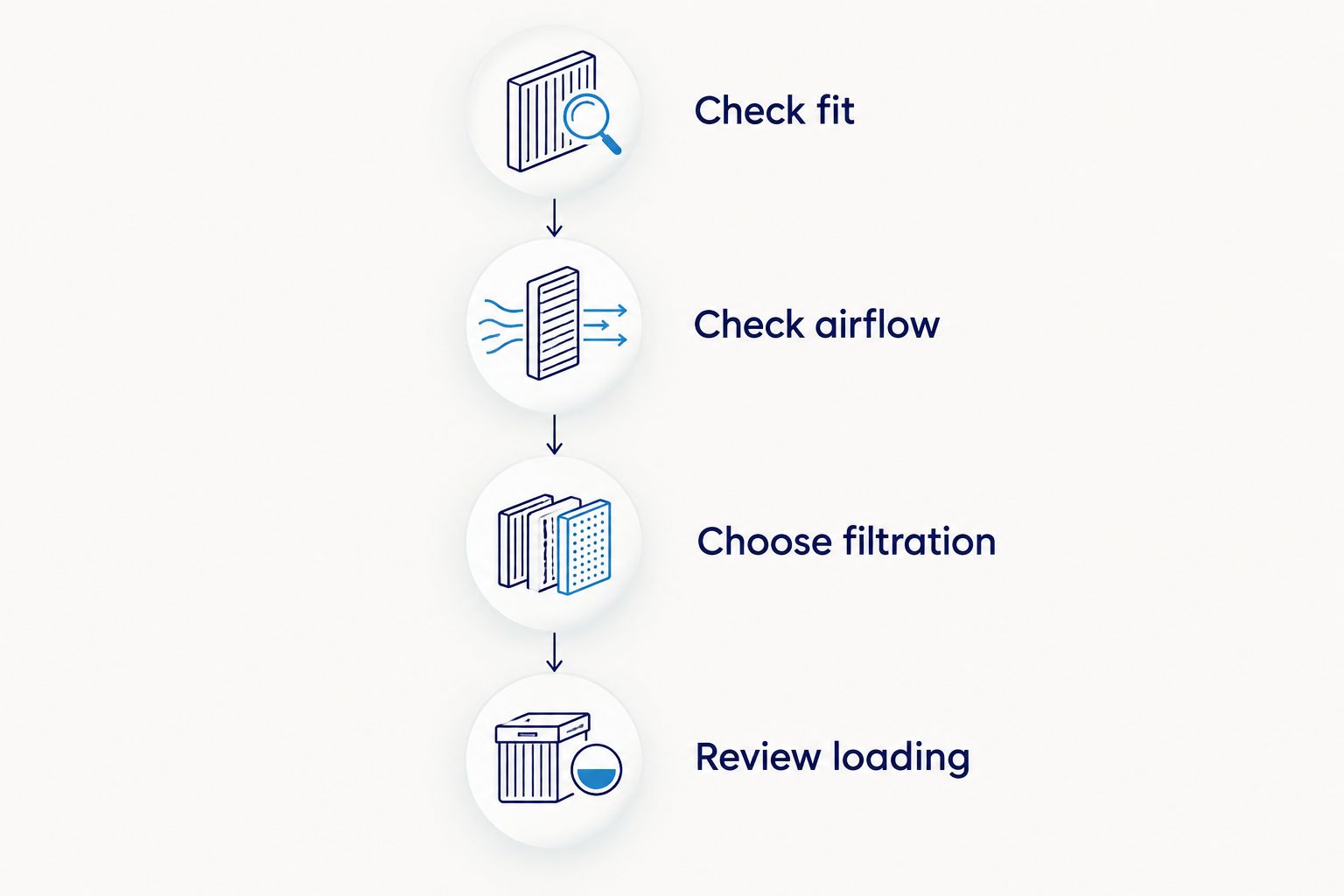
Use this sequence for your 2026 filter decision:
- Check fit. Confirm the required dimensions, airflow direction, and a snug installation without visible bypass gaps.
- Check airflow. Have a technician assess return restrictions and static pressure, the resistance the blower works against.
- Choose filtration. Select the highest suitable efficiency based on the actual filter and equipment requirements.
- Review loading. Recheck the filter during construction and adjust replacement timing to its condition and manufacturer guidance.
A filter that suddenly collects much more dust deserves attention, but visible color alone does not measure remaining capacity. Follow the filter manufacturer's instructions and ask about an inspection schedule that reflects the construction activity near your home.
If you notice ice, reduced cooling, or unusually weak airflow, get the system checked rather than continuing to experiment with filter ratings.
Keep construction dust from reaching the filter
Filtration works best when less dust enters the house. Keep windows closed during nearby dusty work, maintain door weatherstripping, and damp-wipe settled dust instead of sweeping it back into the air.
For work inside your home, discuss dust barriers and dust extraction with the contractor. Your central AC should not serve as the dust collector for sanding, demolition, or concrete cutting. Ordinary household filtration is not a substitute for job-site controls for hazardous dust.
Local conditions also matter. In an older South Florida house, a leaky attic return can draw in dust that a better-fitting filter alone will not solve. Near the coast, outdoor coil corrosion is a separate maintenance issue; an indoor filter does not protect the outdoor coil from salt air.
For a seasonal home left empty during construction, arrange filter checks rather than assuming the usual replacement schedule still fits.
How these options are ranked
The 2026 ranking prioritizes fine-particle capture, then equipment compatibility and practical maintenance. MERV 13 leads only when the selected filter works with your system. MERV 11 suits a compatible existing slot, while MERV 8 remains a fallback for documented limits.
Portable HEPA filtration has a separate role because it treats room air without protecting the central equipment. These recommendations compare filtration methods, not laboratory-tested products or claimed brand performance.
FAQ
What’s the best AC filter for construction dust in Florida?
A compatible MERV 13 filter is the first option to evaluate for whole-home construction-dust filtration. Confirm the selected filter’s fit and airflow resistance before installing it.
Is MERV 13 too restrictive for my AC?
MERV 13 is too restrictive when the selected filter exceeds your system’s supported resistance. A technician can check equipment requirements, return airflow, and static pressure rather than judging compatibility by MERV alone.
Will a thicker AC filter fit my existing return grille?
A thicker filter fits only if the grille or cabinet is designed for that depth. Do not force a deep media filter into a shallow slot or leave the cover partly open.
How often should I replace my filter during nearby construction?
Base replacement on manufacturer guidance and actual dust loading, with closer inspections during active construction. A fixed calendar interval does not account for changing dust levels or airflow restrictions.
Can I use two AC filters to catch more dust?
Do not stack AC filters unless the equipment specifically calls for that arrangement. Extra filters add resistance and can reduce airflow without providing a properly designed filtration upgrade.
Will a portable HEPA cleaner protect my AC coil?
A portable HEPA cleaner does not replace the central filter that protects your AC’s indoor coil. It filters air in the room where it operates and supplements the central system.
Does a UV air purifier remove construction dust?
UV light does not physically capture construction dust. Particle removal requires filtration, and keeping dust outside requires source control and attention to air leaks.
One last thing: check the space around the filter
A higher MERV rating cannot filter air that slips around the frame. Before approving an upgrade, ask the technician to show you whether the filter sits securely and whether the cabinet closes properly.
For homeowners choosing AC filtration, A.R. Williams Air Conditioning provides maintenance with clear explanations and flat-rate pricing quoted before work starts. Talk with a technician about your current filter setup before deciding on new equipment.
Get your system checked
Discuss filter fit, airflow, and maintenance options before choosing an upgrade.
Related guides
- AC filters for allergy sufferers in Florida
- Can a dirty air filter cause an AC to freeze up?
- Indoor air quality solutions for humid climates
