

Opening windows usually does not cool a Florida house faster when your central AC is running, especially when outdoor air is warmer or carries more moisture than indoor air. Open windows help when outside air is cooler and drier, with enough airflow to carry indoor heat away. A breeze can feel good on your skin while still adding moisture that your AC must remove later.
- Opening windows to cool a house faster in Florida usually works against central AC in warm, humid weather.
- Open windows only when outdoor air is cooler and drier, and turn central AC off during ventilation.
- A lower outdoor temperature alone does not mean outdoor air contains less moisture.
- A.R. Williams Air Conditioning helps homeowners address central AC problems with explained findings and repair options.
Why this matters
Your AC removes both heat and moisture. An open window lets outdoor air enter without either treatment, so a falling thermometer reading does not always mean better comfort.
For your 2026 cooling routine, treat window ventilation and central AC as separate choices. If the house stays warm with the windows closed, use this guide to an AC that's running but not cooling rather than opening windows to compensate.
You don't need to keep the house sealed regardless of the weather. You need to choose outdoor air based on what it brings inside, not just how pleasant it feels at the window.
Does opening windows cool a house faster in Florida?
Usually no during warm, humid weather. Sometimes yes during a cooler, drier spell with the AC off. The difference is whether outdoor air can carry heat away without leaving your home wetter.
Use this comparison for everyday cooling decisions in 2026:
| Approach | Best for | What it helps with | Main limitation |
|---|---|---|---|
| Windows closed, central AC running | Warm, humid conditions | Removes indoor heat and moisture | Depends on a properly operating system and adequate airflow |
| Windows open, central AC off | Cooler, drier outdoor conditions | Replaces warmer indoor air with cooler air | Cooling depends on weather and airflow; outdoor moisture and pollen enter |
| Windows open, central AC running | Brief, unavoidable door or window use only | AC still conditions some indoor air | Incoming heat and moisture work against the system |
| Windows closed, ceiling fan running | Comfort in an occupied room | Air movement helps your body lose heat | Does not lower room temperature or remove moisture |
A coastal breeze is not automatically good cooling air. Near the Atlantic or Intracoastal Waterway, moving air can feel comfortable even when it carries enough moisture to make an air-conditioned room feel clammy afterward.
An afternoon shower is another common trap. Outdoor temperature can fall while the air remains moisture-heavy, so opening the house after rain does not automatically reduce the AC's workload.
How to decide whether to open the windows
Start with actual conditions indoors and outdoors. A weather app helps, but an indoor thermometer with a humidity display gives you a better picture of what is happening inside your home.
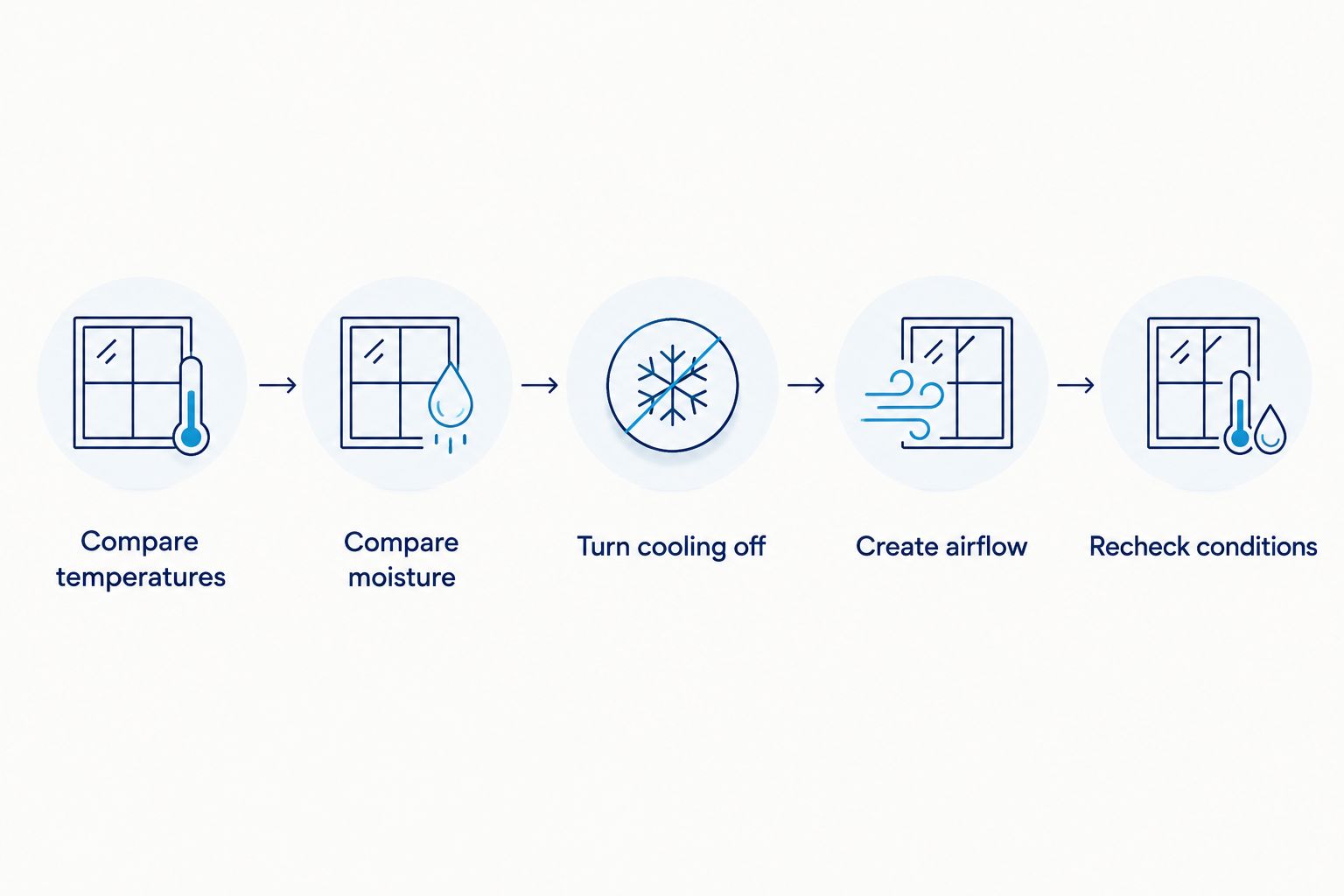
- Compare temperatures. Outdoor air must be cooler than indoor air to lower indoor temperature through ventilation. A breeze alone does not establish that difference.
- Compare moisture. Check outdoor dew point and indoor humidity, not just the outdoor relative humidity percentage. Dew point describes how much moisture the air contains; a lower dew point means less moisture.
- Turn cooling off. If outdoor conditions favor ventilation, switch central AC cooling off before opening windows. Don't ask the system to condition an ongoing supply of outdoor air.
- Create an airflow path. Open secure, screened windows on different sides of the home when conditions allow. Interior doors must also allow air to pass between those openings.
- Recheck conditions. Close windows when outdoor air warms, rain approaches, or indoor humidity rises. Close them before restarting central AC.
Don't leave windows open unattended as a cooling strategy. Weather changes, and an opening that feels pleasant while you are home can admit rain or create a security concern after you leave.
If you cannot judge outdoor moisture confidently, keeping windows closed while central AC runs avoids that uncertainty. There is no need to experiment with ventilation to prove that your system should cool the house.
Why window cooling results vary
Two homes on the same street can respond differently to open windows. These factors explain why a neighbor's approach does not necessarily work in your living room:
- Indoor versus outdoor temperature. Cooler incoming air removes heat; warmer incoming air adds it. The direction of that difference matters more than the season on the calendar.
- Outdoor moisture. Cooler air is not necessarily drier air. Moisture brought indoors becomes part of the AC's next cooling and drying job.
- Wind and window placement. Openings on different sides of a home can support cross-ventilation. A single sheltered window often provides less useful air exchange.
- Stored heat. Walls, floors, and furnishings hold heat after indoor air starts cooling. A brief breeze does not remove all that stored warmth.
- Sun exposure. Direct sun continues adding heat through glass and onto the building. Window ventilation has to compete with that heat gain.
- Room layout. Closed doors and separated rooms interrupt airflow. A breezy living room does not prove that a back bedroom is cooling.
Older homes with altered floor plans deserve particular attention. An enclosed room or added wall can change airflow, whether you are relying on open windows or the central duct system.
Why does the house feel sticky after the windows were open?
Outdoor moisture can enter through the windows and remain after you close them. Your AC then has to remove that moisture along with the indoor heat, so comfortable conditions do not always return as soon as the temperature drops.
The EPA's published mold-prevention guidance recommends indoor relative humidity below 60%, ideally 30% to 50%. Those are moisture-control guidelines, not a promise that every Florida home will hold the same humidity throughout the day.
For your 2026 window-opening decisions, watch the humidity trend as well as the temperature. If the house feels cooler but the humidity keeps rising, ventilation is trading one comfort problem for another.
Damp-feeling bedding or a persistent clammy sensation deserves attention. Neither symptom identifies a specific equipment failure, but both are useful details to share with a technician rather than responding by setting the thermostat progressively lower.
Should I open windows at night in Florida?
Open windows at night only when outdoor air is cooler and drier than indoor air and you can do so safely. Darkness removes direct sunshine, but it does not guarantee suitable moisture conditions.
A mild night following a dry cold front is different from a humid summer evening. Choose based on the weather at your home, not a rule that windows should open whenever the sun goes down.
Before bed, consider rain exposure, screens, and security. If you close the house and restart AC, check that bedroom windows and sliding doors are fully shut, not simply covered by curtains.
Does opening windows help if the AC stops cooling?
Opening windows helps only if outdoor conditions are better than indoor conditions. If outside air is hotter and more humid, opening the house adds to the problem instead of replacing the cooling you lost.
Start with observations, not repairs. Check the thermostat's cooling setting, whether vents are blocked, and whether an accessible filter is visibly dirty, following the equipment instructions for safe filter access.
Avoid removing equipment panels, handling wiring, or trying to add refrigerant. If you see ice, smell burning, or find water near electrical components, stop using the affected equipment and arrange professional assessment.
If indoor heat becomes uncomfortable or unsafe, spend time in a cooler place while you arrange service. Open windows and household fans are not substitutes for working cooling under every weather condition.
What helps your house cool without adding outdoor humidity?
Keep windows closed while central AC runs, then reduce the heat entering the home. Close blinds or curtains where sunlight hits the glass, and keep furniture away from supply vents and return grilles.
Use ceiling fans in occupied rooms for personal comfort. Turn them off when you leave unless they serve another specific purpose, because they do not refrigerate the air or dry the house.
Keep the thermostat at your intended comfortable setting. Turning it much lower does not make a typical single-stage system cool faster; it changes when the system stops.
Don't close a group of supply vents to push more air into one hot room. Central ducted systems need appropriate airflow, and room-to-room problems deserve an airflow assessment rather than guesswork.
For a practical 2026 check, note whether the problem affects the whole house or one room. That distinction helps separate a general cooling problem from a local airflow or sun-exposure issue.
When the answer is an AC check, not an open window
A house that repeatedly needs open windows to feel comfortable while central AC runs needs a closer look. The cause might involve restricted airflow, a dirty coil, duct leakage, or another fault, but symptoms alone cannot establish the diagnosis.
Give the technician useful details:
- Whether the problem affects every room or one area.
- Whether air from the vents feels different from normal.
- Whether the house feels warm, damp, or both.
- Whether the change followed a filter replacement, renovation, or long period away.
For seasonal residents returning to a closed home, explain how the thermostat was set during the absence. Opening every window can make the starting conditions harder to interpret if outdoor air adds moisture before the system is checked.
A.R. Williams Air Conditioning is a fit for homeowners who want central AC findings explained before choosing a repair. Technicians explain what they found and lay out the options, with flat-rate pricing quoted before work starts.
An AC service visit addresses equipment performance; it cannot make humid outdoor air suitable for window cooling. A.R. Williams Air Conditioning provides residential repair, installation, and maintenance, so the recommendation should match the diagnosed problem rather than assume replacement is necessary.
If closed windows and normal thermostat settings still leave your home uncomfortable, talk with a technician. A.R. Williams Air Conditioning offers same-day service when available, without making that a reason to rush your decision.
FAQ
Should I leave a window cracked while the AC is running?
Keep windows closed while central AC is running in warm, humid weather. A cracked window allows untreated outdoor air inside, which adds heat or moisture when outdoor conditions are less favorable.
Is outdoor humidity percentage enough to decide whether to open windows?
Outdoor relative humidity alone is not enough because the percentage changes with temperature. Compare temperatures and use dew point to understand outdoor moisture before choosing ventilation.
Will opening windows after rain cool my Florida house?
Opening windows after rain does not reliably improve indoor comfort. The outdoor temperature can drop while the air still contains enough moisture to make your home feel damp.
Can a ceiling fan cool a room with the windows closed?
A ceiling fan helps you feel cooler but does not lower the room’s air temperature. Use it for comfort while central AC handles heat and moisture removal.
Why does my AC take longer to restore comfort after I close the windows?
Your AC must remove any heat and moisture that entered while the windows were open. Walls and furnishings also hold heat, so closing the windows does not instantly restore the previous conditions.
Does opening windows help with a musty smell?
Opening windows can dilute a smell temporarily when outdoor conditions are suitable, but it does not correct a moisture source. A recurring musty smell needs investigation rather than repeated airing out.
What should I check before opening windows during a cool spell in 2026?
Check that outdoor air is cooler and drier than indoor air, then consider rain, screens, and security. Turn central AC cooling off during ventilation and close the windows before restarting it.
One last thing
Your skin is not a reliable humidity meter. Moving air can make you feel cooler even when that air adds moisture to your house.
Before opening the windows, compare what is outside with what you already have inside. That small distinction separates useful ventilation from extra work for your AC.
Related guides
- How to reduce indoor humidity without overworking your AC
- Is a whole-house fan worth it alongside central AC?
- How to keep upstairs bedrooms cool in a two-story home
